Lab Manufacturers China

Flash Chromatography

快速制备色谱仪

FLC · Chromatography Instruments · 5 models

By Lab Manufacturers China Technical TeamLast reviewed Standards: IEC 61010-1, ATEX 2014/34/EU, ISO 9001

Standards referenced

  • IEC 61010-1
  • ATEX 2014/34/EU
  • ISO 9001
  • USP <621>
  • ICH Q3C
  • EN 60079-0
  • GB/T 15481
  • ISO/IEC 17025

What are Flash Chromatography?

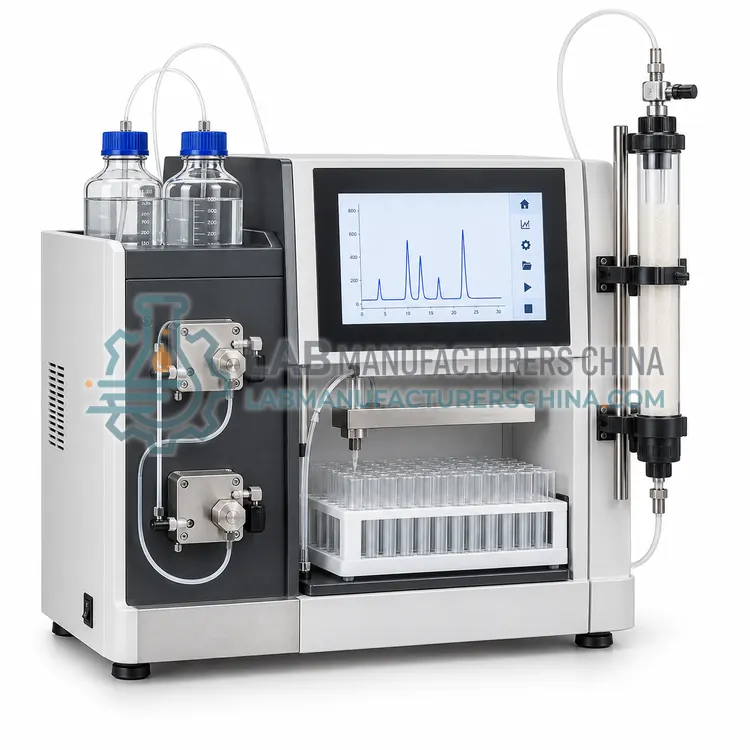
Flash chromatography is a medium-pressure preparative technique that purifies gram-scale mixtures on disposable silica or bonded-phase cartridges using a gradient pump and UV or ELSD detection to trigger fraction collection. Synthetic, medicinal and natural-product chemists use it to isolate reaction products and intermediates quickly before characterization.

5 models of Flash Chromatography

The 5 models below are current configurations; specifications are confirmed on quotation.

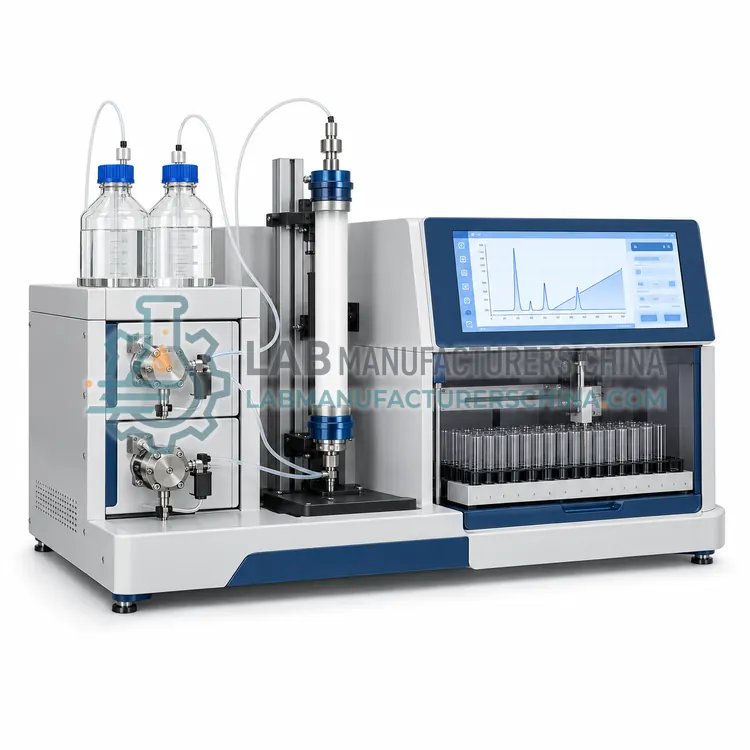
Basic Isocratic Flash Chromatography System

基础等度快速制备色谱系统

  • FLC-0001
  • Flash Chromatography
  • CE (to be confirmed)
  • ISO 9001 manufacturing (to be confirmed)
  • RoHS (to be confirmed)
Flow rate range:
5–100 mL/min
Maximum operating pressure:
7 bar (100 psi)
Solvent channels:
1 (isocratic)
Detector:
UV 254 nm fixed or 200–400 nm variable
Cartridge size range:
4–120 g silica
Sample loading capacity:
up to 1 g crude per 10 g silica

A basic isocratic flash chromatography system pumps a single premixed solvent through a silica cartridge with a fixed-wavelength UV detector and simple fraction collection. It is the lowest-cost automated option for academic and teaching laboratories running routine normal-phase purifications of well-separated compounds.

Request a quote
View details

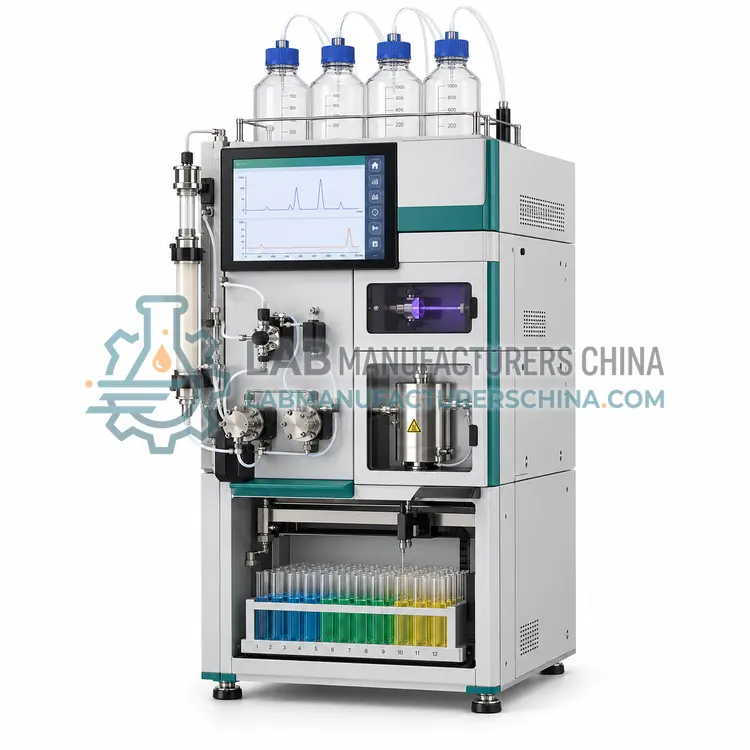
Gradient Flash Chromatography System with UV Detection

梯度快速制备色谱系统(UV 检测)

  • FLC-0002
  • Flash Chromatography
  • CE (to be confirmed)
  • ISO 9001 manufacturing (to be confirmed)
  • ATEX compliance for solvent area (to be confirmed)
Flow rate range:
1–200 mL/min
Maximum operating pressure:
20 bar (300 psi)
Solvent channels:
2 (binary), optional 4
Gradient accuracy:
±2% absolute
Detector wavelength range:
200–400 nm (DAD), 200–800 nm (UV-Vis)
Cartridge size range:
4–330 g silica

A gradient flash chromatography system with UV detection blends two solvents through a binary pump and monitors 200–400 nm with a diode-array or variable UV detector. It is the standard automated configuration for synthetic chemistry laboratories purifying chromophoric products, using programmable gradients that separate closely eluting compounds.

Request a quote
View details

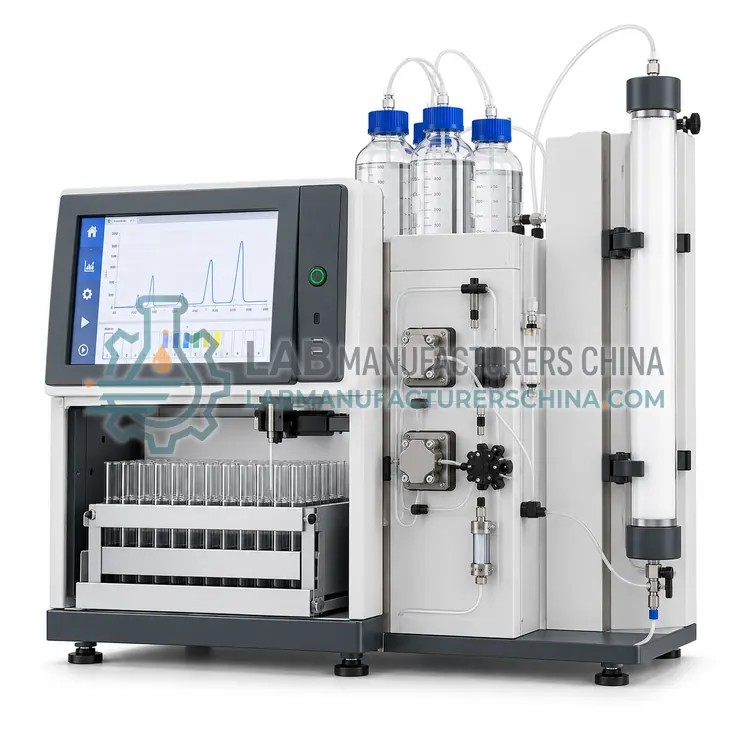
Flash Chromatography System with UV and ELSD Detection

UV 与 ELSD 双检测快速制备色谱系统

  • FLC-0003
  • Flash Chromatography
  • CE (to be confirmed)
  • ISO 9001 manufacturing (to be confirmed)
  • ATEX compliance for solvent area (to be confirmed)
Flow rate range:
1–200 mL/min
Maximum operating pressure:
20 bar (300 psi)
UV detector range:
200–400 nm (DAD)
ELSD drift tube temperature:
30–80 °C
ELSD nebulizer gas:
Nitrogen, 2–4 L/min
ELSD detection limit:
≈10–50 ng on column

A flash chromatography system with UV and ELSD detection adds an evaporative light scattering detector to the UV detector, so compounds without chromophores are detected as well. It is chosen for natural products, carbohydrates, lipids, terpenoids and polymers that cannot be tracked by UV absorption alone.

Request a quote
View details

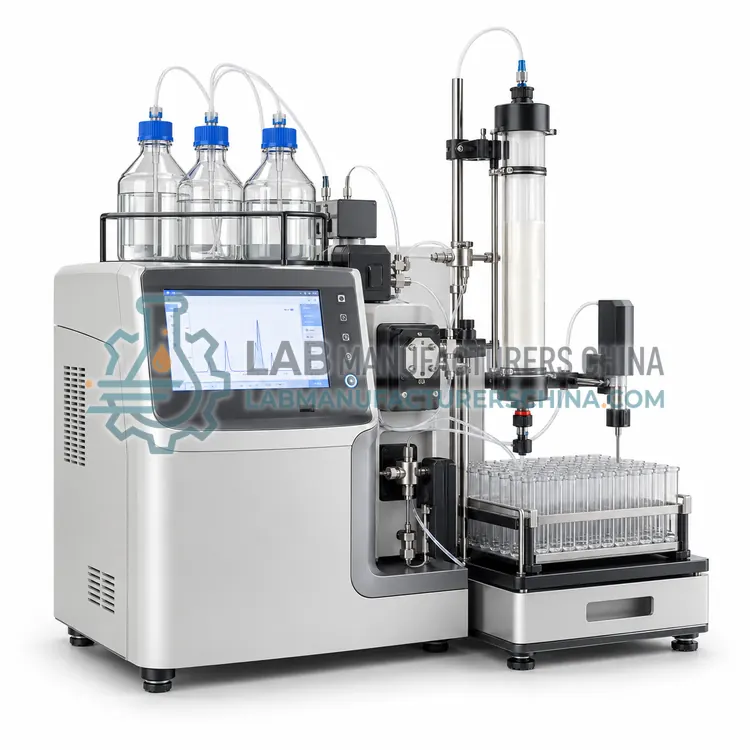
Reversed-Phase Flash Chromatography System

反相快速制备色谱系统

  • FLC-0004
  • Flash Chromatography
  • CE (to be confirmed)
  • ISO 9001 manufacturing (to be confirmed)
  • ATEX compliance for solvent area (to be confirmed)
Flow rate range:
5–150 mL/min
Maximum operating pressure:
25 bar (360 psi)
Solvent system:
Water with acetonitrile or methanol
Modifier compatibility:
0.1% formic acid, TFA, ammonium bicarbonate
Cartridge size range:
5–150 g C18/C8
Particle size:
15–40 µm

A reversed-phase flash chromatography system is configured with aqueous-compatible pumps, C18 or C8 cartridges rated for higher backpressure, and water–acetonitrile or water–methanol gradients. It purifies polar, ionizable and water-soluble compounds such as peptides, natural product glycosides and drug-like amines that run poorly on silica.

Request a quote
View details

Large-Scale Preparative Flash Chromatography System

大规模制备型快速色谱系统

  • FLC-0005
  • Flash Chromatography
  • CE (to be confirmed)
  • ISO 9001 manufacturing (to be confirmed)
  • ATEX (to be confirmed)
Flow rate range:
50–1000 mL/min
Maximum operating pressure:
20 bar (300 psi)
Cartridge size range:
330 g–3 kg silica
Crude loading per run:
30–300 g
Solvent channels:
2–4
Detector:
UV 200–400 nm preparative flow cell

A large-scale preparative flash chromatography system delivers 200–1000 mL/min through cartridges of 330 g to over 3 kg, purifying tens to hundreds of grams of crude per run. It serves process chemistry, scale-up and pilot laboratories that must produce intermediates or reference material at multigram to kilogram scale.

Request a quote
View details

Compare Flash Chromatography models

ModelFlow rate rangeMaximum operating pressureSolvent channelsDetectorCartridge size range
Basic Isocratic Flash Chromatography SystemFLC-00015–100 mL/min7 bar (100 psi)1 (isocratic)UV 254 nm fixed or 200–400 nm variable4–120 g silica
Gradient Flash Chromatography System with UV DetectionFLC-00021–200 mL/min20 bar (300 psi)2 (binary), optional 4—4–330 g silica
Flash Chromatography System with UV and ELSD DetectionFLC-00031–200 mL/min20 bar (300 psi)——4–330 g
Reversed-Phase Flash Chromatography SystemFLC-00045–150 mL/min25 bar (360 psi)—UV 200–400 nm; ELSD or MS optional5–150 g C18/C8
Large-Scale Preparative Flash Chromatography SystemFLC-000550–1000 mL/min20 bar (300 psi)2–4UV 200–400 nm preparative flow cell330 g–3 kg silica

Indicative values for this product class. Final specifications are confirmed on the quotation and in the calibration documents supplied with the instrument.

How do Flash Chromatography work?

Flash chromatography forces solvent through a packed cartridge at moderate pressure, typically 1–20 bar, instead of relying on gravity. Cartridges contain 4 g to over 1 kg of irregular or spherical silica of 20–60 µm, or bonded phases such as C18, amino and cyano. A binary pump blends two solvents, for example hexane and ethyl acetate for normal phase or water and acetonitrile for reversed phase, into linear or step gradients. Dissolved or dry-loaded samples are applied at the column head, and compounds elute according to polarity. A UV or diode-array detector monitors 200–400 nm, and an evaporative light scattering detector (ELSD) detects compounds lacking a chromophore. A fraction collector triggers by threshold or slope and deposits fractions into tubes or flasks, with software showing a real-time chromatogram. Elution can be compared to TLC Rf values to predict gradients.

Which Flash Chromatography variants are available?

  • Basic Isocratic Flash Chromatography System — A basic isocratic flash chromatography system pumps a single premixed solvent through a silica cartridge with a fixed-wavelength UV detector and simple fraction collection.
  • Gradient Flash Chromatography System with UV Detection — A gradient flash chromatography system with UV detection blends two solvents through a binary pump and monitors 200–400 nm with a diode-array or variable UV detector.
  • Flash Chromatography System with UV and ELSD Detection — A flash chromatography system with UV and ELSD detection adds an evaporative light scattering detector to the UV detector, so compounds without chromophores are detected as well.
  • Reversed-Phase Flash Chromatography System — A reversed-phase flash chromatography system is configured with aqueous-compatible pumps, C18 or C8 cartridges rated for higher backpressure, and water–acetonitrile or water–methanol gradients.
  • Large-Scale Preparative Flash Chromatography System — A large-scale preparative flash chromatography system delivers 200–1000 mL/min through cartridges of 330 g to over 3 kg, purifying tens to hundreds of grams of crude per run.

How do I choose the right variant?

Choose by scale, detection and phase. Cartridge size determines loading: roughly 1–10% of silica mass for easy separations, so a 40 g cartridge handles 0.4–4 g of crude. Systems with UV only suit chromophoric compounds, while adding ELSD or a mass detector is required for sugars, lipids and many natural products. Reversed-phase capable systems need pumps and seals compatible with water and higher backpressure, up to 20 bar or more. Consider maximum flow rate, typically 100–300 mL/min for mid-scale and up to 1000 mL/min for kilogram-scale work, and the number of fractions and tube sizes for the collector. Solvent safety matters, so check ATEX-rated designs, closed fraction bays and waste management. Software features such as TLC-to-gradient conversion and method libraries speed routine purification.

Where are Flash Chromatography used?

Flash Chromatography are specified in purification of synthetic reaction products, isolation of natural product fractions, purification of pharmaceutical intermediates, peptide and oligonucleotide cleanup and removal of impurities before NMR or HRMS characterization.

Which standards and certifications apply?

Work with Flash Chromatography is commonly governed by IEC 61010-1, ATEX 2014/34/EU, ISO 9001, USP <621>, ICH Q3C, EN 60079-0, GB/T 15481 and ISO/IEC 17025. Instrument certifications such as CE marking are confirmed per configuration and never assumed.

What are the key considerations before purchase?

Install in a fume hood or ventilated enclosure because normal-phase solvents such as hexane, ethyl acetate and dichloromethane are flammable or hazardous, and keep ignition sources away. Use grounded tubing and containers to avoid static buildup. Flush lines with compatible solvent before changing between normal and reversed phase, using miscible intermediates such as isopropanol. Inspect pump seals, check valves and cartridge holders regularly, and do not exceed cartridge pressure ratings, often 10–20 bar. Calibrate detector baselines with blank gradients and replace UV lamps as recommended. Dispose of solvent waste and used silica following local regulations. Flash systems are not normally subject to GMP qualification, but record methods and audit results for traceability.

Frequently asked questions about Flash Chromatography

Flash chromatography uses larger particles of 20–60 µm at pressures below about 20 bar to purify grams of material quickly at low cost. Preparative HPLC uses 5–10 µm particles at 100–400 bar to achieve higher resolution for difficult separations and higher purity, but with lower loading and greater cost.

Need help specifying Flash Chromatography?

Request a quote