Lab Manufacturers China

UHPLC

超高效液相色谱仪

UHP · Chromatography Instruments · 5 models

By Lab Manufacturers China Technical TeamLast reviewed Standards: USP <621>, Ph. Eur. 2.2.46, USP <1058>

Standards referenced

  • USP <621>
  • Ph. Eur. 2.2.46
  • USP <1058>
  • ICH Q2(R2)
  • ChP 0512
  • IEC 61010-1
  • ISO/IEC 17025
  • 21 CFR Part 11

What are UHPLC?

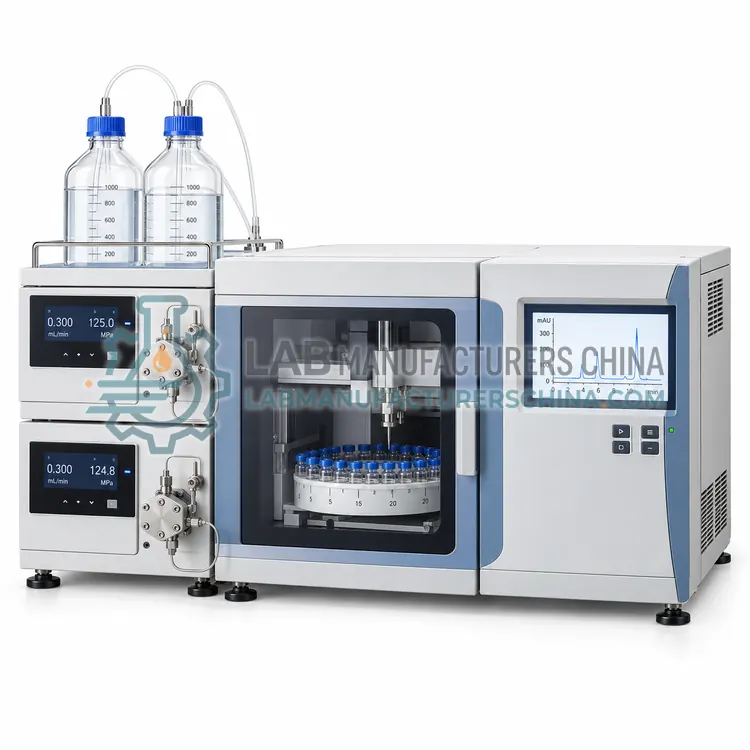
UHPLC, or ultra-high-performance liquid chromatography, uses columns packed with sub-2 µm particles and pumps rated at 600–1300 bar to deliver faster runs and higher resolution than conventional HPLC. It is used in pharmaceutical, food, environmental and bioanalytical laboratories that need high throughput, low solvent use and sharper peaks.

5 models of UHPLC

The 5 models below are current configurations; specifications are confirmed on quotation.

Binary UHPLC System

二元超高效液相色谱系统

  • UHP-0001
  • UHPLC
  • CE (to be confirmed)
  • ISO 9001 manufacturing (to be confirmed)
  • RoHS (to be confirmed)
Maximum operating pressure:
100 MPa (1000 bar)
Flow rate range:
0.01–2 mL/min
Dwell volume:
35–100 µL
Gradient composition precision (RSD):
≤0.1%
Flow precision (RSD):
≤0.05%
Injection cycle time:
≤20 s

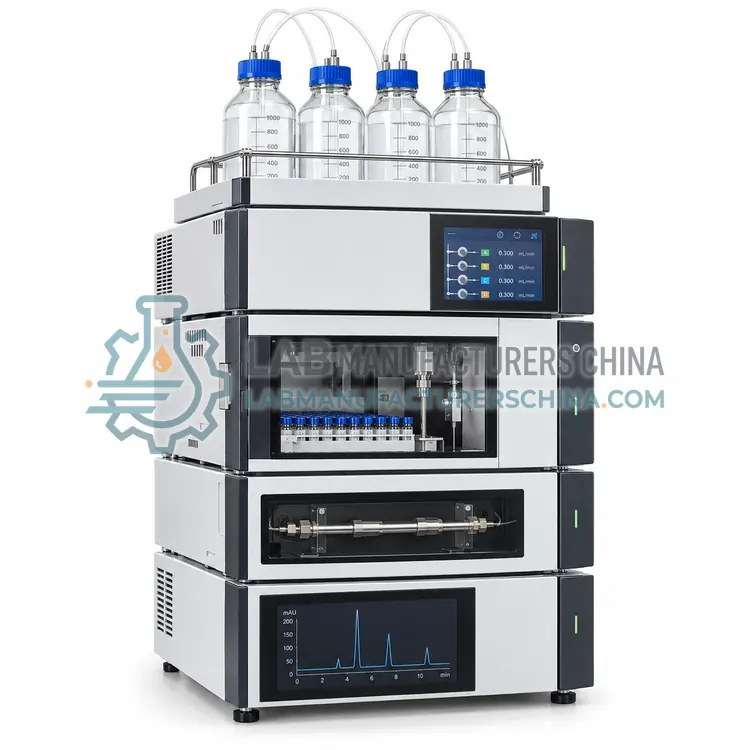
A binary UHPLC system combines two high-pressure pumps rated to about 1000 bar with low dwell volume and low-dispersion plumbing. It is the standard choice for fast reversed-phase gradients on sub-2 µm columns, suited to pharmaceutical impurity profiling and high-throughput quality control where run time matters.

Request a quote
View details

Quaternary UHPLC System

四元超高效液相色谱系统

  • UHP-0002
  • UHPLC
  • CE (to be confirmed)
  • ISO 9001 manufacturing (to be confirmed)
  • RoHS (to be confirmed)
Maximum operating pressure:
60–80 MPa (600–800 bar)
Flow rate range:
0.05–5 mL/min
Solvent channels:
4
Dwell volume:
350–600 µL
Gradient composition accuracy:
±0.5% absolute
Flow precision (RSD):
≤0.1%

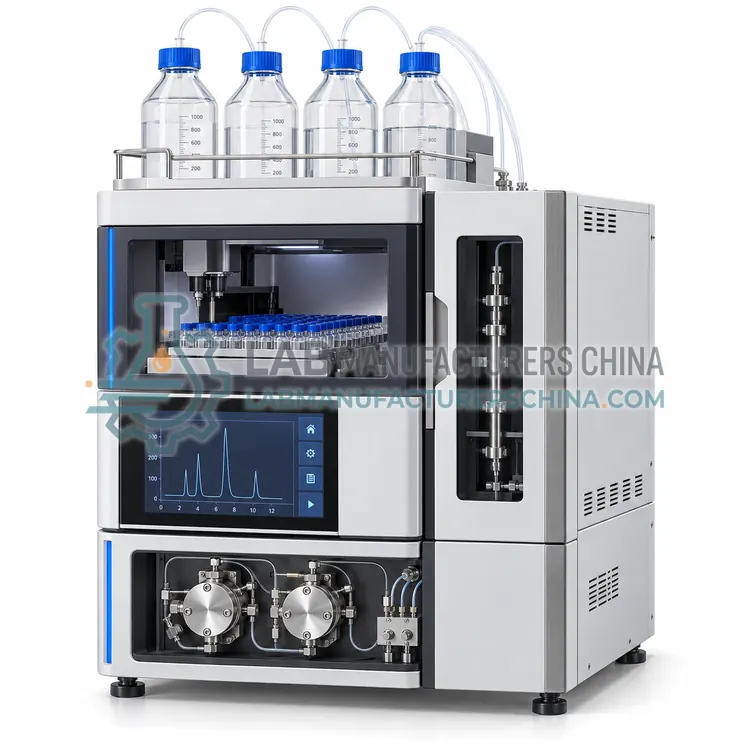
A quaternary UHPLC system blends up to four solvents at low pressure before a single pump rated to about 600–800 bar. It is chosen by method-development and research laboratories that want automated solvent and pH scouting with sub-2 µm or core-shell columns, accepting slightly higher dwell volume than binary designs.

Request a quote
View details

Ultra-High-Pressure 1300 bar UHPLC System

1300 bar 超高压超高效液相色谱系统

  • UHP-0003
  • UHPLC
  • CE (to be confirmed)
  • ISO 9001 manufacturing (to be confirmed)
  • RoHS (to be confirmed)
Maximum operating pressure:
130 MPa (1300 bar)
Flow rate range:
0.01–2 mL/min (full pressure at ≤0.8 mL/min)
Dwell volume:
40–120 µL
Flow precision (RSD):
≤0.05%
Gradient composition accuracy:
±0.5% absolute
Injection volume:
0.1–20 µL

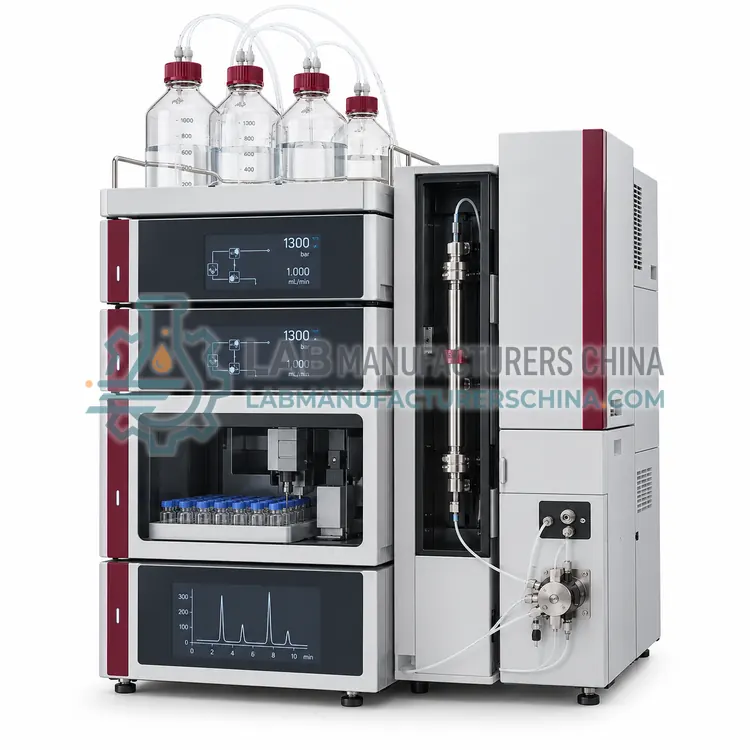
An ultra-high-pressure UHPLC system operates up to 1300 bar, which permits sub-2 µm particles on columns of 150–300 mm or very high flow rates on short columns. It is selected when maximum peak capacity is needed for complex samples such as proteomic digests, natural product extracts and impurity profiles with closely eluting peaks.

Request a quote
View details

Micro-Flow UHPLC System

微流量超高效液相色谱系统

  • UHP-0004
  • UHPLC
  • CE (to be confirmed)
  • ISO 9001 manufacturing (to be confirmed)
  • RoHS (to be confirmed)
Flow rate range:
1–100 µL/min
Maximum operating pressure:
60–100 MPa (600–1000 bar)
Flow precision (RSD):
≤0.2%
Dwell volume:
≤20 µL
Gradient composition accuracy:
±1% absolute
Column internal diameter:
0.3–1.0 mm

A micro-flow UHPLC system delivers stable gradients at 1–100 µL/min through columns of 0.3–1.0 mm internal diameter. It increases mass sensitivity and reduces solvent use, making it the right choice for limited samples and electrospray mass spectrometry in proteomics, metabolomics and trace bioanalysis.

Request a quote
View details

Two-Dimensional UHPLC System

二维超高效液相色谱系统

  • UHP-0005
  • UHPLC
  • CE (to be confirmed)
  • ISO 9001 manufacturing (to be confirmed)
  • RoHS (to be confirmed)
Maximum operating pressure:
100 MPa (1000 bar) per dimension
Flow rate range, 1st dimension:
0.01–2 mL/min
Flow rate range, 2nd dimension:
0.1–5 mL/min
Second-dimension gradient time:
0.5–2 min (comprehensive mode)
Valve type:
2-position, 8-, 10- or 12-port
Sample loop or trap volume:
20–500 µL

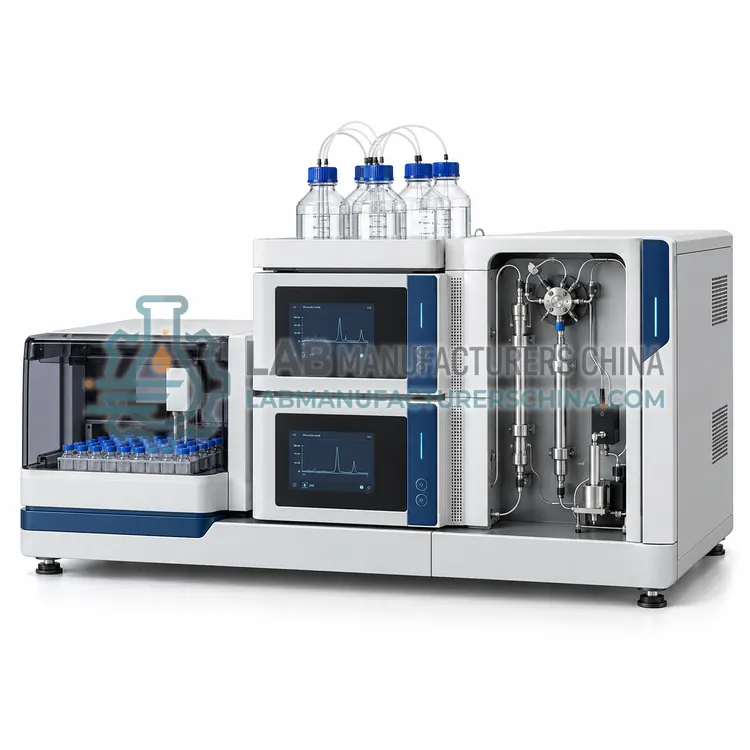
A two-dimensional UHPLC system couples two columns of different selectivity through a switching valve, transferring selected fractions from the first dimension to a fast second-dimension separation. It is used when a single column cannot resolve a complex sample, for example impurities co-eluting with a main peak or peptides in digests.

Request a quote
View details

Compare UHPLC models

ModelMaximum operating pressureFlow rate rangeDwell volumeFlow precision (RSD)Injection carryover
Binary UHPLC SystemUHP-0001100 MPa (1000 bar)0.01–2 mL/min35–100 µL≤0.05%≤0.005%
Quaternary UHPLC SystemUHP-000260–80 MPa (600–800 bar)0.05–5 mL/min350–600 µL≤0.1%≤0.01%
Ultra-High-Pressure 1300 bar UHPLC SystemUHP-0003130 MPa (1300 bar)0.01–2 mL/min (full pressure at ≤0.8 mL/min)40–120 µL≤0.05%≤0.005%
Micro-Flow UHPLC SystemUHP-000460–100 MPa (600–1000 bar)1–100 µL/min≤20 µL≤0.2%≤0.01%
Two-Dimensional UHPLC SystemUHP-0005100 MPa (1000 bar) per dimension————

Indicative values for this product class. Final specifications are confirmed on the quotation and in the calibration documents supplied with the instrument.

How do UHPLC work?

UHPLC follows the same partition principle as HPLC but exploits the van Deemter relationship: smaller particles reduce eddy diffusion and mass-transfer resistance, so efficiency stays high at higher linear velocities. Columns of 1.7–1.9 µm particles, commonly 2.1 mm internal diameter and 50–150 mm long, generate backpressures of several hundred bar, which requires pumps, valves and injectors rated to 1000 bar or more. Extra-column dispersion must be minimized with narrow-bore tubing, low-volume mixers and flow cells of 1–2 µL, otherwise the narrow peaks, often 1–3 seconds wide, are broadened. Fast detector sampling rates of 40–200 Hz are needed to define peaks, and column ovens with active pre-heating control frictional heating. Mobile phases are filtered to 0.2 µm to protect frits. Runs that took 30 minutes on HPLC can often finish in 3–10 minutes.

Which UHPLC variants are available?

  • Binary UHPLC System — A binary UHPLC system combines two high-pressure pumps rated to about 1000 bar with low dwell volume and low-dispersion plumbing.
  • Quaternary UHPLC System — A quaternary UHPLC system blends up to four solvents at low pressure before a single pump rated to about 600–800 bar.
  • Ultra-High-Pressure 1300 bar UHPLC System — An ultra-high-pressure UHPLC system operates up to 1300 bar, which permits sub-2 µm particles on columns of 150–300 mm or very high flow rates on short columns.
  • Micro-Flow UHPLC System — A micro-flow UHPLC system delivers stable gradients at 1–100 µL/min through columns of 0.3–1.0 mm internal diameter.
  • Two-Dimensional UHPLC System — A two-dimensional UHPLC system couples two columns of different selectivity through a switching valve, transferring selected fractions from the first dimension to a fast second-dimension separation.

How do I choose the right variant?

The decisive parameters are pressure rating, dwell and extra-column volume, detector speed and whether methods will be transferred from legacy HPLC. A 600-bar system suffices for 2.7 µm solid-core columns; true sub-2 µm work on 100–150 mm columns calls for 1000–1300 bar. Binary pumps give low dwell volume for fast gradients, while quaternary designs suit screening and pH scouting at modest throughput cost. Micro-flow systems increase mass sensitivity for limited samples and mass spectrometer coupling. Two-dimensional configurations address complex matrices. Also evaluate autosampler cycle time and carryover, because fast runs make injection overhead a large share of total time. Confirm that the software supports method translation with dwell-volume compensation and that data integrity features meet your regulatory requirements.

Where are UHPLC used?

UHPLC are specified in high-throughput pharmaceutical impurity profiling, multi-residue pesticide and veterinary drug screening, bioanalytical PK sample analysis, forced degradation studies and food and beverage contaminant testing.

Which standards and certifications apply?

Work with UHPLC is commonly governed by USP <621>, Ph. Eur. 2.2.46, USP <1058>, ICH Q2(R2), ChP 0512, IEC 61010-1, ISO/IEC 17025 and 21 CFR Part 11. Instrument certifications such as CE marking are confirmed per configuration and never assumed.

What are the key considerations before purchase?

Use LC-MS grade solvents and filter samples to 0.2 µm, since particulates quickly block sub-2 µm frits. Replace inlet filters, seals and rotor seals on the manufacturer schedule because pressure cycling wears them faster than in HPLC. Keep tubing from injector to detector short and narrow, and use zero-dead-volume fittings rated for the operating pressure. Qualify the system following USP <1058> and verify detector sampling rate and gradient accuracy. When transferring HPLC methods, follow the allowable adjustments in USP <621>. Observe safety precautions for high-pressure components and never exceed column pressure limits, which are often 1000 bar for UHPLC columns.

Frequently asked questions about UHPLC

UHPLC uses sub-2 µm particles and hardware rated above 600 bar, typically 1000–1300 bar, which gives narrower peaks, higher resolution and runs three to ten times faster than conventional HPLC. It also requires lower system dispersion and faster detector sampling.

Need help specifying UHPLC?

Request a quote