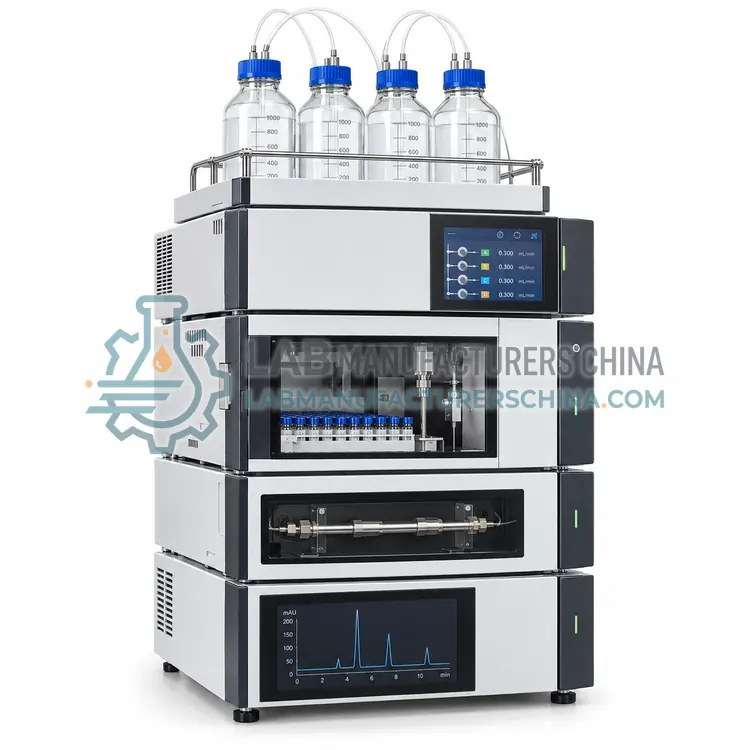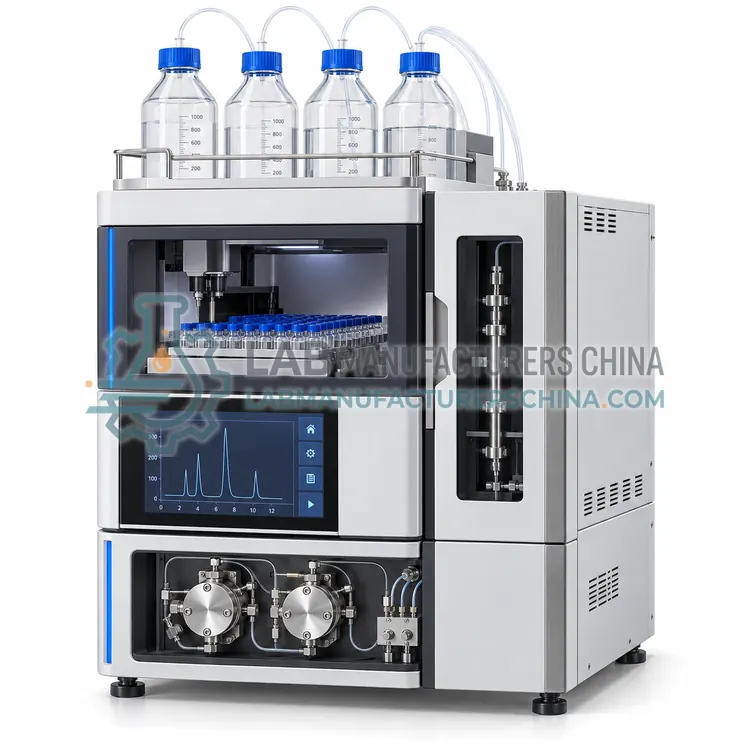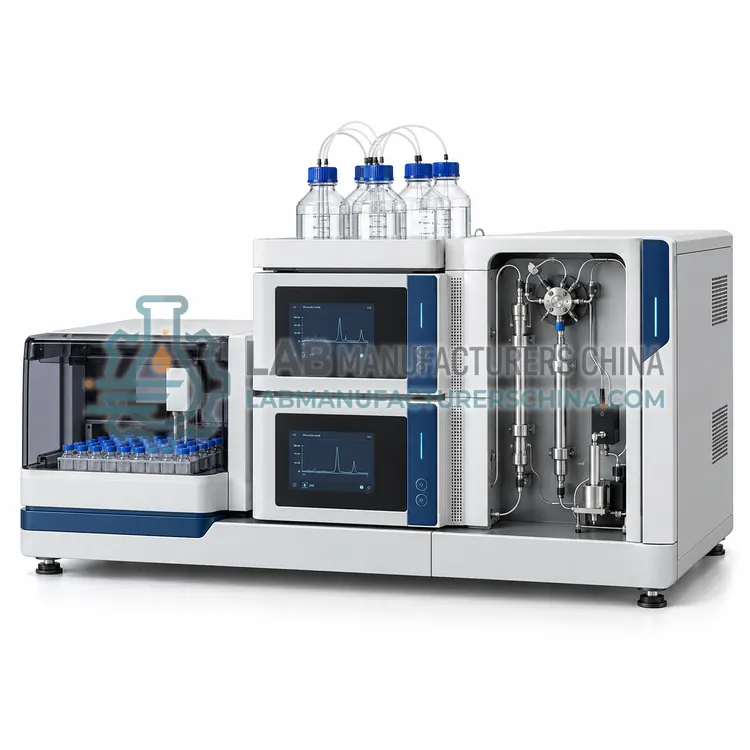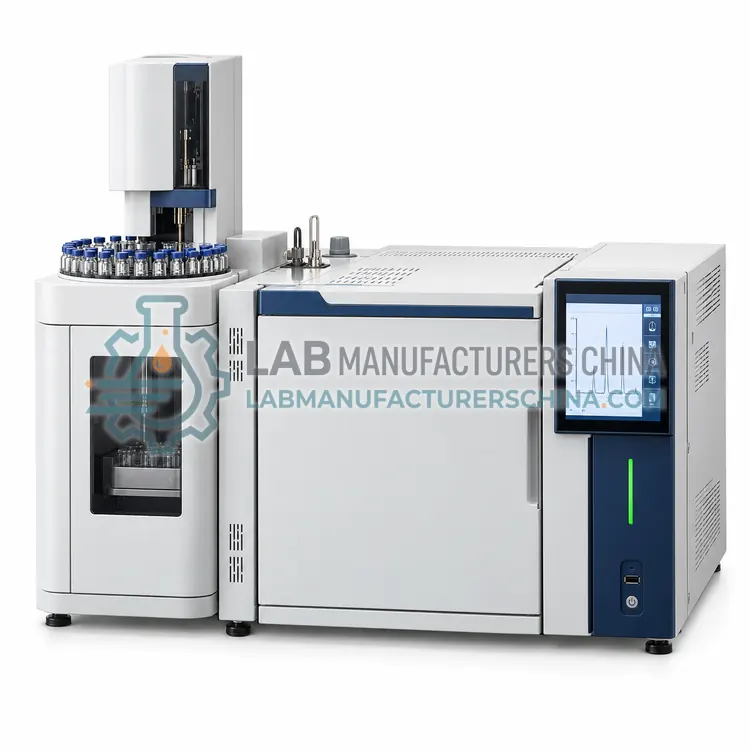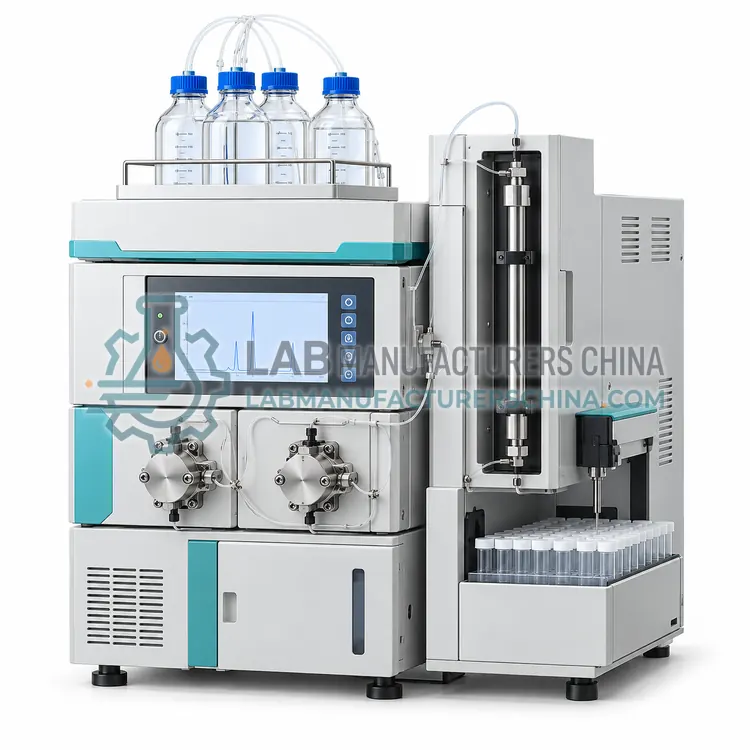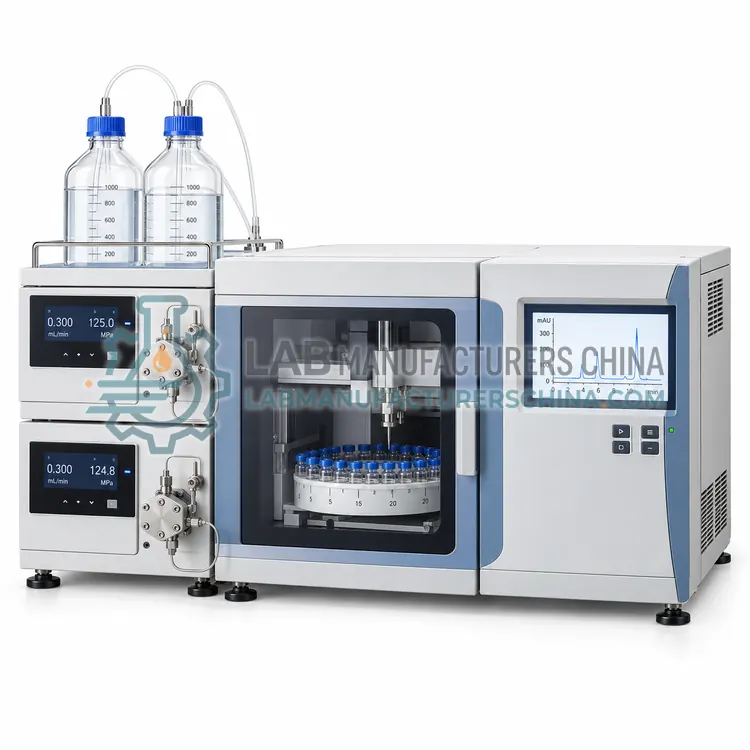
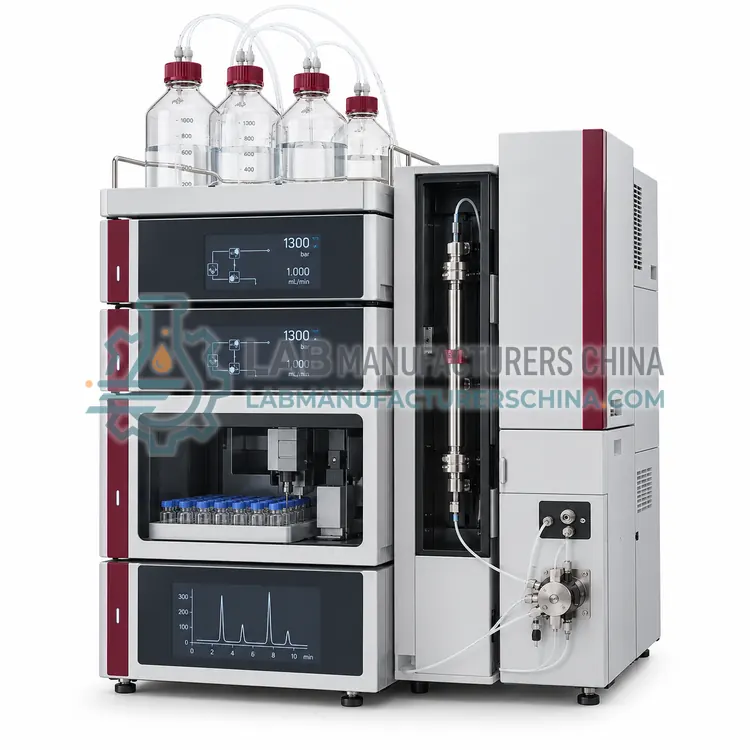
Ultra-High-Pressure 1300 bar UHPLC System
1300 bar 超高压超高效液相色谱系统
- SKU UHP-0003
- UHPLC
- CE (to be confirmed)
- ISO 9001 manufacturing (to be confirmed)
- RoHS (to be confirmed)
Price on request — FOB / CIF quoted per order
Prices depend on configuration, quantity and destination port.
Key specifications
| Maximum operating pressure | 130 MPa (1300 bar) |
|---|---|
| Flow rate range | 0.01–2 mL/min (full pressure at ≤0.8 mL/min) |
| Dwell volume | 40–120 µL |
| Flow precision (RSD) | ≤0.05% |
| Gradient composition accuracy | ±0.5% absolute |
| Injection volume | 0.1–20 µL |
Request a quote Download brochure · to be provided
By Lab Manufacturers China Technical TeamLast reviewed Standards: USP <621>, Ph. Eur. 2.2.46, USP <1058>
What is the Ultra-High-Pressure 1300 bar UHPLC System?
An ultra-high-pressure UHPLC system operates up to 1300 bar, which permits sub-2 µm particles on columns of 150–300 mm or very high flow rates on short columns. It is selected when maximum peak capacity is needed for complex samples such as proteomic digests, natural product extracts and impurity profiles with closely eluting peaks.
What is the Ultra-High-Pressure 1300 bar UHPLC System?
An ultra-high-pressure UHPLC system operates up to 1300 bar, which permits sub-2 µm particles on columns of 150–300 mm or very high flow rates on short columns. It is selected when maximum peak capacity is needed for complex samples such as proteomic digests, natural product extracts and impurity profiles with closely eluting peaks.
Overview
Raising the pressure limit from 1000 to 1300 bar lets users lengthen columns or increase flow, since peak capacity scales with column length and the square root of efficiency. The system uses hardened pump heads, seals and valves rated to 130 MPa, a binary high-pressure mixing design with dwell volume around 40–120 µL, and narrow-bore capillaries with pressure-rated fittings. Columns are commonly 2.1 × 150 mm or 2.1 × 250 mm with 1.7–1.9 µm particles, yielding 25,000–45,000 theoretical plates or more. Elevated temperature up to 90 °C reduces viscosity and therefore backpressure. The added capability is most useful for peptide mapping, forced-degradation samples, and methods requiring resolution of isomers. Seal and rotor wear is faster at the top of the pressure range, so maintenance intervals must be monitored by pressure cycle counters.
How does it work?
UHPLC follows the same partition principle as HPLC but exploits the van Deemter relationship: smaller particles reduce eddy diffusion and mass-transfer resistance, so efficiency stays high at higher linear velocities. Columns of 1.7–1.9 µm particles, commonly 2.1 mm internal diameter and 50–150 mm long, generate backpressures of several hundred bar, which requires pumps, valves and injectors rated to 1000 bar or more. Extra-column dispersion must be minimized with narrow-bore tubing, low-volume mixers and flow cells of 1–2 µL, otherwise the narrow peaks, often 1–3 seconds wide, are broadened. Fast detector sampling rates of 40–200 Hz are needed to define peaks, and column ovens with active pre-heating control frictional heating. Mobile phases are filtered to 0.2 µm to protect frits. Runs that took 30 minutes on HPLC can often finish in 3–10 minutes.
What are the key features?
- Pump, valves and injector rated to 130 MPa (1300 bar) for long sub-2 µm columns
- Binary high-pressure mixing with dwell volume around 40–120 µL
- Pressure cycle counters and predictive maintenance alerts for seals and rotor seals
- Column heater to 90 °C reducing mobile phase viscosity and backpressure
- Supports 2.1 × 150–250 mm columns generating over 40,000 theoretical plates
What are the technical specifications?
A typical ultra-high-pressure 1300 bar uhplc system configuration offers maximum operating pressure of 130 MPa (1300 bar), flow rate range of 0.01–2 mL/min (full pressure at ≤0.8 mL/min), dwell volume of 40–120 µL, flow precision (RSD) of ≤0.05%, gradient composition accuracy of ±0.5% absolute and injection volume of 0.1–20 µL. Values are indicative of the product class; the exact figures for each configuration are confirmed on the quotation and the calibration documents supplied with the instrument.
Which applications is it used for?
The Ultra-High-Pressure 1300 bar UHPLC System is used in peptide mapping and protein digests, complex natural product extracts, isomer and closely eluting impurity resolution, forced degradation profiling and metabolite profiling. Across the wider UHPLC class, laboratories also deploy it for high-throughput pharmaceutical impurity profiling, multi-residue pesticide and veterinary drug screening and bioanalytical PK sample analysis.
Which standards and certifications apply?
Relevant standards and methods include USP <621>, Ph. Eur. 2.2.46, USP <1058>, ICH Q2(R2), ChP 0512, IEC 61010-1, ISO/IEC 17025 and 21 CFR Part 11. Certification candidates for this model are CE, ISO 9001 manufacturing and RoHS; each is to be confirmed for the specific configuration before shipment, and certificates are supplied only where they have been issued.
Use LC-MS grade solvents and filter samples to 0.2 µm, since particulates quickly block sub-2 µm frits. Replace inlet filters, seals and rotor seals on the manufacturer schedule because pressure cycling wears them faster than in HPLC. Keep tubing from injector to detector short and narrow, and use zero-dead-volume fittings rated for the operating pressure. Qualify the system following USP <1058> and verify detector sampling rate and gradient accuracy. When transferring HPLC methods, follow the allowable adjustments in USP <621>. Observe safety precautions for high-pressure components and never exceed column pressure limits, which are often 1000 bar for UHPLC columns.
How do I select the right Ultra-High-Pressure 1300 bar UHPLC System?
Select this variant when peak capacity is the limiting factor and you can justify longer 1.7–1.9 µm columns. For routine QC, a 1000-bar binary system is usually sufficient and cheaper to maintain. In an RFQ specify maximum pressure at working flow rate, column length, detector data rate, dwell volume and maintenance monitoring features.
How does it compare with other UHPLC variants?
The decisive parameters are pressure rating, dwell and extra-column volume, detector speed and whether methods will be transferred from legacy HPLC. A 600-bar system suffices for 2.7 µm solid-core columns; true sub-2 µm work on 100–150 mm columns calls for 1000–1300 bar. Binary pumps give low dwell volume for fast gradients, while quaternary designs suit screening and pH scouting at modest throughput cost. Micro-flow systems increase mass sensitivity for limited samples and mass spectrometer coupling. Two-dimensional configurations address complex matrices. Also evaluate autosampler cycle time and carryover, because fast runs make injection overhead a large share of total time. Confirm that the software supports method translation with dwell-volume compensation and that data integrity features meet your regulatory requirements.
Full specifications
| Maximum operating pressure | 130 MPa (1300 bar) |
|---|---|
| Flow rate range | 0.01–2 mL/min (full pressure at ≤0.8 mL/min) |
| Dwell volume | 40–120 µL |
| Flow precision (RSD) | ≤0.05% |
| Gradient composition accuracy | ±0.5% absolute |
| Injection volume | 0.1–20 µL |
| Injection carryover | ≤0.005% |
| Column oven range | 5–90 °C |
| Detector data rate | up to 200 Hz |
| Maximum column length supported | 300 mm |
Indicative values for this product class. Final specifications are confirmed on the quotation and in the calibration documents supplied with the instrument.
Applications
- Peptide mapping and protein digests
- Complex natural product extracts
- Isomer and closely eluting impurity resolution
- Forced degradation profiling
- Metabolite profiling
Key features
- Pump, valves and injector rated to 130 MPa (1300 bar) for long sub-2 µm columns
- Binary high-pressure mixing with dwell volume around 40–120 µL
- Pressure cycle counters and predictive maintenance alerts for seals and rotor seals
- Column heater to 90 °C reducing mobile phase viscosity and backpressure
- Supports 2.1 × 150–250 mm columns generating over 40,000 theoretical plates
Frequently asked questions about Ultra-High-Pressure 1300 bar UHPLC System
It is needed when you want long columns of 150–300 mm with sub-2 µm particles at optimal linear velocity, or high flow on short columns with viscous mobile phases. For typical 50–100 mm columns, 1000 bar is normally adequate and 1300 bar provides little practical advantage.
Yes. Seals, rotor seals, check valves and needle seats are loaded more heavily at high pressure cycles, so replacement intervals are shorter. Pressure cycle counters help schedule maintenance, and operating below the maximum rating for routine methods extends service life.
Only columns explicitly rated by their manufacturer, typically hardware with 1.7–1.9 µm particles and 2.1 mm internal diameter rated to 1000–1300 bar. Using a column rated for less than the system pressure risks bed collapse or leakage, so always check the column data sheet.
UHPLC uses sub-2 µm particles and hardware rated above 600 bar, typically 1000–1300 bar, which gives narrower peaks, higher resolution and runs three to ten times faster than conventional HPLC. It also requires lower system dispersion and faster detector sampling.
Usually yes. Keep the stationary phase chemistry, scale column length to particle size ratio, adjust flow rate and gradient time proportionally, and compensate for dwell volume differences. USP <621> defines permitted adjustments, but changes beyond those limits require revalidation.
Generally yes. Shorter columns of narrower internal diameter and faster runs typically reduce solvent use per sample by 60–90% compared with a 4.6 × 250 mm HPLC method. The saving depends on whether the method is fully redeveloped on a 2.1 mm column.
Related models