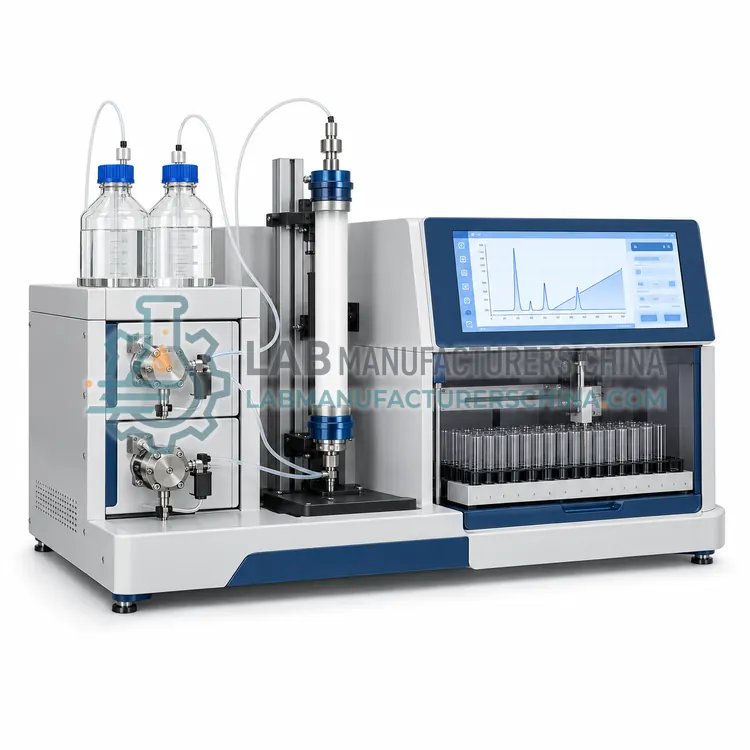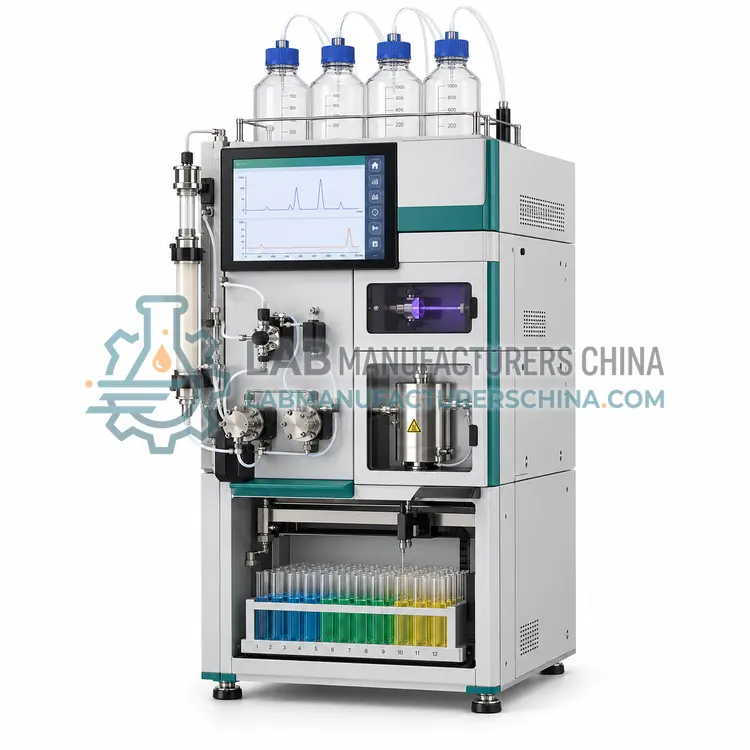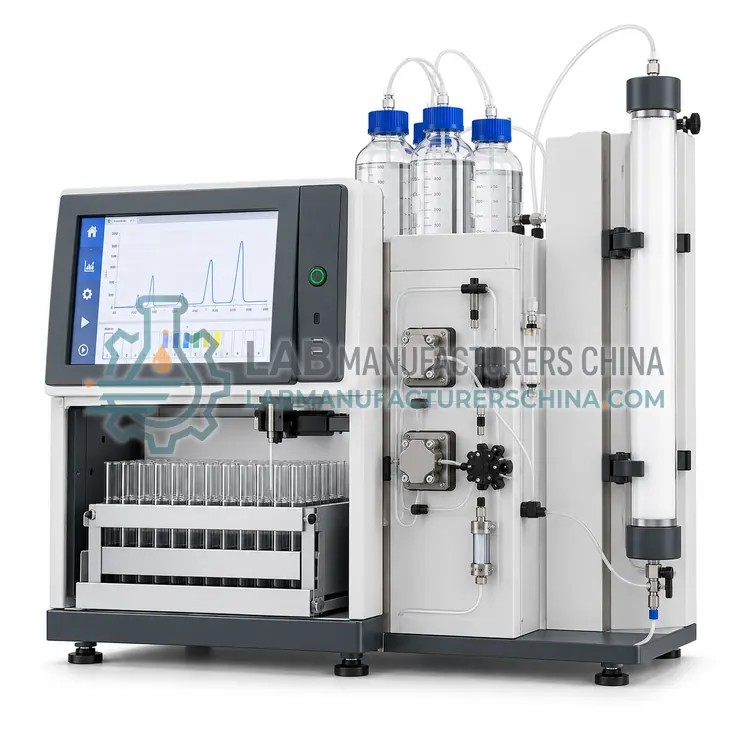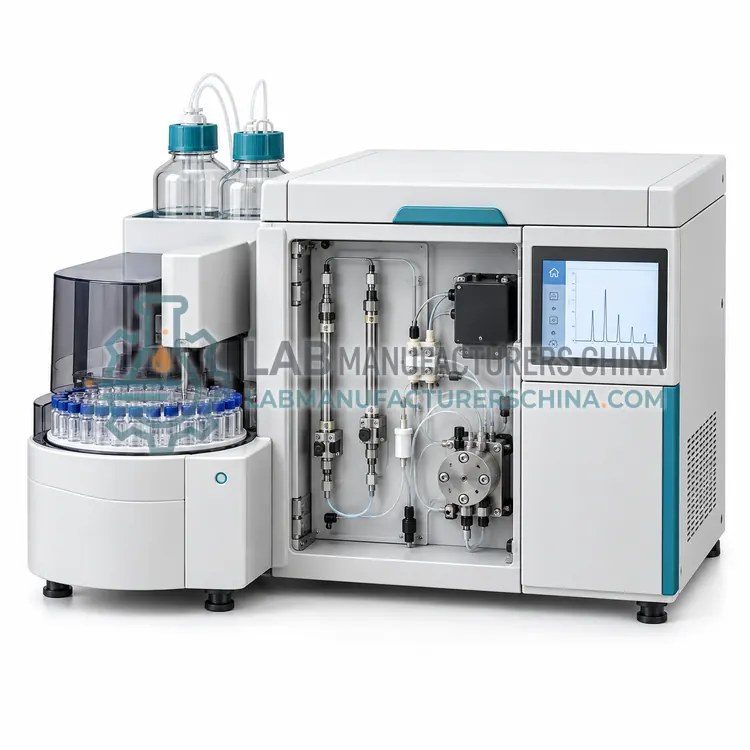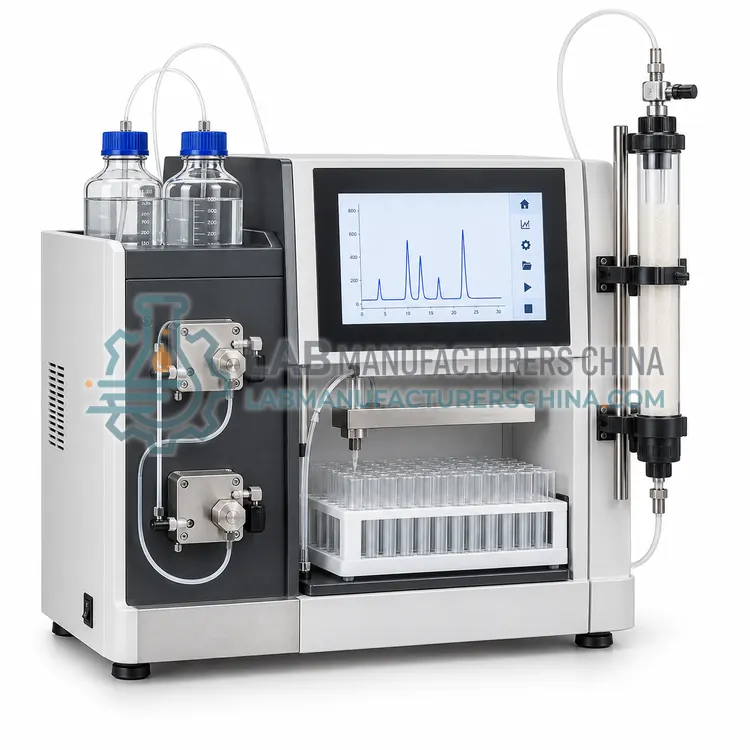
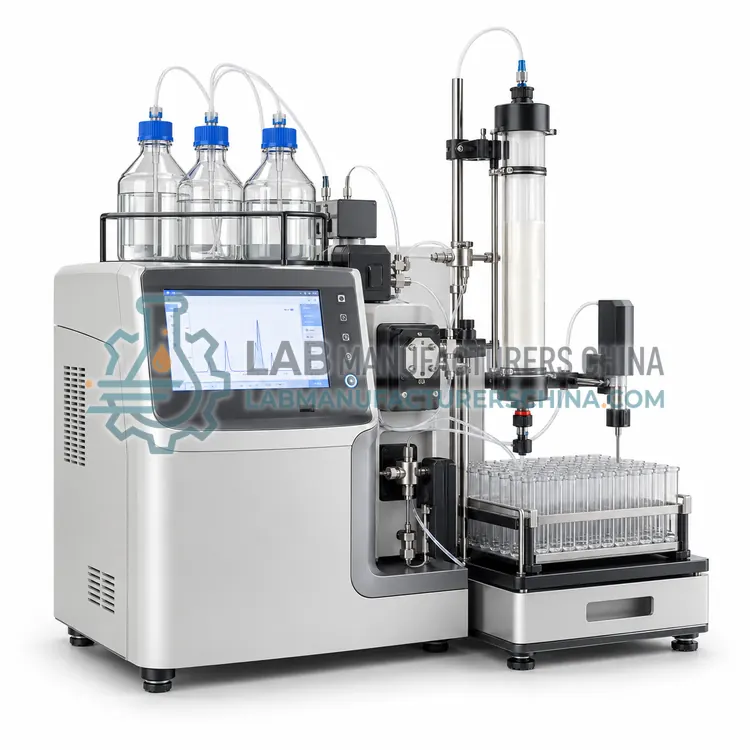
Large-Scale Preparative Flash Chromatography System
大规模制备型快速色谱系统
- SKU FLC-0005
- Flash Chromatography
- CE (to be confirmed)
- ISO 9001 manufacturing (to be confirmed)
- ATEX (to be confirmed)
Price on request — FOB / CIF quoted per order
Prices depend on configuration, quantity and destination port.
Key specifications
| Flow rate range | 50–1000 mL/min |
|---|---|
| Maximum operating pressure | 20 bar (300 psi) |
| Cartridge size range | 330 g–3 kg silica |
| Crude loading per run | 30–300 g |
| Solvent channels | 2–4 |
| Detector | UV 200–400 nm preparative flow cell |
Request a quote Download brochure · to be provided
By Lab Manufacturers China Technical TeamLast reviewed Standards: IEC 61010-1, ATEX 2014/34/EU, ISO 9001
What is the Large-Scale Preparative Flash Chromatography System?
A large-scale preparative flash chromatography system delivers 200–1000 mL/min through cartridges of 330 g to over 3 kg, purifying tens to hundreds of grams of crude per run. It serves process chemistry, scale-up and pilot laboratories that must produce intermediates or reference material at multigram to kilogram scale.
What is the Large-Scale Preparative Flash Chromatography System?
A large-scale preparative flash chromatography system delivers 200–1000 mL/min through cartridges of 330 g to over 3 kg, purifying tens to hundreds of grams of crude per run. It serves process chemistry, scale-up and pilot laboratories that must produce intermediates or reference material at multigram to kilogram scale.
Overview
Scaling flash purification requires higher flow, larger cartridges and robust solvent handling. This system uses a high-flow binary pump delivering up to 1000 mL/min at 10–20 bar, pressure-rated steel or plastic cartridge holders for 330 g to 3 kg media, and a large-format fraction collector using flasks or bottles up to 2 L rather than test tubes. Loading capacity reaches 30–300 g of crude on 1–3 kg of silica. A high-volume injection system or dry-load cartridges handle solid-phase loading, and solvent consumption of several liters per run makes solvent recovery or bulk solvent supply practical considerations. UV detection with a preparative flow cell avoids signal saturation. Explosion-protected electronics and ATEX-rated designs are common for kilo-lab use. Method development is typically done on a small cartridge and scaled linearly by cartridge mass and flow rate, keeping the same column volumes.
How does it work?
Flash chromatography forces solvent through a packed cartridge at moderate pressure, typically 1–20 bar, instead of relying on gravity. Cartridges contain 4 g to over 1 kg of irregular or spherical silica of 20–60 µm, or bonded phases such as C18, amino and cyano. A binary pump blends two solvents, for example hexane and ethyl acetate for normal phase or water and acetonitrile for reversed phase, into linear or step gradients. Dissolved or dry-loaded samples are applied at the column head, and compounds elute according to polarity. A UV or diode-array detector monitors 200–400 nm, and an evaporative light scattering detector (ELSD) detects compounds lacking a chromophore. A fraction collector triggers by threshold or slope and deposits fractions into tubes or flasks, with software showing a real-time chromatogram. Elution can be compared to TLC Rf values to predict gradients.
What are the key features?
- High-flow binary pump delivering up to 1000 mL/min at 10–20 bar
- Cartridge holders for 330 g to 3 kg silica with pressure-rated housings
- Large-format fraction collector for flasks and bottles up to 2 L
- Preparative UV flow cell preventing detector saturation at high concentration
- ATEX-rated explosion-protected design options for kilo-lab solvent environments
What are the technical specifications?
A typical large-scale preparative flash chromatography system configuration offers flow rate range of 50–1000 mL/min, maximum operating pressure of 20 bar (300 psi), cartridge size range of 330 g–3 kg silica, crude loading per run of 30–300 g, solvent channels of 2–4 and detector of UV 200–400 nm preparative flow cell. Values are indicative of the product class; the exact figures for each configuration are confirmed on the quotation and the calibration documents supplied with the instrument.
Which applications is it used for?
The Large-Scale Preparative Flash Chromatography System is used in process chemistry intermediate purification, multigram to kilogram scale-up, reference standard production, natural product bulk fractionation and pilot plant purification support. Across the wider Flash Chromatography class, laboratories also deploy it for purification of synthetic reaction products, isolation of natural product fractions and purification of pharmaceutical intermediates.
Which standards and certifications apply?
Relevant standards and methods include IEC 61010-1, ATEX 2014/34/EU, ISO 9001, USP <621>, ICH Q3C, EN 60079-0, GB/T 15481 and ISO/IEC 17025. Certification candidates for this model are CE, ISO 9001 manufacturing and ATEX; each is to be confirmed for the specific configuration before shipment, and certificates are supplied only where they have been issued.
Install in a fume hood or ventilated enclosure because normal-phase solvents such as hexane, ethyl acetate and dichloromethane are flammable or hazardous, and keep ignition sources away. Use grounded tubing and containers to avoid static buildup. Flush lines with compatible solvent before changing between normal and reversed phase, using miscible intermediates such as isopropanol. Inspect pump seals, check valves and cartridge holders regularly, and do not exceed cartridge pressure ratings, often 10–20 bar. Calibrate detector baselines with blank gradients and replace UV lamps as recommended. Dispose of solvent waste and used silica following local regulations. Flash systems are not normally subject to GMP qualification, but record methods and audit results for traceability.
How do I select the right Large-Scale Preparative Flash Chromatography System?
Select a large-scale system when routine batches exceed 10–20 g of crude or when process development demands kilogram output. For typical discovery chemistry below 5 g, a mid-scale gradient system is more economical. In an RFQ specify maximum flow rate, cartridge mass, loading per run, vessel sizes, hazardous-area classification and solvent supply method.
How does it compare with other Flash Chromatography variants?
Choose by scale, detection and phase. Cartridge size determines loading: roughly 1–10% of silica mass for easy separations, so a 40 g cartridge handles 0.4–4 g of crude. Systems with UV only suit chromophoric compounds, while adding ELSD or a mass detector is required for sugars, lipids and many natural products. Reversed-phase capable systems need pumps and seals compatible with water and higher backpressure, up to 20 bar or more. Consider maximum flow rate, typically 100–300 mL/min for mid-scale and up to 1000 mL/min for kilogram-scale work, and the number of fractions and tube sizes for the collector. Solvent safety matters, so check ATEX-rated designs, closed fraction bays and waste management. Software features such as TLC-to-gradient conversion and method libraries speed routine purification.
Full specifications
| Flow rate range | 50–1000 mL/min |
|---|---|
| Maximum operating pressure | 20 bar (300 psi) |
| Cartridge size range | 330 g–3 kg silica |
| Crude loading per run | 30–300 g |
| Solvent channels | 2–4 |
| Detector | UV 200–400 nm preparative flow cell |
| Fraction vessel size | Tubes to 2 L bottles |
| Fraction collector capacity | 40–200 vessels |
| Gradient accuracy | ±2% absolute |
| Explosion protection | ATEX-rated option (to be confirmed) |
Indicative values for this product class. Final specifications are confirmed on the quotation and in the calibration documents supplied with the instrument.
Applications
- Process chemistry intermediate purification
- Multigram to kilogram scale-up
- Reference standard production
- Natural product bulk fractionation
- Pilot plant purification support
Key features
- High-flow binary pump delivering up to 1000 mL/min at 10–20 bar
- Cartridge holders for 330 g to 3 kg silica with pressure-rated housings
- Large-format fraction collector for flasks and bottles up to 2 L
- Preparative UV flow cell preventing detector saturation at high concentration
- ATEX-rated explosion-protected design options for kilo-lab solvent environments
Frequently asked questions about Large-Scale Preparative Flash Chromatography System
Keep the same gradient in column volumes, scale cartridge mass by the ratio of sample mass, and scale flow rate proportionally to column cross-sectional area. Maintaining bed height and particle size preserves resolution. Verify with a pilot run before committing the full batch.
Practical limits include solvent consumption, silica disposal cost, fraction volume handling and solvent evaporation capacity. Above several hundred grams per run, alternatives such as crystallization, extraction or continuous chromatography may be more economical.
When running large volumes of flammable solvents such as hexane or ethyl acetate in a classified area, equipment should meet the area's hazardous-zone requirements, for example ATEX or IECEx. Requirements depend on local regulation and risk assessment.
Flash chromatography uses larger particles of 20–60 µm at pressures below about 20 bar to purify grams of material quickly at low cost. Preparative HPLC uses 5–10 µm particles at 100–400 bar to achieve higher resolution for difficult separations and higher purity, but with lower loading and greater cost.
As a guide, load 1–10% of the silica mass. Easy separations with large Rf differences tolerate up to 10%, while close-running compounds need 1% or less. A 40 g silica cartridge therefore takes roughly 0.4–4 g crude. Dry loading onto silica improves resolution for poorly soluble samples.
Use ELSD when target compounds lack a UV chromophore, such as sugars, lipids, saponins, terpenoids and many polymers. It responds to any non-volatile analyte in a volatile mobile phase, but is destructive and requires a splitter to divert a small portion of flow.
Related models