How do Titrators work?
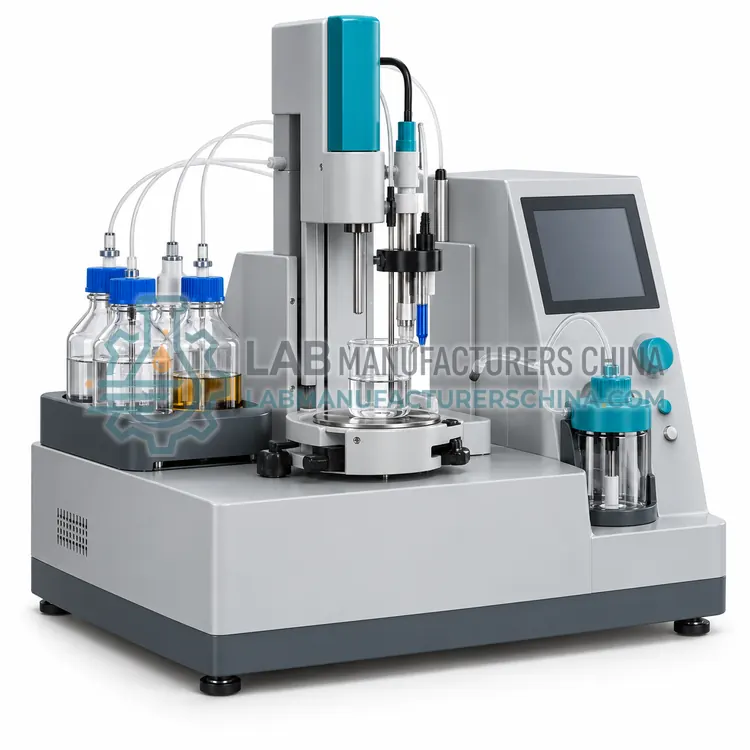
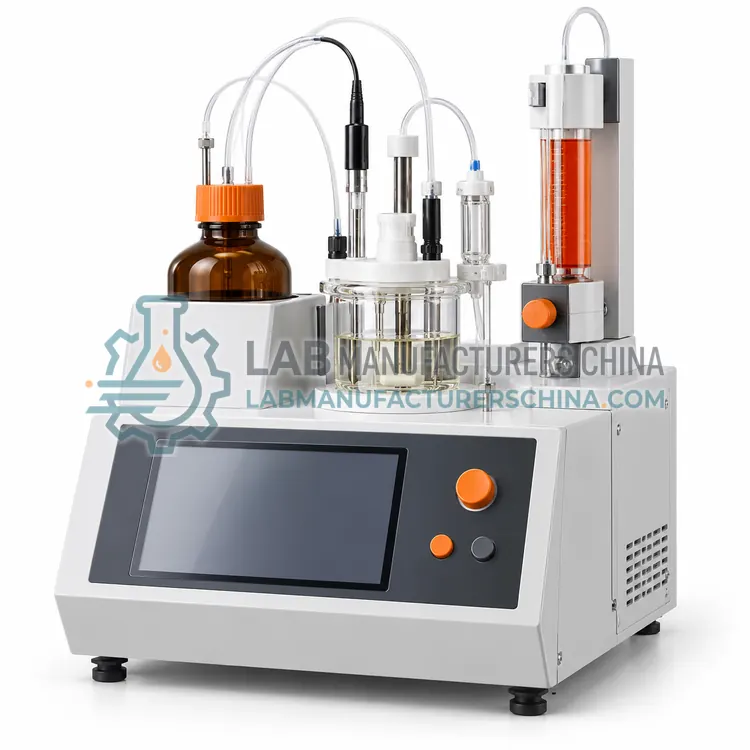
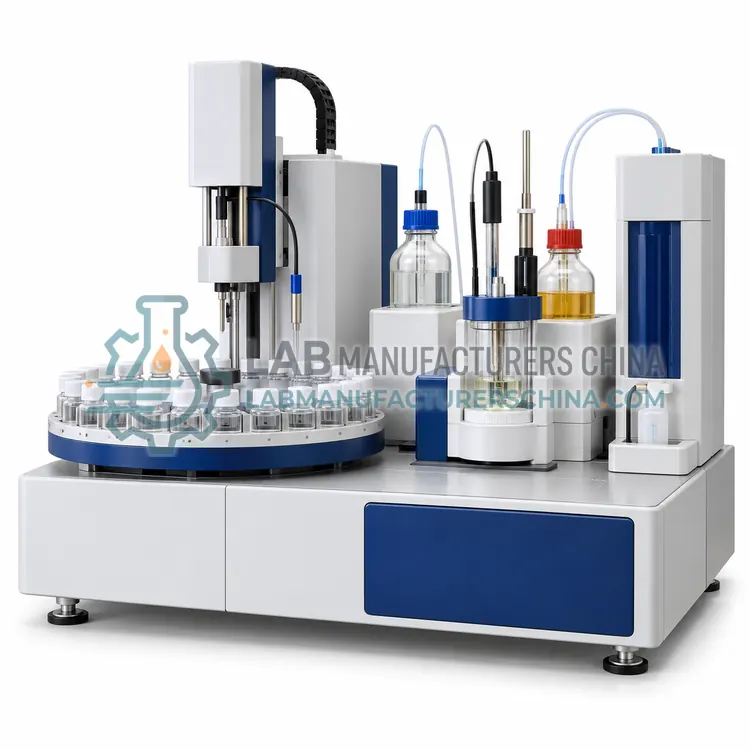
A titrator combines a precision burette or coulometric generator electrode, a stirred titration vessel, a sensor and a control unit. In volumetric titration, a motor-driven piston burette dispenses titrant while a sensor, usually a pH glass electrode, redox platinum electrode or photometric probe, tracks the solution. The endpoint is identified as a preset potential or the inflection point of the titration curve, and the result is calculated from titrant volume, concentration and stoichiometry. In coulometric Karl Fischer titration, iodine is generated electrochemically at a generator electrode and the charge passed, according to Faraday's law, gives the mass of water directly without a burette. Dynamic dosing slows addition near the endpoint to improve accuracy, and automatic sample changers allow unattended series.
Which Titrators variants are available?
- Automatic Potentiometric Titrator — An automatic potentiometric titrator dispenses titrant with a motorized burette and detects the endpoint by electrode potential.
- Coulometric Karl Fischer Titrator — A coulometric Karl Fischer titrator generates iodine electrochemically in a sealed cell and calculates water mass from the charge passed.
- Volumetric Karl Fischer Titrator — A volumetric Karl Fischer titrator dispenses a one-component or two-component iodine reagent from a burette to the water endpoint.
- Photometric Titrator — A photometric titrator detects the endpoint with an optical sensor that measures light transmission at a fixed wavelength, typically 520 to 660 nm.
- Titrator with Automatic Sample Changer — A titrator with automatic sample changer processes a rack of samples unattended, including dispensing, stirring, titration, electrode rinsing and result calculation.
How do I choose the right variant?
The decisive choice is the titration chemistry. Water in oils, solvents and solids calls for Karl Fischer, volumetric above about 0.1% water and coulometric below it. Acid and base number in petroleum products and general acid-base, redox, argentometric and complexometric titrations call for a potentiometric titrator. Consider sample throughput, because an automatic sample changer is justified beyond roughly 20 samples per day. Check burette resolution, available sensors and whether the software supports the standard methods you run, such as ASTM D664 or ASTM D6304. Also weigh solvent consumption and waste handling, reagent storage for moisture-sensitive titrants, and whether audit-trail and user management features are required for accredited or regulated work.
Where are Titrators used?
Titrators are specified in water determination in oils and solvents, acid and base number of petroleum products, chloride and salt content in food and water, pharmaceutical assay and loss-on-drying alternatives and alkalinity and hardness of water.
Which standards and certifications apply?
Work with Titrators is commonly governed by ASTM D664, ASTM D974, ASTM D6304, ASTM E203, ISO 760, USP <921> and IEC 61010-1. Instrument certifications such as CE marking are confirmed per configuration and never assumed.
What are the key considerations before purchase?
Place the titrator on a vibration-free bench away from drafts and direct sunlight. Standardize titrants regularly against a primary standard such as potassium hydrogen phthalate or sodium oxalate, and record the titer. Verify electrodes with buffers and check the burette volume gravimetrically at defined intervals. For Karl Fischer work, replace desiccant, keep the cell sealed, check drift before each series and verify with a certified water standard. Rinse tubing when changing titrants to avoid cross-contamination, and inspect piston seals and valves as part of preventive maintenance. Dispose of reagents, particularly pyridine-free Karl Fischer solutions and organic solvents, according to local waste rules.