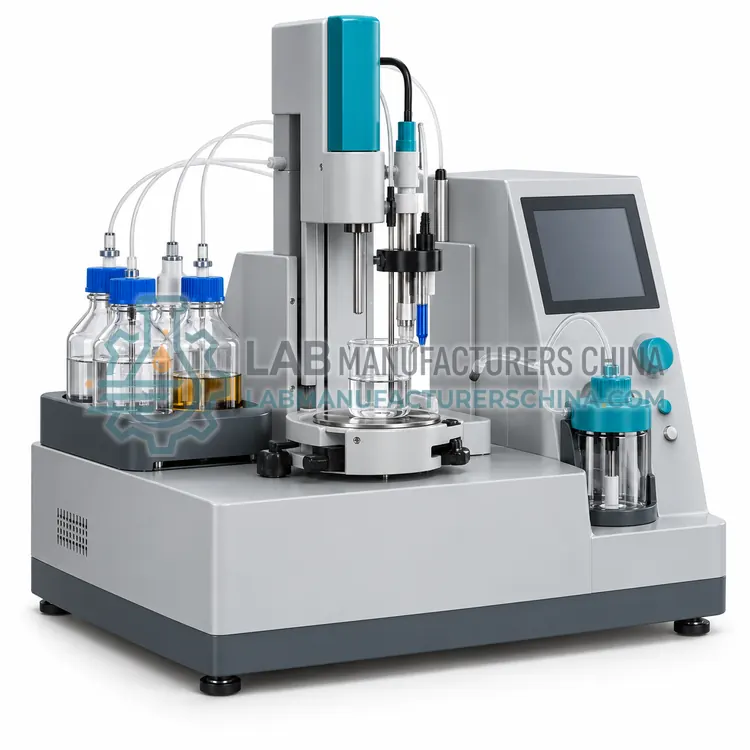
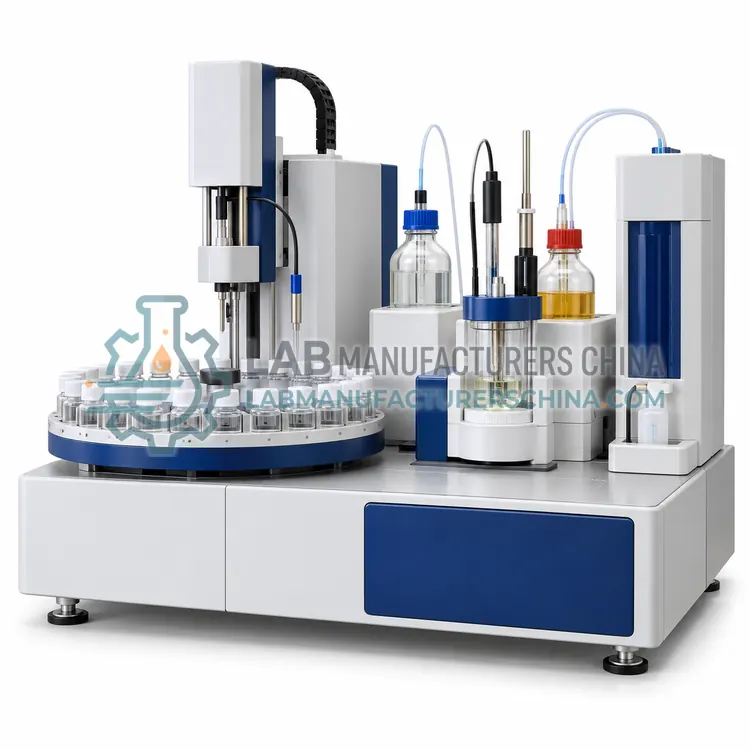
Titrator with Automatic Sample Changer
带自动进样器的滴定仪
- SKU TIT-0005
- Titrators
- CE (to be confirmed)
- ISO 9001 manufacturing (to be confirmed)
- RoHS (to be confirmed)
Price on request — FOB / CIF quoted per order
Prices depend on configuration, quantity and destination port.
Key specifications
| Sample positions | 18, 30 or 36 (beakers 100–150 mL) |
|---|---|
| Changer type | Rotary or linear |
| Burette volume | 10 mL or 20 mL |
| Number of burettes | 1 to 4 |
| Dosing resolution | 1/20,000 burette volume |
| Potential measuring range | ±2000 mV |
Request a quote Download brochure · to be provided
By Lab Manufacturers China Technical TeamLast reviewed Standards: ASTM D664, ASTM D974, ASTM D6304
What is the Titrator with Automatic Sample Changer?
A titrator with automatic sample changer processes a rack of samples unattended, including dispensing, stirring, titration, electrode rinsing and result calculation. It is the right choice for laboratories running more than about 20 similar titrations per day, such as water quality, food or petroleum QC.
What is the Titrator with Automatic Sample Changer?
A titrator with automatic sample changer processes a rack of samples unattended, including dispensing, stirring, titration, electrode rinsing and result calculation. It is the right choice for laboratories running more than about 20 similar titrations per day, such as water quality, food or petroleum QC.
Overview
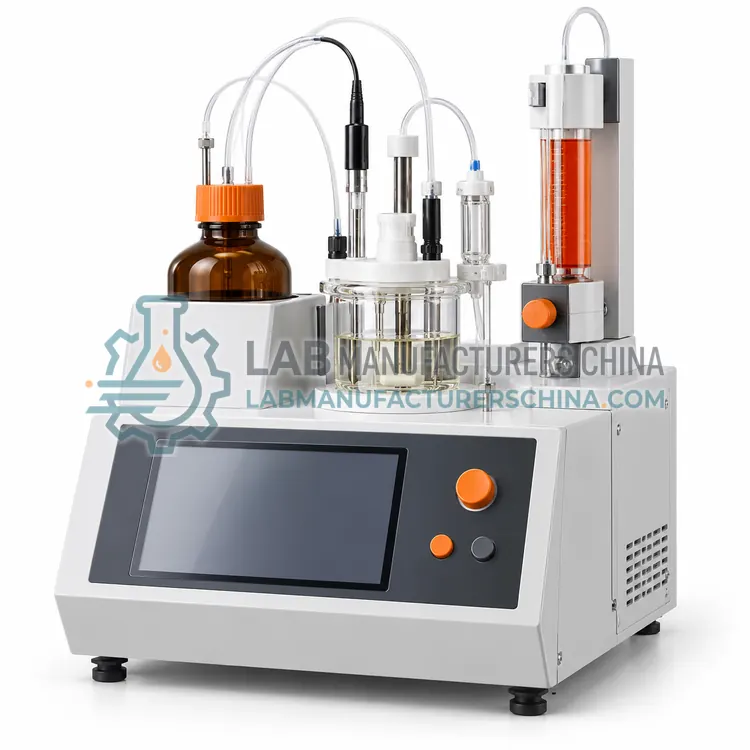
A rotary or linear sample changer carries beakers, typically 18 to 36 positions, beneath a titration head holding burette tips, electrodes, a stirrer and dispensing lines. After each sample the head lifts, the electrode is rinsed and conditioned in a rinse station and the next position is indexed. Integrated pumps add solvents, buffers or sample aliquots, and balance connection transfers sample weights without transcription error. Sample series are defined by sequence tables with method assignments, so one rack can mix different titrations. Waste is pumped to a collection bottle to limit operator exposure to solvents. The configuration is chosen for repeatability and throughput, with typical run times of 3 to 6 minutes per sample, and it reduces operator-dependent variation in routine QC.
How does it work?
A titrator combines a precision burette or coulometric generator electrode, a stirred titration vessel, a sensor and a control unit. In volumetric titration, a motor-driven piston burette dispenses titrant while a sensor, usually a pH glass electrode, redox platinum electrode or photometric probe, tracks the solution. The endpoint is identified as a preset potential or the inflection point of the titration curve, and the result is calculated from titrant volume, concentration and stoichiometry. In coulometric Karl Fischer titration, iodine is generated electrochemically at a generator electrode and the charge passed, according to Faraday's law, gives the mass of water directly without a burette. Dynamic dosing slows addition near the endpoint to improve accuracy, and automatic sample changers allow unattended series.
What are the key features?
- Rotary or linear changer with 18 to 36 sample positions
- Electrode rinse and conditioning station between samples to prevent carry-over
- Balance interface transferring sample weights directly into the method
- Integrated dosing pumps for solvents, buffers and diluents
- Sequence tables mixing different methods within a single rack
- Waste pump system reducing operator contact with solvents
What are the technical specifications?
A typical titrator with automatic sample changer configuration offers sample positions of 18, 30 or 36 (beakers 100–150 mL), changer type of Rotary or linear, burette volume of 10 mL or 20 mL, number of burettes of 1 to 4, dosing resolution of 1/20,000 burette volume and potential measuring range of ±2000 mV. Values are indicative of the product class; the exact figures for each configuration are confirmed on the quotation and the calibration documents supplied with the instrument.
Which applications is it used for?
The Titrator with Automatic Sample Changer is used in routine acid number testing in oil laboratories, water alkalinity and chloride series, beverage and food acidity control, incoming inspection of chemical raw materials and batch assay in pharmaceutical QC. Across the wider Titrators class, laboratories also deploy it for water determination in oils and solvents, acid and base number of petroleum products and chloride and salt content in food and water.
Which standards and certifications apply?
Relevant standards and methods include ASTM D664, ASTM D974, ASTM D6304, ASTM E203, ISO 760, USP <921> and IEC 61010-1. Certification candidates for this model are CE, ISO 9001 manufacturing and RoHS; each is to be confirmed for the specific configuration before shipment, and certificates are supplied only where they have been issued.
Place the titrator on a vibration-free bench away from drafts and direct sunlight. Standardize titrants regularly against a primary standard such as potassium hydrogen phthalate or sodium oxalate, and record the titer. Verify electrodes with buffers and check the burette volume gravimetrically at defined intervals. For Karl Fischer work, replace desiccant, keep the cell sealed, check drift before each series and verify with a certified water standard. Rinse tubing when changing titrants to avoid cross-contamination, and inspect piston seals and valves as part of preventive maintenance. Dispose of reagents, particularly pyridine-free Karl Fischer solutions and organic solvents, according to local waste rules.
How do I select the right Titrator with Automatic Sample Changer?
Select this variant when daily sample numbers justify unattended operation, typically more than 20 similar titrations. A single-sample titrator suffices for occasional work. In an RFQ, specify the number of sample positions, beaker size, number of burettes and pumps, balance model to interface, and whether solvents are flammable, which affects changer material and ventilation needs.
How does it compare with other Titrators variants?
The decisive choice is the titration chemistry. Water in oils, solvents and solids calls for Karl Fischer, volumetric above about 0.1% water and coulometric below it. Acid and base number in petroleum products and general acid-base, redox, argentometric and complexometric titrations call for a potentiometric titrator. Consider sample throughput, because an automatic sample changer is justified beyond roughly 20 samples per day. Check burette resolution, available sensors and whether the software supports the standard methods you run, such as ASTM D664 or ASTM D6304. Also weigh solvent consumption and waste handling, reagent storage for moisture-sensitive titrants, and whether audit-trail and user management features are required for accredited or regulated work.
Full specifications
| Sample positions | 18, 30 or 36 (beakers 100–150 mL) |
|---|---|
| Changer type | Rotary or linear |
| Burette volume | 10 mL or 20 mL |
| Number of burettes | 1 to 4 |
| Dosing resolution | 1/20,000 burette volume |
| Potential measuring range | ±2000 mV |
| Rinse solution pumps | 2 to 4 peristaltic or diaphragm pumps |
| Typical sample throughput | 10–20 samples/hour |
| Balance interface | RS-232 / USB |
| Power supply | 100–240 V AC, 50/60 Hz |
Indicative values for this product class. Final specifications are confirmed on the quotation and in the calibration documents supplied with the instrument.
Applications
- Routine acid number testing in oil laboratories
- Water alkalinity and chloride series
- Beverage and food acidity control
- Incoming inspection of chemical raw materials
- Batch assay in pharmaceutical QC
Key features
- Rotary or linear changer with 18 to 36 sample positions
- Electrode rinse and conditioning station between samples to prevent carry-over
- Balance interface transferring sample weights directly into the method
- Integrated dosing pumps for solvents, buffers and diluents
- Sequence tables mixing different methods within a single rack
- Waste pump system reducing operator contact with solvents
Frequently asked questions about Titrator with Automatic Sample Changer
It removes manual handling between samples, so operators prepare the rack and start the series, then return to results. Hands-on time falls from several minutes per sample to a few minutes per rack, and overnight runs become possible.
The electrode and burette tips are lifted and rinsed in a dedicated station with solvent or deionized water after each sample. Rinse volume and cycles are programmed per method, and a conditioning step restores the electrode response where needed.
Yes, provided the titration head carries the required electrodes and burettes, or has an electrode switching option. Sequence tables assign a method to each position, and results are stored per sample with the associated method parameters.
Volumetric Karl Fischer adds iodine-containing titrant from a burette and suits samples above roughly 0.1% water. Coulometric Karl Fischer generates iodine electrochemically and suits trace water from about 1 ppm to 5%, because it uses no burette and has lower detection limits.
The titrator monitors a sensor signal such as potential, pH or light transmission during titrant addition. The endpoint is either a preset signal value or the inflection point of the titration curve found by first or second derivative evaluation, which is more robust for weak acids or unknown samples.
Standardize titrants whenever a new batch is prepared and then at intervals set by stability, commonly weekly for sodium hydroxide and every few days for Karl Fischer titrant. Record the titer and investigate any drift, since titer errors transfer directly into every result.