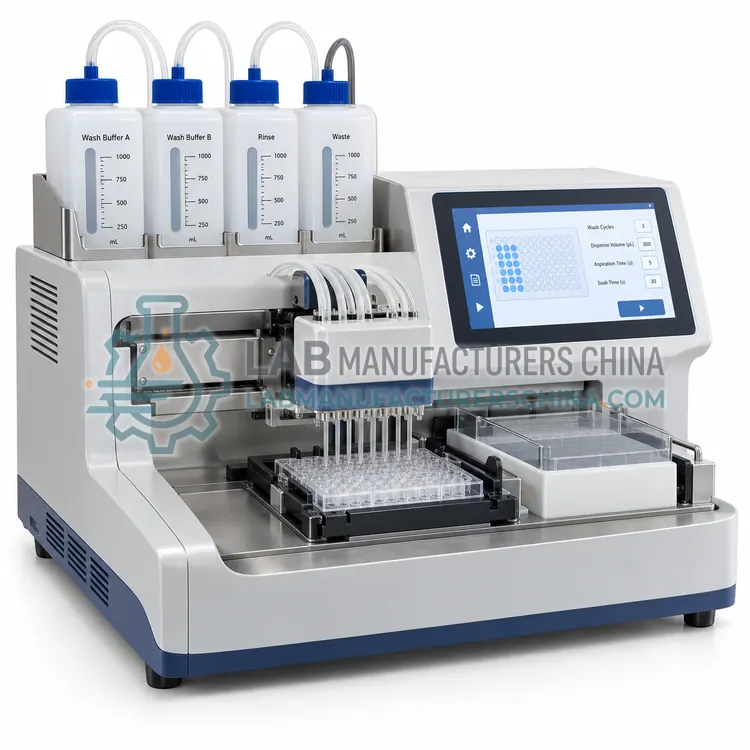
How do Microplate Washers work?
A microplate washer uses a manifold carrying rows of dispense and aspirate tubes that enter the wells. Wash buffer is delivered from a reservoir by a peristaltic or diaphragm pump through the dispense tubes at a set volume and flow rate. The aspirate tubes, connected to a vacuum source, remove liquid, and their height is set to leave a low residual volume, often below 2 microliters per well in a 96-well plate. Programs combine multiple cycles with soak times, shaking, bottom washing and crosswise aspiration. Sensors detect clogged tubes and buffer level, and a waste bottle collects effluent. Dual-manifold designs allow two buffers, while magnetic bead washers hold beads with a magnet during aspiration. Precise alignment between manifold and well, particularly at 384-well density, is essential.
Which Microplate Washers variants are available?
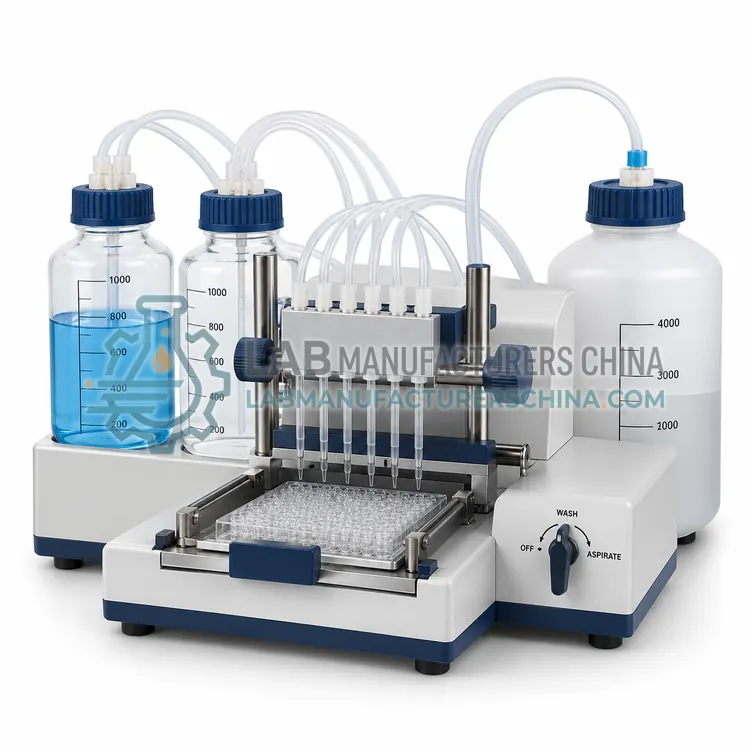
- Manual Microplate Washer Manifold — A manual microplate washer is a hand-operated manifold with aspirate and dispense tubes connected to a vacuum source and buffer reservoir.
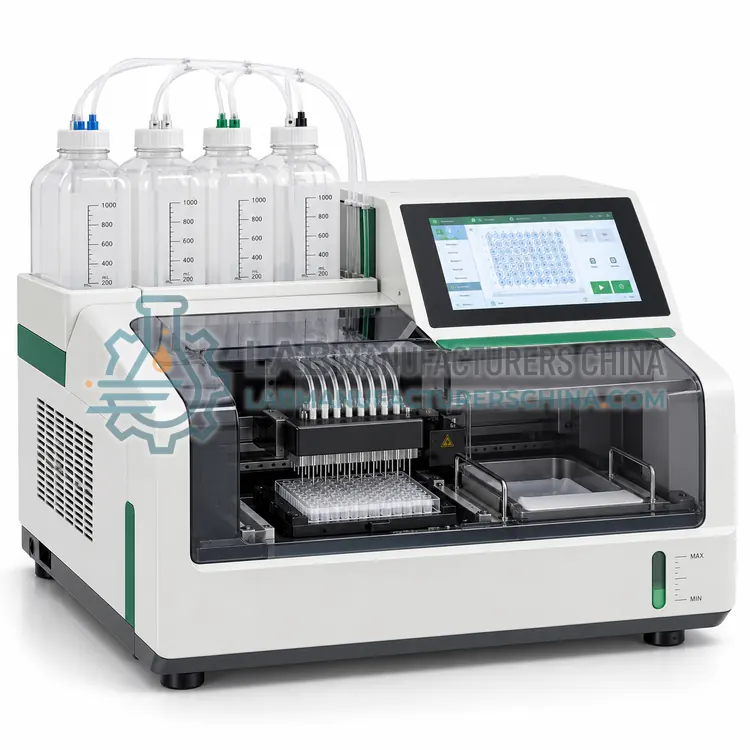
- Automatic 96-Well Microplate Washer — An automatic 96-well microplate washer performs programmed aspiration, dispensing, soaking and shaking on a full plate with pump-controlled volumes and low residual volume.
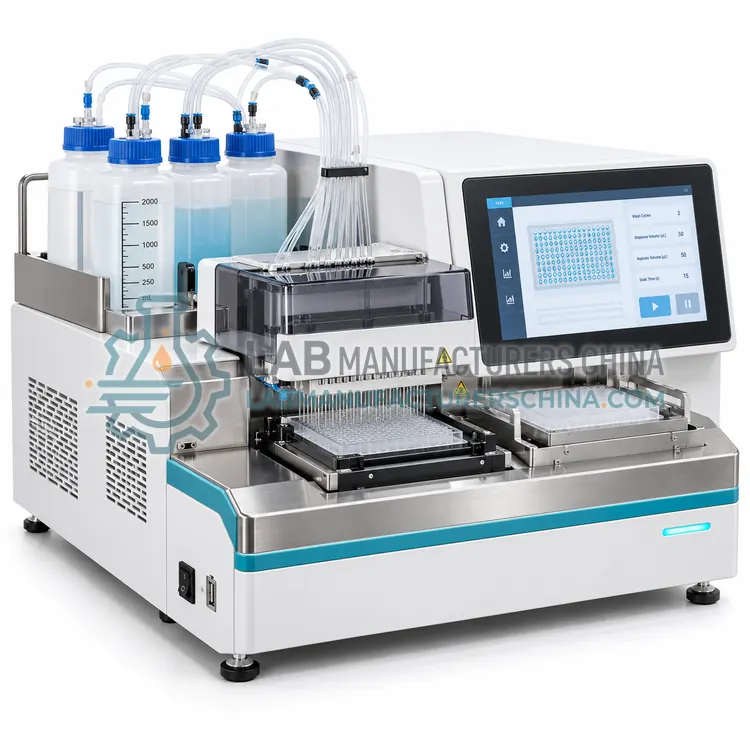
- 384-Well High-Density Microplate Washer — A 384-well high-density microplate washer uses fine-tipped manifolds aligned to small wells for precise aspiration and dispensing at 384-well and often 1536-well density.
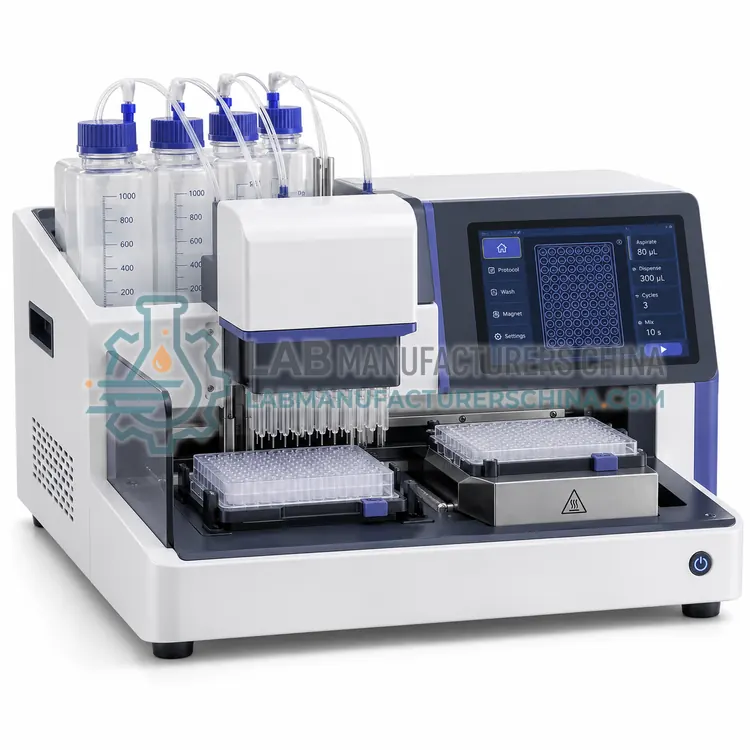
- Magnetic Bead Microplate Washer — A magnetic bead microplate washer holds paramagnetic beads in each well with a magnet plate while supernatant is aspirated and buffer is added.
- Microplate Washer for Cell-Based Assays with Gentle Aspiration — A gentle-aspiration microplate washer for cell-based assays has low-flow dispensing and offset aspiration that keep adherent cell monolayers intact during medium exchange and washing.
How do I choose the right variant?
Choose a washer by plate format, throughput and assay sensitivity. Manual or semi-automatic manifolds suit low volume laboratories, while automatic washers with programmable protocols suit routine ELISA. Check residual volume per well, dispense precision, and the presence of bottom washing, soak and shake functions. For cell-based assays, select gentle dispensing with adjustable flow rate and offset aspiration to avoid cell detachment. For magnetic bead assays, confirm magnet compatibility. High-throughput laboratories need 384-well heads, stacker integration and fast cycle times. Consider capacity of buffer and waste bottles, tube cleaning routines, and ease of priming. Request residual volume and coefficient of variation data for your plate type.
Where are Microplate Washers used?
Microplate Washers are specified in ELISA wash cycles, cell-based assay medium exchange, magnetic bead immunoassay washing, western dot-blot and plate-based staining, bacterial biofilm plate washing and serology screening.
Which standards and certifications apply?
Work with Microplate Washers is commonly governed by IEC 61010-1, IEC 61010-2-081, IEC 61326-1, ANSI/SLAS 1-2004 to 4-2004, ISO 13485 (IVD use) and CLSI EP15-A3. Instrument certifications such as CE marking are confirmed per configuration and never assumed.
What are the key considerations before purchase?
Prime the washer before each run and flush with deionized water at the end of the day to prevent salt crystallization and microbial growth. Run a weekly cleaning cycle with dilute disinfectant or sodium hypochlorite, following the manufacturer's guidance, and inspect manifold tubes for blockage. Verify dispense volume gravimetrically and residual volume with a dye method during qualification and at least annually. Treat effluent as biohazardous waste when samples are infectious, and use a vacuum trap with disinfectant. Use plate-specific alignment settings and replace tubing and seals according to schedule.