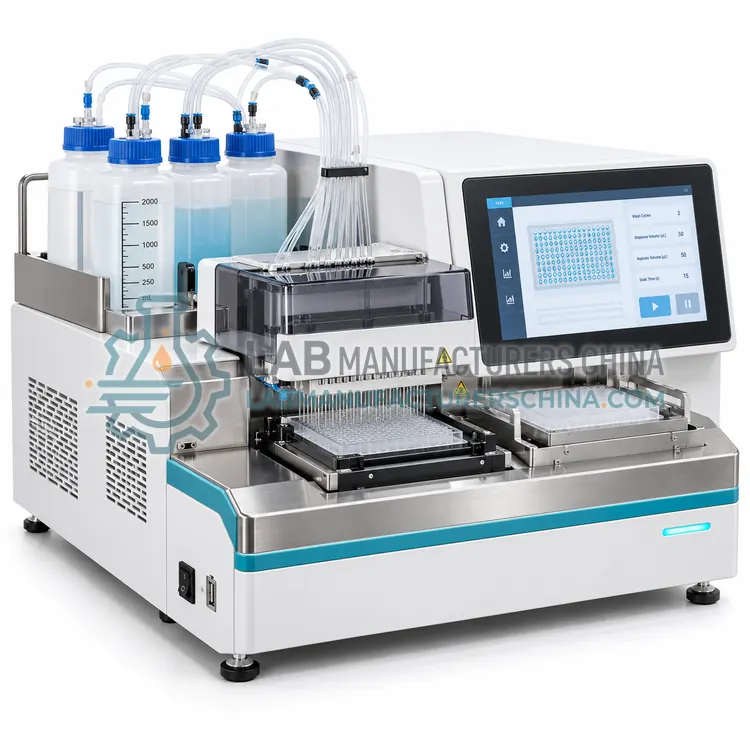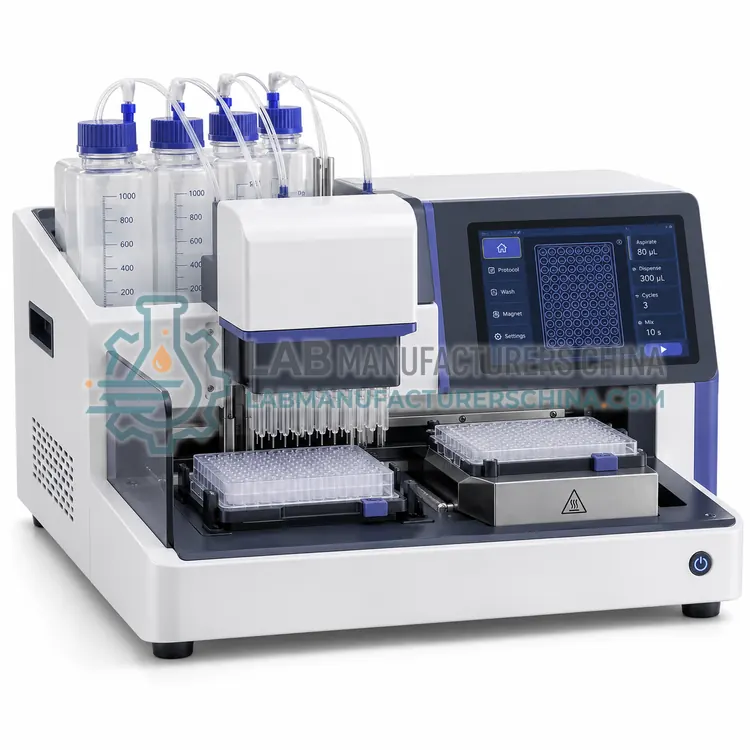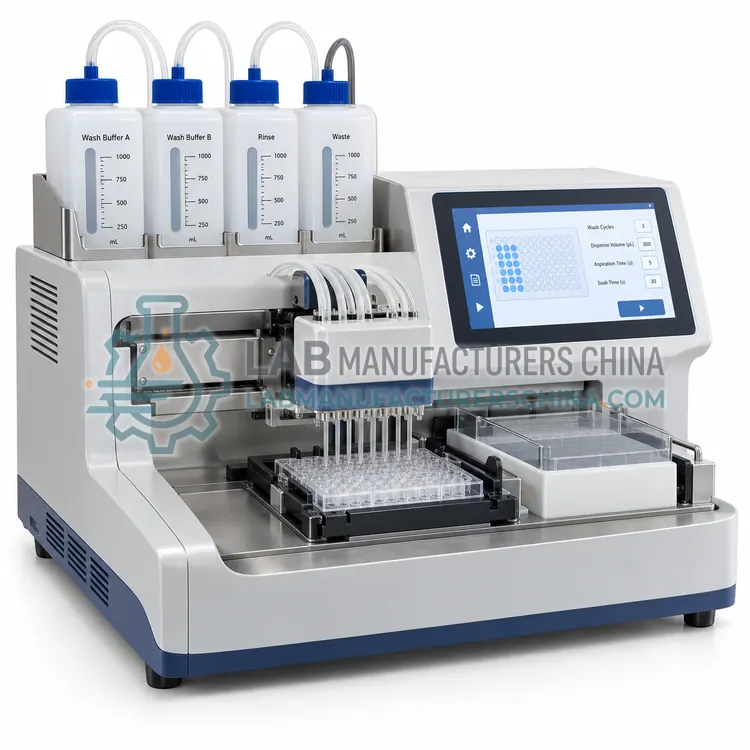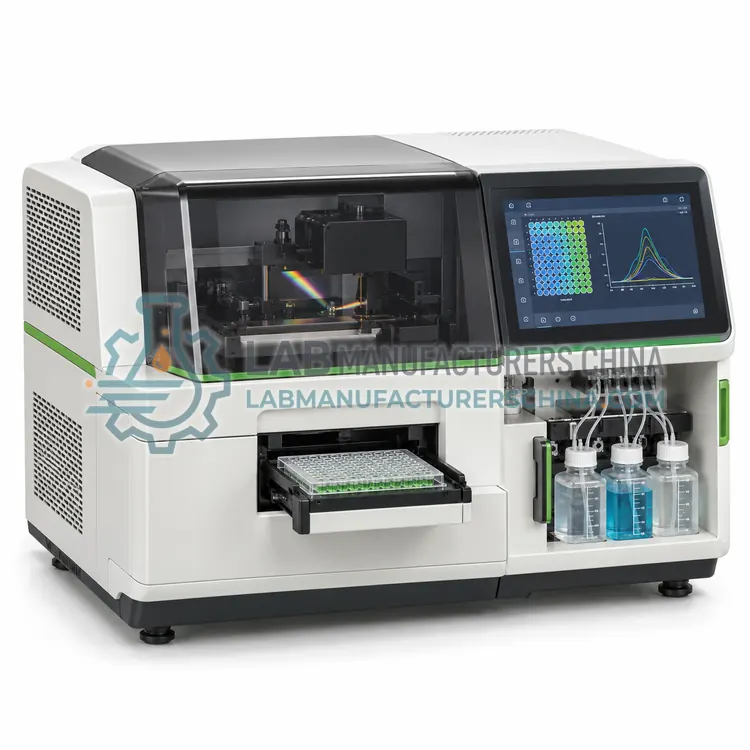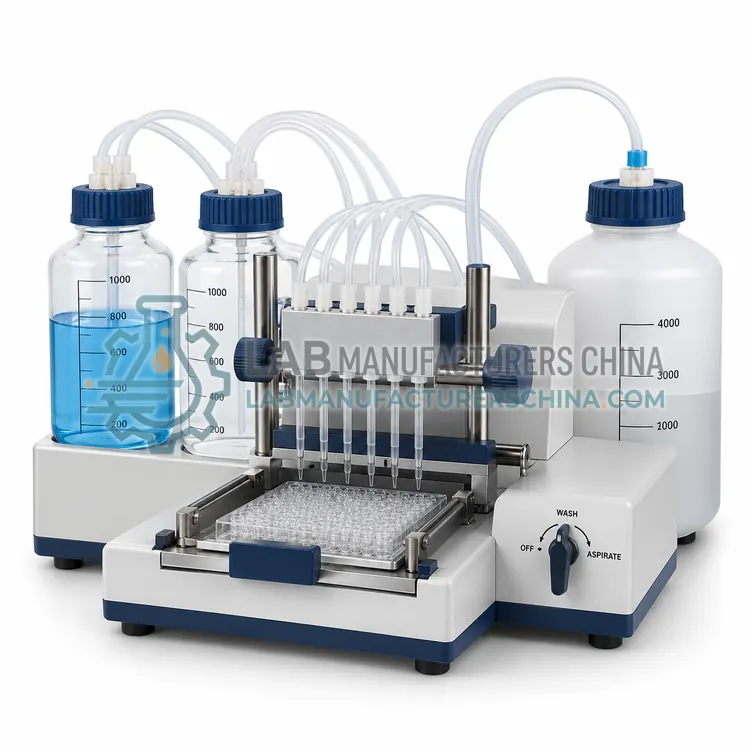
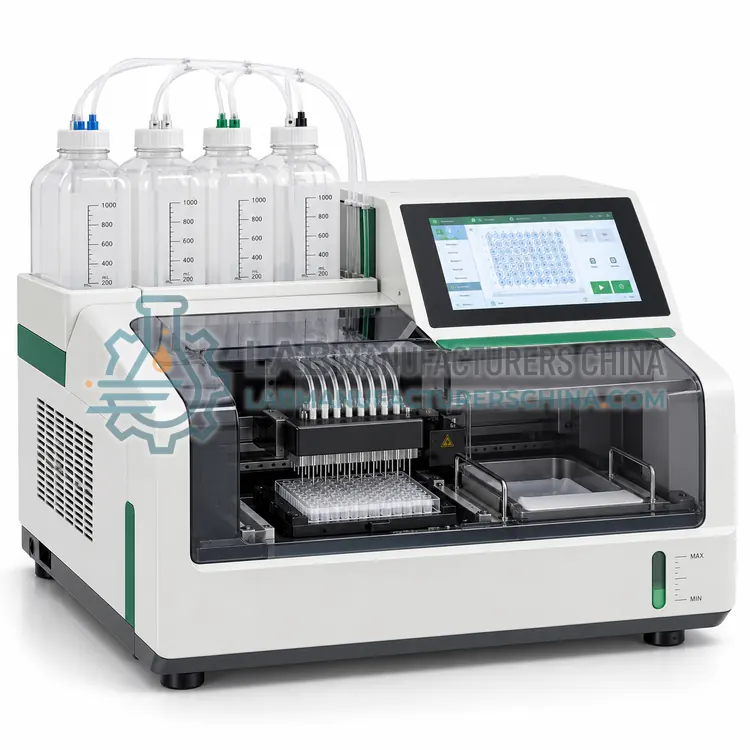
Automatic 96-Well Microplate Washer
全自动 96 孔洗板机
- SKU MIW-0002
- Microplate Washers
- CE (to be confirmed)
- ISO 13485 manufacturing for IVD use (to be confirmed)
- ISO 9001 manufacturing (to be confirmed)
Price on request — FOB / CIF quoted per order
Prices depend on configuration, quantity and destination port.
Key specifications
| Plate format | 96-well (flat, U, V bottom), strip wells |
|---|---|
| Manifold type | 8-, 12- or 96-pin |
| Dispense volume | 50–3,000 µL/well |
| Dispense precision | CV < 3% |
| Residual volume | < 2 µL/well (flat bottom) |
| Wash cycles | 1–99 |
Request a quote Download brochure · to be provided
By Lab Manufacturers China Technical TeamLast reviewed Standards: IEC 61010-1, IEC 61010-2-081, IEC 61326-1
What is the Automatic 96-Well Microplate Washer?
An automatic 96-well microplate washer performs programmed aspiration, dispensing, soaking and shaking on a full plate with pump-controlled volumes and low residual volume. It is the standard choice for routine ELISA in clinical, biopharmaceutical and food testing laboratories.
What is the Automatic 96-Well Microplate Washer?
An automatic 96-well microplate washer performs programmed aspiration, dispensing, soaking and shaking on a full plate with pump-controlled volumes and low residual volume. It is the standard choice for routine ELISA in clinical, biopharmaceutical and food testing laboratories.
Overview
The automatic 96-well washer uses an 8-, 12- or 96-pin manifold on a motorized plate carrier, with a peristaltic or syringe pump system delivering 50 to 3,000 microliters per well and a vacuum pump for aspiration. Programmable protocols store cycle number, volume, soak time, shake and aspirate height, and users can recall them from a touchscreen. Residual volume is typically below 2 microliters per well for flat-bottom plates, and a full plate wash of three cycles takes under two minutes. Bottom wash, crosswise aspiration and strip-well holders are common. Dual-buffer and priming functions, liquid level sensors and clog detection improve reliability. Dispensing cross-contamination is avoided by a separate dispense and aspirate line, and software records maintenance and programs for audit.
How does it work?
A microplate washer uses a manifold carrying rows of dispense and aspirate tubes that enter the wells. Wash buffer is delivered from a reservoir by a peristaltic or diaphragm pump through the dispense tubes at a set volume and flow rate. The aspirate tubes, connected to a vacuum source, remove liquid, and their height is set to leave a low residual volume, often below 2 microliters per well in a 96-well plate. Programs combine multiple cycles with soak times, shaking, bottom washing and crosswise aspiration. Sensors detect clogged tubes and buffer level, and a waste bottle collects effluent. Dual-manifold designs allow two buffers, while magnetic bead washers hold beads with a magnet during aspiration. Precise alignment between manifold and well, particularly at 384-well density, is essential.
What are the key features?
- Programmable wash protocols with soak, shake and bottom wash steps
- Residual volume typically below 2 microliters per well
- Touchscreen program storage for up to 100 protocols
- Liquid level and clog detection for run reliability
- Dual-buffer option with automated priming
- Strip-well and standard plate carriers
What are the technical specifications?
A typical automatic 96-well microplate washer configuration offers plate format of 96-well (flat, U, V bottom), strip wells, manifold type of 8-, 12- or 96-pin, dispense volume of 50–3,000 µL/well, dispense precision of CV < 3%, residual volume of < 2 µL/well (flat bottom) and wash cycles of 1–99. Values are indicative of the product class; the exact figures for each configuration are confirmed on the quotation and the calibration documents supplied with the instrument.
Which applications is it used for?
The Automatic 96-Well Microplate Washer is used in clinical ELISA and serology, vaccine and biologics potency ELISA, food allergen and mycotoxin ELISA, cytokine immunoassays and cell adhesion and staining assays. Across the wider Microplate Washers class, laboratories also deploy it for ELISA wash cycles, cell-based assay medium exchange and magnetic bead immunoassay washing.
Which standards and certifications apply?
Relevant standards and methods include IEC 61010-1, IEC 61010-2-081, IEC 61326-1, ANSI/SLAS 1-2004 to 4-2004, ISO 13485 (IVD use) and CLSI EP15-A3. Certification candidates for this model are CE, ISO 13485 manufacturing for IVD use and ISO 9001 manufacturing; each is to be confirmed for the specific configuration before shipment, and certificates are supplied only where they have been issued.
Prime the washer before each run and flush with deionized water at the end of the day to prevent salt crystallization and microbial growth. Run a weekly cleaning cycle with dilute disinfectant or sodium hypochlorite, following the manufacturer's guidance, and inspect manifold tubes for blockage. Verify dispense volume gravimetrically and residual volume with a dye method during qualification and at least annually. Treat effluent as biohazardous waste when samples are infectious, and use a vacuum trap with disinfectant. Use plate-specific alignment settings and replace tubing and seals according to schedule.
How do I select the right Automatic 96-Well Microplate Washer?
Select this variant for routine ELISA with regular plate numbers where validated, repeatable washing matters. It is excessive for occasional use, and 384-well work needs a different head. In an RFQ specify manifold type, dispense volume range, residual volume target, buffer channels, soak and shake needs and any LIS or audit trail requirement.
How does it compare with other Microplate Washers variants?
Choose a washer by plate format, throughput and assay sensitivity. Manual or semi-automatic manifolds suit low volume laboratories, while automatic washers with programmable protocols suit routine ELISA. Check residual volume per well, dispense precision, and the presence of bottom washing, soak and shake functions. For cell-based assays, select gentle dispensing with adjustable flow rate and offset aspiration to avoid cell detachment. For magnetic bead assays, confirm magnet compatibility. High-throughput laboratories need 384-well heads, stacker integration and fast cycle times. Consider capacity of buffer and waste bottles, tube cleaning routines, and ease of priming. Request residual volume and coefficient of variation data for your plate type.
Full specifications
| Plate format | 96-well (flat, U, V bottom), strip wells |
|---|---|
| Manifold type | 8-, 12- or 96-pin |
| Dispense volume | 50–3,000 µL/well |
| Dispense precision | CV < 3% |
| Residual volume | < 2 µL/well (flat bottom) |
| Wash cycles | 1–99 |
| Soak time | 0–24 h adjustable |
| Wash time (3 cycles) | < 2 min per plate |
| Program memory | ≥ 50 protocols |
| Buffer channels | 1–2 |
| Display | Touchscreen |
Indicative values for this product class. Final specifications are confirmed on the quotation and in the calibration documents supplied with the instrument.
Applications
- Clinical ELISA and serology
- Vaccine and biologics potency ELISA
- Food allergen and mycotoxin ELISA
- Cytokine immunoassays
- Cell adhesion and staining assays
Key features
- Programmable wash protocols with soak, shake and bottom wash steps
- Residual volume typically below 2 microliters per well
- Touchscreen program storage for up to 100 protocols
- Liquid level and clog detection for run reliability
- Dual-buffer option with automated priming
- Strip-well and standard plate carriers
Frequently asked questions about Automatic 96-Well Microplate Washer
An 8-pin washer processes a plate one row at a time and is slower and less costly. A 96-pin washer treats all wells simultaneously, finishing a cycle in seconds and reducing differences in incubation time between wells.
Crosswise or swept aspiration moves the aspirate tube across the well bottom to remove liquid from the edges. It lowers residual volume and improves washing in flat-bottom wells, at the cost of slightly longer cycle times.
Dispense accuracy is verified by weighing the liquid delivered to each well position on a balance, or by dye-based photometric checks across all wells. Acceptance limits are usually a coefficient of variation below 3 percent.
Residual volume is the liquid left in a well after aspiration. Low and consistent values, typically below 2 microliters in 96-well plates, dilute unbound conjugate less and give lower background and better well-to-well precision in ELISA.
Most ELISA protocols specify three to five wash cycles with 300 to 350 microliters per well of buffer containing a detergent such as Tween 20. Always follow the kit insert, and add soak time if background is high.
Some washers offer interchangeable manifolds or heads for each density, but tube spacing differs, so each format needs a matching manifold. Confirm plate height adjustment and aspiration alignment for each format before purchase.
Related models