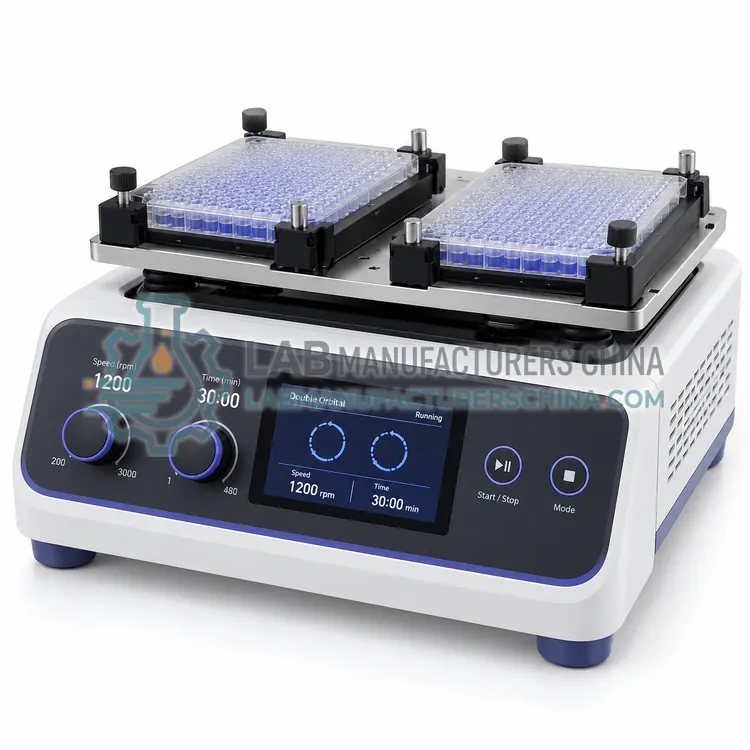
Double-Orbital Microplate Shaker for 384-Well Plates
用于 384 孔板的双轨道微孔板振荡器
- SKU MSH-0003
- Microplate Shakers
- CE (to be confirmed)
- ISO 9001 manufacturing (to be confirmed)
- RoHS (to be confirmed)
Price on request — FOB / CIF quoted per order
Prices depend on configuration, quantity and destination port.
Key specifications
| Motion type | Double-orbital |
|---|---|
| Orbit diameter | 1–2 mm |
| Speed range | 100–1,000 rpm |
| Suitable volumes | 5–50 µL (384-well) |
| Plate formats | 96-, 384-, 1536-well |
| Mixing time (typical) | 5–60 s |
Request a quote Download brochure · to be provided
By Lab Manufacturers China Technical TeamLast reviewed Standards: ANSI/SLAS 1-2004 to 4-2004, IEC 61010-1, IEC 61010-2-051
What is the Double-Orbital Microplate Shaker for 384-Well Plates?
A double-orbital microplate shaker combines two overlapping circular motions to mix small volumes in 384- and 1536-well plates without splashing. It is the choice for high-density assays where conventional orbital shaking fails to mix microliter volumes effectively.
What is the Double-Orbital Microplate Shaker for 384-Well Plates?
A double-orbital microplate shaker combines two overlapping circular motions to mix small volumes in 384- and 1536-well plates without splashing. It is the choice for high-density assays where conventional orbital shaking fails to mix microliter volumes effectively.
Overview
In high-density plates, small volumes and high surface tension limit mixing by simple orbital motion. Double-orbital shakers drive the platform in two superimposed circles, with orbit diameters such as 1 to 2 millimeters, producing a fluid vortex that mixes 5 to 50 microliter volumes within seconds without droplets leaving the wells. Speeds are typically 100 to 1,000 revolutions per minute, and mixing intensity is tuned with orbit diameter and speed. The shaker can be a standalone benchtop unit or an integrated module inside a plate reader or automation line, where precise plate seating matters. Many units have a low profile and open access for robotic plate handling. Because vigorous mixing in sealed plates can generate pressure, sealing films should be rated for shaking. Amplitude is small, so heavy foam or viscous fluids need extended mixing time.
How does it work?
A microplate shaker converts motor rotation into a small, controlled plate movement. In orbital designs, an eccentric cam or drive pin moves a platform in a circular path with an orbit diameter of about 1 to 4 millimeters, and speeds of 100 to 1,500 revolutions per minute. Linear shakers move the plate back and forth, and double-orbital shakers combine two circular motions for vigorous mixing in small wells. The amplitude is deliberately small so liquid swirls within each well without spilling, and surface tension limits splashing in high-density plates. Microplate clamps or non-slip platforms hold plates of different heights. Heating versions add a block or forced-air system for temperature control, and brushless motors with speed feedback provide consistent rotation for long incubations.
What are the key features?
- Double-orbital motion mixes 5 to 50 microliters in 384-well plates
- Orbit diameters from 1 to 2 millimeters prevent droplet loss
- Speed range of 100 to 1,000 revolutions per minute with fine adjustment
- Low-profile design with open access for robotic plate handling
- Available as stand-alone or integrated module in readers
- Precise plate seating with spring-loaded clamps for high-density plates
What are the technical specifications?
A typical double-orbital microplate shaker for 384-well plates configuration offers motion type of Double-orbital, orbit diameter of 1–2 mm, speed range of 100–1,000 rpm, suitable volumes of 5–50 µL (384-well), plate formats of 96-, 384-, 1536-well and mixing time (typical) of 5–60 s. Values are indicative of the product class; the exact figures for each configuration are confirmed on the quotation and the calibration documents supplied with the instrument.
Which applications is it used for?
The Double-Orbital Microplate Shaker for 384-Well Plates is used in high-throughput screening mixing, homogeneous assay reagent mixing, 384-well ELISA and bead incubations, cell lysis in high-density plates and kinetic assay initiation in plate readers. Across the wider Microplate Shakers class, laboratories also deploy it for ELISA incubation mixing, bead-based immunoassay suspension and cell suspension culture in plates.
Which standards and certifications apply?
Relevant standards and methods include ANSI/SLAS 1-2004 to 4-2004, IEC 61010-1, IEC 61010-2-051, IEC 61326-1 and ISO 13485 (IVD workflows). Certification candidates for this model are CE, ISO 9001 manufacturing and RoHS; each is to be confirmed for the specific configuration before shipment, and certificates are supplied only where they have been issued.
Place the shaker on a level, stable surface and secure plates with clamps to avoid walking at high speed. Seal plates with adhesive film or lids to prevent evaporation and cross-contamination during long incubations. Check speed accuracy with a tachometer and, for thermoshakers, temperature accuracy with a calibrated probe during qualification and periodically thereafter. Clean spills immediately with compatible disinfectants and avoid liquids entering the drive. When used inside incubators, confirm the motor is rated for high humidity and heat. Service motor bearings according to the supplier's recommended schedule.
How do I select the right Double-Orbital Microplate Shaker for 384-Well Plates?
Choose this variant for assays in 384- or 1536-well plates with small volumes where standard orbital shakers leave reagents unmixed. For 96-well work a conventional orbital shaker is enough. In an RFQ specify plate formats, volume range, orbit diameter, automation interface and height limit.
How does it compare with other Microplate Shakers variants?
Select a microplate shaker by motion type, speed range, orbit diameter and capacity. Orbital shakers with 2 to 3 millimeter orbit suit ELISA incubations and general mixing. Double-orbital or small-orbit models suit 384- and 1536-well plates, where splashing limits speed. Thermoshakers add heating and cooling for temperature-sensitive incubations. Check the plate carrier for your formats, including deep-well plates, and maximum load for stacked plates. Confirm low-speed stability for cell suspensions and high-speed performance for bead mixing. For incubators, choose models with low heat output and appropriate IP rating for humidity. Consider noise, timer and programmable profiles, and whether integration with automation requires open-lid access or a communication interface.
Full specifications
| Motion type | Double-orbital |
|---|---|
| Orbit diameter | 1–2 mm |
| Speed range | 100–1,000 rpm |
| Suitable volumes | 5–50 µL (384-well) |
| Plate formats | 96-, 384-, 1536-well |
| Mixing time (typical) | 5–60 s |
| Plate capacity | 1 plate |
| Timer | 1 s–24 h |
| Robot access | Open top, SiLA or contact closure |
| Height | ≤ 100 mm (low profile) |
| Speed accuracy | ±2% |
Indicative values for this product class. Final specifications are confirmed on the quotation and in the calibration documents supplied with the instrument.
Applications
- High-throughput screening mixing
- Homogeneous assay reagent mixing
- 384-well ELISA and bead incubations
- Cell lysis in high-density plates
- Kinetic assay initiation in plate readers
Key features
- Double-orbital motion mixes 5 to 50 microliters in 384-well plates
- Orbit diameters from 1 to 2 millimeters prevent droplet loss
- Speed range of 100 to 1,000 revolutions per minute with fine adjustment
- Low-profile design with open access for robotic plate handling
- Available as stand-alone or integrated module in readers
- Precise plate seating with spring-loaded clamps for high-density plates
Frequently asked questions about Double-Orbital Microplate Shaker for 384-Well Plates
Surface tension and small well diameter hold liquid in place, so simple orbital motion moves the plate without moving the liquid enough. Double-orbital motion adds a stronger rotational force that generates vortex flow in microliter volumes.
At moderate speeds it is generally gentle enough for suspension cells, but adherent monolayers can detach at high speed. Validate mixing speed and duration with your cell line and avoid extended vigorous mixing.
Yes. Use sealing films or lids specified for shaking and temperature range. Loose seals allow splashing and cross-contamination, while inappropriate films can bulge or detach at high speeds.
For ELISA incubations, 300 to 600 revolutions per minute with a 2 to 3 millimeter orbit is common. Higher speeds of 800 to 1,200 revolutions suit bead suspension, while 384-well plates often require lower speeds or double-orbital motion to avoid splashing.
Orbital shaking moves the plate in a circle and mixes efficiently with low spillage. Linear shaking moves back and forth, creating a wave action that can be gentler for cells but tends to splash at high speeds in full wells.
Many ELISA steps run at room temperature, so simple shakers suffice. Steps that specify 37 degrees or lower, such as enzymatic reactions or hybridization, benefit from thermoshakers with heating and often cooling for temperature consistency.
Related models