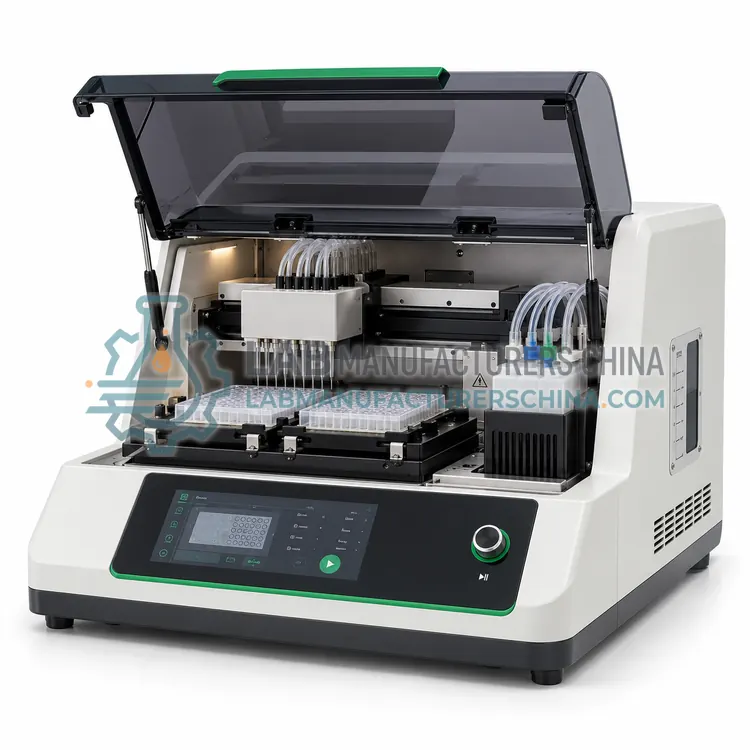
How do Microplate Shakers work?
A microplate shaker converts motor rotation into a small, controlled plate movement. In orbital designs, an eccentric cam or drive pin moves a platform in a circular path with an orbit diameter of about 1 to 4 millimeters, and speeds of 100 to 1,500 revolutions per minute. Linear shakers move the plate back and forth, and double-orbital shakers combine two circular motions for vigorous mixing in small wells. The amplitude is deliberately small so liquid swirls within each well without spilling, and surface tension limits splashing in high-density plates. Microplate clamps or non-slip platforms hold plates of different heights. Heating versions add a block or forced-air system for temperature control, and brushless motors with speed feedback provide consistent rotation for long incubations.
Which Microplate Shakers variants are available?
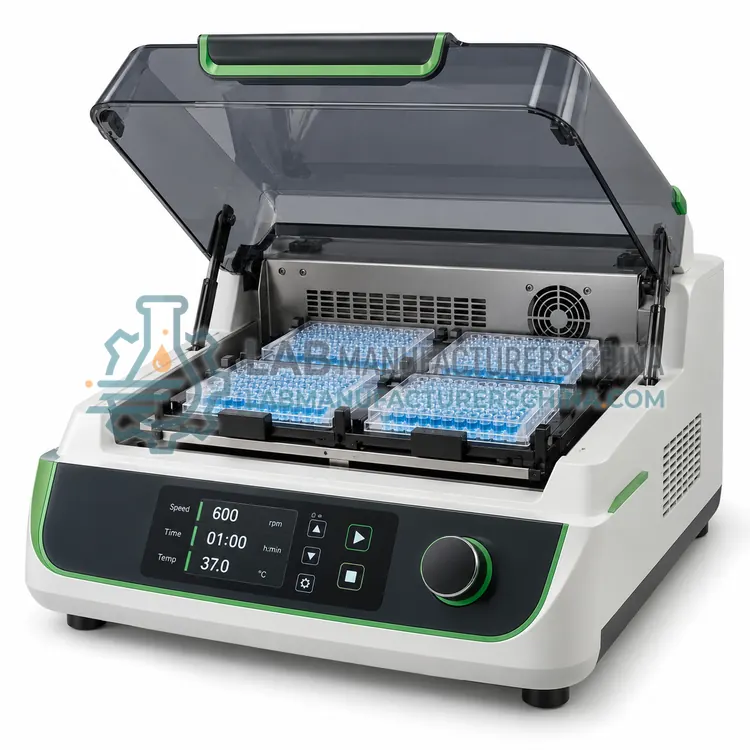
- Orbital Microplate Shaker for ELISA Incubation — An orbital microplate shaker moves 96-well plates in a small circular path at 100 to 1,500 revolutions per minute to mix reagents during ELISA incubations.
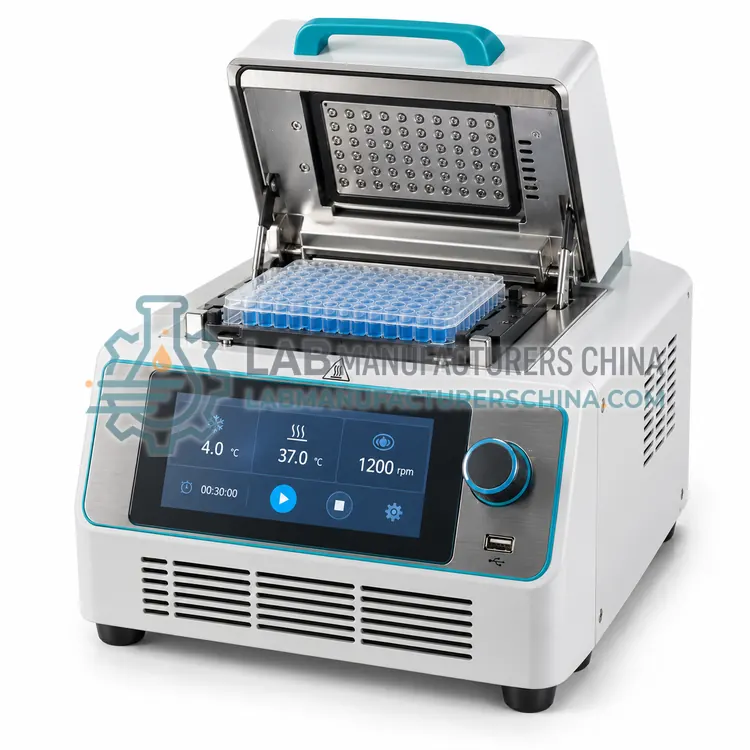
- Microplate Thermoshaker with Heating and Cooling — A microplate thermoshaker combines orbital shaking with a heating and cooling block that holds plates at a set temperature, typically from 4 to 100 degrees Celsius.
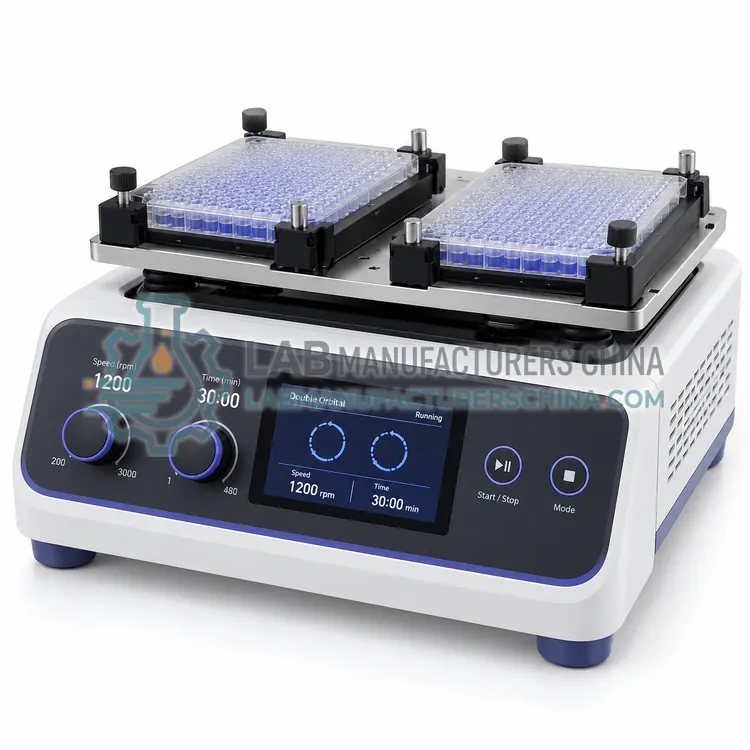
- Double-Orbital Microplate Shaker for 384-Well Plates — A double-orbital microplate shaker combines two overlapping circular motions to mix small volumes in 384- and 1536-well plates without splashing.
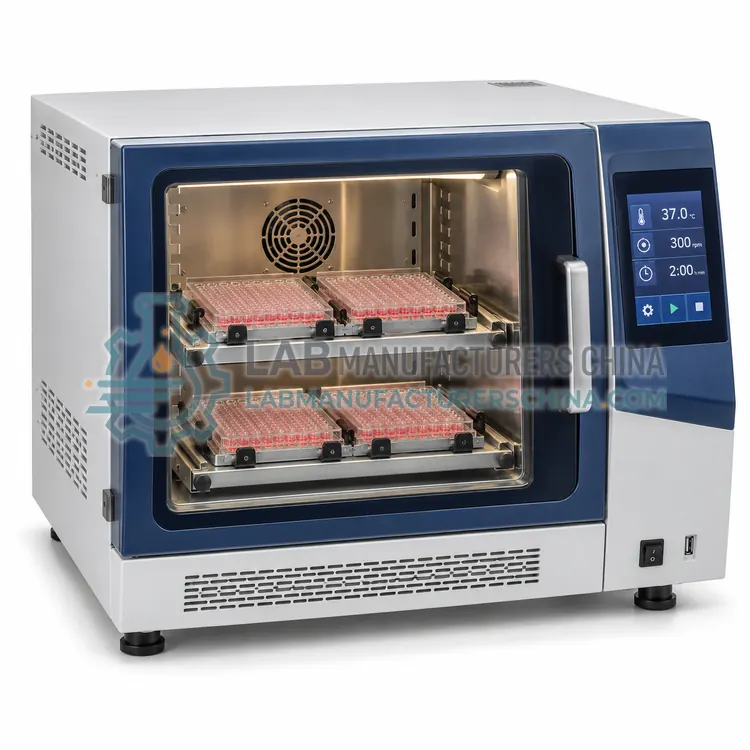
- Microplate Shaker Incubator for Cell and Microbial Growth — A microplate shaker incubator holds plates at controlled temperature and often humidity while shaking, supporting bacterial growth, suspension cell culture and long enzymatic incubations.
- Magnetic Bead Mixing Microplate Shaker — A magnetic bead mixing microplate shaker provides high-speed orbital motion tuned to keep paramagnetic beads in suspension in plates during binding and elution steps.
How do I choose the right variant?
Select a microplate shaker by motion type, speed range, orbit diameter and capacity. Orbital shakers with 2 to 3 millimeter orbit suit ELISA incubations and general mixing. Double-orbital or small-orbit models suit 384- and 1536-well plates, where splashing limits speed. Thermoshakers add heating and cooling for temperature-sensitive incubations. Check the plate carrier for your formats, including deep-well plates, and maximum load for stacked plates. Confirm low-speed stability for cell suspensions and high-speed performance for bead mixing. For incubators, choose models with low heat output and appropriate IP rating for humidity. Consider noise, timer and programmable profiles, and whether integration with automation requires open-lid access or a communication interface.
Where are Microplate Shakers used?
Microplate Shakers are specified in ELISA incubation mixing, bead-based immunoassay suspension, cell suspension culture in plates, reagent mixing in screening, bacterial growth in microplates and sample lysis and extraction in plates.
Which standards and certifications apply?
Work with Microplate Shakers is commonly governed by ANSI/SLAS 1-2004 to 4-2004, IEC 61010-1, IEC 61010-2-051, IEC 61326-1 and ISO 13485 (IVD workflows). Instrument certifications such as CE marking are confirmed per configuration and never assumed.
What are the key considerations before purchase?
Place the shaker on a level, stable surface and secure plates with clamps to avoid walking at high speed. Seal plates with adhesive film or lids to prevent evaporation and cross-contamination during long incubations. Check speed accuracy with a tachometer and, for thermoshakers, temperature accuracy with a calibrated probe during qualification and periodically thereafter. Clean spills immediately with compatible disinfectants and avoid liquids entering the drive. When used inside incubators, confirm the motor is rated for high humidity and heat. Service motor bearings according to the supplier's recommended schedule.