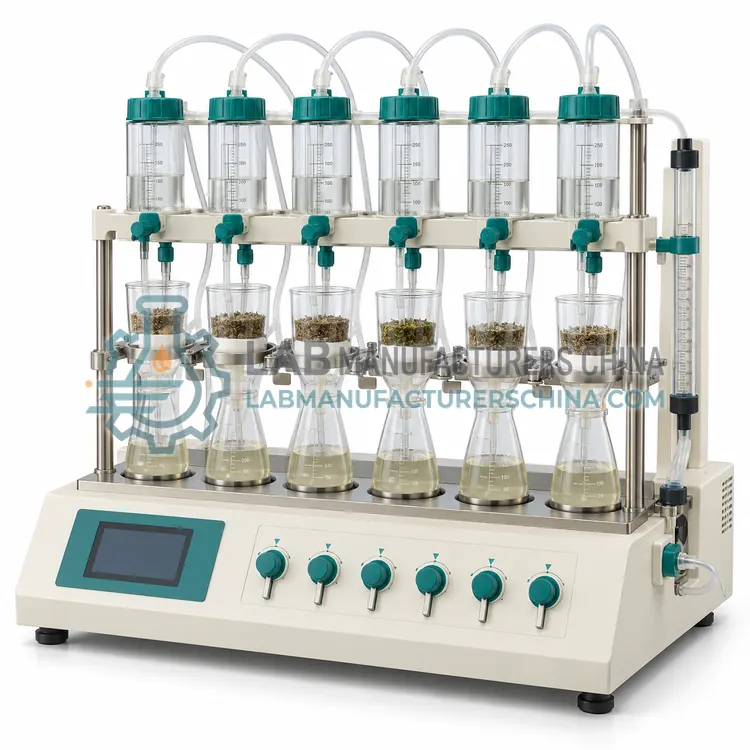
How do Crop Analysis work?
Crop analysis uses several measurement principles. Penetrometers push a calibrated plunger into fruit flesh and record the peak force needed, giving a firmness index related to ripeness and storage life. Refractometers measure the refractive index of juice, which depends on dissolved solids, and report results as degrees Brix for sugars and total soluble solids. Colorimeters illuminate the surface and measure reflected light in defined colour spaces, so ripeness, sorting and defects can be assessed objectively. Near-infrared analyzers measure reflectance from ground forage or feed and predict protein, fibre, fat, starch and dry matter from calibration models. Moisture meters and microwave or halogen analyzers determine dry matter by loss on drying, which is important for silage and hay. Together these tools support harvest timing, grading, blending and quality control.
Which Crop Analysis variants are available?
- NIR Crop and Feed Quality Analyzer — A near-infrared instrument that predicts protein, fibre, fat, starch and dry matter in forage, feed and crop samples.
- Fruit Firmness Tester — A hand-held penetrometer that records the force needed to push a plunger into fruit flesh.
- Digital Refractometer for Crop Brix — A digital instrument that measures the refractive index of juice and reports Brix or total soluble solids.
- Portable Colorimeter for Crop Grading — A portable instrument that measures the colour of produce and crops in a defined colour space.
- Forage Dry Matter and Moisture Analyzer — An instrument that determines dry matter in silage, hay and fresh forage by rapid drying.
How do I choose the right variant?
Define the quality parameter that drives the decision before choosing an instrument. For ripeness and harvest timing in fruit, a penetrometer and a refractometer give direct, low-cost readings; select a plunger diameter and force range suited to the crop, since standards specify these. For objective grading and sorting, a colorimeter with the correct colour space and aperture avoids subjective judgement. For feed and forage value, a near-infrared analyzer predicts several nutrients at once but needs local calibrations from wet chemistry. For dry matter in silage and hay, choose a microwave or halogen analyzer with the sample preparation the standard requires. Consider portability for field use, calibration and reference sample support, and whether results must be exported to grading or quality systems.
Where are Crop Analysis used?
Crop Analysis are specified in fruit and vegetable harvest timing, produce grading and packing lines, silage and hay dry matter management and feed ingredient quality control.
Which standards and certifications apply?
Work with Crop Analysis is commonly governed by ISO 2173 (soluble solids), ISO 5984 (crude ash), ISO 6496 (moisture, feeds), ISO 6865 (crude fibre), UNECE FFV standards and AOAC 934.01. Instrument certifications such as CE marking are confirmed per configuration and never assumed.
What are the key considerations before purchase?
Follow the standard sampling and preparation procedure, because firmness, Brix and dry matter depend strongly on fruit temperature, sample position and time since harvest. Calibrate refractometers with distilled water and check them against a sucrose standard, and clean the prism carefully to avoid a cloudy reading. For penetrometers, standardise the plunger size, penetration speed and skin removal, and discard samples with visible defects. Keep near-infrared instruments clean and update forage and feed calibrations with local samples each season. For moisture and dry matter, control drying temperature and time exactly. Record sample origin, handling and instrument settings, and keep reference samples for traceability. Store and transport instruments so that optics, probes and batteries are protected.