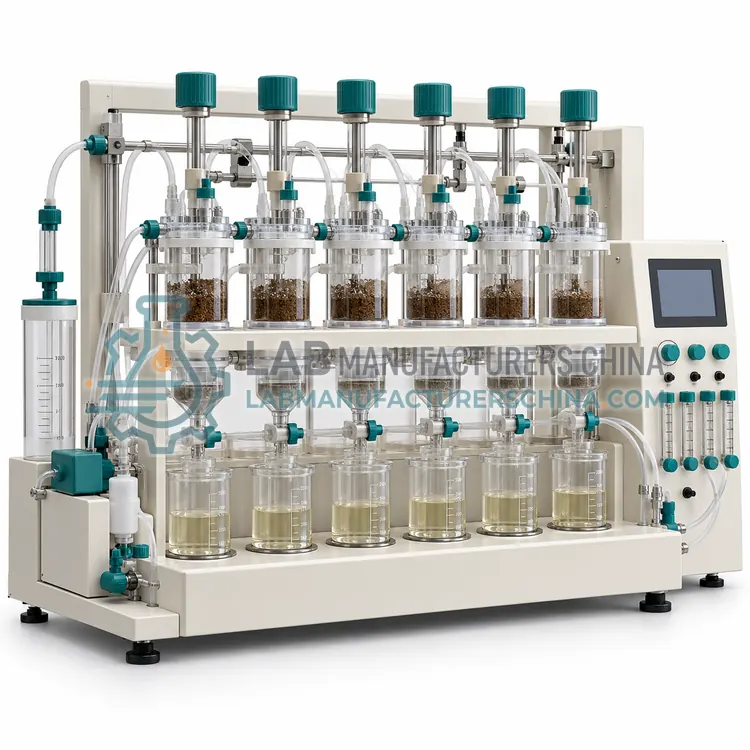
How do Plant Analysis work?
Plant analysis instruments rely on optical and gas exchange principles. Leaf area meters measure the shadow or scanned image of a leaf to compute area, and optical canopy analyzers infer leaf area index from the interception of light at several angles. Chlorophyll meters transmit light at two wavelengths, one absorbed by chlorophyll and one not, and report a relative index that correlates with chlorophyll content and nitrogen status. Portable photosynthesis systems use an infrared gas analyzer to measure carbon dioxide uptake and water vapour release inside a clamped leaf chamber under controlled light, carbon dioxide and temperature, yielding assimilation and conductance. Chlorophyll fluorescence instruments apply a modulated light pulse and analyse the emitted fluorescence to assess photosystem II efficiency and stress before visible symptoms appear.
Which Plant Analysis variants are available?
- Leaf Area Meter — An instrument that measures the area of individual leaves from a scanned image or optical shadow.
- Chlorophyll Content Meter — A hand-held meter that reports a relative chlorophyll index from leaf transmittance.
- Portable Photosynthesis System — A field instrument that measures leaf carbon dioxide uptake and water loss in a controlled chamber.
- Plant Canopy Analyzer — An optical instrument that estimates leaf area index and canopy structure from light interception.
- Chlorophyll Fluorescence Analyzer — An instrument that measures chlorophyll fluorescence to assess photosystem II efficiency and stress.
How do I choose the right variant?
Match the instrument to the question. For rapid nitrogen and chlorophyll screening across many plots, a hand-held chlorophyll meter gives a relative index in seconds and needs only a calibration to local crop and variety. When leaf area or canopy light interception drives yield models, use a leaf area meter for individual leaves and an optical canopy analyzer for stands. For mechanistic studies of assimilation, conductance and temperature response, a portable photosynthesis system is required and should be specified with the chamber type, light source and gas supply. Chlorophyll fluorescence adds early stress detection and photosystem diagnostics. Consider field power, chamber size for the species, data export formats and the reference standards used for quality control.
Where are Plant Analysis used?
Plant Analysis are specified in crop nitrogen status diagnosis, plant physiology and stress research, breeding selection for photosynthetic traits and forest and canopy productivity studies.
Which standards and certifications apply?
Work with Plant Analysis is commonly governed by IEC 61010-1, ISO 10519 (chlorophyll), ISO 12099 (NIR spectrometry), ISO/IEC 17025 and ASTM E1755 (biomass ash). Instrument certifications such as CE marking are confirmed per configuration and never assumed.
What are the key considerations before purchase?
Standardize measurement position and time of day, because leaf angle, light history and water status change within hours and bias comparisons. For chlorophyll meters, take readings on similar leaves of the same developmental stage and avoid veins and damaged tissue, and calibrate against destructive chlorophyll extraction for each species. For leaf area meters, avoid folding or shading leaves and keep the background contrast uniform. Photosynthesis systems need careful chamber sealing, CO2 and water calibration, and stable light and temperature control, and long measurement sessions require periodic leak checks. Fluorescence measurements must allow dark adaptation for the required period. Keep optics clean, protect sensors from moisture, and record environmental conditions with every dataset so results remain interpretable.