Fruit Firmness Tester
水果硬度计
- SKU CRA-0002
- Crop Analysis
- CE (to be confirmed)
- RoHS (to be confirmed)
- ISO 9001 manufacturing (to be confirmed)
Price on request — FOB / CIF quoted per order
Prices depend on configuration, quantity and destination port.
Key specifications
| Measurement | Peak penetration force |
|---|---|
| Force range | 0–50 kgf / 0–500 N |
| Resolution | 0.01 kgf / 0.1 N |
| Accuracy | ±1% of full scale |
| Plunger diameter | 8 mm or 11 mm (interchangeable) |
| Penetration depth | 7–10 mm, adjustable |
Request a quote Download brochure · to be provided
By Lab Manufacturers China Technical TeamLast reviewed Standards: ISO 2173 (soluble solids), ISO 5984 (crude ash), ISO 6496 (moisture, feeds)
What is the Fruit Firmness Tester?
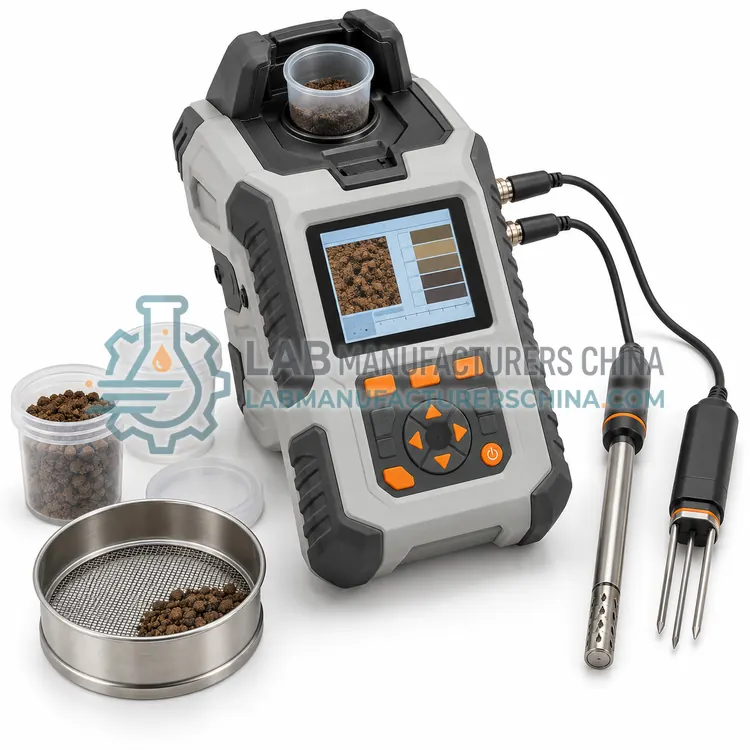
A hand-held penetrometer that records the force needed to push a plunger into fruit flesh. It is the right choice for harvest timing, storage monitoring and packing decisions in orchards and packhouses.
What is the Fruit Firmness Tester?
A hand-held penetrometer that records the force needed to push a plunger into fruit flesh. It is the right choice for harvest timing, storage monitoring and packing decisions in orchards and packhouses.
Overview
The fruit firmness tester presses a cylindrical plunger of defined diameter into peeled fruit tissue and displays the peak force, reported in newtons, kilograms-force or pounds. Because cell wall breakdown during ripening reduces firmness, the reading is a direct and well-established ripeness index for apples, pears, peaches, kiwifruit and many other crops. Motorised models drive the plunger at a constant speed to remove differences between operators, while hand-held spring gauges are simpler and cheaper. Some instruments provide a full force-distance curve, from which firmness, toughness and the work of penetration can be derived. Measurements are usually taken on two opposite sides of each fruit after removing a disc of skin, and a sample of ten or more fruit gives a representative average. Standards define plunger size, speed and sample handling for each crop.
How does it work?
Crop analysis uses several measurement principles. Penetrometers push a calibrated plunger into fruit flesh and record the peak force needed, giving a firmness index related to ripeness and storage life. Refractometers measure the refractive index of juice, which depends on dissolved solids, and report results as degrees Brix for sugars and total soluble solids. Colorimeters illuminate the surface and measure reflected light in defined colour spaces, so ripeness, sorting and defects can be assessed objectively. Near-infrared analyzers measure reflectance from ground forage or feed and predict protein, fibre, fat, starch and dry matter from calibration models. Moisture meters and microwave or halogen analyzers determine dry matter by loss on drying, which is important for silage and hay. Together these tools support harvest timing, grading, blending and quality control.
What are the key features?
- Direct peak-force reading gives an objective ripeness index.
- Motorised drive removes operator speed variation.
- Interchangeable plungers suit different fruit sizes and standards.
- Force-distance curve option distinguishes firmness from toughness.
- Portable design allows orchard and storage room use.
- Data logging stores readings and sample averages.
What are the technical specifications?
A typical fruit firmness tester configuration offers measurement of Peak penetration force, force range of 0–50 kgf / 0–500 N, resolution of 0.01 kgf / 0.1 N, accuracy of ±1% of full scale, plunger diameter of 8 mm or 11 mm (interchangeable) and penetration depth of 7–10 mm, adjustable. Values are indicative of the product class; the exact figures for each configuration are confirmed on the quotation and the calibration documents supplied with the instrument.
Which applications is it used for?
The Fruit Firmness Tester is used in orchard harvest timing, cold storage quality monitoring, packhouse grading and sorting and post-harvest research and variety trials. Across the wider Crop Analysis class, laboratories also deploy it for fruit and vegetable harvest timing, produce grading and packing lines and silage and hay dry matter management.
Which standards and certifications apply?
Relevant standards and methods include ISO 2173 (soluble solids), ISO 5984 (crude ash), ISO 6496 (moisture, feeds), ISO 6865 (crude fibre), UNECE FFV standards and AOAC 934.01. Certification candidates for this model are CE, RoHS and ISO 9001 manufacturing; each is to be confirmed for the specific configuration before shipment, and certificates are supplied only where they have been issued.
Follow the standard sampling and preparation procedure, because firmness, Brix and dry matter depend strongly on fruit temperature, sample position and time since harvest. Calibrate refractometers with distilled water and check them against a sucrose standard, and clean the prism carefully to avoid a cloudy reading. For penetrometers, standardise the plunger size, penetration speed and skin removal, and discard samples with visible defects. Keep near-infrared instruments clean and update forage and feed calibrations with local samples each season. For moisture and dry matter, control drying temperature and time exactly. Record sample origin, handling and instrument settings, and keep reference samples for traceability. Store and transport instruments so that optics, probes and batteries are protected.
How do I select the right Fruit Firmness Tester?
Select a motorised penetrometer when repeatability and data logging matter, and a simple spring gauge for occasional checks. When sugar content is also decisive, pair it with a refractometer. In an RFQ, specify the crop, plunger diameter, force range and whether a force curve is required.
How does it compare with other Crop Analysis variants?
Define the quality parameter that drives the decision before choosing an instrument. For ripeness and harvest timing in fruit, a penetrometer and a refractometer give direct, low-cost readings; select a plunger diameter and force range suited to the crop, since standards specify these. For objective grading and sorting, a colorimeter with the correct colour space and aperture avoids subjective judgement. For feed and forage value, a near-infrared analyzer predicts several nutrients at once but needs local calibrations from wet chemistry. For dry matter in silage and hay, choose a microwave or halogen analyzer with the sample preparation the standard requires. Consider portability for field use, calibration and reference sample support, and whether results must be exported to grading or quality systems.
Full specifications
| Measurement | Peak penetration force |
|---|---|
| Force range | 0–50 kgf / 0–500 N |
| Resolution | 0.01 kgf / 0.1 N |
| Accuracy | ±1% of full scale |
| Plunger diameter | 8 mm or 11 mm (interchangeable) |
| Penetration depth | 7–10 mm, adjustable |
| Drive speed | Constant, motorised option |
| Data memory | Up to 1000 readings |
| Outputs | USB or Bluetooth export |
| Operating temperature | 0–40 °C |
| Power supply | Battery, rechargeable |
Indicative values for this product class. Final specifications are confirmed on the quotation and in the calibration documents supplied with the instrument.
Applications
- Orchard harvest timing
- Cold storage quality monitoring
- Packhouse grading and sorting
- Post-harvest research and variety trials
Key features
- Direct peak-force reading gives an objective ripeness index.
- Motorised drive removes operator speed variation.
- Interchangeable plungers suit different fruit sizes and standards.
- Force-distance curve option distinguishes firmness from toughness.
- Portable design allows orchard and storage room use.
- Data logging stores readings and sample averages.
Frequently asked questions about Fruit Firmness Tester
For most fruit the skin disc is removed so the plunger contacts flesh directly, because skin adds variable resistance. The standard procedure for each crop specifies whether to peel and how many measurements per fruit to average.
A minimum of ten fruit per lot is common, measured on two opposite sides, because biological variability is high. Larger samples improve the confidence of the average, especially near a harvest threshold.
Flesh resists slowly and quickly applied force differently, so hand-pushed plungers give inconsistent results between operators. A motorised drive at a fixed speed, such as 1 mm per second, makes readings comparable over time and between sites.
Brix is the concentration of dissolved solids in juice, mainly sugars, expressed in degrees, and it predicts sweetness, maturity and potential quality. It is measured by refractometry and is used widely in fruit, grape and sugar crop assessment.
A penetrometer presses a plunger of specified diameter into peeled flesh at a controlled speed and records the peak force in newtons or pounds. Firmness falls as fruit ripens, so the reading guides harvest date and predicts storage life.
Dry matter determines the feeding value and preservation of silage and hay. If it is too low, effluent and poor fermentation result; if too high, compaction and mould are problems. Growers use it to time cutting and to manage wilting.
Related models