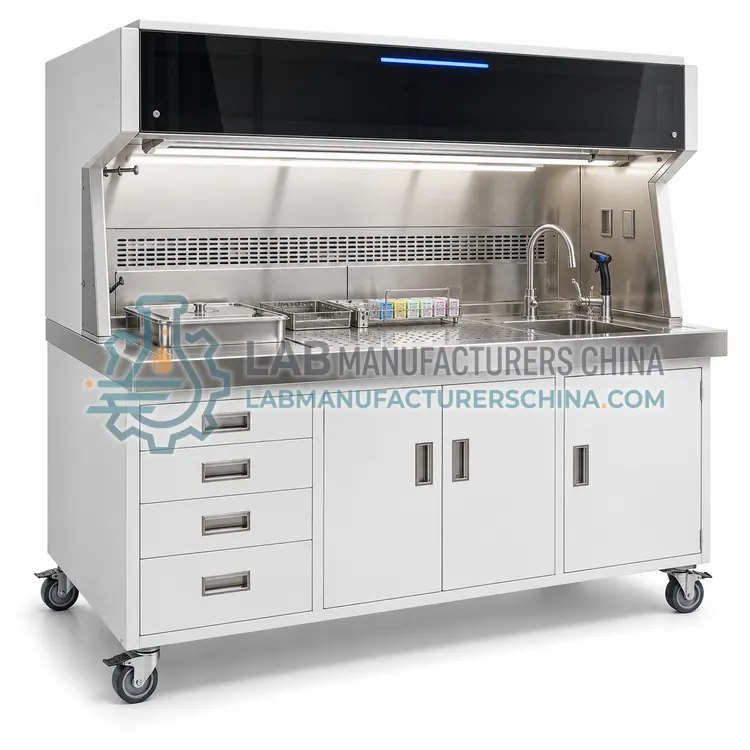
How do Grossing Stations work?
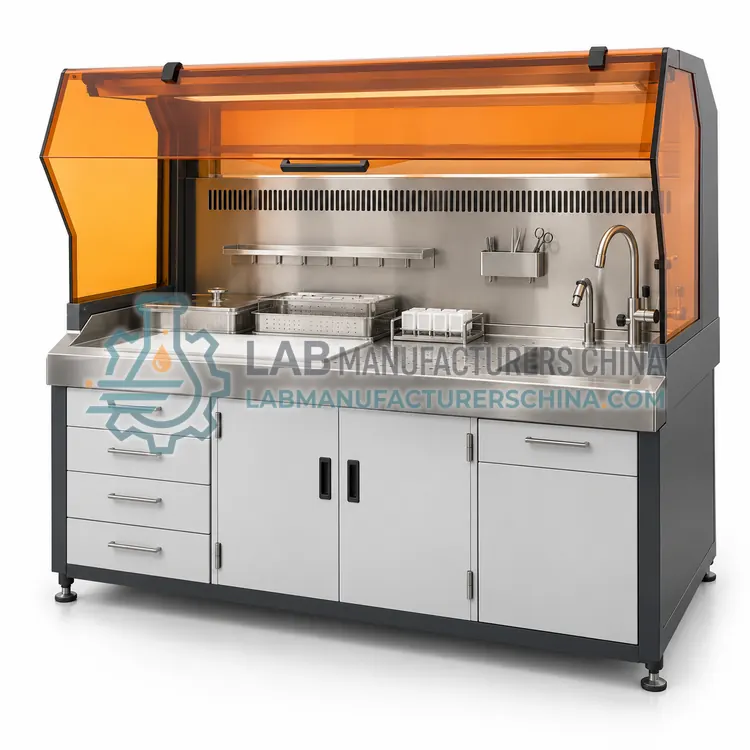
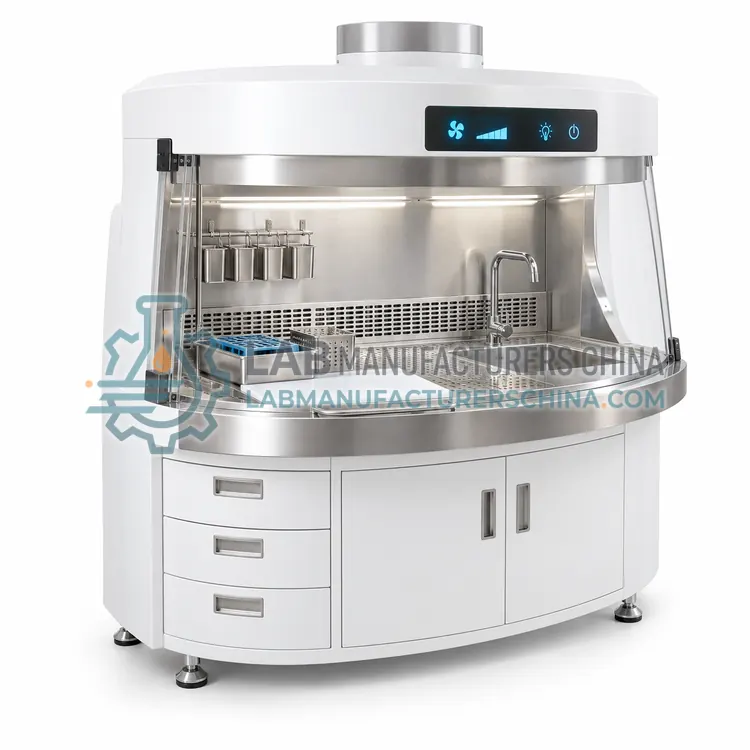
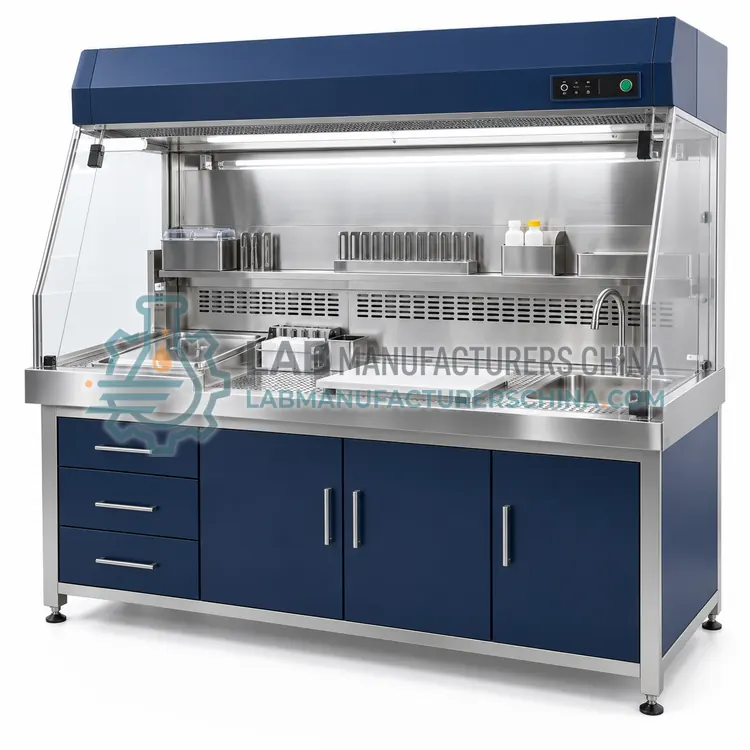
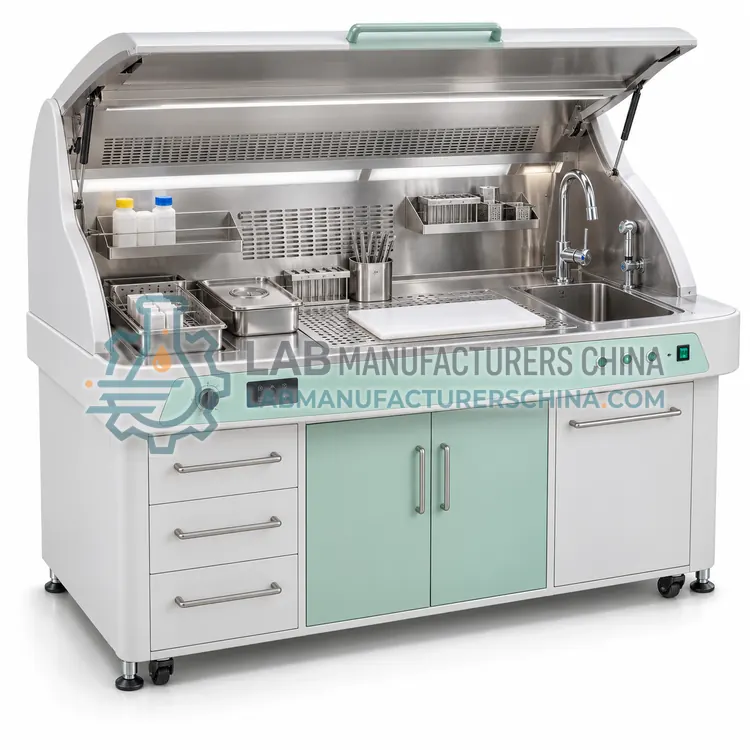
A grossing station protects the operator from formaldehyde and biological hazards by drawing air away from the breathing zone. Downdraft tables pull air through a perforated or slotted work surface into a plenum below, backdraft designs pull air through a rear slot behind the work area, and hooded types use a canopy. Air passes through a duct to the outside or through carbon filters in a ductless unit that captures vapors. Typical face velocities of 0.3 to 0.5 m/s maintain capture. Work surfaces are stainless steel or solid resin, resistant to formalin and disinfectants. A sink with foot or sensor water control, a waste disposal chute, task lighting, a balance and sometimes an overhead camera support workflow. Fans are sized to give quiet operation and adequate airflow without disrupting dissection.
Which Grossing Stations variants are available?
- Downdraft Grossing Station — A downdraft grossing station draws air down through a perforated work surface into a plenum, capturing formalin vapors at the source.
- Backdraft Grossing Station — A backdraft grossing station draws air through a slot at the back of the work area and sometimes across the top, directing vapors away from the operator.
- Ductless Filtered Grossing Station — A ductless filtered grossing station recirculates air through activated carbon or chemical filters that adsorb formaldehyde and solvent vapors.
- Height-Adjustable Grossing Station with Imaging — A height-adjustable grossing station with imaging combines an ergonomic table with an overhead or arm-mounted camera, scale and data capture.
- Mobile Grossing Cart with Fume Extraction — A mobile grossing cart with fume extraction is a wheeled dissection workstation with an integral filter and small work surface.
How do I choose the right variant?
Choose the airflow design first: downdraft for large specimens and best capture at the work surface, backdraft for bench-style setups, and ductless filtered units where ducting is not possible. Consider table size and height adjustment for ergonomics, sink position, surface material, integrated scales, cameras and lighting. Check airflow and face velocity data, noise level and whether filter life indicators are provided. Ducted systems need exhaust capacity and makeup air, while ductless units need scheduled carbon filter changes and formaldehyde monitoring. Confirm the layout of multiple stations in the room and compliance with workplace exposure limits. Ask for installation, airflow testing and staff training support, and confirm compatibility with laboratory information systems if data capture is included.
Where are Grossing Stations used?
Grossing Stations are specified in surgical pathology grossing, autopsy sample handling, veterinary pathology, forensic pathology and teaching anatomy and pathology.
Which standards and certifications apply?
Work with Grossing Stations is commonly governed by OSHA 29 CFR 1910.1048 (formaldehyde), ISO 15189, IEC 61010-1, ISO 14644-1 and GBZ 2.1. Instrument certifications such as CE marking are confirmed per configuration and never assumed.
What are the key considerations before purchase?
Test airflow at installation and at least annually, recording face velocity across the work area. Formaldehyde exposure should be measured against local occupational limits, with action levels and monitoring programs in place. Carbon filters in ductless units saturate and must be replaced on schedule, ideally with a vapor sensor. Keep the work surface and drain clean and use compatible disinfectants. Provide makeup air so that room pressure stays balanced. Train staff to work within the capture zone and to keep specimens away from the edge. Dispose of formalin-contaminated waste under hazardous waste rules, and inspect electrical and mechanical parts regularly.