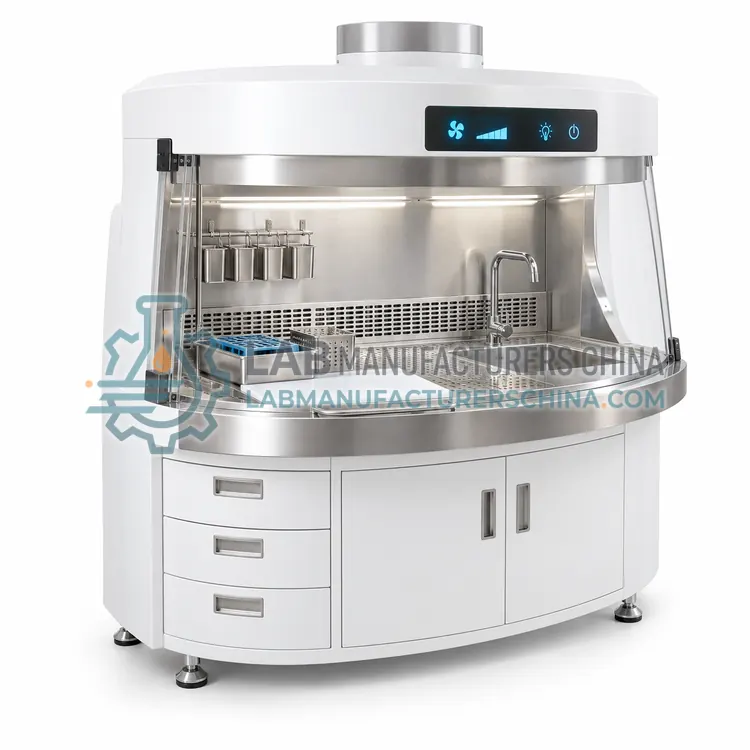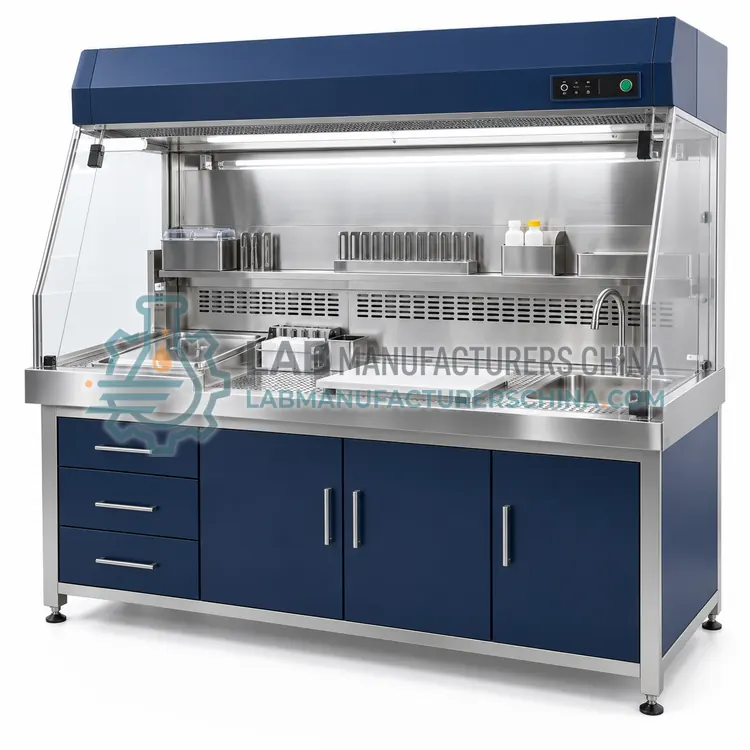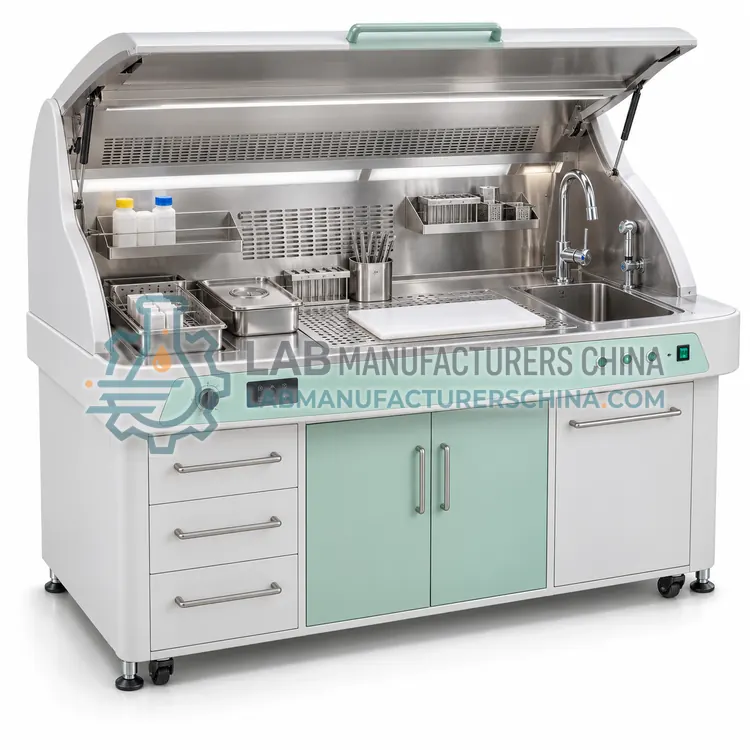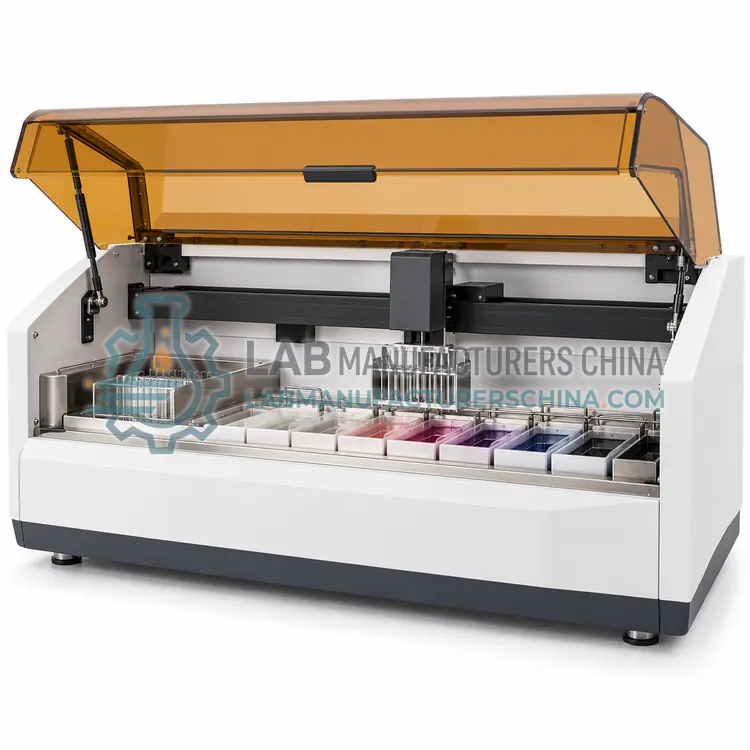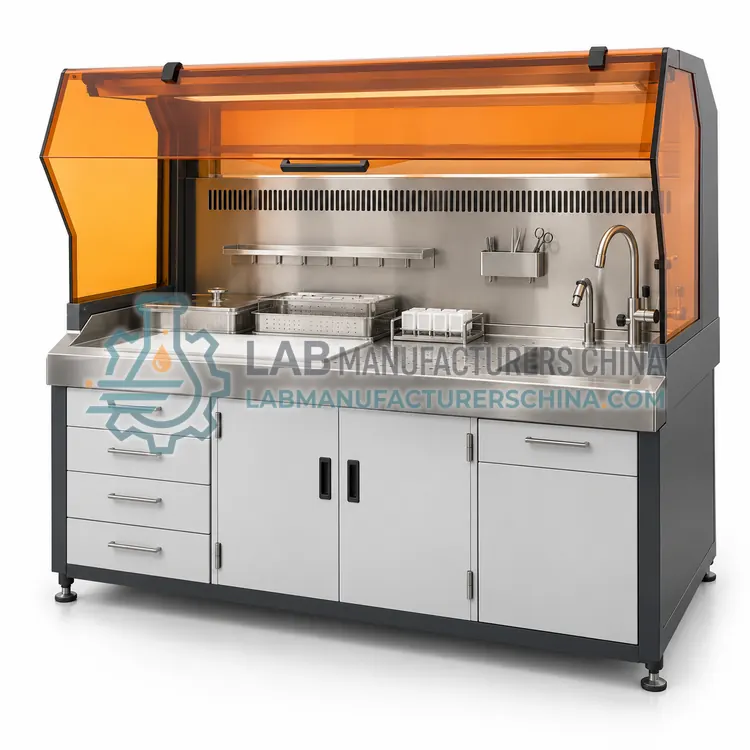
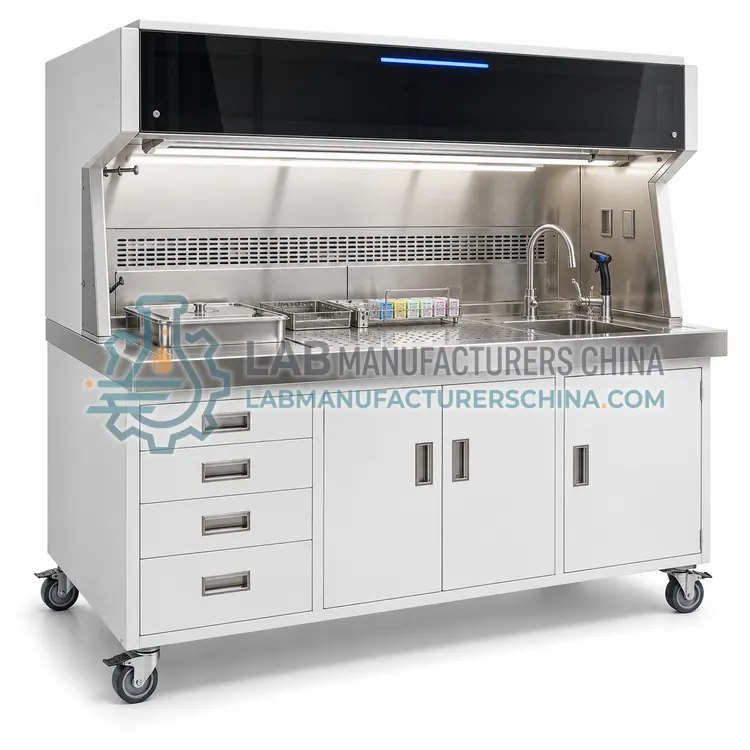
Mobile Grossing Cart with Fume Extraction
带排风的移动取材车
- SKU GRS-0005
- Grossing Stations
- CE (to be confirmed)
- IEC 61010-1 compliance (to be confirmed)
- ISO 9001 manufacturing (to be confirmed)
Price on request — FOB / CIF quoted per order
Prices depend on configuration, quantity and destination port.
Key specifications
| Work surface width | 600–1000 mm |
|---|---|
| Airflow | 300–600 m³/h |
| Filter type | Activated carbon |
| Filter life | approx. 2–4 months at light loads |
| Surface material | 304 stainless steel |
| Mobility | 4 casters, 2 lockable |
Request a quote Download brochure · to be provided
By Lab Manufacturers China Technical TeamLast reviewed Standards: OSHA 29 CFR 1910.1048 (formaldehyde), ISO 15189, IEC 61010-1
What is the Mobile Grossing Cart with Fume Extraction?
A mobile grossing cart with fume extraction is a wheeled dissection workstation with an integral filter and small work surface. It supports temporary, satellite or teaching grossing areas where fixed installation is not possible.
What is the Mobile Grossing Cart with Fume Extraction?
A mobile grossing cart with fume extraction is a wheeled dissection workstation with an integral filter and small work surface. It supports temporary, satellite or teaching grossing areas where fixed installation is not possible.
Overview
A mobile grossing cart has a compact stainless steel top of about 600 to 1000 mm width, a small fan and a carbon filter module in a wheeled cabinet. It recirculates air through the filter at 300 to 600 m³/h, giving local capture of formaldehyde vapor at the work surface. Lockable casters allow repositioning between rooms, and a collection tray and lidded waste container contain liquids. Power is usually from a standard outlet, and some models include a battery or a low-voltage LED light. The limited size and airflow mean it suits small specimens, biopsy trimming or teaching, not large organs. Filter monitoring and capture verification are essential because performance is lower than for full-size fixed stations.
How does it work?
A grossing station protects the operator from formaldehyde and biological hazards by drawing air away from the breathing zone. Downdraft tables pull air through a perforated or slotted work surface into a plenum below, backdraft designs pull air through a rear slot behind the work area, and hooded types use a canopy. Air passes through a duct to the outside or through carbon filters in a ductless unit that captures vapors. Typical face velocities of 0.3 to 0.5 m/s maintain capture. Work surfaces are stainless steel or solid resin, resistant to formalin and disinfectants. A sink with foot or sensor water control, a waste disposal chute, task lighting, a balance and sometimes an overhead camera support workflow. Fans are sized to give quiet operation and adequate airflow without disrupting dissection.
What are the key features?
- Wheeled cabinet with lockable casters
- Compact stainless steel work surface
- Integral carbon filter module with fan
- Airflow of 300 to 600 m³/h
- Collection tray and lidded waste container
- Standard outlet power for easy relocation
What are the technical specifications?
A typical mobile grossing cart with fume extraction configuration offers work surface width of 600–1000 mm, airflow of 300–600 m³/h, filter type of Activated carbon, filter life of approx. 2–4 months at light loads, surface material of 304 stainless steel and mobility of 4 casters, 2 lockable. Values are indicative of the product class; the exact figures for each configuration are confirmed on the quotation and the calibration documents supplied with the instrument.
Which applications is it used for?
The Mobile Grossing Cart with Fume Extraction is used in satellite grossing areas, teaching laboratories, biopsy trimming and temporary pathology setups. Across the wider Grossing Stations class, laboratories also deploy it for surgical pathology grossing, autopsy sample handling and veterinary pathology.
Which standards and certifications apply?
Relevant standards and methods include OSHA 29 CFR 1910.1048 (formaldehyde), ISO 15189, IEC 61010-1, ISO 14644-1 and GBZ 2.1. Certification candidates for this model are CE, IEC 61010-1 compliance and ISO 9001 manufacturing; each is to be confirmed for the specific configuration before shipment, and certificates are supplied only where they have been issued.
Test airflow at installation and at least annually, recording face velocity across the work area. Formaldehyde exposure should be measured against local occupational limits, with action levels and monitoring programs in place. Carbon filters in ductless units saturate and must be replaced on schedule, ideally with a vapor sensor. Keep the work surface and drain clean and use compatible disinfectants. Provide makeup air so that room pressure stays balanced. Train staff to work within the capture zone and to keep specimens away from the edge. Dispose of formalin-contaminated waste under hazardous waste rules, and inspect electrical and mechanical parts regularly.
How do I select the right Mobile Grossing Cart with Fume Extraction?
Choose a mobile cart for small specimens, occasional use or flexible locations. It cannot replace a fixed station for routine large specimen grossing. Specify surface size, airflow, filter life, mobility, waste containers and power, and verify capture performance at the intended worksite.
How does it compare with other Grossing Stations variants?
Choose the airflow design first: downdraft for large specimens and best capture at the work surface, backdraft for bench-style setups, and ductless filtered units where ducting is not possible. Consider table size and height adjustment for ergonomics, sink position, surface material, integrated scales, cameras and lighting. Check airflow and face velocity data, noise level and whether filter life indicators are provided. Ducted systems need exhaust capacity and makeup air, while ductless units need scheduled carbon filter changes and formaldehyde monitoring. Confirm the layout of multiple stations in the room and compliance with workplace exposure limits. Ask for installation, airflow testing and staff training support, and confirm compatibility with laboratory information systems if data capture is included.
Full specifications
| Work surface width | 600–1000 mm |
|---|---|
| Airflow | 300–600 m³/h |
| Filter type | Activated carbon |
| Filter life | approx. 2–4 months at light loads |
| Surface material | 304 stainless steel |
| Mobility | 4 casters, 2 lockable |
| Noise level | ≤ 55 dB(A) |
| Weight | about 60–110 kg |
| Power supply | 220 V, 50 Hz, about 0.3 kW |
Indicative values for this product class. Final specifications are confirmed on the quotation and in the calibration documents supplied with the instrument.
Applications
- Satellite grossing areas
- Teaching laboratories
- Biopsy trimming
- Temporary pathology setups
Key features
- Wheeled cabinet with lockable casters
- Compact stainless steel work surface
- Integral carbon filter module with fan
- Airflow of 300 to 600 m³/h
- Collection tray and lidded waste container
- Standard outlet power for easy relocation
Frequently asked questions about Mobile Grossing Cart with Fume Extraction
Generally no. Limited surface size and airflow make it suitable for small specimens and biopsies. Large organs should be grossed at a fixed downdraft or high-capacity station with verified capture.
Use the vapor sensor if fitted, track usage hours and cassette counts, and run periodic air tests in the breathing zone. When odors are noticed, the filter is already saturated and should be replaced immediately.
Yes, it is commonly used in teaching laboratories because it can be moved and stored. Keep group sizes small, use small specimens and follow exposure monitoring protocols to protect students and instructors.
A grossing station is a ventilated dissection workstation for examining and cutting surgical specimens. It captures formaldehyde vapors and aerosols near the work surface, protecting staff while they describe, measure and sample tissue for processing.
Most designs aim for a face velocity of 0.3 to 0.5 m/s across the work surface, with total airflow of 500 to 1500 m³/h depending on size. Verify with smoke tests and anemometer readings at installation and yearly.
Ductless units with activated carbon or chemical filters can control formaldehyde when filters are replaced on schedule and vapor monitoring is used. They suit rooms where ducting is difficult, but may need more monitoring than ducted systems.
Related models