Linear Dip Slide Stainer
线性浸染式玻片染色机
- SKU SLS-0001
- Slide Stainers
- CE (to be confirmed)
- IEC 61010-1 compliance (to be confirmed)
- ISO 13485 manufacturing (to be confirmed)
Price on request — FOB / CIF quoted per order
Prices depend on configuration, quantity and destination port.
Key specifications
| Slides per rack | 20–30 |
|---|---|
| Stations | 20–30 |
| Throughput | 200–400 slides/h |
| Racks in process | up to 8 |
| Dwell time | 1 s–99 min |
| Oven / drying stations | 1–2 |
Request a quote Download brochure · to be provided
By Lab Manufacturers China Technical TeamLast reviewed Standards: IEC 61010-1, IEC 61010-2-101, IEC 61326-1
What is the Linear Dip Slide Stainer?
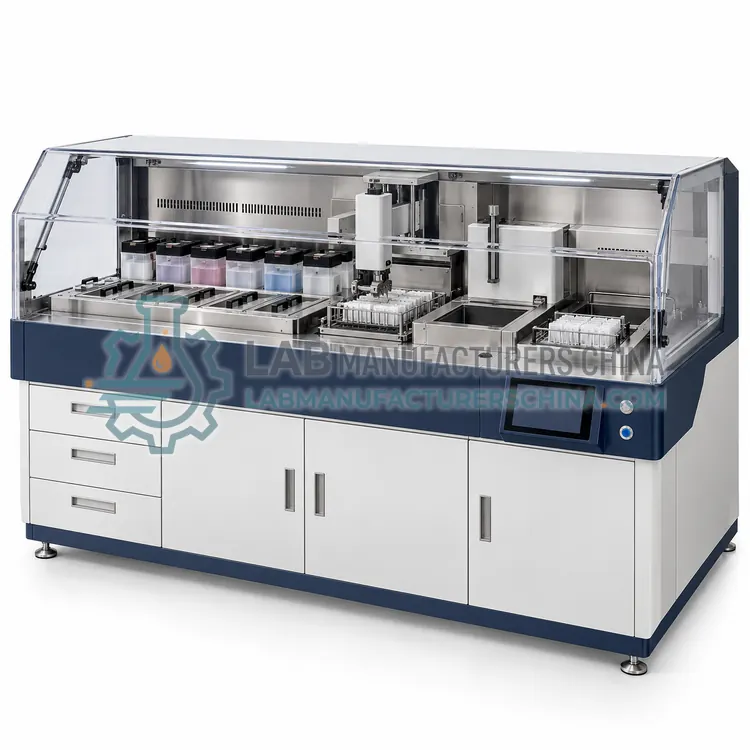
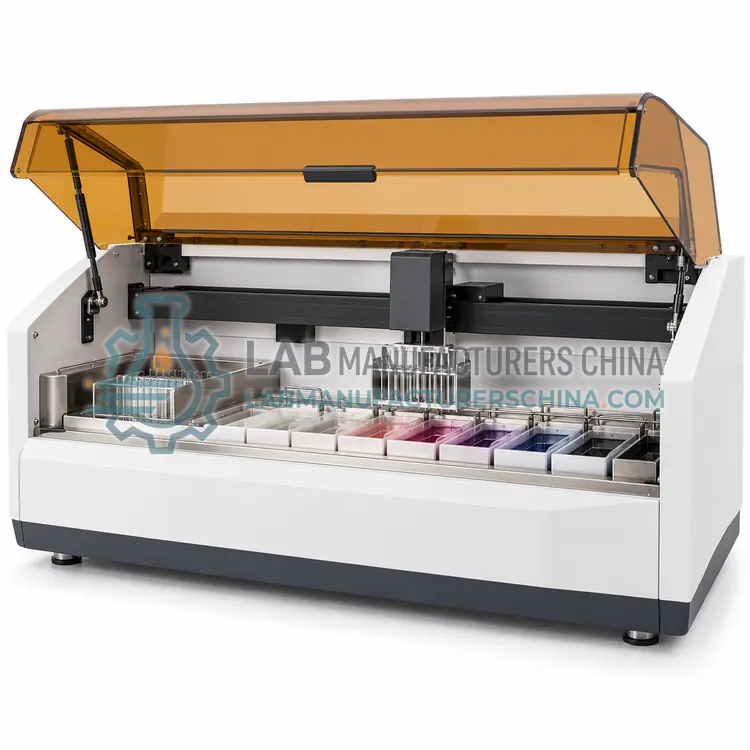
A linear dip slide stainer transports racks of slides along a row of reagent stations with a robotic arm, following programmed times. It is used for high-volume routine H and E staining and can be fitted with an inline coverslipper.
What is the Linear Dip Slide Stainer?
A linear dip slide stainer transports racks of slides along a row of reagent stations with a robotic arm, following programmed times. It is used for high-volume routine H and E staining and can be fitted with an inline coverslipper.
Overview
In a linear dip stainer, a robotic arm lifts a rack of slides, moves it to the next station in a row, and lowers it for a programmed time with optional agitation. A typical layout has 20 to 30 stations including dewaxing, alcohols, hematoxylin, bluing, eosin, dehydration and clearing, plus oven and drying stations. Racks hold 20 to 30 slides, and several racks run in parallel for throughput of 200 to 400 slides per hour. Because the reagents are in bulk containers, running cost is low and the protocol is easy to adjust. Fume extraction covers the row. The system may link to a coverslipper by a transfer unit, giving continuous staining to mounted slides. Its footprint is long, so installation space and exhaust must be planned.
How does it work?
A slide stainer performs a sequence of steps on cut tissue sections. Paraffin is removed with xylene or a substitute, the slides are rehydrated through graded alcohols to water, stained with hematoxylin, differentiated and blued, counterstained with eosin, then dehydrated and cleared for coverslipping. In dip-and-dunk systems a robotic arm or carousel carries slide racks between reagent stations with programmed times, agitation and drying. Reagent-dispensing systems instead apply small volumes of antibody or stain to each slide in a temperature-controlled chamber, which suits immunohistochemistry. Key components are the transport mechanism, reagent containers, heaters, wash stations, fume control and a controller that stores protocols and logs reagent use. Consistent timing and temperature give reproducible staining intensity.
What are the key features?
- Robotic arm transports slide racks between stations
- 20 to 30 reagent stations in one row
- Parallel racks for 200 to 400 slides per hour
- Inline connection to a coverslipper
- Programmable dwell time and agitation per step
- Fume extraction along the reagent row
What are the technical specifications?
A typical linear dip slide stainer configuration offers slides per rack of 20–30, stations of 20–30, throughput of 200–400 slides/h, racks in process of up to 8, dwell time of 1 s–99 min and oven / drying stations of 1–2. Values are indicative of the product class; the exact figures for each configuration are confirmed on the quotation and the calibration documents supplied with the instrument.
Which applications is it used for?
The Linear Dip Slide Stainer is used in high-volume routine H and E, reference laboratories, hospital pathology and research histology. Across the wider Slide Stainers class, laboratories also deploy it for routine hematoxylin and eosin staining, immunohistochemistry and special stains.
Which standards and certifications apply?
Relevant standards and methods include IEC 61010-1, IEC 61010-2-101, IEC 61326-1, ISO 15189, CLSI QMS 02 and ISO 13485. Certification candidates for this model are CE, IEC 61010-1 compliance and ISO 13485 manufacturing; each is to be confirmed for the specific configuration before shipment, and certificates are supplied only where they have been issued.
Install the stainer in a ventilated area with a carbon filter or exhaust duct and a stable electrical supply. Establish a reagent management program that replaces stains and solvents according to slide counts, and record changes. Keep wash stations clean to prevent precipitate and carry-over, and filter hematoxylin regularly. Validate each protocol with control slides, checking nuclear and cytoplasmic staining balance. Perform daily wipe-down, weekly deep cleaning and annual preventive maintenance. Follow safety rules for solvent and stain handling, with spill kits and training, and follow local regulations for hazardous waste.
How do I select the right Linear Dip Slide Stainer?
Select a linear dip stainer for large routine H and E workloads and when low reagent cost per slide matters. It needs a long bench and exhaust. Specify stations, rack capacity, throughput, coverslipper link, fume control and protocol flexibility. For special stains or immunohistochemistry choose another configuration.
How does it compare with other Slide Stainers variants?
Match the stainer to the dominant staining type. Routine H and E in high volume favors robotic or carousel dip systems with integrated coverslippers, while immunohistochemistry and in situ hybridization require reagent-dispensing systems with heat retrieval and open or closed reagent options. Consider slide capacity per run, number of reagent stations, flexibility to change protocols and whether special stains are supported. Evaluate reagent use per slide, xylene-free options, fume containment and cleaning requirements. Check connectivity with laboratory information systems, slide labeling, and the maker's validation documents. Match footprint to available bench space and confirm service response times, since stainer downtime delays diagnosis.
Full specifications
| Slides per rack | 20–30 |
|---|---|
| Stations | 20–30 |
| Throughput | 200–400 slides/h |
| Racks in process | up to 8 |
| Dwell time | 1 s–99 min |
| Oven / drying stations | 1–2 |
| Stored protocols | up to 50 |
| Dimensions (W×D×H) | about 1800 × 700 × 800 mm |
| Power supply | 220 V, 50 Hz, about 1.5 kW |
Indicative values for this product class. Final specifications are confirmed on the quotation and in the calibration documents supplied with the instrument.
Applications
- High-volume routine H and E
- Reference laboratories
- Hospital pathology
- Research histology
Key features
- Robotic arm transports slide racks between stations
- 20 to 30 reagent stations in one row
- Parallel racks for 200 to 400 slides per hour
- Inline connection to a coverslipper
- Programmable dwell time and agitation per step
- Fume extraction along the reagent row
Frequently asked questions about Linear Dip Slide Stainer
Typical systems process 200 to 400 slides per hour depending on protocol length and the number of racks in progress. Actual throughput depends on dwell times, transfer speed and any integrated coverslipping steps.
Yes, if the scheduler supports it. Some models manage different racks with different protocols, as long as they do not conflict for the same station. Check how conflicts are resolved and whether custom programs can be stored.
Wash stations and regular reagent changes limit carry-over. Some systems add overflow wash or filtration. Protocol design, such as adequate rinse time between stain and differentiator, and quality control slides verify results.
A slide stainer automatically stains tissue sections on glass slides. It removes paraffin, rehydrates the tissue, applies stains such as hematoxylin and eosin or antibodies, then rinses and dehydrates the slide, giving consistent results with less manual handling.
Capacity ranges from about 20 slides for small benchtop units to more than 300 slides per run for carousel or robotic systems. Throughput in a day depends on protocol length, which is typically 15 to 40 minutes for H and E.
Usually not well. H and E stainers use dip or carousel methods with bulk reagents, while immunohistochemistry needs individual slide reagent application and heat retrieval. Some laboratories use two separate instruments to optimize quality and throughput.
Related models