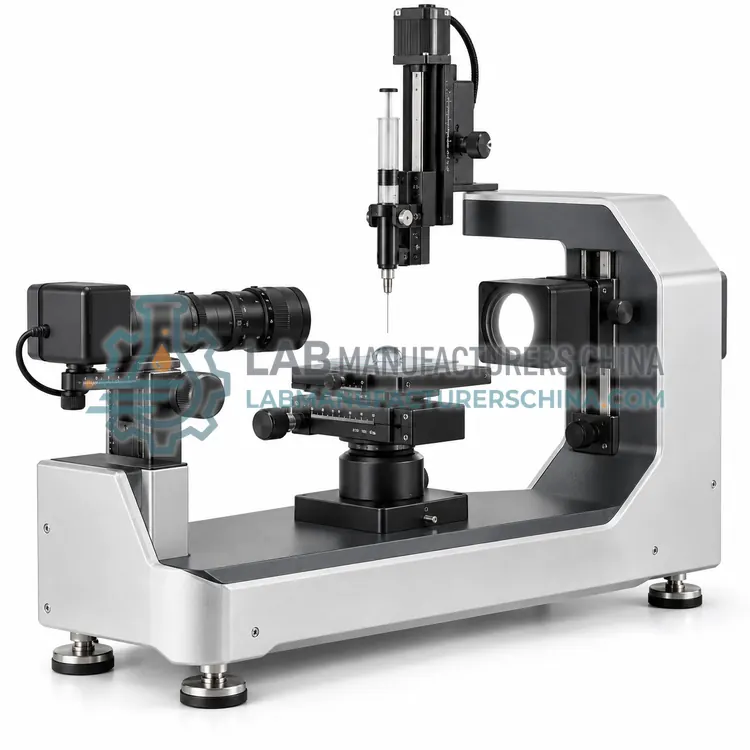
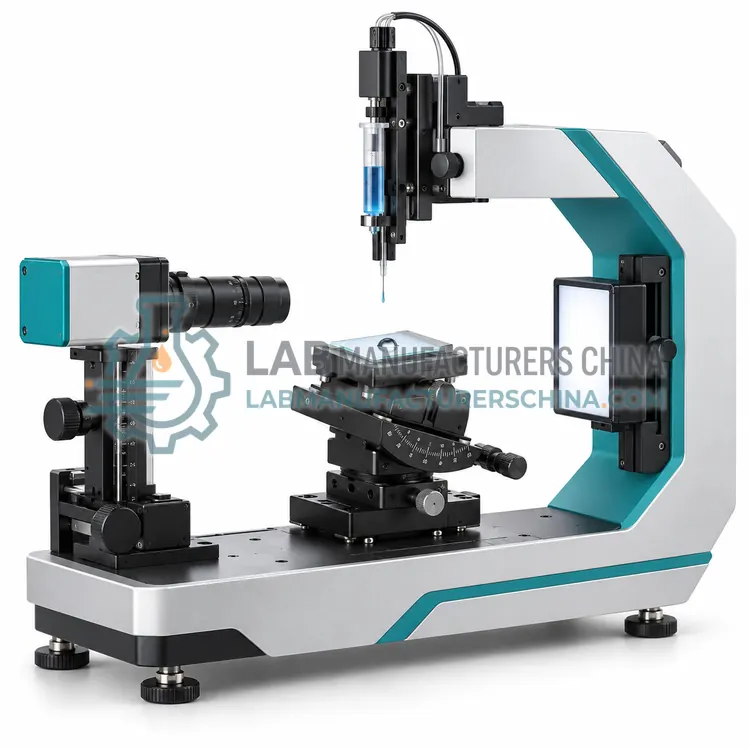
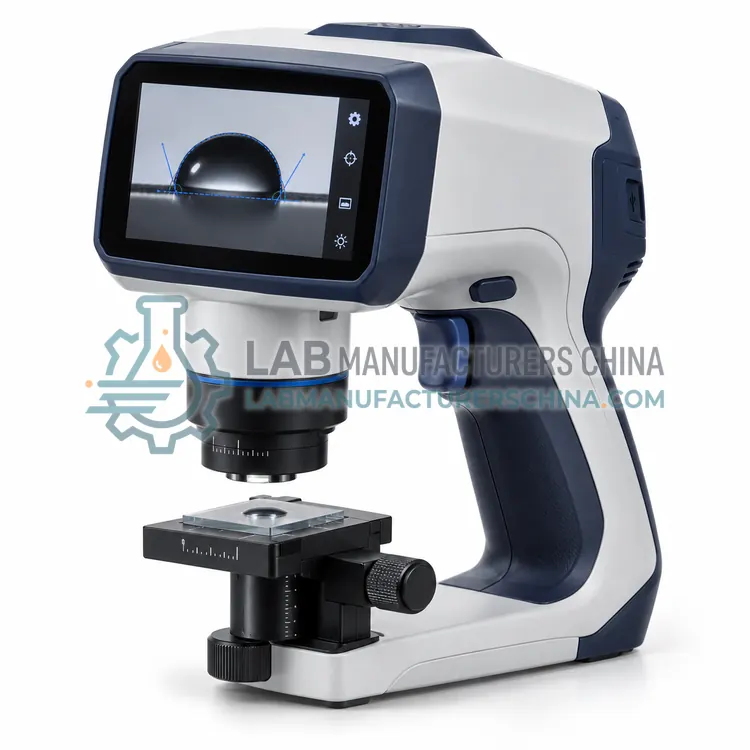
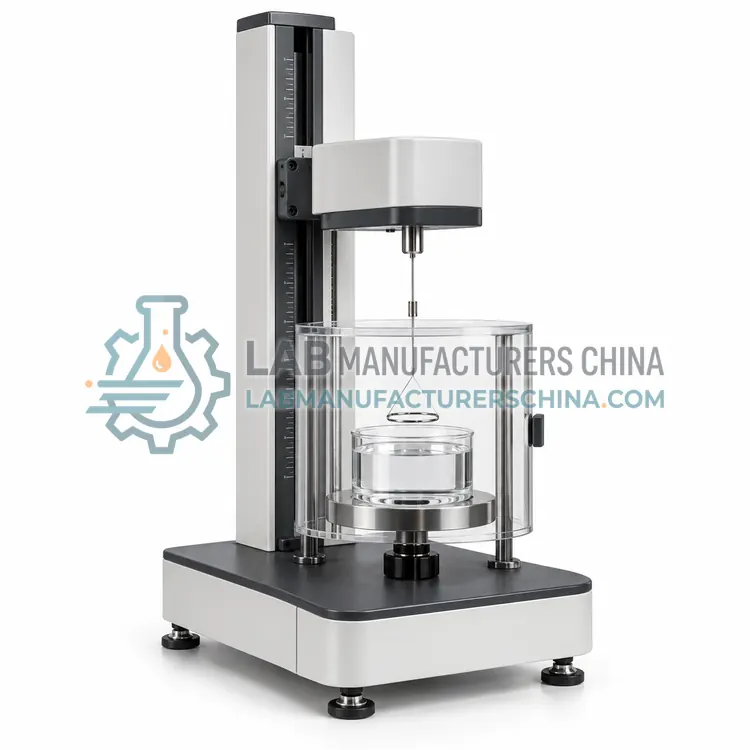
The contact angle is defined by Young's equation, which balances the solid–vapor, solid–liquid and liquid–vapor interfacial tensions at the three-phase line. An optical contact angle meter places a drop of a few microliters on the sample, images its silhouette with a camera under backlight, and fits the drop profile using a tangent, circle or Young–Laplace model to compute the angle. Advancing and receding angles are measured by adding and removing liquid or by tilting the stage, and their difference is the hysteresis. Using several test liquids, surface free energy is calculated by the Owens–Wendt or Wu methods. Force tensiometers infer the angle from the wetting force on a Wilhelmy plate, fiber or powder column.
- Benchtop Optical Contact Angle Goniometer with Motorized Dosing — A laboratory goniometer with a camera, backlight, motorized syringe and XYZ stage that measures static contact angle by sessile drop analysis.
- Dynamic Contact Angle Goniometer with Tilting Stage — A goniometer with a motorized tilting base and high-speed camera that measures advancing, receding and sliding angles as a drop rolls on an inclined surface.
- Portable Handheld Contact Angle Meter for Production Lines — A compact battery-powered device with an integrated camera and screen that measures water contact angle on site in seconds.
- Force Tensiometer for Dynamic Wetting of Fibers and Powders — A microbalance-based instrument that measures the wetting force as a fiber, plate or powder column contacts a test liquid, from which contact angle is calculated with the Wilhelmy or Washburn method.
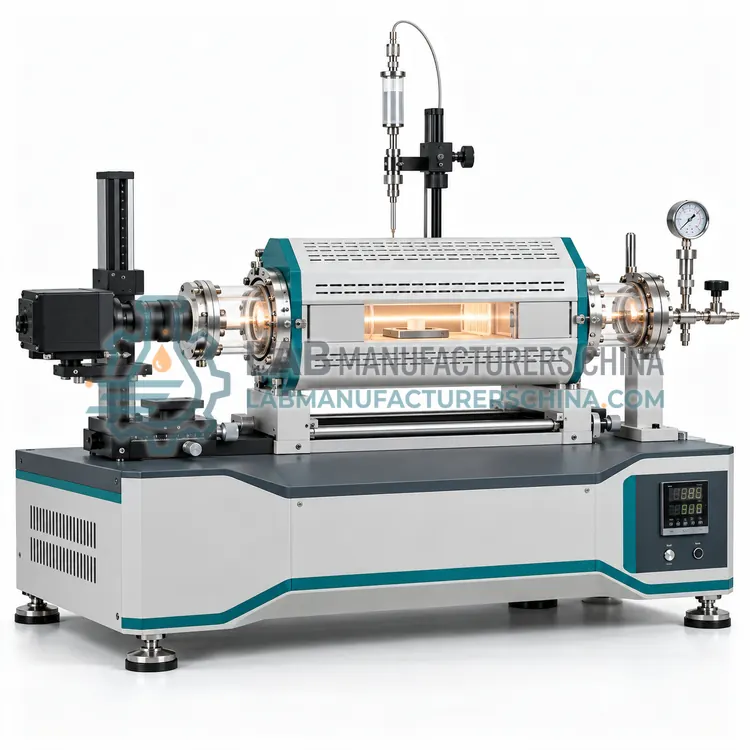
- High-Temperature Contact Angle System for Molten Materials — A goniometer combined with a furnace and optical window that images sessile drops of molten metals, glasses or salts on substrates at up to 1600 °C or higher.
How do I choose the right variant?
Match the instrument to the sample and to the required data. Flat films, coatings and wafers suit a benchtop optical goniometer with a motorized syringe. Large or curved parts, such as automotive panels, may need a portable or large-stage system. Dynamic measurements, including advancing and receding angles or tilting stage tests, need automated dosing and a high-speed camera. Fibers, powders and porous solids are better measured with a force tensiometer. Consider camera resolution and frame rate, stage travel, temperature and humidity control, dosing accuracy, software models and compliance with ASTM D7334, ASTM D5946 or ISO 19403. For production lines, a quick single-point portable tester is often enough.
Contact Angle Meters are specified in coating and paint wetting, plasma and corona treatment verification, adhesion promotion on plastics, biomaterial and medical device surfaces and textile water repellency.
Which standards and certifications apply?
Work with Contact Angle Meters is commonly governed by ASTM D7334, ASTM D5946, ISO 19403-2, ASTM D724 and DIN 55660-2. Instrument certifications such as CE marking are confirmed per configuration and never assumed.
What are the key considerations before purchase?
Contact angles are sensitive to contamination, so handle samples with clean tweezers, avoid touching test areas and record storage and cleaning procedures. Use ultrapure water or high-purity test liquids and replace syringes and needles regularly. Place the instrument on a vibration-free bench with stable lighting, and level the stage. Verify the optical system with a calibration sphere or a reference surface of known angle. Control temperature and humidity, because drops evaporate, and measure within defined times after deposition. Report the number of drops, drop volume, liquid and fitting method along with the mean and standard deviation.