Benchtop Optical Contact Angle Goniometer with Motorized Dosing
带电动加液的台式光学接触角测角仪
- SKU CAM-0001
- Contact Angle Meters
- CE (to be confirmed)
- ISO 9001 manufacturing (to be confirmed)
- RoHS (to be confirmed)
Price on request — FOB / CIF quoted per order
Prices depend on configuration, quantity and destination port.
Key specifications
| Contact angle range | 0–180° |
|---|---|
| Angle resolution | 0.1° |
| Accuracy | ±0.5° |
| Camera | 1.3–5 MP, 30–60 fps |
| Dosing volume | 0.1–50 µL |
| Sample size | Up to 100 × 100 × 30 mm |
Request a quote Download brochure · to be provided
By Lab Manufacturers China Technical TeamLast reviewed Standards: ASTM D7334, ASTM D5946, ISO 19403-2
What is the Benchtop Optical Contact Angle Goniometer with Motorized Dosing?
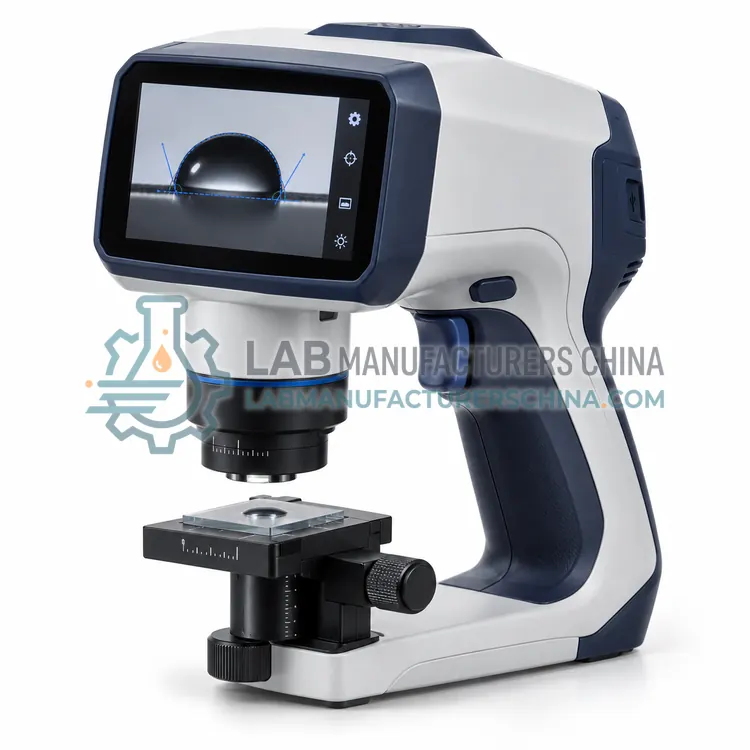
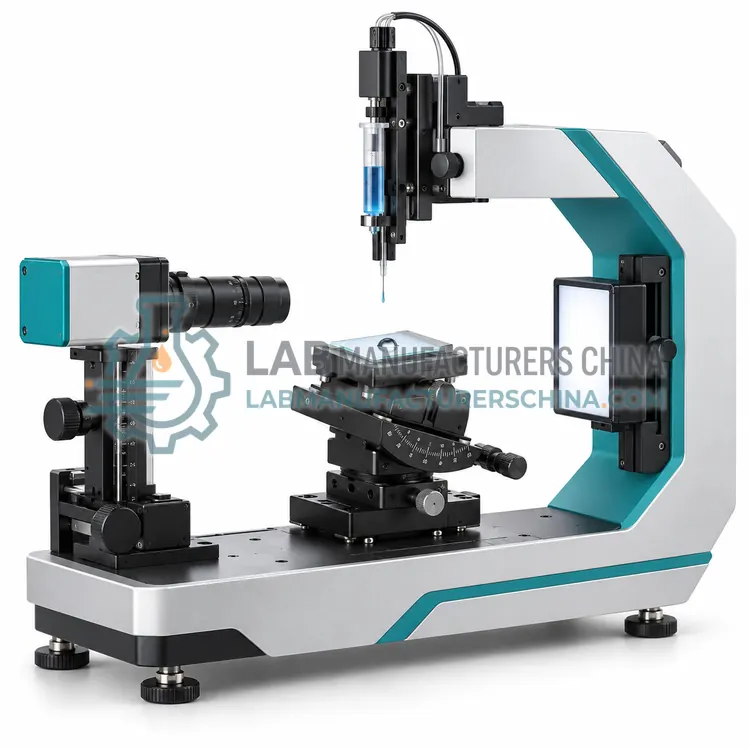
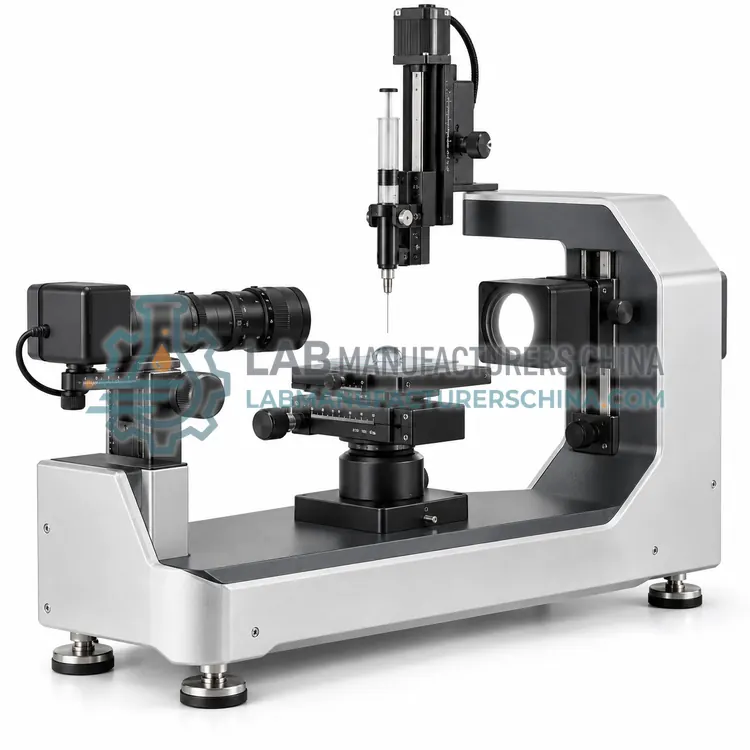
A laboratory goniometer with a camera, backlight, motorized syringe and XYZ stage that measures static contact angle by sessile drop analysis. It is the standard choice for general wettability and surface free energy measurements on flat films, coatings and plastics.
What is the Benchtop Optical Contact Angle Goniometer with Motorized Dosing?
A laboratory goniometer with a camera, backlight, motorized syringe and XYZ stage that measures static contact angle by sessile drop analysis. It is the standard choice for general wettability and surface free energy measurements on flat films, coatings and plastics.
Overview
This variant is the core laboratory configuration. A uniform LED backlight and a monochrome camera of about 1.3 to 5 megapixels capture the drop silhouette while a motorized syringe delivers volumes from 0.1 µL to 50 µL with a repeatability of about 1 µL or better. The XYZ stage positions the sample under the needle, and software detects the baseline and fits the profile using tangent, circle, ellipse or Young–Laplace methods. Angles from 0° to 180° are reported with a resolution of 0.1° and typical accuracy of ±0.1° to ±0.5° on well-defined drops. Multi-liquid measurement and surface free energy calculation are included. The setup handles samples up to about 100 mm wide and 30 mm thick.
How does it work?
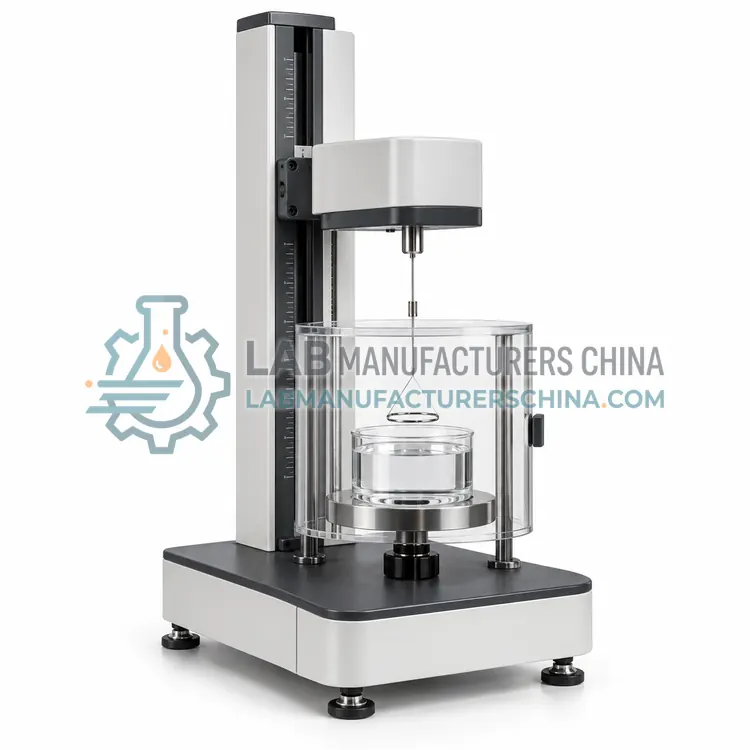
The contact angle is defined by Young's equation, which balances the solid–vapor, solid–liquid and liquid–vapor interfacial tensions at the three-phase line. An optical contact angle meter places a drop of a few microliters on the sample, images its silhouette with a camera under backlight, and fits the drop profile using a tangent, circle or Young–Laplace model to compute the angle. Advancing and receding angles are measured by adding and removing liquid or by tilting the stage, and their difference is the hysteresis. Using several test liquids, surface free energy is calculated by the Owens–Wendt or Wu methods. Force tensiometers infer the angle from the wetting force on a Wilhelmy plate, fiber or powder column.
What are the key features?
- Uniform LED backlight with adjustable intensity
- Motorized syringe for repeatable drop volume
- Manual or motorized XYZ stage with fine focus
- Multiple drop fitting models including Young–Laplace
- Surface free energy software with Owens–Wendt and Wu models
- Video recording for drop evolution and evaporation studies
What are the technical specifications?
A typical benchtop optical contact angle goniometer with motorized dosing configuration offers contact angle range of 0–180°, angle resolution of 0.1°, accuracy of ±0.5°, camera of 1.3–5 MP, 30–60 fps, dosing volume of 0.1–50 µL and sample size of Up to 100 × 100 × 30 mm. Values are indicative of the product class; the exact figures for each configuration are confirmed on the quotation and the calibration documents supplied with the instrument.
Which applications is it used for?
The Benchtop Optical Contact Angle Goniometer with Motorized Dosing is used in coating wettability testing, plastic film surface treatment control, semiconductor wafer cleanliness and surface free energy determination. Across the wider Contact Angle Meters class, laboratories also deploy it for coating and paint wetting, plasma and corona treatment verification and adhesion promotion on plastics.
Which standards and certifications apply?
Relevant standards and methods include ASTM D7334, ASTM D5946, ISO 19403-2, ASTM D724 and DIN 55660-2. Certification candidates for this model are CE, ISO 9001 manufacturing and RoHS; each is to be confirmed for the specific configuration before shipment, and certificates are supplied only where they have been issued.
Contact angles are sensitive to contamination, so handle samples with clean tweezers, avoid touching test areas and record storage and cleaning procedures. Use ultrapure water or high-purity test liquids and replace syringes and needles regularly. Place the instrument on a vibration-free bench with stable lighting, and level the stage. Verify the optical system with a calibration sphere or a reference surface of known angle. Control temperature and humidity, because drops evaporate, and measure within defined times after deposition. Report the number of drops, drop volume, liquid and fitting method along with the mean and standard deviation.
How do I select the right Benchtop Optical Contact Angle Goniometer with Motorized Dosing?
Select this variant for routine static wettability and surface energy work on flat samples. For advancing and receding angles or tilting, choose the dynamic tilting version. In an RFQ, specify camera resolution, dosing type, sample size, software models required, and any standard method to be followed.
How does it compare with other Contact Angle Meters variants?
Match the instrument to the sample and to the required data. Flat films, coatings and wafers suit a benchtop optical goniometer with a motorized syringe. Large or curved parts, such as automotive panels, may need a portable or large-stage system. Dynamic measurements, including advancing and receding angles or tilting stage tests, need automated dosing and a high-speed camera. Fibers, powders and porous solids are better measured with a force tensiometer. Consider camera resolution and frame rate, stage travel, temperature and humidity control, dosing accuracy, software models and compliance with ASTM D7334, ASTM D5946 or ISO 19403. For production lines, a quick single-point portable tester is often enough.
Full specifications
| Contact angle range | 0–180° |
|---|---|
| Angle resolution | 0.1° |
| Accuracy | ±0.5° |
| Camera | 1.3–5 MP, 30–60 fps |
| Dosing volume | 0.1–50 µL |
| Sample size | Up to 100 × 100 × 30 mm |
| Stage travel | X/Y 50 mm, Z 30 mm |
| Magnification | 0.7–4.5×, zoom lens |
| Fitting methods | Tangent, circle, ellipse, Young–Laplace |
| Power supply | 100–240 V, 50/60 Hz |
Indicative values for this product class. Final specifications are confirmed on the quotation and in the calibration documents supplied with the instrument.
Applications
- Coating wettability testing
- Plastic film surface treatment control
- Semiconductor wafer cleanliness
- Surface free energy determination
Key features
- Uniform LED backlight with adjustable intensity
- Motorized syringe for repeatable drop volume
- Manual or motorized XYZ stage with fine focus
- Multiple drop fitting models including Young–Laplace
- Surface free energy software with Owens–Wendt and Wu models
- Video recording for drop evolution and evaporation studies
Frequently asked questions about Benchtop Optical Contact Angle Goniometer with Motorized Dosing
Typical volumes are 2 to 5 µL for water on flat surfaces. The drop should be small enough to avoid gravity distortion, which makes the Young–Laplace fit necessary above about 10 µL, yet large enough to reduce edge detection error.
On clean, smooth surfaces, repeatability of ±1° is typical and absolute accuracy depends on calibration, baseline placement and fit. Rough or heterogeneous surfaces show larger scatter caused by the sample, not by the instrument.
Yes, but high angles are harder to fit accurately because the baseline is difficult to see. A high-contrast image, minimal tilt, and circle or Young–Laplace fitting give the most repeatable results for superhydrophobic samples.
It indicates how well a liquid wets a surface. Angles below 90° show wetting, above 90° show poor wetting, and above 150° indicate superhydrophobic behavior. Combined with several liquids, it yields surface free energy for adhesion and coating decisions.
It is the difference between advancing and receding contact angles measured as the liquid front moves across a surface. Large hysteresis indicates roughness or chemical heterogeneity and explains why drops stick to inclined surfaces.
At least three to five drops at different locations per sample are commonly reported, with mean and standard deviation. Heterogeneous or rough surfaces may require ten or more drops, because local variation is large.
Related models