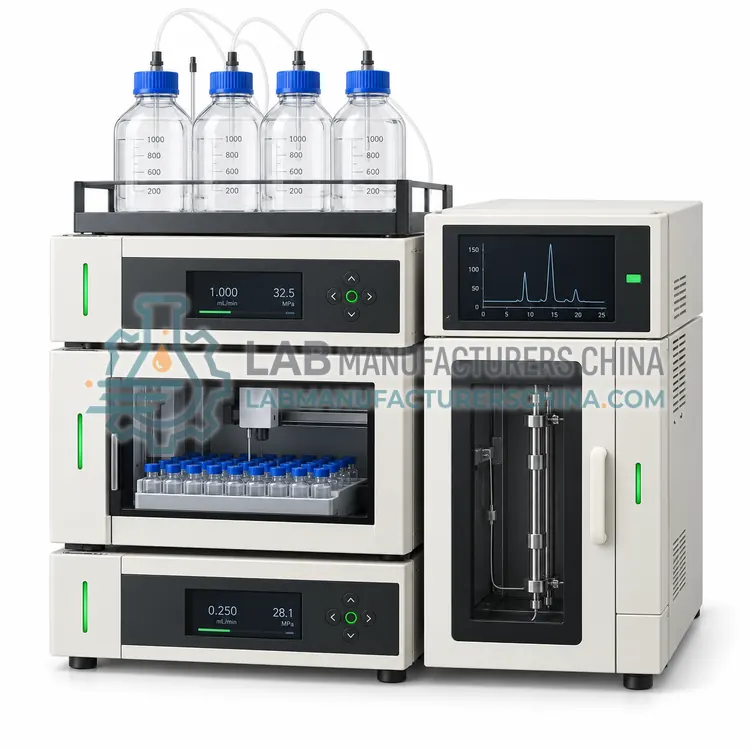
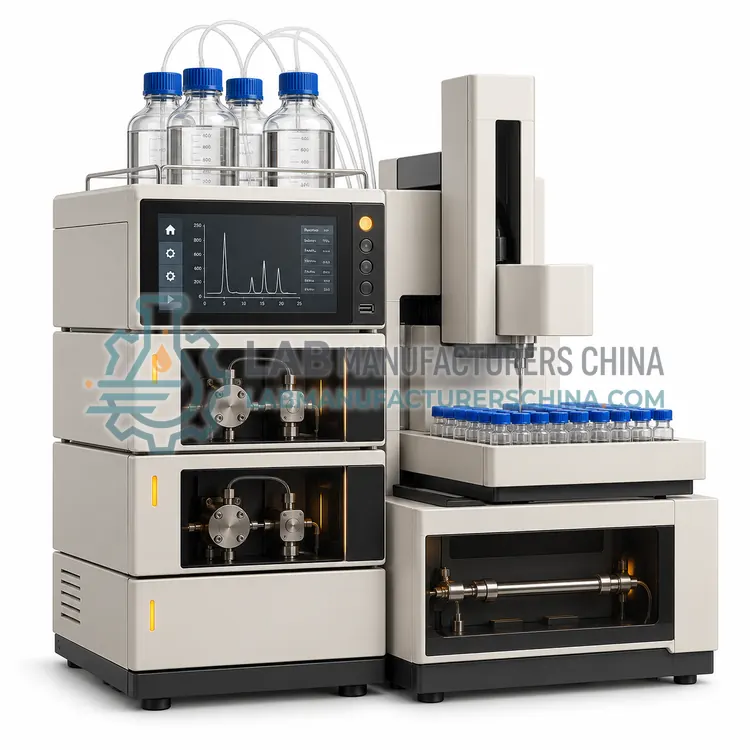
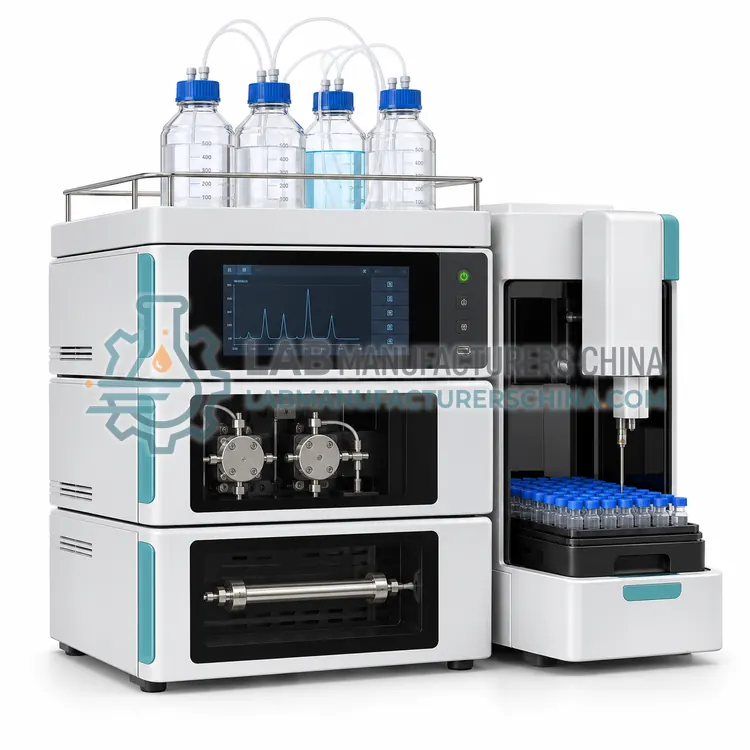
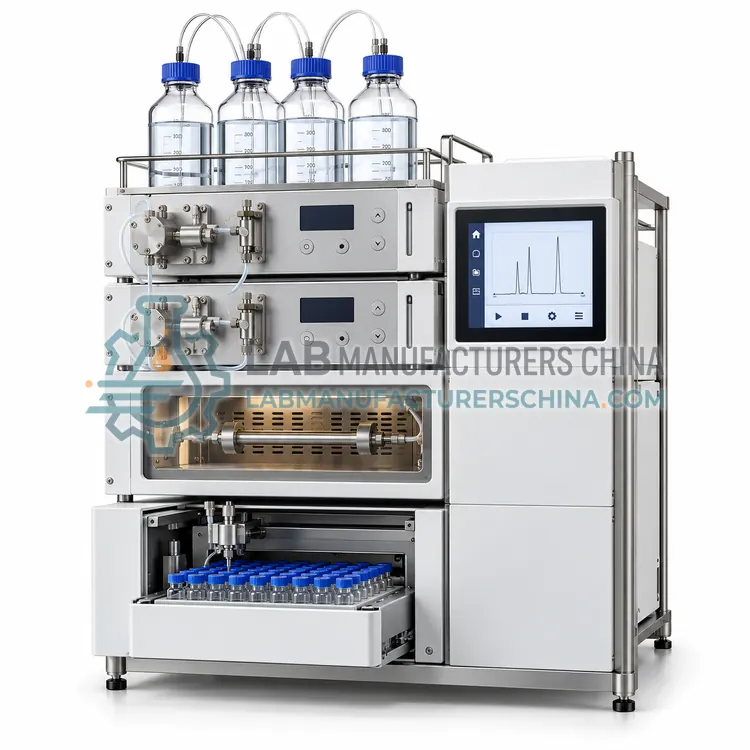
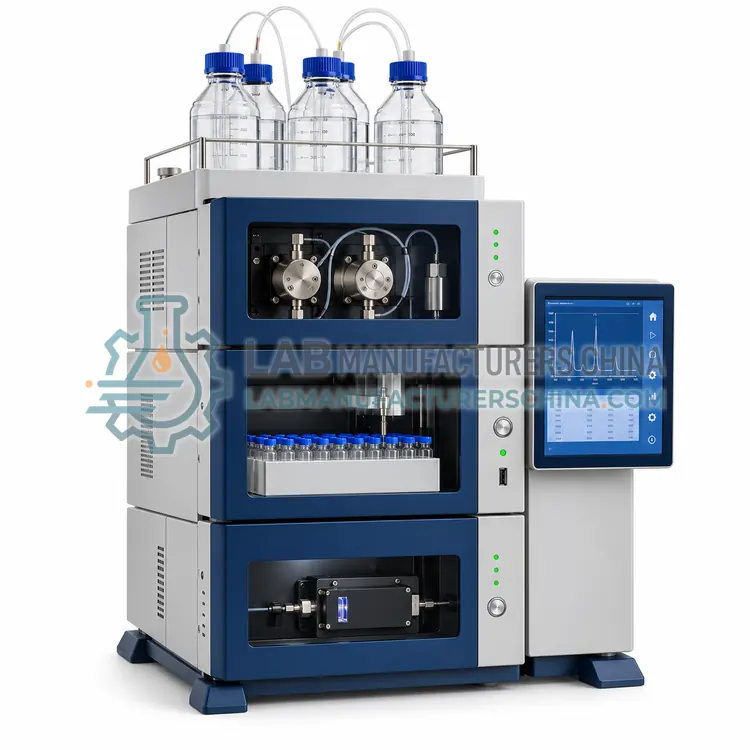
How do HPLC work?
HPLC pumps a liquid mobile phase through a column packed with stationary phase. The sample is injected, and components partition between the mobile and stationary phases, so they elute at characteristic retention times. A detector, usually UV-Vis or diode-array, records absorbance and gives peak areas proportional to concentration. Pharmaceutical methods use reversed-phase columns in most cases, with buffered aqueous and organic mobile phases, isocratic or gradient elution, and a column oven for reproducibility. System suitability parameters such as resolution, tailing factor, theoretical plates and relative standard deviation must meet the criteria in the monograph before results are reported. Pump accuracy, injector precision, detector linearity, column temperature and mobile phase preparation all influence performance, so qualification and method control are essential.
Which HPLC variants are available?
- HPLC System for Pharmacopoeial Assay — An HPLC system for pharmacopoeial assay quantifies the active ingredient against a reference standard using a validated isocratic or simple gradient method.
- HPLC System for Dissolution Sample Analysis — An HPLC system for dissolution sample analysis handles large numbers of filtered aliquots from dissolution vessels at short intervals.
- HPLC System for Related Substances Testing — An HPLC system for related substances testing separates and quantifies impurities and degradation products at low levels.
- UHPLC System for Pharmaceutical Quality Control — A UHPLC system for pharmaceutical quality control uses sub-2 µm or superficially porous columns at high pressure to deliver faster, better-resolved separations.
- HPLC System with Diode-Array Detection for Method Validation — An HPLC system with diode-array detection records full ultraviolet spectra for method development and validation work.
How do I choose the right variant?
Select an HPLC system from the method itself. For pharmacopoeial assay, a robust isocratic or simple gradient system with UV detection is usually enough. For related substances and degradation products, gradient capability, low dwell volume and a diode-array or mass spectrometer detector help separate and identify impurities at low levels. For dissolution samples, a system with a high-capacity autosampler and fast run times is more valuable than high resolution. UHPLC suits laboratories that want shorter run times and better resolution, provided the method is transferred and validated. Compare pressure limit, flow range, autosampler capacity and precision, detector options, column oven control and software for data integrity. Confirm qualification documents and service support.
Where are HPLC used?
HPLC are specified in pharmacopoeial assay of drug substances, related substances and impurity testing, dissolution sample analysis, content uniformity testing, stability indicating methods and cleaning validation analysis.
Which standards and certifications apply?
Work with HPLC is commonly governed by USP <621>, USP <711>, USP <905>, ICH Q2(R2), ICH Q3A and IEC 61010-1. Instrument certifications such as CE marking are confirmed per configuration and never assumed.
What are the key considerations before purchase?
Install the system on a stable bench with a solvent tray and waste container below it, and keep the laboratory free of vibration and temperature swings that affect retention. Use HPLC-grade solvents and filtered, degassed mobile phases, and prepare buffers fresh because microbial growth damages columns. Equilibrate the column at the method flow and temperature before each run, and verify system suitability before samples. Change seals, pistons and lamps on schedule, and record maintenance. Retain raw chromatograms, integration parameters and audit trails, because regulators expect the original data. Dispose of solvent waste as hazardous waste according to local rules.