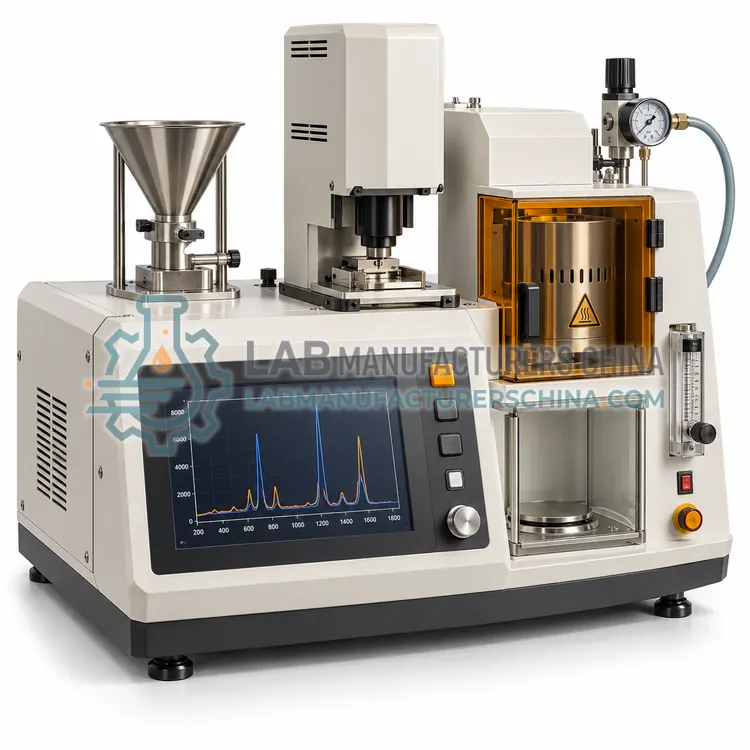
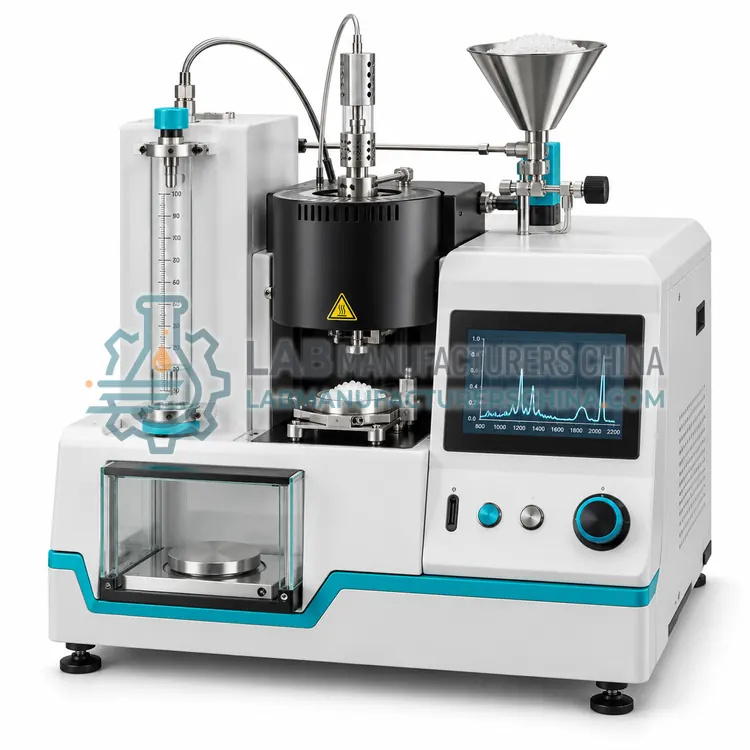
How do Polymer Spectroscopy work?
Molecules absorb infrared radiation at frequencies that match their vibrational modes, so a spectrum of absorbance against wavenumber acts as a fingerprint of the polymer backbone and of the additives present. Fourier-transform instruments use an interferometer and a mathematical transform to record the full spectrum quickly and at high signal-to-noise ratio. Attenuated total reflection brings the beam into a high-refractive-index crystal in contact with the sample, so surface layers of a few micrometres can be measured without preparation. Raman spectroscopy complements this by measuring inelastically scattered light from a laser, which is sensitive to non-polar bonds, and near-infrared spectroscopy records overtone and combination bands that are weak but penetrating, making it suitable for rapid screening through packaging or with fibre probes.
Which Polymer Spectroscopy variants are available?
- FTIR Spectrometer for Polymer Identification — A bench FTIR spectrometer records mid-infrared absorption spectra of polymers for identification against reference libraries.
- ATR-FTIR Spectrometer for Polymer Analysis — An ATR-FTIR spectrometer measures solid and opaque polymer samples by total internal reflection in a crystal pressed against the surface.
- FTIR Microscopy System for Polymer Analysis — An FTIR microscope focuses the infrared beam onto a small area of a polymer sample, allowing analysis of particles, gels, fibres, films and layer structures.
- Raman Spectrometer for Polymer Characterization — A bench Raman spectrometer measures inelastically scattered laser light to characterise polymer structure, crystallinity and additives, and works well for dark, filled or aqueous samples that are difficult for infrared.
- Portable Raman Spectrometer for Polymer Identification — A portable Raman spectrometer identifies polymers on the spot, through transparent packaging if needed, using battery power and an onboard library.
- Near-Infrared Spectrometer for Polymer Analysis — A near-infrared spectrometer measures weak overtone and combination absorptions that penetrate deeply into polymers, so samples can be screened rapidly without preparation.
How do I choose the right variant?
Infrared is the default for polymer identification because spectral libraries are extensive and the method is well standardised. Add an attenuated total reflection accessory when samples are solid, opaque or dirty, since it removes pressing, grinding and solvent steps. Choose an infrared microscope when the target is a contaminant, a gel particle or a multilayer film that must be measured at a defined point or mapped across a surface. Raman is preferred for aqueous samples, for polymers that are strong infrared absorbers such as filled or black materials, and for portable field identification through transparent packaging. Near-infrared is selected for high-throughput screening and quantitative additive or moisture measurement using chemometric models.
Where are Polymer Spectroscopy used?
Polymer Spectroscopy are specified in incoming identification of resin and rubber grades, contaminant and gel particle analysis, additive, filler and plasticiser detection, failure analysis of degraded polymer parts, multilayer film and coating characterisation and recycled plastic sorting verification.
Which standards and certifications apply?
Work with Polymer Spectroscopy is commonly governed by ASTM E1252, ASTM E168, ASTM D5576, ASTM D3677, ISO 4650, ASTM E1840 and IEC 61010-1. Instrument certifications such as CE marking are confirmed per configuration and never assumed.
What are the key considerations before purchase?
Keep the spectrometer purged or desiccated because water vapour and carbon dioxide bands appear in the mid-infrared and can mask weak peaks. Run a background scan at the same resolution and purge conditions as the sample, and verify wavenumber calibration with a polystyrene film at defined intervals. For ATR work, clean the crystal immediately after each measurement and check for scratches, because damaged surfaces distort bands. Raman systems should be calibrated against a standard such as silicon or cyclohexane, and laser power must be limited for dark or heat-sensitive polymers to avoid burning the sample.