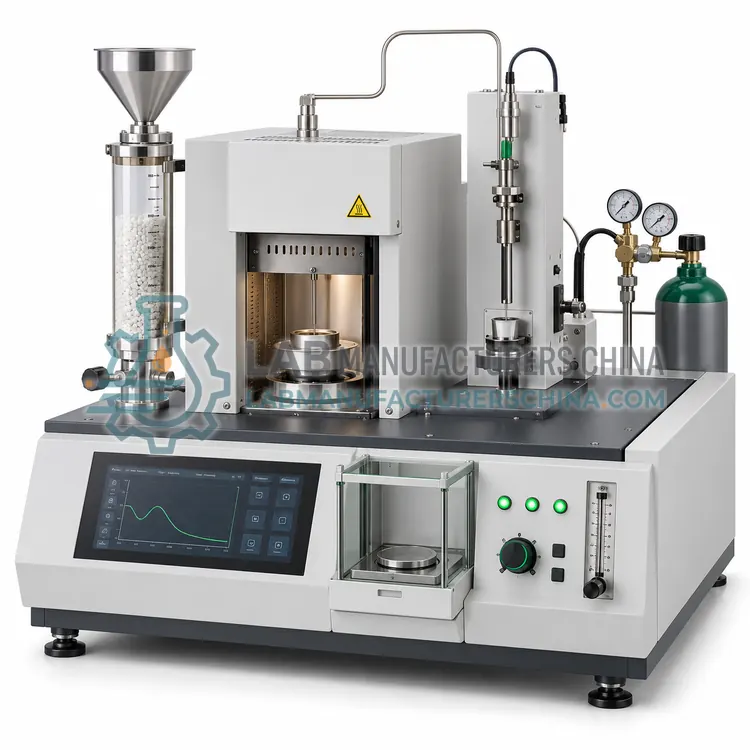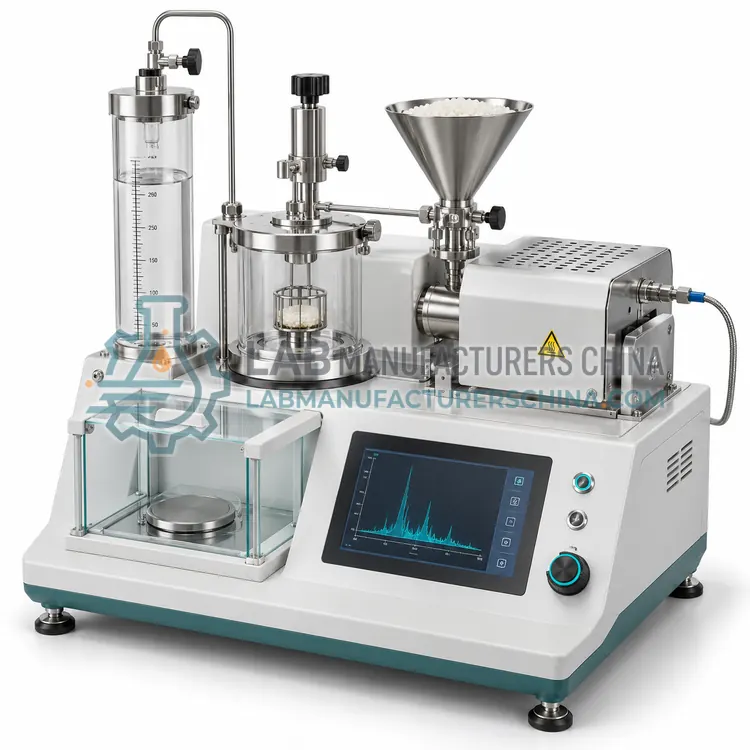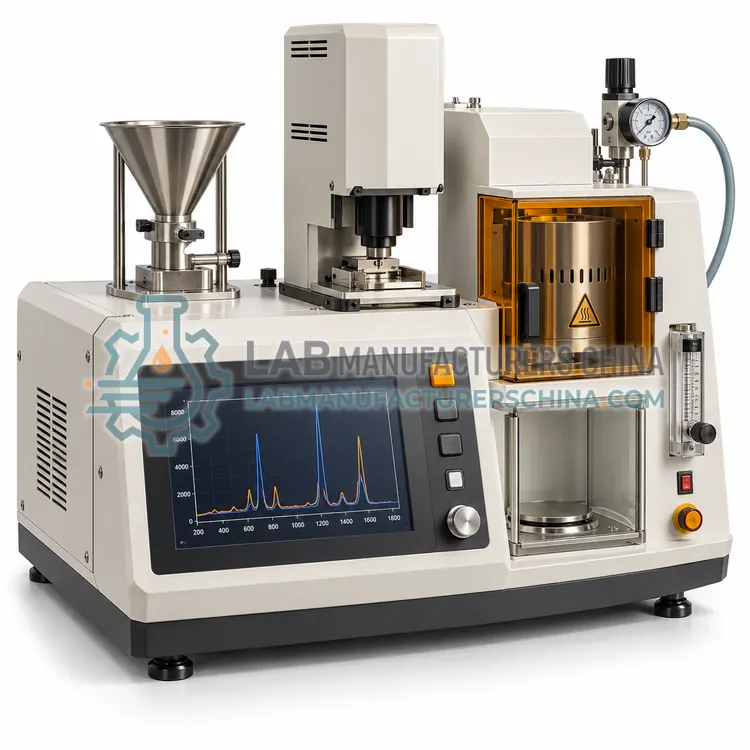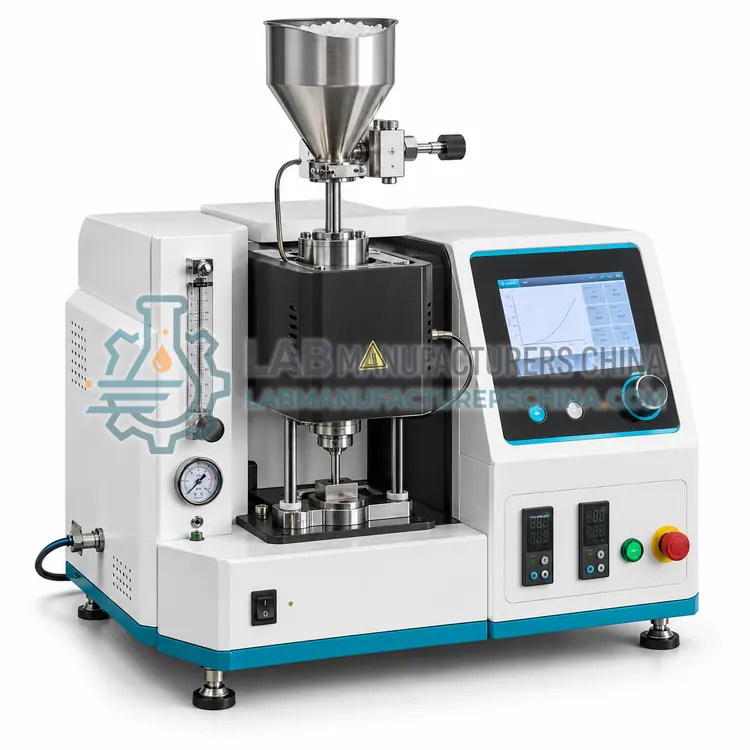
FTIR Spectrometer for Polymer Identification
聚合物鉴别用傅里叶变换红外光谱仪
- SKU PSP-0001
- Polymer Spectroscopy
- CE (to be confirmed)
- ISO 9001 manufacturing (to be confirmed)
Price on request — FOB / CIF quoted per order
Prices depend on configuration, quantity and destination port.
Key specifications
| Spectral range | 4000–400 cm⁻¹ (optional to 7800 cm⁻¹) |
|---|---|
| Resolution | 0.5–4 cm⁻¹ selectable |
| Signal-to-noise ratio | Better than 30,000:1 (4 cm⁻¹, 1 min) |
| Wavenumber accuracy | ±0.1 cm⁻¹ |
| Detector | DLATGS with KBr window |
| Beamsplitter | Broadband KBr |
Request a quote Download brochure · to be provided
By Lab Manufacturers China Technical TeamLast reviewed Standards: ASTM E1252, ASTM E168, ASTM D5576
What is the FTIR Spectrometer for Polymer Identification?
A bench FTIR spectrometer records mid-infrared absorption spectra of polymers for identification against reference libraries. It is the standard instrument for incoming material verification, quality disputes and general laboratory identification of plastics and rubbers.
What is the FTIR Spectrometer for Polymer Identification?
A bench FTIR spectrometer records mid-infrared absorption spectra of polymers for identification against reference libraries. It is the standard instrument for incoming material verification, quality disputes and general laboratory identification of plastics and rubbers.
Overview
The instrument combines an infrared source, an interferometer with a beamsplitter, a sample compartment and a detector, all controlled by software that transforms the interferogram into a spectrum. Typical coverage is 4000 to 400 cm⁻¹ with optional extension to 7800 cm⁻¹, and resolution between 0.5 and 4 cm⁻¹ depending on the requirement. Signal-to-noise ratio determines how well weak additive bands can be seen, so a purge or desiccant system is normally supplied. Sampling options include transmission through pressed films or solution cells, diffuse reflectance, and accessories for gas and liquid analysis. Libraries with tens of thousands of reference spectra allow automated identification, and quantitative methods based on peak height or area are used for additive content.
How does it work?
Molecules absorb infrared radiation at frequencies that match their vibrational modes, so a spectrum of absorbance against wavenumber acts as a fingerprint of the polymer backbone and of the additives present. Fourier-transform instruments use an interferometer and a mathematical transform to record the full spectrum quickly and at high signal-to-noise ratio. Attenuated total reflection brings the beam into a high-refractive-index crystal in contact with the sample, so surface layers of a few micrometres can be measured without preparation. Raman spectroscopy complements this by measuring inelastically scattered light from a laser, which is sensitive to non-polar bonds, and near-infrared spectroscopy records overtone and combination bands that are weak but penetrating, making it suitable for rapid screening through packaging or with fibre probes.
What are the key features?
- Spectral range 4000–400 cm⁻¹, extendable
- Resolution selectable from 0.5 to 4 cm⁻¹
- Purged or desiccated optics compartment
- Automatic library search and hit quality reporting
- Transmission, diffuse reflectance and gas cell options
- Quantitative methods using peak height or area
What are the technical specifications?
A typical ftir spectrometer for polymer identification configuration offers spectral range of 4000–400 cm⁻¹ (optional to 7800 cm⁻¹), resolution of 0.5–4 cm⁻¹ selectable, signal-to-noise ratio of Better than 30,000:1 (4 cm⁻¹, 1 min), wavenumber accuracy of ±0.1 cm⁻¹, detector of DLATGS with KBr window and beamsplitter of Broadband KBr. Values are indicative of the product class; the exact figures for each configuration are confirmed on the quotation and the calibration documents supplied with the instrument.
Which applications is it used for?
The FTIR Spectrometer for Polymer Identification is used in incoming identification of polymer granules, batch identity verification for converters, contaminant identification in finished parts and filler and additive screening. Across the wider Polymer Spectroscopy class, laboratories also deploy it for incoming identification of resin and rubber grades, contaminant and gel particle analysis and additive, filler and plasticiser detection.
Which standards and certifications apply?
Relevant standards and methods include ASTM E1252, ASTM E168, ASTM D5576, ASTM D3677, ISO 4650, ASTM E1840 and IEC 61010-1. Certification candidates for this model are CE and ISO 9001 manufacturing; each is to be confirmed for the specific configuration before shipment, and certificates are supplied only where they have been issued.
Keep the spectrometer purged or desiccated because water vapour and carbon dioxide bands appear in the mid-infrared and can mask weak peaks. Run a background scan at the same resolution and purge conditions as the sample, and verify wavenumber calibration with a polystyrene film at defined intervals. For ATR work, clean the crystal immediately after each measurement and check for scratches, because damaged surfaces distort bands. Raman systems should be calibrated against a standard such as silicon or cyclohexane, and laser power must be limited for dark or heat-sensitive polymers to avoid burning the sample.
How do I select the right FTIR Spectrometer for Polymer Identification?
Choose a bench FTIR when identification against libraries is the main requirement and samples can be presented as films, powders, pellets or liquids. Confirm the resolution you need for additive work and whether a purge system is included, since it affects the quality of weak bands. Ask about library licensing and about accessories for diffuse reflectance if powders will be measured.
How does it compare with other Polymer Spectroscopy variants?
Infrared is the default for polymer identification because spectral libraries are extensive and the method is well standardised. Add an attenuated total reflection accessory when samples are solid, opaque or dirty, since it removes pressing, grinding and solvent steps. Choose an infrared microscope when the target is a contaminant, a gel particle or a multilayer film that must be measured at a defined point or mapped across a surface. Raman is preferred for aqueous samples, for polymers that are strong infrared absorbers such as filled or black materials, and for portable field identification through transparent packaging. Near-infrared is selected for high-throughput screening and quantitative additive or moisture measurement using chemometric models.
Full specifications
| Spectral range | 4000–400 cm⁻¹ (optional to 7800 cm⁻¹) |
|---|---|
| Resolution | 0.5–4 cm⁻¹ selectable |
| Signal-to-noise ratio | Better than 30,000:1 (4 cm⁻¹, 1 min) |
| Wavenumber accuracy | ±0.1 cm⁻¹ |
| Detector | DLATGS with KBr window |
| Beamsplitter | Broadband KBr |
| Source | Silicon carbide, high stability |
| Purge requirement | Dry air or nitrogen, or desiccant |
| Library size | Tens of thousands of reference spectra |
| Power supply | 220 V, 50/60 Hz |
Indicative values for this product class. Final specifications are confirmed on the quotation and in the calibration documents supplied with the instrument.
Applications
- Incoming identification of polymer granules
- Batch identity verification for converters
- Contaminant identification in finished parts
- Filler and additive screening
Key features
- Spectral range 4000–400 cm⁻¹, extendable
- Resolution selectable from 0.5 to 4 cm⁻¹
- Purged or desiccated optics compartment
- Automatic library search and hit quality reporting
- Transmission, diffuse reflectance and gas cell options
- Quantitative methods using peak height or area
Frequently asked questions about FTIR Spectrometer for Polymer Identification
It distinguishes repeating units, not molecular weight or grade, because chain length does not change the vibrational spectrum. Grade differences caused by additives, comonomer content or oxidation can be seen, and the carbonyl index or specific additive bands are the usual diagnostic features. Molecular weight comparisons need other techniques.
The material is dissolved or hot pressed into a film thin enough that the strongest bands stay within the linear response of the detector, typically 10 to 50 µm. Pressing temperature should be kept low enough to avoid degradation, and films must be free of bubbles and of contamination from the pressing surfaces.
The carbonyl index is the ratio of the carbonyl absorption around 1715 cm⁻¹ to a reference band of the polymer backbone. It rises as oxidation produces carbonyl groups, so it is used to follow ageing, weathering and processing degradation even when no other spectral feature changes clearly.
Infrared spectroscopy is normally the first choice because reference libraries cover the common thermoplastics and rubbers and the method is standardised. Attenuated total reflection makes measurement of a solid part straightforward. Raman is used when the sample is dark, filled, wet or must be identified through packaging, and near-infrared when many samples must be screened rapidly.
ATR needs no KBr pressing, no grinding and no solvent, so an irregular part, a pellet or a film can be measured in seconds with good contact. The beam penetrates only a few micrometres, which means surface contamination dominates the spectrum, so the surface should be representative or cleaned before measurement.
The measured spectrum is searched against a library using correlation or hit-quality algorithms that compare peak positions and relative intensities. Results are reported as a ranked list with a match score, and identification should be confirmed by checking the key diagnostic bands of the proposed polymer rather than relying on the score alone.