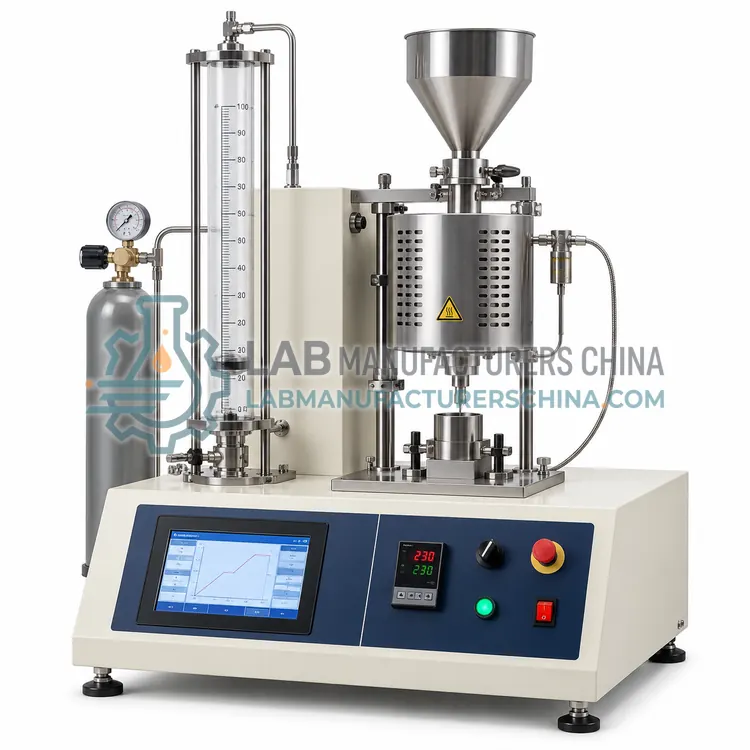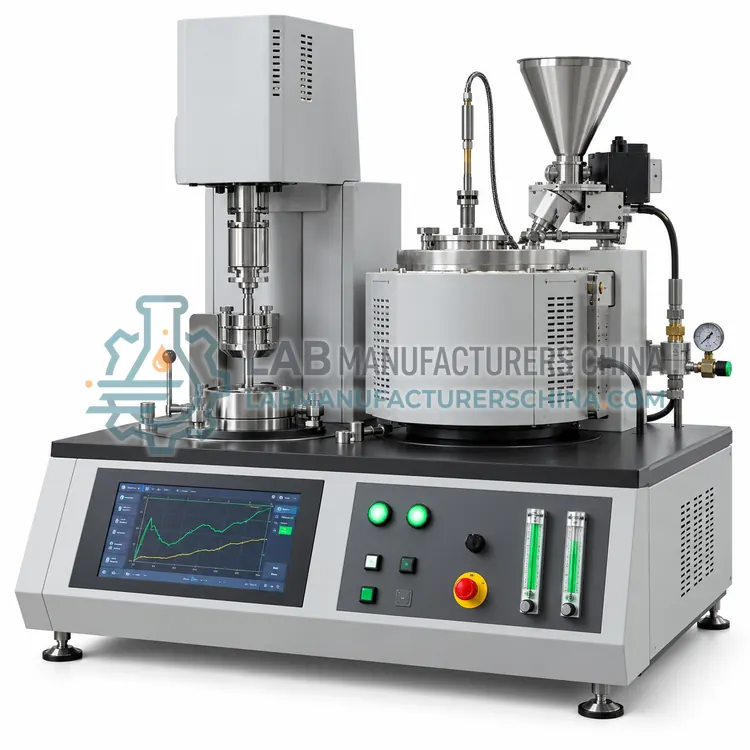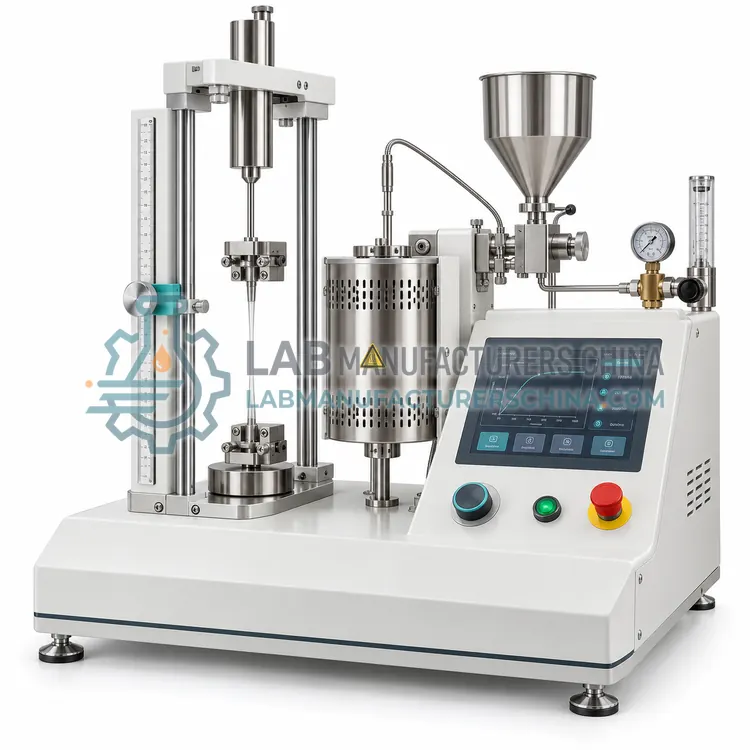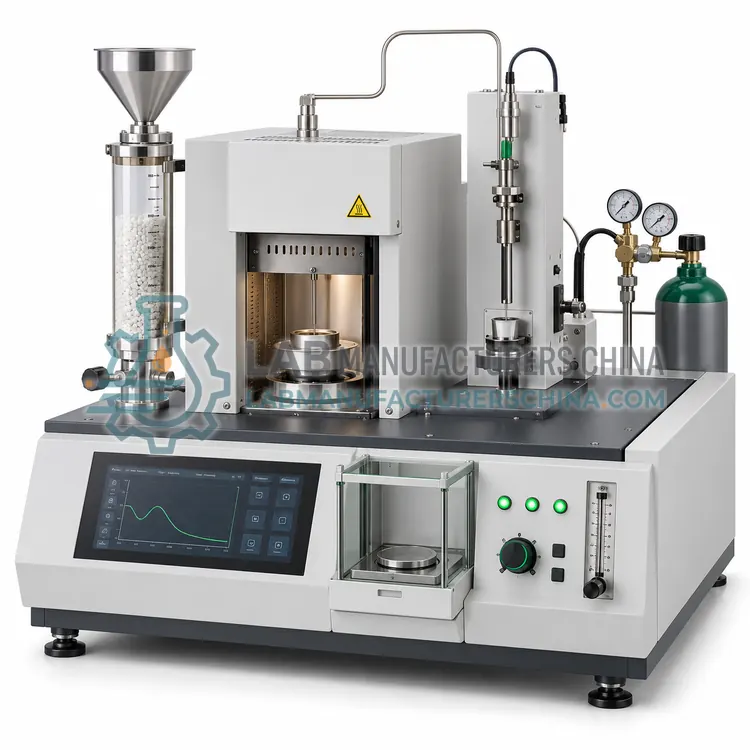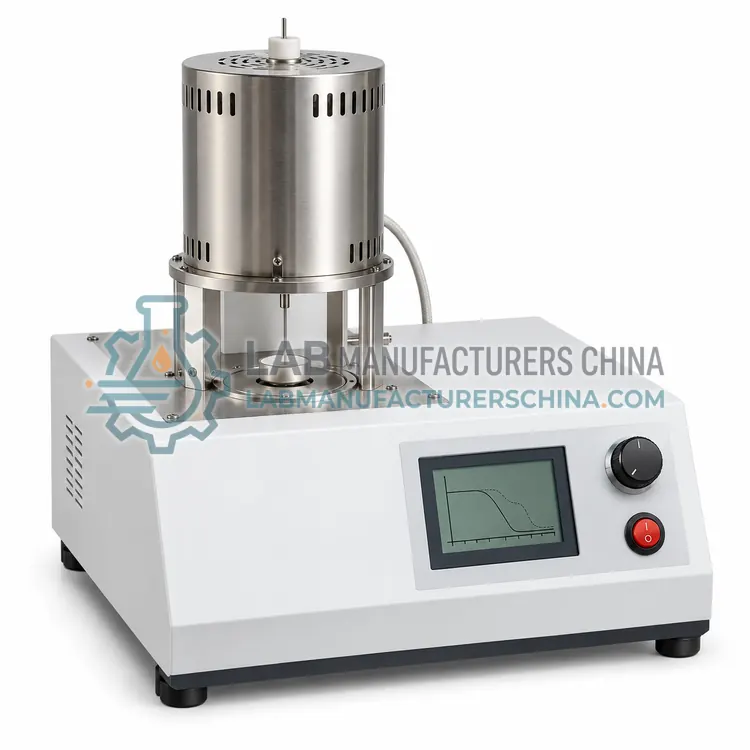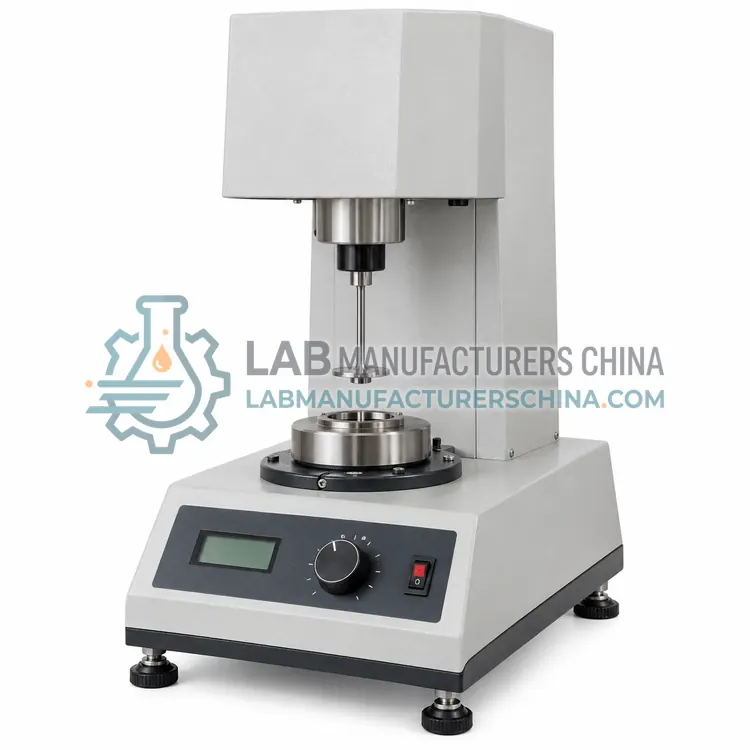
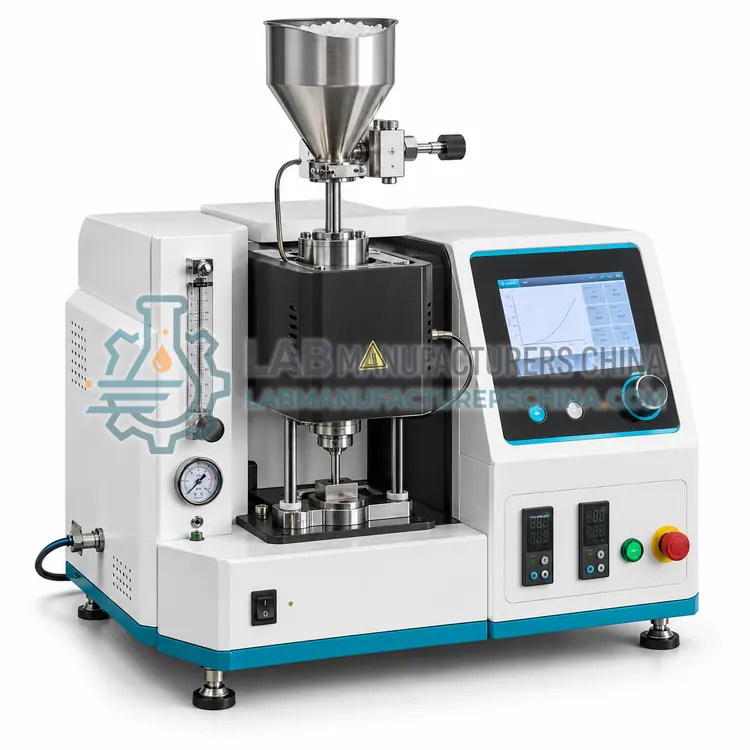
Capillary Rheometer for Polymer Processing
聚合物加工用毛细管流变仪
- SKU RHE-0002
- Rheometers
- CE (to be confirmed)
- ISO 9001 manufacturing (to be confirmed)
Price on request — FOB / CIF quoted per order
Prices depend on configuration, quantity and destination port.
Key specifications
| Maximum pressure | Up to 1000 bar |
|---|---|
| Barrel diameter | 9.55 / 12 / 15 mm |
| Temperature range | Ambient to 400 °C |
| Temperature accuracy | ±0.5 °C |
| Piston speed | 0.001–20 mm/s |
| Shear rate range | 1–10⁶ s⁻¹ |
Request a quote Download brochure · to be provided
By Lab Manufacturers China Technical TeamLast reviewed Standards: ISO 3219, ISO 11443, ISO 6721-10
What is the Capillary Rheometer for Polymer Processing?
A capillary rheometer forces molten polymer through a die at controlled piston speed and measures the pressure required, giving viscosity at shear rates that match extrusion and injection moulding. It is used where process-relevant viscosity, not elasticity, is the required output.
What is the Capillary Rheometer for Polymer Processing?
A capillary rheometer forces molten polymer through a die at controlled piston speed and measures the pressure required, giving viscosity at shear rates that match extrusion and injection moulding. It is used where process-relevant viscosity, not elasticity, is the required output.
Overview
A heated barrel with a piston forces melt through a die of defined diameter and length, and a pressure transducer above the die records the pressure drop. Shear stress is calculated from pressure and die geometry, apparent shear rate from piston speed, and the ratio gives apparent viscosity. Because pressure is measured continuously, the instrument also records die swell, melt fracture onset and the pressure at which flow becomes unstable. Die sets with different length-to-diameter ratios allow the Bagley correction for entrance pressure loss, and multiple barrel diameters extend the shear rate range. Typical coverage is 1 to 10⁶ s⁻¹, which includes the conditions in a real extruder die, and the instrument tolerates filled, reinforced and recycled materials that would damage a rotational gap.
How does it work?
A rheometer applies a controlled deformation to a polymer sample and measures the resulting force or torque. Rotational instruments use parallel plates, cones or concentric cylinders and can work in steady shear, giving shear viscosity against shear rate, or in oscillation, giving storage and loss moduli against frequency. Capillary instruments force melt through a die of known diameter and length at a controlled piston speed, measuring pressure to calculate apparent shear viscosity at shear rates that reach those of real extrusion. Torque rheometers mix material in a heated chamber and record the torque needed to turn the rotors, which tracks gelation, fusion and degradation in a compounding context. The choice depends on the shear rate range, the sample form and whether elasticity or only viscosity is required.
What are the key features?
- Die sets with L/D ratios of 10, 20 and 30
- Pressure measurement at shear rates to 10⁶ s⁻¹
- Bagley and Rabinowitsch correction utilities
- Barrel diameters for extended shear rate range
- Detection of melt fracture and die swell
- Interchangeable dies in hardened or corrosion-resistant steel
What are the technical specifications?
A typical capillary rheometer for polymer processing configuration offers maximum pressure of Up to 1000 bar, barrel diameter of 9.55 / 12 / 15 mm, temperature range of Ambient to 400 °C, temperature accuracy of ±0.5 °C, piston speed of 0.001–20 mm/s and shear rate range of 1–10⁶ s⁻¹. Values are indicative of the product class; the exact figures for each configuration are confirmed on the quotation and the calibration documents supplied with the instrument.
Which applications is it used for?
The Capillary Rheometer for Polymer Processing is used in extrusion grade selection and process window definition, injection moulding fill simulation input, filled and reinforced compound viscosity and recycled polymer processability assessment. Across the wider Rheometers class, laboratories also deploy it for molecular weight and molecular weight distribution comparison, processing behaviour prediction for extrusion and moulding and filler and additive effect on melt viscosity.
Which standards and certifications apply?
Relevant standards and methods include ISO 3219, ISO 11443, ISO 6721-10, ASTM D3835, ASTM D4440, ASTM D2538 and IEC 61010-1. Certification candidates for this model are CE and ISO 9001 manufacturing; each is to be confirmed for the specific configuration before shipment, and certificates are supplied only where they have been issued.
Sample preparation dominates repeatability: dry hygroscopic polymers, compression-mould discs of defined thickness for rotational testing, and ensure filled samples are homogeneous. Set the gap and check it with a zero-gap routine before each series, because a small gap error changes the calculated viscosity. In capillary work, verify piston speed and pressure transducer calibration, and apply the Bagley and Rabinowitsch corrections when true viscosity is required. Purge the oven with nitrogen for high-temperature or oxidation-sensitive polymers. Clean dies and plates thoroughly, since degraded residue changes the surface and the measured torque, and record temperature, geometry and gap with every result.
How do I select the right Capillary Rheometer for Polymer Processing?
Select a capillary rheometer when the viscosity range of interest lies above what a rotational instrument can reach, when samples contain abrasive fillers, or when die swell and melt fracture data are needed for die design. Specify the maximum pressure and temperature for your stiffest and hottest material, and confirm the die sets and barrel diameters required to cover the shear rate range.
How does it compare with other Rheometers variants?
Match the instrument to the shear rate range that governs your process. Rotational rheometers cover low shear rates and are the only option when viscoelastic data, yield stress or normal force are required, making them suitable for molecular weight comparisons and additive studies. Capillary rheometers reach the high shear rates of extrusion and injection moulding and are more tolerant of filled and highly viscous materials. Torque rheometers are used when the question concerns compounding behaviour, gelation or thermal stability under shear rather than a fundamental viscosity value. Inline instruments are selected for continuous process monitoring and never replace laboratory characterisation, because they see only one fixed measurement point.
Full specifications
| Maximum pressure | Up to 1000 bar |
|---|---|
| Barrel diameter | 9.55 / 12 / 15 mm |
| Temperature range | Ambient to 400 °C |
| Temperature accuracy | ±0.5 °C |
| Piston speed | 0.001–20 mm/s |
| Shear rate range | 1–10⁶ s⁻¹ |
| Die diameters | 0.5–2.0 mm |
| Die L/D ratios | 10, 20, 30 |
| Sample mass per test | 10–50 g depending on barrel |
| Power supply | 220 V or 380 V, 50/60 Hz |
Indicative values for this product class. Final specifications are confirmed on the quotation and in the calibration documents supplied with the instrument.
Applications
- Extrusion grade selection and process window definition
- Injection moulding fill simulation input
- Filled and reinforced compound viscosity
- Recycled polymer processability assessment
Key features
- Die sets with L/D ratios of 10, 20 and 30
- Pressure measurement at shear rates to 10⁶ s⁻¹
- Bagley and Rabinowitsch correction utilities
- Barrel diameters for extended shear rate range
- Detection of melt fracture and die swell
- Interchangeable dies in hardened or corrosion-resistant steel
Frequently asked questions about Capillary Rheometer for Polymer Processing
Part of the measured pressure is lost at the die entrance rather than in the capillary, and this entrance loss becomes more significant at short dies. Measuring at three or more length-to-diameter ratios and extrapolating to zero length, the Bagley correction, separates the entrance loss from the true shear stress in the die.
Apparent viscosity is calculated assuming a Newtonian velocity profile in the die, which is not valid for polymer melts that shear thin. The Rabinowitsch correction accounts for the true non-Newtonian profile, and the Bagley correction removes entrance pressure loss. True viscosity is reported when comparing data between laboratories or instruments.
Depending on barrel diameter, one filling is typically 10 to 50 g, and a complete flow curve with three dies may need several fillings. Because measurements are destructive, the technique suits granulate and moulded parts that can be cut, and a material budget should be planned before requesting a full characterisation.
A rotational rheometer measures viscosity in steady or oscillatory shear at low shear rates, where the material response is dominated by molecular relaxation. A capillary rheometer measures at high shear rates that match extrusion and injection moulding. The two techniques overlap in a mid-range and should agree after corrections, but each covers a shear rate window the other cannot reach.
Viscosity is calculated from measured torque, angular velocity and the gap between the geometries, so an error in gap propagates directly into the result. Compression of the sample and thermal expansion change the effective gap, which is why a zero-gap routine and a constant sample thickness are used before each series.
They can, but filler particles may slip at the plate surface, settle, or bridge the gap, so the measured viscosity can be too low. Practical measures are to use serrated or roughened plates, larger gaps, and lower filler loadings where possible, and to compare results only between samples of the same filler content and particle size.
Related models