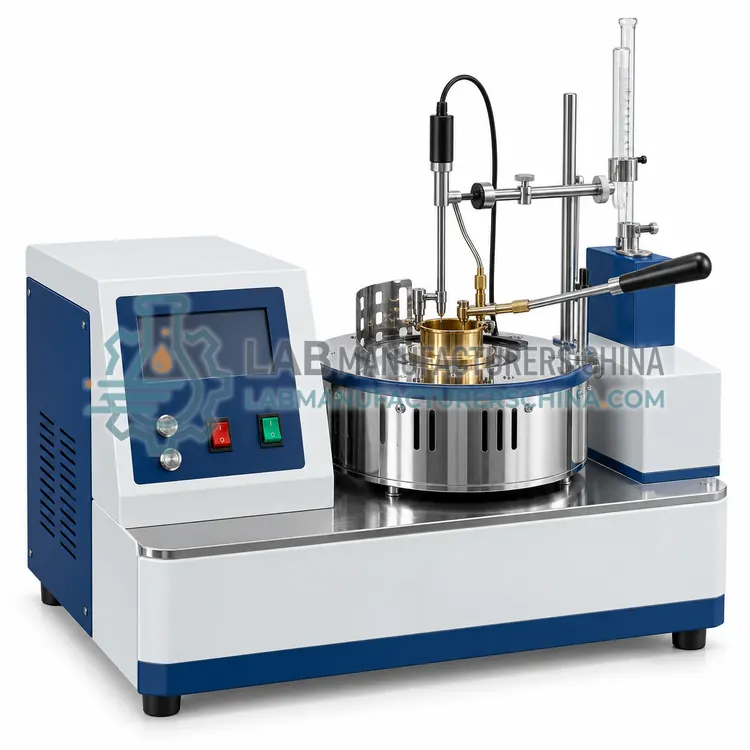
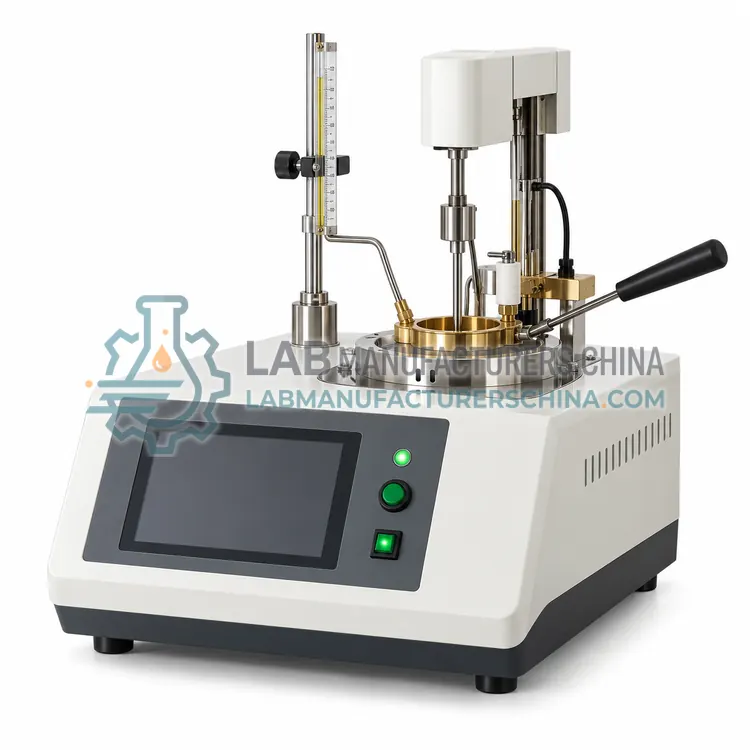
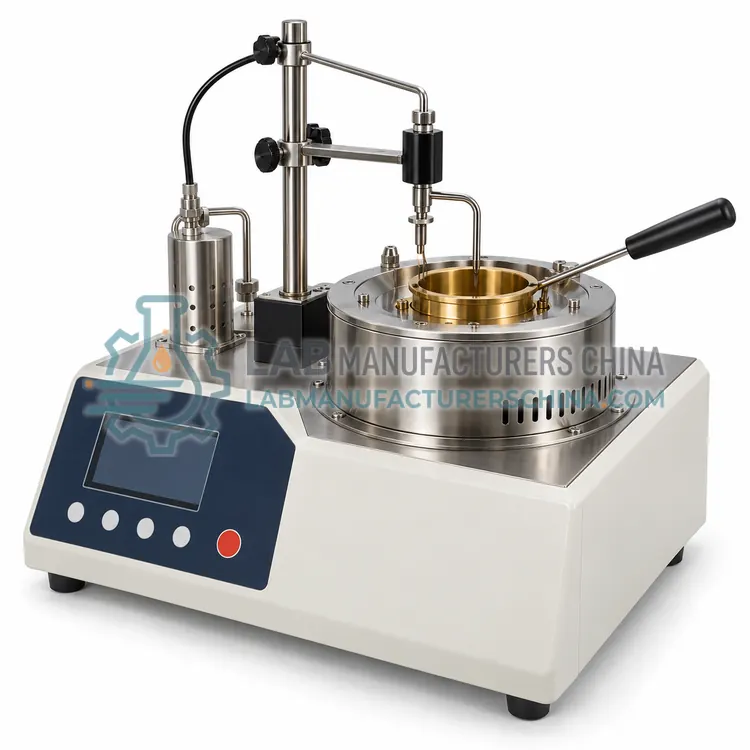
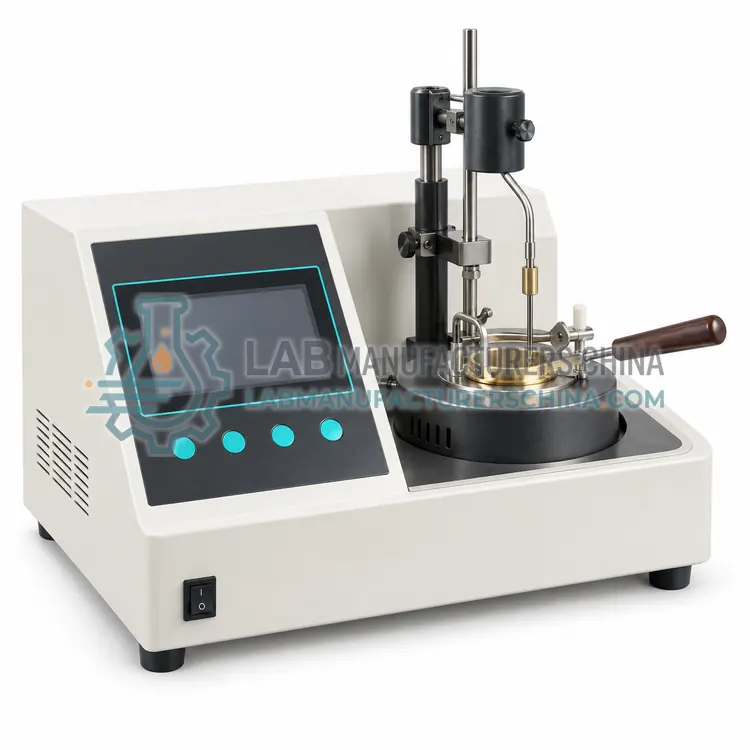
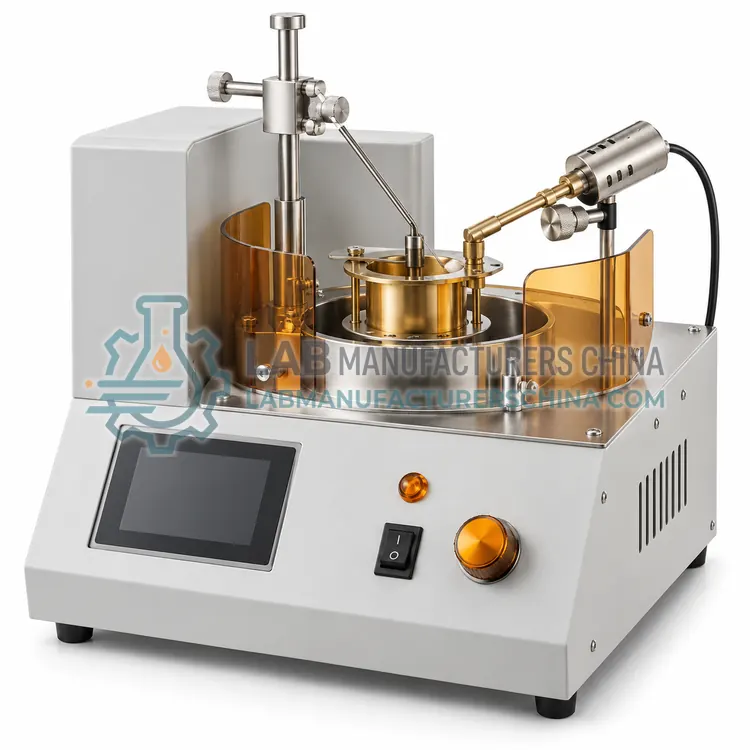
How do Flash Point Testers work?
A flash point tester heats a measured sample in a standard cup at a prescribed rate while stirring or not, depending on the method. At set temperature intervals an ignition source, either a gas flame or an electric igniter, is dipped into the vapor space above the liquid. The flash point is the lowest corrected temperature at which the vapors ignite with a distinct flash. Closed-cup designs confine vapors under a lid and give lower values, while open-cup designs expose the surface to air and give higher values. Main components are the test cup, heating block or bath, stirrer, shutter and igniter assembly, temperature probe and, in automatic models, a flash detector using ionization or thermal sensing. Barometric pressure is recorded because results are corrected to 101.3 kPa.
Which Flash Point Testers variants are available?
- Manual Pensky-Martens Closed Cup Flash Point Tester — A manual Pensky-Martens closed cup tester heats a sample in a brass cup with stirring while the operator triggers the igniter by hand.
- Automatic Pensky-Martens Closed Cup Flash Point Tester — An automatic Pensky-Martens closed cup tester controls heating, stirring, ignition and flash detection electronically, and applies barometric correction to the result.
- Automatic Cleveland Open Cup Flash and Fire Point Tester — An automatic Cleveland open cup tester heats a sample in an open brass cup and finds both the flash point and the fire point.
- Tag Closed Cup Flash Point Tester — A Tag closed cup tester heats a sample in a glass cup set in a liquid bath at a slow constant rate and tests for flash point with a small gas flame.
- Small-Scale Closed-Cup Flash Point Tester — A small-scale closed-cup tester determines flash point with only about 2 to 4 mL of sample using a rapidly heated metal block and a small flame or electric igniter.
How do I choose the right variant?
Select first by the method your specification cites, since cup geometry, heating rate and stirring differ between Pensky-Martens, Cleveland, Tag and small-scale procedures. Closed-cup methods suit fuels, solvents and most regulatory classification. Open-cup methods suit viscous lubricants, bitumen and products whose fire point is also required. Next consider throughput and operator dependence: manual testers are economical for occasional use, while automatic models control the heating ramp, detect the flash electronically and apply barometric correction. Check the temperature range against your products, including whether you need cooling for sub-ambient samples. Small-scale testers save sample and time for screening but may not be accepted as a referee method. Confirm fume extraction, flame-safety shutoff and available calibration reference fluids.
Where are Flash Point Testers used?
Flash Point Testers are specified in refinery product release, lubricant and base oil QC, hazardous goods classification, fuel contamination screening and solvent and paint flammability testing.
Which standards and certifications apply?
Work with Flash Point Testers is commonly governed by ASTM D93, ASTM D92, ASTM D56, ASTM D3828, ISO 2719, ISO 2592, IP 34, GB/T 261 and IEC 61010-1. Instrument certifications such as CE marking are confirmed per configuration and never assumed.
What are the key considerations before purchase?
Place the tester in a draft-free area, because air movement disturbs vapor concentration and shifts results. Connect a fume extraction hood and keep flammable samples away from the heating block. Verify the temperature probe and, where applicable, the barometer against traceable references at least annually. Check instrument performance regularly with certified reference fluids such as n-decane or n-hexadecane and compare results with stated tolerances. Clean the cup, lid and igniter after each test to prevent carbon build-up. Replace gas supply hoses on schedule, and confirm flame-out detection works. Record the ambient pressure with each result. Operators should be trained on sample handling, because losing volatile fractions before the test lowers apparent flammability risk.