
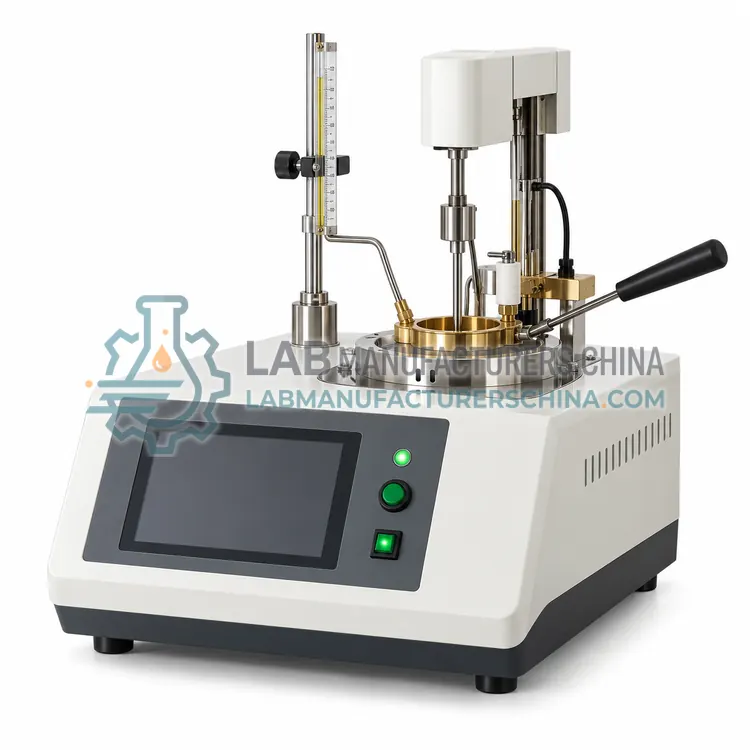
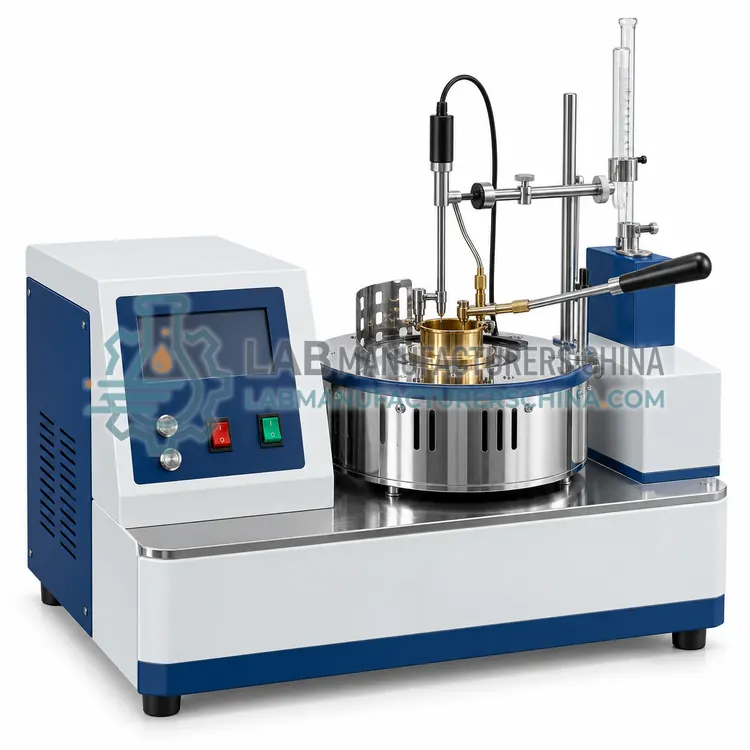
Manual Pensky-Martens Closed Cup Flash Point Tester
手动彭斯基-马丁斯闭口闪点测定仪
- SKU FPT-0001
- Flash Point Testers
- CE (to be confirmed)
- ISO 9001 manufacturing (to be confirmed)
Price on request — FOB / CIF quoted per order
Prices depend on configuration, quantity and destination port.
Key specifications
| Test method | ASTM D93 Procedure A/B, ISO 2719 |
|---|---|
| Temperature range | Ambient to 370 °C |
| Temperature resolution | 0.1 °C |
| Heating rate | 1–6 °C/min adjustable |
| Stirring speed | 90–120 rpm |
| Sample volume | About 70 mL |
Request a quote Download brochure · to be provided
By Lab Manufacturers China Technical TeamLast reviewed Standards: ASTM D93, ASTM D92, ASTM D56
What is the Manual Pensky-Martens Closed Cup Flash Point Tester?
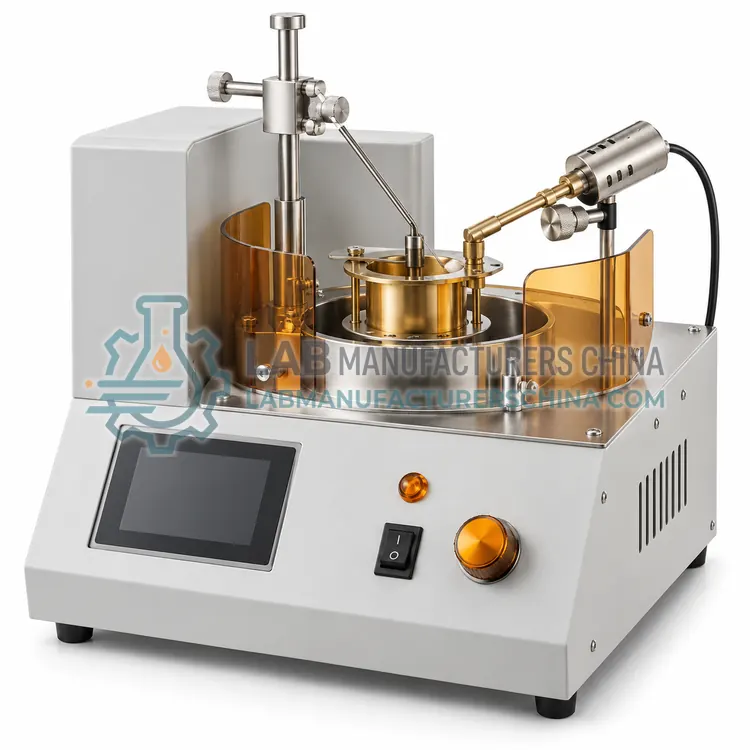
A manual Pensky-Martens closed cup tester heats a sample in a brass cup with stirring while the operator triggers the igniter by hand. It suits laboratories running a few fuel or lubricant samples per day under ASTM D93 or ISO 2719 that want a low-cost, method-compliant instrument.
What is the Manual Pensky-Martens Closed Cup Flash Point Tester?
A manual Pensky-Martens closed cup tester heats a sample in a brass cup with stirring while the operator triggers the igniter by hand. It suits laboratories running a few fuel or lubricant samples per day under ASTM D93 or ISO 2719 that want a low-cost, method-compliant instrument.
Overview
The manual Pensky-Martens closed cup tester follows the apparatus dimensions in ASTM D93 and ISO 2719. A brass test cup with a lid, shutter and stirrer sits in a heating block controlled by a temperature controller. The operator sets the heating rate, turns the stirring shaft through a flexible drive, and lowers the ignition flame at each temperature step by operating a lever. A thermometer or digital probe records the temperature at the flash. Because ignition and judgment of the flash are manual, results depend on operator skill, although procedures limit this by specifying ignition intervals and flame size. The design covers most distillate and residual fuels, lubricating oils and suspensions. It has few electronic parts, making it straightforward to maintain, but it needs continuous operator attention and an external reference to correct for barometric pressure.
How does it work?
A flash point tester heats a measured sample in a standard cup at a prescribed rate while stirring or not, depending on the method. At set temperature intervals an ignition source, either a gas flame or an electric igniter, is dipped into the vapor space above the liquid. The flash point is the lowest corrected temperature at which the vapors ignite with a distinct flash. Closed-cup designs confine vapors under a lid and give lower values, while open-cup designs expose the surface to air and give higher values. Main components are the test cup, heating block or bath, stirrer, shutter and igniter assembly, temperature probe and, in automatic models, a flash detector using ionization or thermal sensing. Barometric pressure is recorded because results are corrected to 101.3 kPa.
What are the key features?
- Brass test cup with lid, shutter and stirrer
- Heating block with digital controller
- Adjustable heating rate per method
- Gas flame or electric ignition by hand lever
- Digital temperature probe with display
- Compact benchtop footprint
What are the technical specifications?
A typical manual pensky-martens closed cup flash point tester configuration offers test method of ASTM D93 Procedure A/B, ISO 2719, temperature range of Ambient to 370 °C, temperature resolution of 0.1 °C, heating rate of 1–6 °C/min adjustable, stirring speed of 90–120 rpm and sample volume of About 70 mL. Values are indicative of the product class; the exact figures for each configuration are confirmed on the quotation and the calibration documents supplied with the instrument.
Which applications is it used for?
The Manual Pensky-Martens Closed Cup Flash Point Tester is used in lubricating oil QC, diesel and heating oil testing, paint and solvent flash point and inspection laboratory screening. Across the wider Flash Point Testers class, laboratories also deploy it for refinery product release, lubricant and base oil QC and hazardous goods classification.
Which standards and certifications apply?
Relevant standards and methods include ASTM D93, ASTM D92, ASTM D56, ASTM D3828, ISO 2719, ISO 2592, IP 34, GB/T 261 and IEC 61010-1. Certification candidates for this model are CE and ISO 9001 manufacturing; each is to be confirmed for the specific configuration before shipment, and certificates are supplied only where they have been issued.
Place the tester in a draft-free area, because air movement disturbs vapor concentration and shifts results. Connect a fume extraction hood and keep flammable samples away from the heating block. Verify the temperature probe and, where applicable, the barometer against traceable references at least annually. Check instrument performance regularly with certified reference fluids such as n-decane or n-hexadecane and compare results with stated tolerances. Clean the cup, lid and igniter after each test to prevent carbon build-up. Replace gas supply hoses on schedule, and confirm flame-out detection works. Record the ambient pressure with each result. Operators should be trained on sample handling, because losing volatile fractions before the test lowers apparent flammability risk.
How do I select the right Manual Pensky-Martens Closed Cup Flash Point Tester?
Select this model for low sample volumes, teaching laboratories or backup use where operator supervision is acceptable. It offers the lowest purchase cost among closed-cup options. For an RFQ specify method (D93 Procedure A or B), maximum temperature, ignition source type, and whether a barometer and certified reference fluid are included. Choose an automatic model for high throughput or audit-heavy work.
How does it compare with other Flash Point Testers variants?
Select first by the method your specification cites, since cup geometry, heating rate and stirring differ between Pensky-Martens, Cleveland, Tag and small-scale procedures. Closed-cup methods suit fuels, solvents and most regulatory classification. Open-cup methods suit viscous lubricants, bitumen and products whose fire point is also required. Next consider throughput and operator dependence: manual testers are economical for occasional use, while automatic models control the heating ramp, detect the flash electronically and apply barometric correction. Check the temperature range against your products, including whether you need cooling for sub-ambient samples. Small-scale testers save sample and time for screening but may not be accepted as a referee method. Confirm fume extraction, flame-safety shutoff and available calibration reference fluids.
Full specifications
| Test method | ASTM D93 Procedure A/B, ISO 2719 |
|---|---|
| Temperature range | Ambient to 370 °C |
| Temperature resolution | 0.1 °C |
| Heating rate | 1–6 °C/min adjustable |
| Stirring speed | 90–120 rpm |
| Sample volume | About 70 mL |
| Ignition source | Gas flame or electric igniter |
| Power supply | 220 V, 50 Hz, 500 W |
Indicative values for this product class. Final specifications are confirmed on the quotation and in the calibration documents supplied with the instrument.
Applications
- Lubricating oil QC
- Diesel and heating oil testing
- Paint and solvent flash point
- Inspection laboratory screening
Key features
- Brass test cup with lid, shutter and stirrer
- Heating block with digital controller
- Adjustable heating rate per method
- Gas flame or electric ignition by hand lever
- Digital temperature probe with display
- Compact benchtop footprint
Frequently asked questions about Manual Pensky-Martens Closed Cup Flash Point Tester
Yes, a manual tester can comply with ASTM D93 if its cup, lid, shutter, stirrer and heating rate match the method dimensions and tolerances. Compliance also depends on operator technique and on using a calibrated temperature sensor. Ask the supplier for a dimensional inspection report.
Procedure A applies to distillate fuels, lubricating oils and other homogeneous liquids, using a specified stirring and heating rate. Procedure B applies to residual fuel oils, cutback asphalts and liquids that form a surface film or contain suspended solids, using a different rate and stirring.
Yes, it can test viscous lubricating oils and many residual fuels within its temperature range, following the procedure suited to the product. Very viscous or solid-containing samples may need warming before loading and careful cup cleaning afterward.
Closed-cup testers confine vapors under a lid, so they reach ignitable concentration at lower temperature and give lower, more conservative values. Open-cup testers expose the liquid surface to air and give higher values. Regulations and product specifications state which method applies to each product type.
Diesel fuel flash point is usually determined by ASTM D93 using the Pensky-Martens closed cup, which ISO 2719 mirrors. Jet fuel often uses D56 Tag or D3828 small-scale methods instead. Check your product specification, such as ASTM D975, for the required method and minimum flash point.
Flash point varies with atmospheric pressure, because vapor-air ignition depends on partial pressure. Methods such as ASTM D93 require correcting the observed value to standard pressure of 101.3 kPa. Automatic testers often include a built-in barometer and apply the correction to the reported result.
Related models
Automatic Atmospheric Distillation Analyzer with Refrigerated Condenser
带制冷冷凝器的自动常压蒸馏分析仪
- CE (to be confirmed)
- +2