How do Island Benches work?
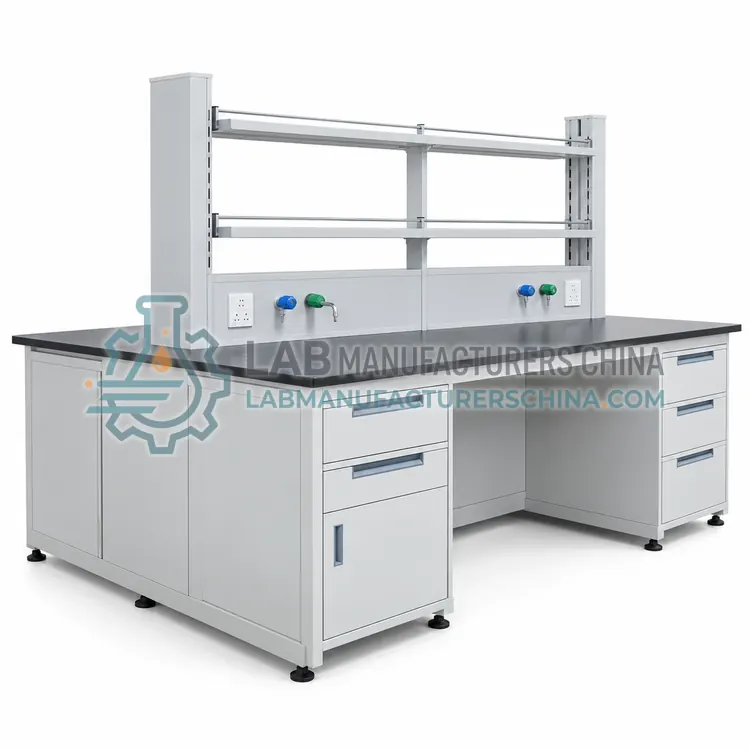
An island bench is a freestanding frame and worktop assembly of typically 1500–3600 mm length and 1200–1800 mm width, with base cabinets or open legs on both sides. Because it has no wall behind it, utilities must come from a central service spine, ceiling service panel or floor service box. The spine carries electrical sockets, gas and water taps, data ports and reagent shelves, and it is often fitted with an overhead shelf or lighting. Worktops are commonly epoxy resin, phenolic or stainless steel. Double-sided cabinets, a sink at one end and cantilever frames for wheelchair and cleaning access are frequent options. Structural stiffness and anchoring matter because the unit is not braced by walls.
Which Island Benches variants are available?
- Double-Sided Island Bench with Central Service Spine — A double-sided island bench with a central service spine lets two rows of users work back to back while sharing electricity, gas, water and data from one fixed column.
- Island Bench with Integrated Sink — An island bench with an integrated sink combines a central work surface with a polypropylene, epoxy or stainless steel sink at one end.
- Island Bench with Overhead Reagent Shelf — An island bench with an overhead reagent shelf adds a suspended shelf or gantry above the central service spine for reagent bottles, lighting and instrument displays, keeping the bench surface free for experiments while frequently used bottles remain within easy reach.
- Peninsula Island Bench (Wall-Attached) — A peninsula bench is an island-style work station with one end attached to a wall or service column.
- Cantilever Frame Island Bench — A cantilever frame island bench uses C-shaped steel supports instead of full-length legs so the floor beneath stays clear.
How do I choose the right variant?
Begin with the number of users and the side access you need. Two-sided islands with a central spine suit teaching labs and group research, while peninsula units attach to a wall for one-sided supply. Decide how services arrive: a fixed service spine, ceiling pendant or floor box, since this determines flexibility and cost. Choose worktop material by chemical exposure, and cabinet type by storage and accessibility needs. Check the room layout for circulation space: aisles of at least 1.5 m between benches are common, and 1.8 m where carts or wheelchairs are used. Confirm load rating and anchoring method on the actual floor type.
Where are Island Benches used?
Island Benches are specified in teaching laboratories, pharmaceutical R&D, chemistry research groups, biology and life science labs and quality control laboratories.
Which standards and certifications apply?
Work with Island Benches is commonly governed by SEFA 8 (laboratory grade casework), EN 13150 (laboratory workbenches), GB 24820 (laboratory furniture), EN 14056 (laboratory furniture recommendations for design and installation) and IEC 61010-1 (electrical safety, room services). Instrument certifications such as CE marking are confirmed per configuration and never assumed.
What are the key considerations before purchase?
Ensure the floor can carry the concentrated load and permits anchoring or provides a cast-in service box. Coordinate ceiling service panels and floor penetrations with the building design early, since relocating them later is costly. Provide RCD protection on sockets and isolate gas lines with accessible shut-off valves. Level the island precisely and seal joins between modules. Sight lines from all sides help supervision but require tidy service management. Inspect anchor points, taps and hoses every six months and clean resin tops with neutral detergent after chemical contact.