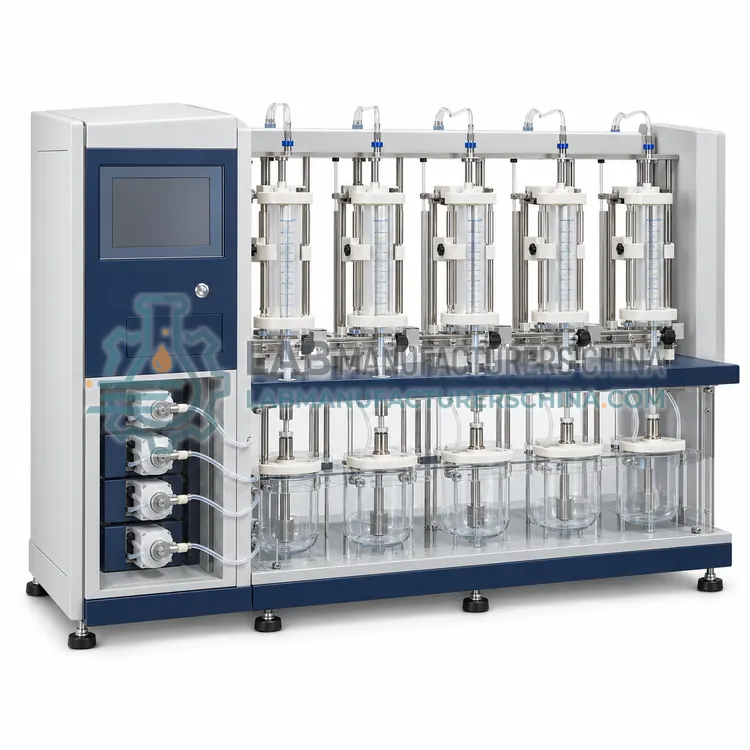
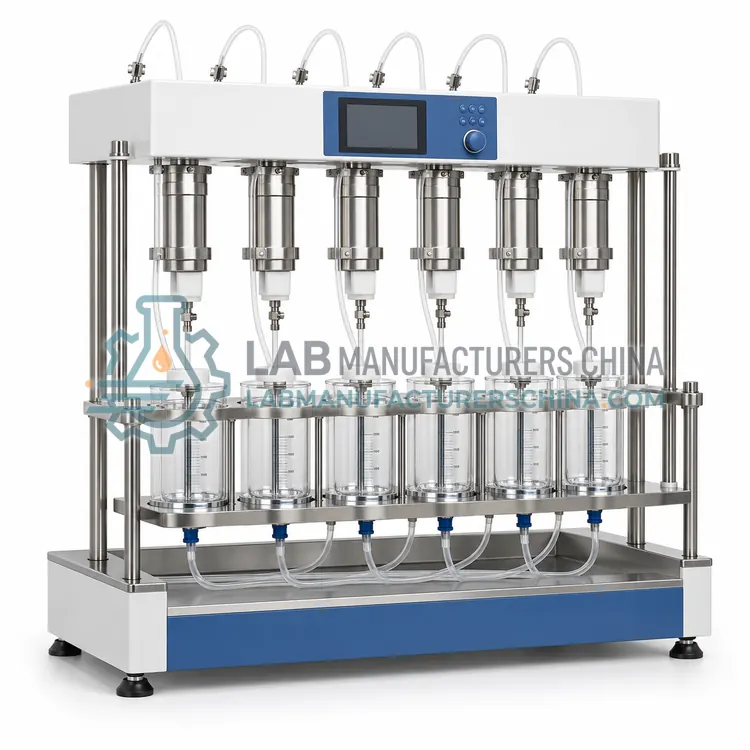
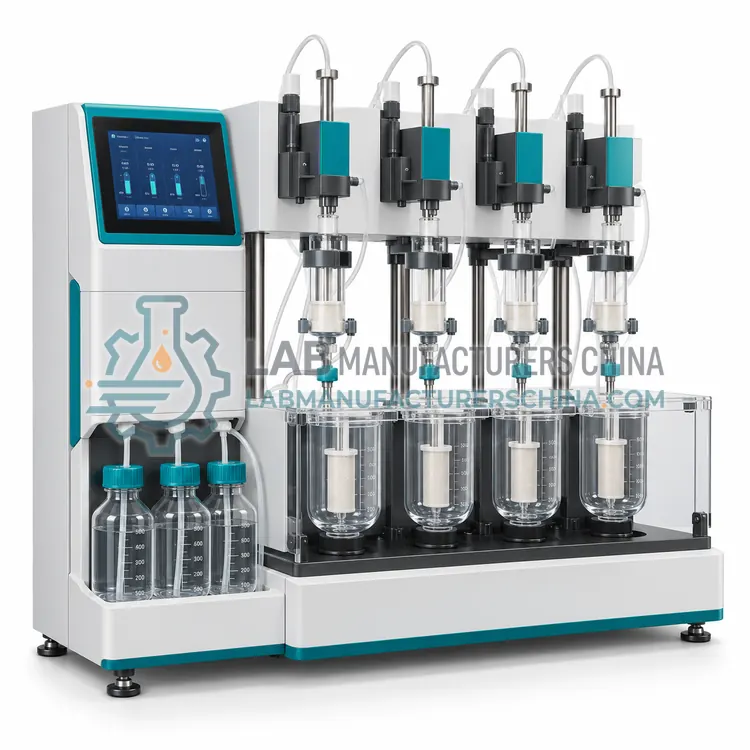
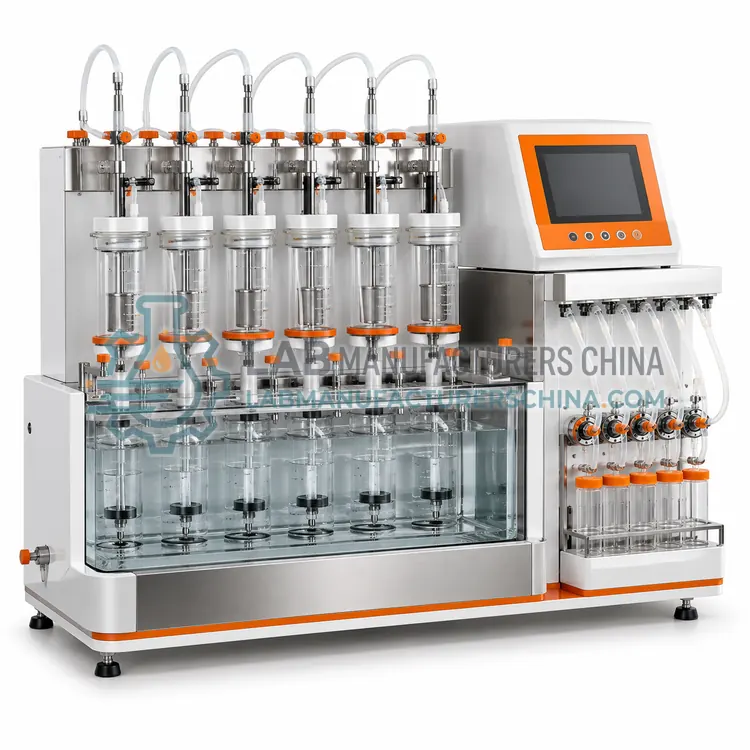
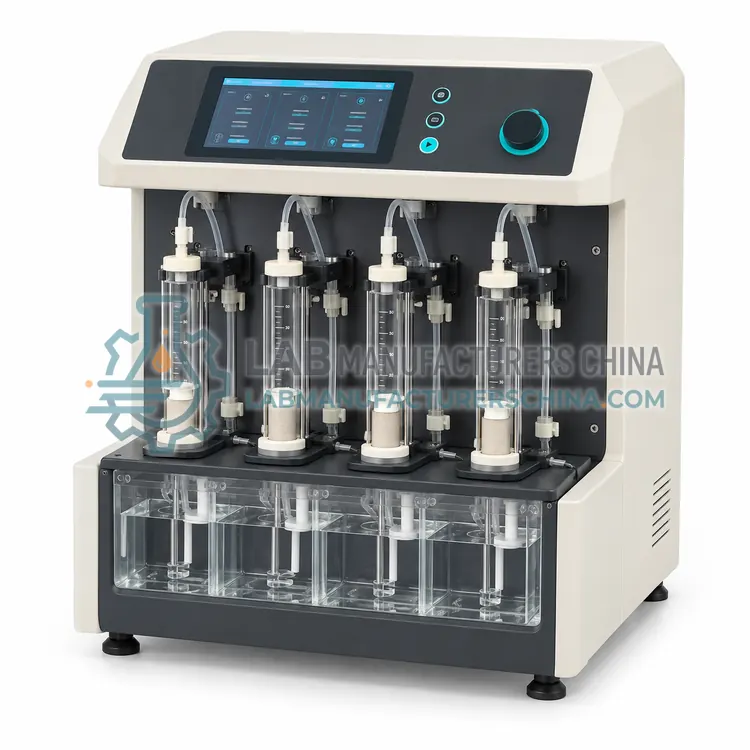
How do Flow-Through Systems work?
A flow-through system uses a piston pump to deliver medium at a controlled flow rate, typically 4–16 mL/min, with a sinusoidal pulse of 120 ± 10 pulses per minute, upward through a vertical cell. The dosage form sits on a bed of glass beads, which stabilize laminar flow, and a filter at the top retains particles. The medium can go once through the cell (open loop), so fresh solvent continually maintains sink conditions, or return to a reservoir (closed loop). Because the cell is stationary, hydrodynamics are mild and reproducible, and the medium can be changed programmatically to create pH profiles. Key components are the pump, cells of 12 or 22.6 mm diameter, a heated bath holding 37 °C, filter heads, and a collector or detector. Release follows diffusion and erosion kinetics, and flow rate determines the boundary layer thickness around the dosage form.
Which Flow-Through Systems variants are available?
- Open-Loop Flow-Through Dissolution System (USP Apparatus 4) — An open-loop flow-through dissolution system pumps fresh medium once through a thermostatted cell holding the dosage form and sends the eluate to a collector or detector.
- Closed-Loop Flow-Through Dissolution System — A closed-loop flow-through dissolution system recirculates a fixed volume of medium through the cell and back to a reservoir, so concentration builds up over time.
- Flow-Through Dissolution System for Implants and Stents — This flow-through variant uses specialized cells and holders for drug-eluting stents, implants, microspheres and other non-standard dosage forms.
- Automated Multi-Channel Flow-Through Dissolution System with HPLC Interface — This system runs six to eight flow-through cells in parallel under software control and delivers timed fractions to an HPLC autosampler vial tray or UV detector.
- Flow-Through Cell Dissolution Module for Retrofit — A retrofit flow-through module adds USP Apparatus 4 capability to a standard laboratory using a compact pump, cells and heater, without replacing an existing dissolution bath.
How do I choose the right variant?
Choose by the nature of the product and the regulatory requirement. Open-loop suits poorly soluble actives and extended-release forms needing sink conditions; closed-loop suits low-dose tablets and small media volumes. Implants, stents and microspheres need specialty cells and low flow rates. For high throughput or unattended runs, pick an automated multi-channel system with fraction collection and audit trail. A retrofit module is the lowest-cost route to meet an Apparatus 4 monograph. Evaluate flow accuracy (±5% or better), pulse rate control, cell diameter options, wetted-part material, number of channels and software data integrity features. Also consider medium volume and waste because open-loop runs can consume many liters.
Where are Flow-Through Systems used?
Flow-Through Systems are specified in extended-release product QC, poorly soluble drug testing, stent and implant release studies, microsphere release testing and generic drug f2 comparison.
Which standards and certifications apply?
Work with Flow-Through Systems is commonly governed by USP <711>, USP <1092>, Ph. Eur. 2.9.3, JP 6.10, ChP 0931, USP <724> and FDA Guidance on Dissolution Testing of Immediate Release Solid Oral Dosage Forms. Instrument certifications such as CE marking are confirmed per configuration and never assumed.
What are the key considerations before purchase?
Degas media and prime the pump to remove air, since bubbles in cells cause flow variation and filter blockage. Verify flow rate gravimetrically and check pulse rate at installation and regularly. Use calibrated thermometers to confirm cell temperature at 37.0 ± 0.5 °C. Clean cells, beads and filters after each run and replace worn pump seals or check valves. Keep tubing lengths short to limit dead volume. Qualification should include IQ/OQ, flow calibration and dissolution performance verification using reference tablets. For regulated work, ensure software supports audit trail and data integrity.