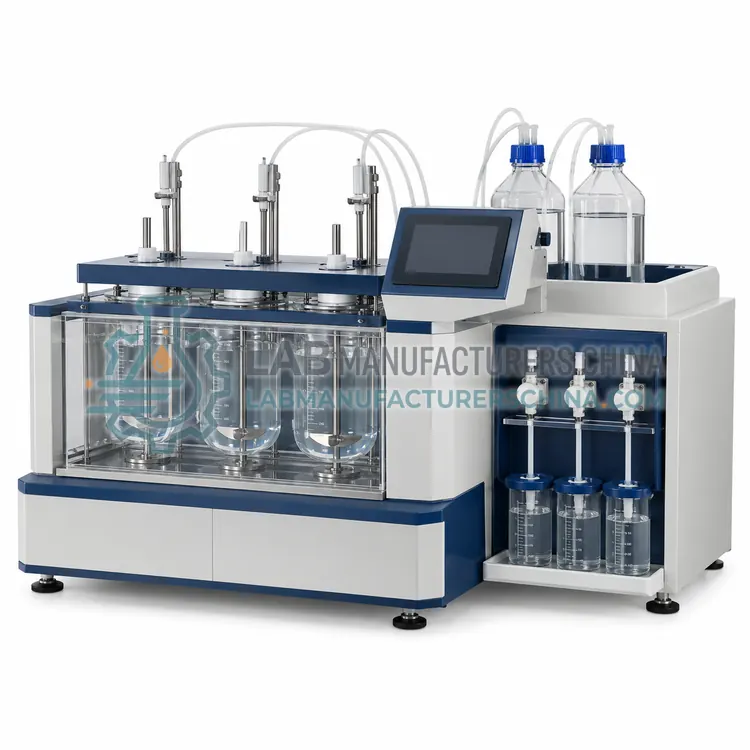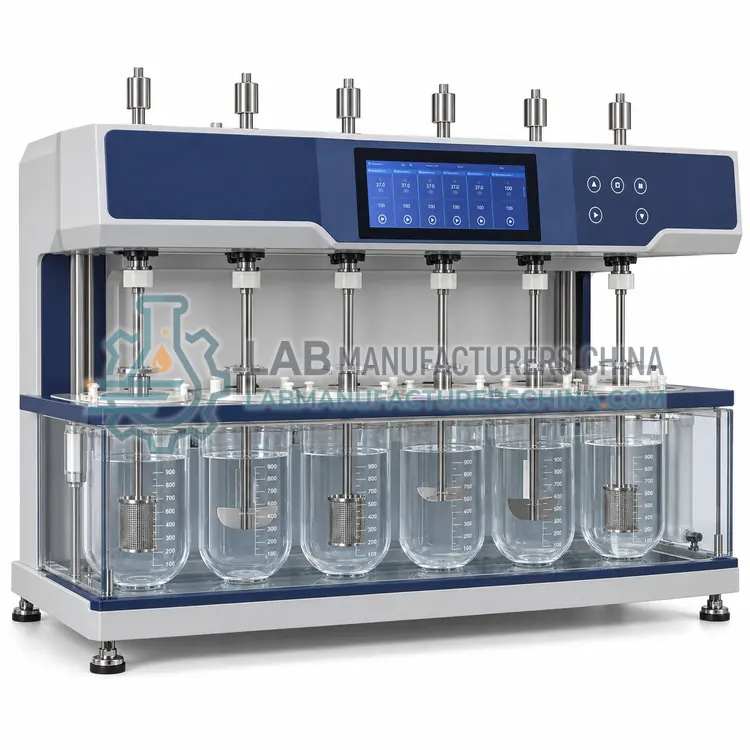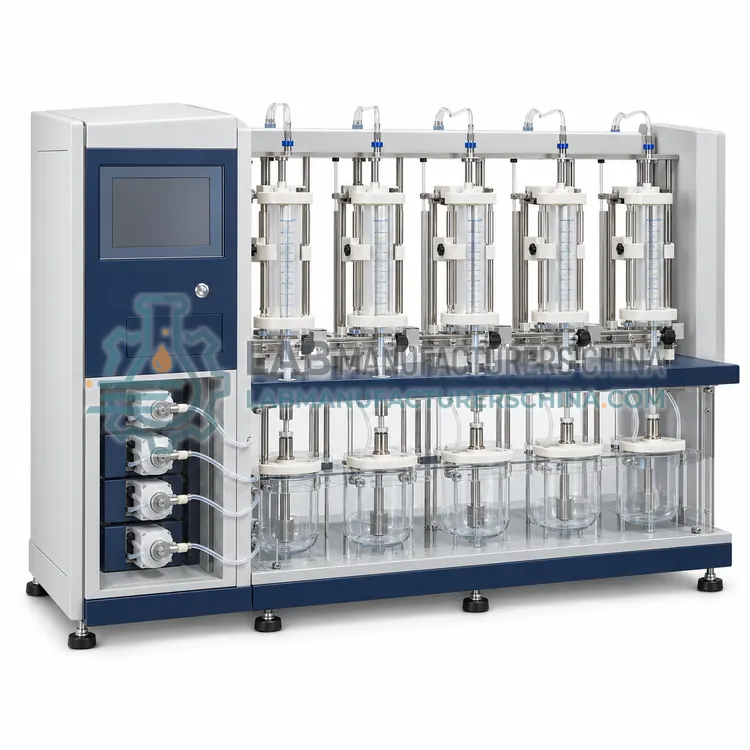
Open-Loop Flow-Through Dissolution System (USP Apparatus 4)
开环流通池溶出系统(USP 装置 4)
- CE (to be confirmed)
- +1
Welcome to Lab Manufacturers China — laboratory instruments direct from a Chinese manufacturer
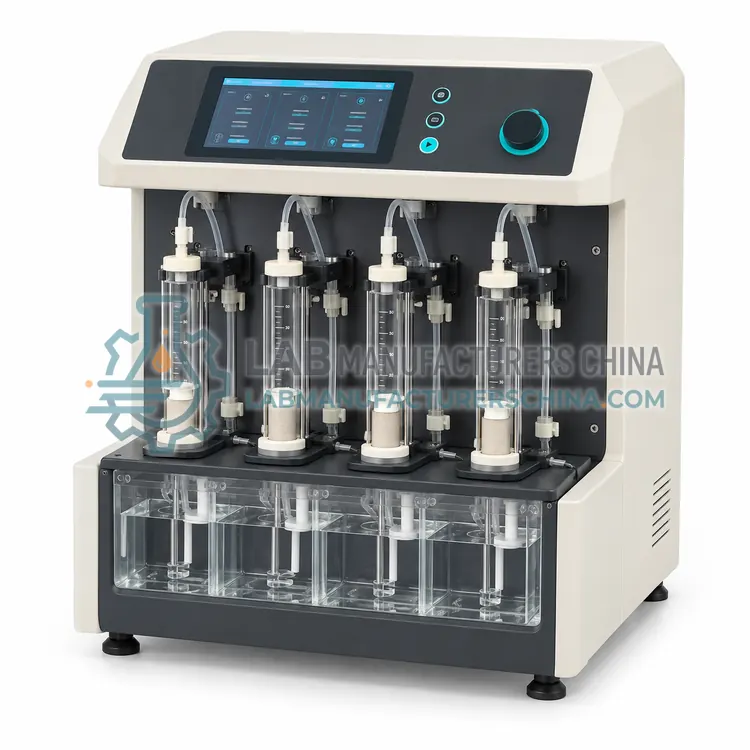
流通池溶出改装模块
Price on request — FOB / CIF quoted per order
Prices depend on configuration, quantity and destination port.
| Apparatus type | USP Apparatus 4, retrofit |
|---|---|
| Number of cells | 4 or 6 |
| Pump type | piston, pulsed |
| Flow rate | 4–16 mL/min |
| Pulse rate | 120 ± 10 pulses/min |
| Temperature control | 37.0 ± 0.5 °C |
By Lab Manufacturers China Technical TeamLast reviewed Standards: USP <711>, USP <1092>, Ph. Eur. 2.9.3
A retrofit flow-through module adds USP Apparatus 4 capability to a standard laboratory using a compact pump, cells and heater, without replacing an existing dissolution bath. It suits laboratories needing occasional flow-through tests with limited budget and bench space.
A retrofit flow-through module adds USP Apparatus 4 capability to a standard laboratory using a compact pump, cells and heater, without replacing an existing dissolution bath. It suits laboratories needing occasional flow-through tests with limited budget and bench space.
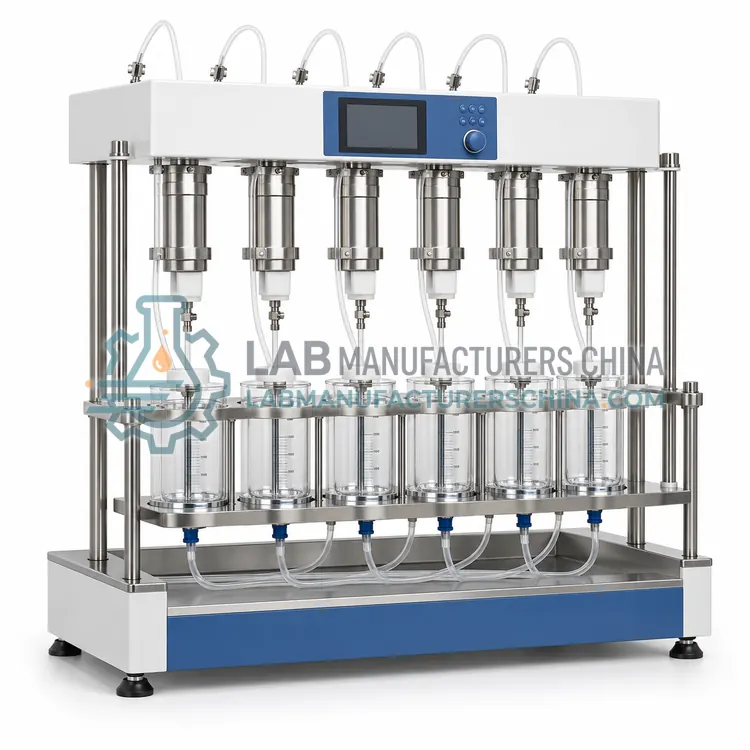
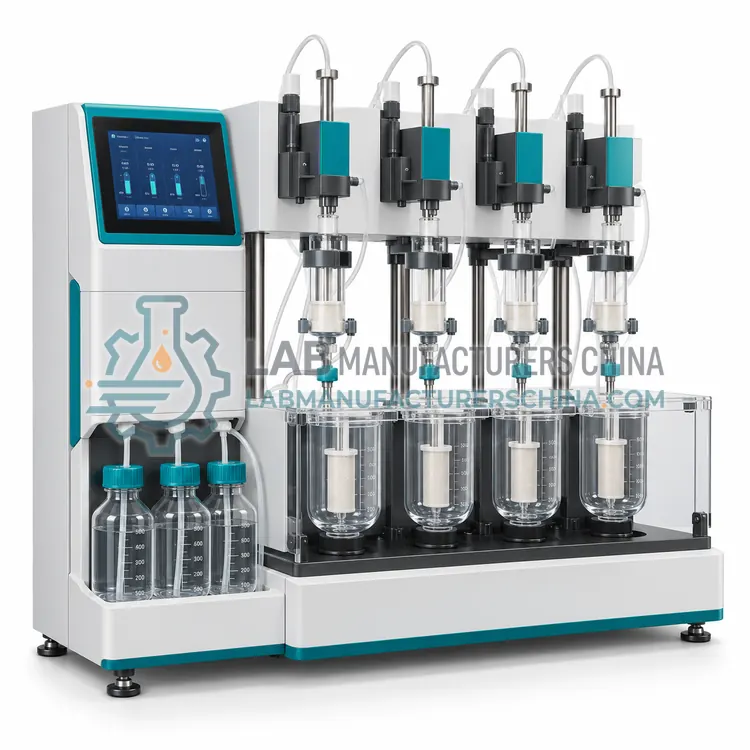
The retrofit module is a stand-alone pump unit with a set of cells that installs in an existing water bath or a separate thermostatted block. A single piston pump drives a manifold that splits flow to multiple cells, so flow is shared rather than individually controlled, which makes channel-to-channel verification particularly important. It supports open- or closed-loop operation, with cells in 12 mm and 22.6 mm diameter and standard bead beds. Because it is compact, it is used as a development tool or for occasional compendial methods. Limitations compared with fully automated systems are manual medium switching, manual sampling and limited data handling. Typical flow is 4–16 mL/min, and the heating block or bath maintains 37 °C. The module can reduce capital cost while still allowing laboratories to meet monograph requirements that call for Apparatus 4.
A flow-through system uses a piston pump to deliver medium at a controlled flow rate, typically 4–16 mL/min, with a sinusoidal pulse of 120 ± 10 pulses per minute, upward through a vertical cell. The dosage form sits on a bed of glass beads, which stabilize laminar flow, and a filter at the top retains particles. The medium can go once through the cell (open loop), so fresh solvent continually maintains sink conditions, or return to a reservoir (closed loop). Because the cell is stationary, hydrodynamics are mild and reproducible, and the medium can be changed programmatically to create pH profiles. Key components are the pump, cells of 12 or 22.6 mm diameter, a heated bath holding 37 °C, filter heads, and a collector or detector. Release follows diffusion and erosion kinetics, and flow rate determines the boundary layer thickness around the dosage form.
A typical flow-through cell dissolution module for retrofit configuration offers apparatus type of USP Apparatus 4, retrofit, number of cells of 4 or 6, pump type of piston, pulsed, flow rate of 4–16 mL/min, pulse rate of 120 ± 10 pulses/min and temperature control of 37.0 ± 0.5 °C. Values are indicative of the product class; the exact figures for each configuration are confirmed on the quotation and the calibration documents supplied with the instrument.
The Flow-Through Cell Dissolution Module for Retrofit is used in development laboratories, occasional compendial flow-through tests, teaching and training and method feasibility studies. Across the wider Flow-Through Systems class, laboratories also deploy it for extended-release product QC, poorly soluble drug testing and stent and implant release studies.
Relevant standards and methods include USP <711>, USP <1092>, Ph. Eur. 2.9.3, JP 6.10, ChP 0931, USP <724> and FDA Guidance on Dissolution Testing of Immediate Release Solid Oral Dosage Forms. Certification candidates for this model are CE and ISO 9001 manufacturing; each is to be confirmed for the specific configuration before shipment, and certificates are supplied only where they have been issued.
Degas media and prime the pump to remove air, since bubbles in cells cause flow variation and filter blockage. Verify flow rate gravimetrically and check pulse rate at installation and regularly. Use calibrated thermometers to confirm cell temperature at 37.0 ± 0.5 °C. Clean cells, beads and filters after each run and replace worn pump seals or check valves. Keep tubing lengths short to limit dead volume. Qualification should include IQ/OQ, flow calibration and dissolution performance verification using reference tablets. For regulated work, ensure software supports audit trail and data integrity.
Choose the retrofit module when flow-through tests are occasional and budget or space is limited. Specify cell sizes, number of cells, bath compatibility and whether fraction collection is needed. For regulated high-volume flow-through testing, a dedicated automated system is more appropriate. Confirm bath compatibility with the supplier.
Choose by the nature of the product and the regulatory requirement. Open-loop suits poorly soluble actives and extended-release forms needing sink conditions; closed-loop suits low-dose tablets and small media volumes. Implants, stents and microspheres need specialty cells and low flow rates. For high throughput or unattended runs, pick an automated multi-channel system with fraction collection and audit trail. A retrofit module is the lowest-cost route to meet an Apparatus 4 monograph. Evaluate flow accuracy (±5% or better), pulse rate control, cell diameter options, wetted-part material, number of channels and software data integrity features. Also consider medium volume and waste because open-loop runs can consume many liters.
| Apparatus type | USP Apparatus 4, retrofit |
|---|---|
| Number of cells | 4 or 6 |
| Pump type | piston, pulsed |
| Flow rate | 4–16 mL/min |
| Pulse rate | 120 ± 10 pulses/min |
| Temperature control | 37.0 ± 0.5 °C |
| Cell diameter | 12 mm and 22.6 mm |
| Sampling | manual or fraction collector |
| Footprint | about 0.4 m² |
| Power supply | 220 V AC, 50/60 Hz, about 0.5 kW |
Indicative values for this product class. Final specifications are confirmed on the quotation and in the calibration documents supplied with the instrument.
Often yes, if the bath can hold the cells at 37 ± 0.5 °C and has suitable geometry. Compatibility with the specific bath should be confirmed before purchase.
A retrofit module typically has manual medium switching, manual sampling and basic controls, and shared pump flow across cells. It is adequate for development and occasional tests but less efficient for high-volume regulated work.
Many modules accept add-on fraction collectors, UV flow cells and control software, so laboratories can grow capability in stages. Confirm the upgrade path at the quotation stage.
It is a dissolution apparatus, USP Apparatus 4, in which medium is pumped through a vertical cell holding the dosage form. The medium either passes once (open loop) or recirculates (closed loop), providing gentle, reproducible hydrodynamics.
It is preferred for poorly soluble drugs needing sink conditions, for implants and stents, for extended-release forms, and for testing where medium changes are needed without handling the sample.
Compendial methods typically use 4, 8 or 16 mL/min with a pulsation of 120 ± 10 pulses per minute. Specialty methods for implants may use lower flow rates of 0.1 to 4 mL/min.
开环流通池溶出系统(USP 装置 4)
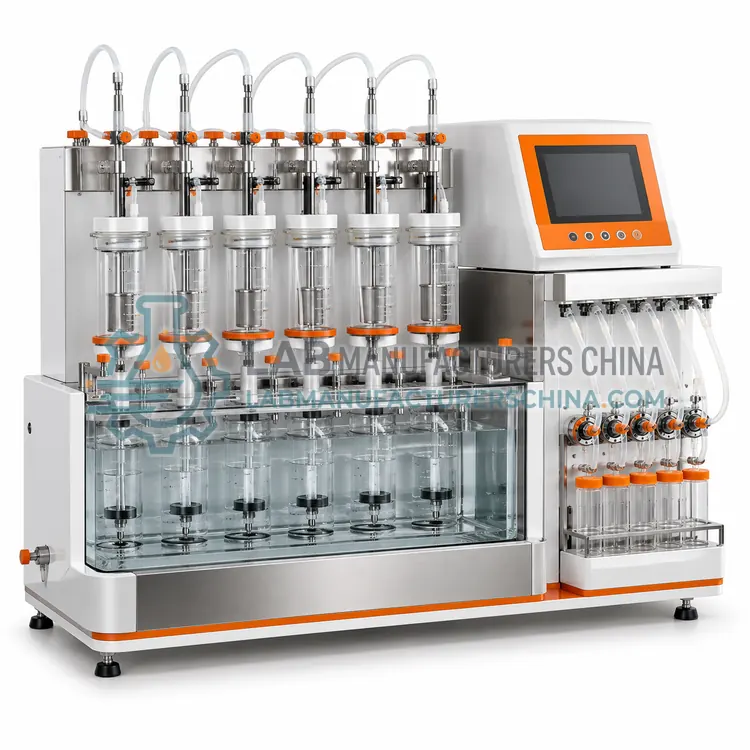
带 HPLC 接口的自动多通道流通池溶出系统