Lab Manufacturers China

Glass Bioreactors

玻璃生物反应器

GLB · Bioreactors · 5 models

By Lab Manufacturers China Technical TeamLast reviewed Standards: ISO 9001, USP <87>, USP <88>

Standards referenced

  • ISO 9001
  • USP <87>
  • USP <88>
  • IEC 61010-1
  • ISO 11133
  • GB/T 150

What are Glass Bioreactors?

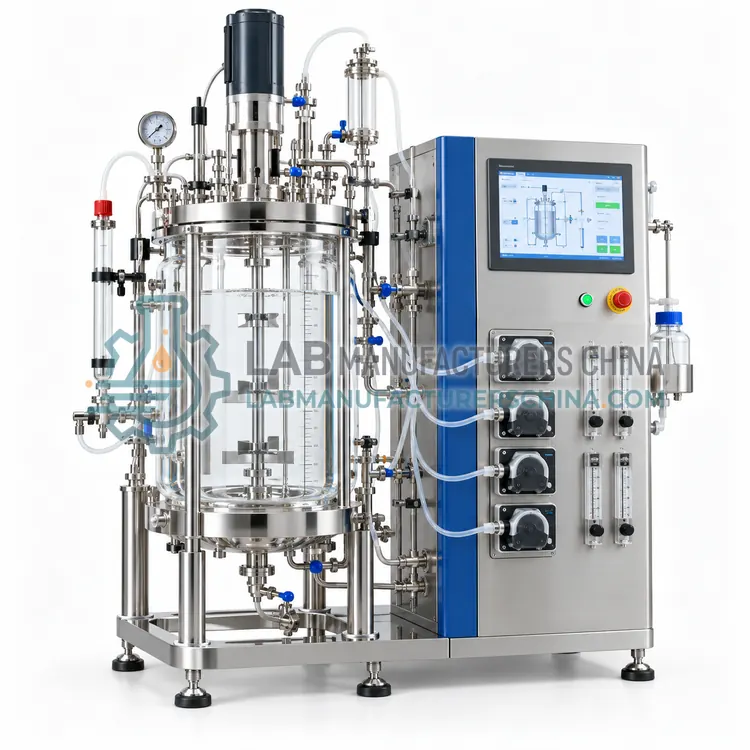
Glass bioreactors are small cultivation vessels with a borosilicate body that allows direct observation of the culture. They are used for process development, cell culture and small-scale production where visibility and rapid reconfiguration matter.

5 models of Glass Bioreactors

The 5 models below are current configurations; specifications are confirmed on quotation.

Benchtop Glass Stirred-Tank Bioreactor

台式玻璃搅拌罐生物反应器

  • GLB-0001
  • Glass Bioreactors
  • CE (to be confirmed)
  • ISO 9001 manufacturing (to be confirmed)
  • IEC 61010-1 compliance (to be confirmed)
Working volume:
0.5–10 L
Vessel material:
Borosilicate glass 3.3
Temperature range:
Ambient +5 to 60 °C, ±0.2 °C
pH control:
2–12, ±0.05
Dissolved oxygen control:
0–100% with air or O2 enrichment
Agitation:
50–1,200 rpm

A benchtop glass stirred-tank bioreactor is a transparent vessel with an impeller, probes and gas supply for small-scale cultivation. It is the standard development tool for cell culture and microbial fermentation studies.

Request a quote
View details

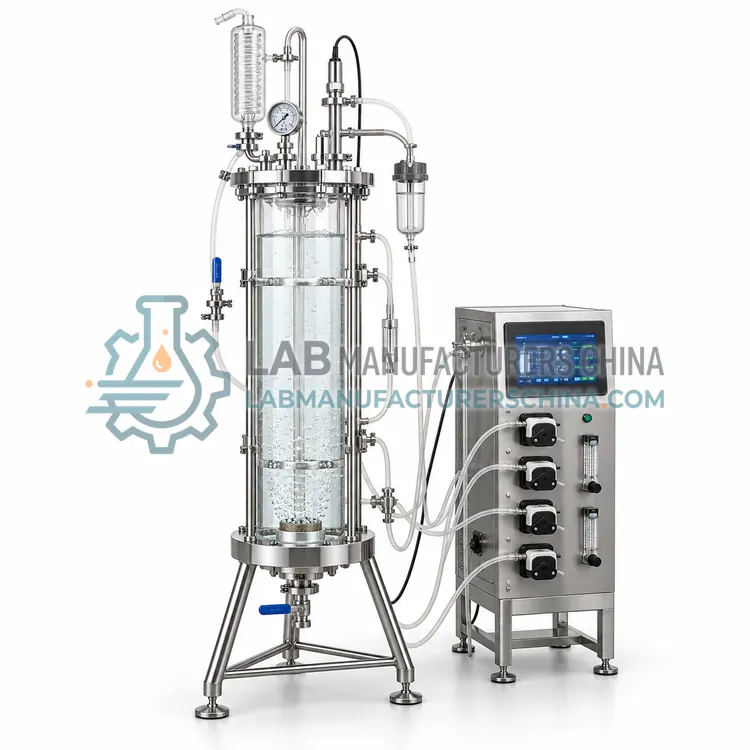
Glass Airlift Bioreactor

玻璃气升式生物反应器

  • GLB-0002
  • Glass Bioreactors
  • CE (to be confirmed)
  • ISO 9001 manufacturing (to be confirmed)
  • IEC 61010-1 compliance (to be confirmed)
Working volume:
0.5–20 L
Column geometry:
Divided glass column with draft tube
Aeration rate:
0.5–2 vvm
Temperature range:
Ambient +5 to 60 °C
pH control:
2–12, ±0.05
Dissolved oxygen control:
Via gas flow or composition

A glass airlift bioreactor uses gas-driven circulation in a tall transparent column, providing gentle low-shear mixing and clearly visible flow. It suits shear-sensitive cells, filamentous organisms, algae and teaching demonstrations of circulation.

Request a quote
View details

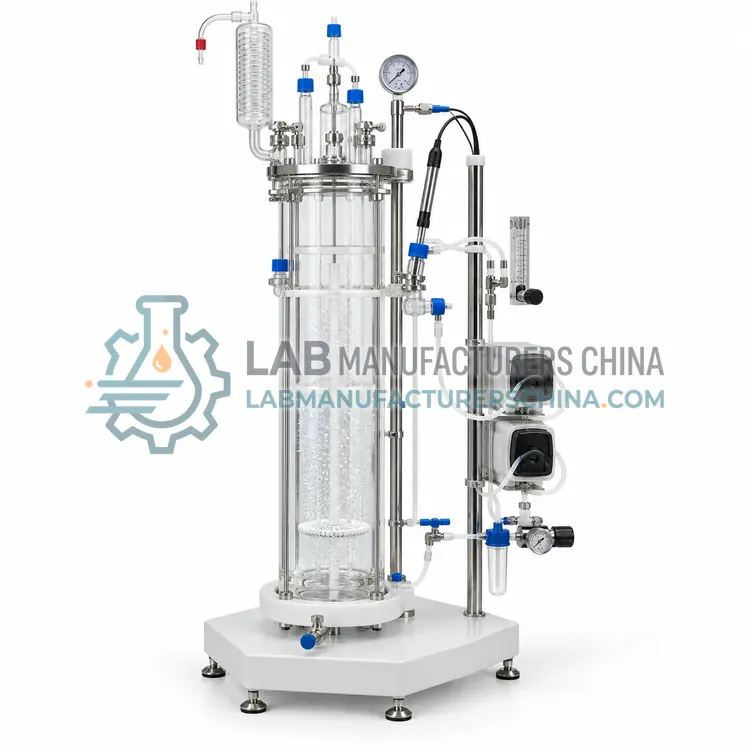
Glass Bubble Column Bioreactor

玻璃鼓泡柱生物反应器

  • GLB-0003
  • Glass Bioreactors
  • CE (to be confirmed)
  • ISO 9001 manufacturing (to be confirmed)
  • IEC 61010-1 compliance (to be confirmed)
Working volume:
0.5–20 L
Column type:
Simple bubble column
Aeration rate:
0.5–3 vvm
Temperature range:
Ambient +5 to 60 °C
pH control:
2–12, ±0.05
Dissolved oxygen control:
Via gas flow or enrichment

A glass bubble column bioreactor aerates and mixes the culture with gas bubbles rising through a simple transparent column. It offers gentle, uniform mixing with no internal parts and is easy to observe.

Request a quote
View details

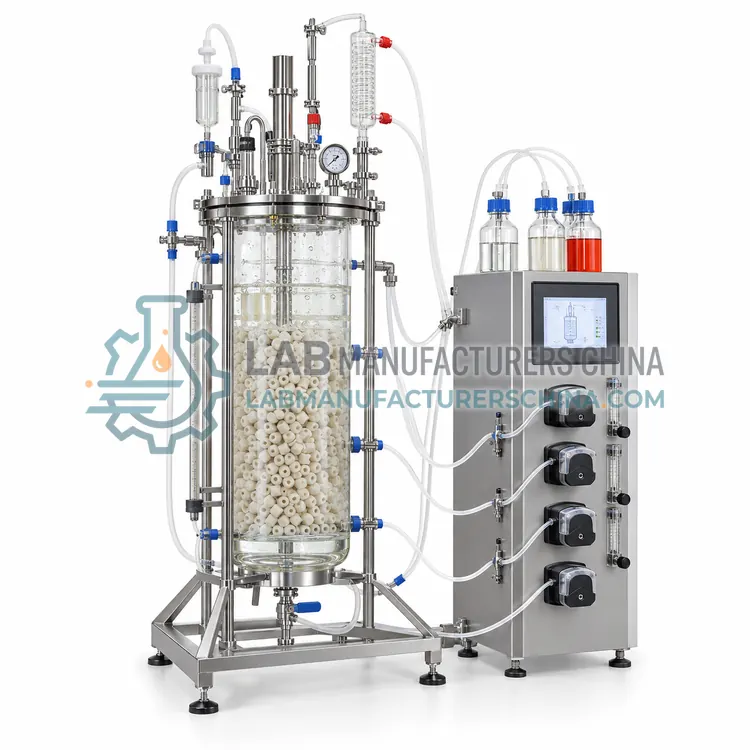
Glass Packed-Bed Bioreactor

玻璃填充床生物反应器

  • GLB-0004
  • Glass Bioreactors
  • CE (to be confirmed)
  • ISO 9001 manufacturing (to be confirmed)
  • ISO 13485 manufacturing (to be confirmed)
Bed volume:
0.2–10 L
Carrier type:
Porous glass, ceramic or polymer beads
Surface area per volume:
Up to several thousand cm²/L
Flow rate:
0.5–20 L/h recirculation
Temperature range:
Ambient +5 to 45 °C
pH control:
6.5–8.0, ±0.05

A glass packed-bed bioreactor grows adherent cells on carriers held in a transparent column while medium flows through. It provides a high surface area per volume and low shear for anchorage-dependent cells.

Request a quote
View details

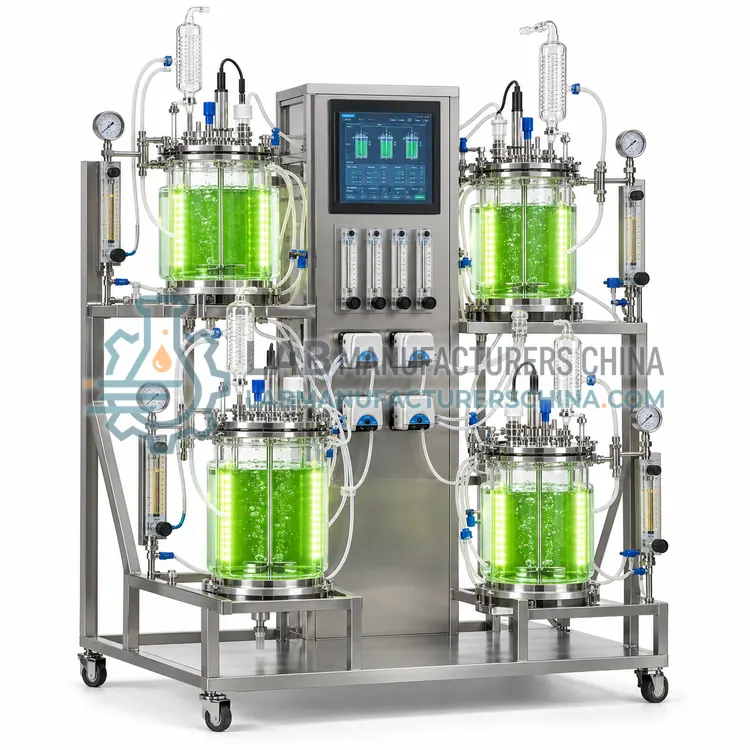
Glass Photobioreactor

玻璃光生物反应器

  • GLB-0005
  • Glass Bioreactors
  • CE (to be confirmed)
  • ISO 9001 manufacturing (to be confirmed)
  • IEC 61010-1 compliance (to be confirmed)
Working volume:
0.5–50 L
Light source:
LED panels or tubes, 400–700 nm
Light intensity:
50–2,000 µmol/m²/s (adjustable)
Photoperiod:
Programmable, 0–24 h
Temperature range:
15–45 °C, ±0.5 °C
CO2 supply:
Sparged, 0.5–5% in air

A glass photobioreactor cultivates photosynthetic organisms with controlled light, carbon dioxide, mixing and temperature in a transparent vessel. It is widely used in research laboratories for microalgae, cyanobacteria and plant cell research.

Request a quote
View details

Compare Glass Bioreactors models

ModelWorking volumeTemperature rangepH controlDissolved oxygen controlSterilization
Benchtop Glass Stirred-Tank BioreactorGLB-00010.5–10 LAmbient +5 to 60 °C, ±0.2 °C2–12, ±0.050–100% with air or O2 enrichmentAutoclave assembly
Glass Airlift BioreactorGLB-00020.5–20 LAmbient +5 to 60 °C2–12, ±0.05Via gas flow or compositionAutoclave assembly
Glass Bubble Column BioreactorGLB-00030.5–20 LAmbient +5 to 60 °C2–12, ±0.05Via gas flow or enrichmentAutoclave assembly
Glass Packed-Bed BioreactorGLB-0004—Ambient +5 to 45 °C6.5–8.0, ±0.05Via gas exchangerAutoclave assembly
Glass PhotobioreactorGLB-00050.5–50 L15–45 °C, ±0.5 °CVia CO2 addition, ±0.05——

Indicative values for this product class. Final specifications are confirmed on the quotation and in the calibration documents supplied with the instrument.

How do Glass Bioreactors work?

A glass bioreactor uses a transparent vessel so that mixing, foam, color and biomass can be observed directly during culture. Borosilicate glass resists thermal shock and most cleaning agents, and a detachable headplate carries the agitator, sparger, probes and ports. Temperature is controlled by a water jacket, a heating blanket or a water bath, pH is adjusted by dosing acid, base or carbon dioxide, and dissolved oxygen is held by adjusting gas flow, oxygen fraction or agitation speed. Mixing may be by impeller, by gas-driven circulation in airlift or bubble column designs, or by gentle rocking for sensitive cells. Glass vessels are usually sterilized in an autoclave, which limits their practical size, but they allow rapid changes of impeller, sparger and sensor configuration between experiments.

Which Glass Bioreactors variants are available?

  • Benchtop Glass Stirred-Tank Bioreactor — A benchtop glass stirred-tank bioreactor is a transparent vessel with an impeller, probes and gas supply for small-scale cultivation.
  • Glass Airlift Bioreactor — A glass airlift bioreactor uses gas-driven circulation in a tall transparent column, providing gentle low-shear mixing and clearly visible flow.
  • Glass Bubble Column Bioreactor — A glass bubble column bioreactor aerates and mixes the culture with gas bubbles rising through a simple transparent column.
  • Glass Packed-Bed Bioreactor — A glass packed-bed bioreactor grows adherent cells on carriers held in a transparent column while medium flows through.
  • Glass Photobioreactor — A glass photobioreactor cultivates photosynthetic organisms with controlled light, carbon dioxide, mixing and temperature in a transparent vessel.

How do I choose the right variant?

Choose a glass bioreactor when you need to see the culture, change configuration quickly or work at small volumes. Select the mixing principle from the cell type and oxygen demand: stirred designs give flexible power input, airlift and bubble columns suit shear-sensitive cultures, packed-bed designs suit adherent cells on carriers, and photobioreactors suit photosynthetic organisms. Confirm the working volume and headspace, the number and type of ports, and whether the headplate can accommodate the probes and feeds you need. Check the temperature control method, since a water jacket gives more uniform heating than a blanket, and confirm how the vessel is sterilized. Verify that materials and connectors suit autoclaving and that spare headplates and vessels allow parallel or rapid sequential experiments.

Where are Glass Bioreactors used?

Glass Bioreactors are specified in process development and scale-down models, cell culture optimization, microbial fermentation studies, algae and photobioreactor research and teaching and training.

Which standards and certifications apply?

Work with Glass Bioreactors is commonly governed by ISO 9001, USP <87>, USP <88>, IEC 61010-1, ISO 11133 and GB/T 150. Instrument certifications such as CE marking are confirmed per configuration and never assumed.

What are the key considerations before purchase?

Inspect glass for chips or cracks before each run, because even a small flaw can fail under autoclaving or pressure. Assemble the headplate carefully so that probes do not touch the impeller, and check that all ports are sealed. Calibrate pH and dissolved oxygen probes before sterilization and confirm they survive the cycle. Use a protective shield or cabinet where pressure or a fragile vessel could present a hazard. Clean glass promptly to avoid baked-on residue, and avoid strong alkalis that etch the surface over time. Replace gaskets and O-rings on a schedule, and keep a log of sterilization cycles for each vessel and headplate.

Frequently asked questions about Glass Bioreactors

It cultivates cells or microorganisms at small scale while allowing direct observation. Uses include process development, scale-down modelling of production vessels, cell culture optimization, algae research and teaching, where visibility and quick configuration changes are valuable.

Need help specifying Glass Bioreactors?

Request a quote