FPLC Protein Purification System
FPLC 蛋白纯化系统
- SKU PRA-0005
- Protein Analysis
- CE (to be confirmed)
- ISO 9001 manufacturing (to be confirmed)
Price on request — FOB / CIF quoted per order
Prices depend on configuration, quantity and destination port.
Key specifications
| Flow rate range | 0.01–25 mL/min (up to 50 optional) |
|---|---|
| Maximum pressure | up to 20–40 bar |
| Gradient accuracy | ±0.5 % B |
| Flow accuracy | ±1 % |
| UV detection | Multi-wavelength, 190–700 nm |
| Conductivity range | 0.01–999.99 mS/cm |
Request a quote Download brochure · to be provided
By Lab Manufacturers China Technical TeamLast reviewed Standards: IEC 61010-1, IEC 61010-2-101, IEC 61326-2-6
What is the FPLC Protein Purification System?
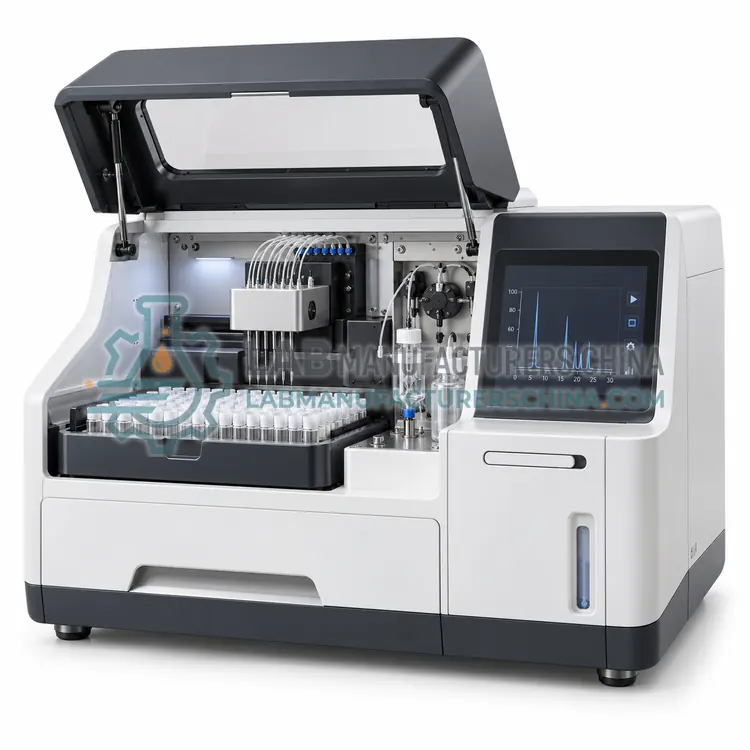
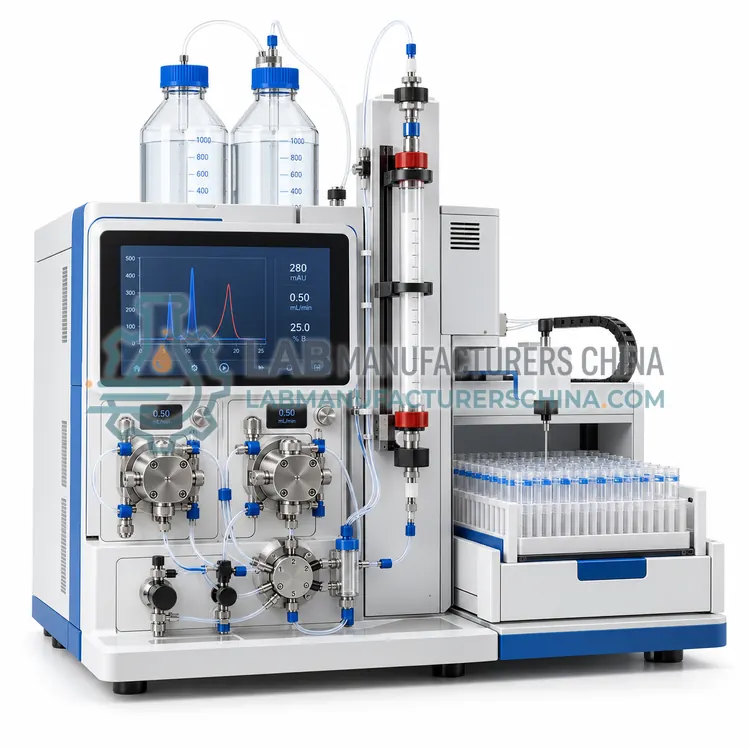
An FPLC protein purification system pumps buffers through chromatography columns at up to 25 or 50 mL/min and monitors UV absorbance, conductivity and pH to purify proteins by affinity, ion exchange or size exclusion. It suits research and process development laboratories purifying milligram to gram quantities.
What is the FPLC Protein Purification System?
An FPLC protein purification system pumps buffers through chromatography columns at up to 25 or 50 mL/min and monitors UV absorbance, conductivity and pH to purify proteins by affinity, ion exchange or size exclusion. It suits research and process development laboratories purifying milligram to gram quantities.
Overview
An FPLC system uses low-pressure gradient pumps, typically operating up to 20 to 40 bar, to deliver precise buffer mixtures with flow rates from 0.01 to 25 mL/min or higher. A sample is loaded through a sample pump, injection valve or superloop, and proteins bind to a column such as Ni-NTA affinity, ion exchange or size exclusion media. Detectors include UV at 280 nm with multiple wavelengths, conductivity and pH, and a fraction collector collects peaks based on absorbance thresholds or volume. Software enables method programming with gradient steps, column equilibration, scouting and data logging. Biocompatible flow paths of PEEK and titanium avoid metal ion leaching that could harm proteins. Pressure alarms protect columns, and cold-room compatible designs are available.
How does it work?
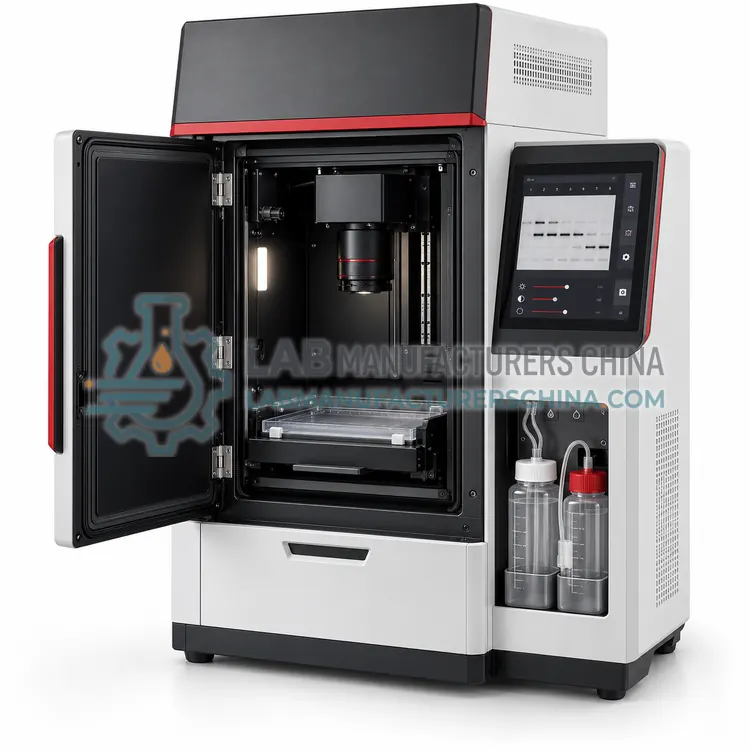
Protein analysis relies on several complementary physical principles. Microplate readers measure absorbance, fluorescence or luminescence from wells to quantify protein by colorimetric assays such as BCA and Bradford or to read ELISA signals, using monochromators or filters and photomultiplier tubes or photodiodes. Electrophoretic systems separate proteins by size, charge or isoelectric point; in capillary systems, SDS-coated proteins migrate through a sieving polymer under high voltage and are detected by UV absorbance or laser-induced fluorescence. Western blot imagers capture chemiluminescent or fluorescent signals from membranes using cooled CCD cameras with long exposure. Chromatography systems such as FPLC pump buffers through columns to bind and elute proteins by affinity, ion exchange or size exclusion, with UV, conductivity and pH monitors guiding fraction collection.
What are the key features?
- Gradient pumps deliver flow from 0.01 to 25 mL/min with low pulsation.
- UV, conductivity and pH monitors guide purification in real time.
- Biocompatible PEEK and titanium flow paths protect protein integrity.
- Fraction collector triggered by peak, volume or threshold.
- Method programming supports gradients, scouting and column equilibration.
- Pressure alarms and cold-room compatible design.
What are the technical specifications?
A typical fplc protein purification system configuration offers flow rate range of 0.01–25 mL/min (up to 50 optional), maximum pressure of up to 20–40 bar, gradient accuracy of ±0.5 % B, flow accuracy of ±1 %, UV detection of Multi-wavelength, 190–700 nm and conductivity range of 0.01–999.99 mS/cm. Values are indicative of the product class; the exact figures for each configuration are confirmed on the quotation and the calibration documents supplied with the instrument.
Which applications is it used for?
The FPLC Protein Purification System is used in his-tag protein purification, antibody purification by Protein A, ion exchange polishing and size exclusion analysis and desalting. Across the wider Protein Analysis class, laboratories also deploy it for ELISA and immunoassay readout, protein concentration determination and antibody purity and size variant analysis.
Which standards and certifications apply?
Relevant standards and methods include IEC 61010-1, IEC 61010-2-101, IEC 61326-2-6, USP <1053>, USP <1055>, Ph. Eur. 2.2.31 and ICH Q6B. Certification candidates for this model are CE and ISO 9001 manufacturing; each is to be confirmed for the specific configuration before shipment, and certificates are supplied only where they have been issued.
Protein instruments depend on good sample handling: keep samples cold, use protease inhibitors and avoid repeated freeze-thaw cycles. Microplate readers need periodic verification of wavelength accuracy and absorbance linearity with reference filters or dye solutions. Capillary systems require clean buffers, filtered samples and replacement of cartridges on schedule. Imaging systems should be kept in a dust-free, temperature-stable location, and cameras need flat-field correction. FPLC columns must be stored in recommended solutions, and pump seals replaced regularly. Regulated laboratories should perform installation and operational qualification, and consider 21 CFR Part 11 compliant software.
How do I select the right FPLC Protein Purification System?
Choose an FPLC system for purifying proteins at milligram to gram scale under gentle, biocompatible conditions. Specify flow range, pressure, detectors, fraction collector, sample loading method and cold-room use. For analytical small-molecule separation, an HPLC system is more appropriate.
How does it compare with other Protein Analysis variants?
Define the analytical goal first: quantification and ELISA point to microplate readers, purity and size variants to capillary electrophoresis, expression and semi-quantitative detection to Western blot imaging, and isolation of milligram quantities to chromatography systems. Check sensitivity and dynamic range against your lowest expected signal, for example pg/mL for ELISA or ng per band for blotting. Consider throughput and automation, such as 96-sample capillary runs or plate stackers. For purification, specify column pressure limits, flow rate range and detector options. Confirm compatibility with your assay formats and reagents, and evaluate software for data integrity, regulatory audit trail and export. Factor in consumable costs, such as capillary cartridges or detection reagents, and available training.
Full specifications
| Flow rate range | 0.01–25 mL/min (up to 50 optional) |
|---|---|
| Maximum pressure | up to 20–40 bar |
| Gradient accuracy | ±0.5 % B |
| Flow accuracy | ±1 % |
| UV detection | Multi-wavelength, 190–700 nm |
| Conductivity range | 0.01–999.99 mS/cm |
| pH monitor range | pH 0–14 |
| Fraction collector capacity | Up to 175 × 15 mm tubes |
| Wetted materials | PEEK, titanium, PTFE |
| Power supply | 100–240 V, 50/60 Hz |
Indicative values for this product class. Final specifications are confirmed on the quotation and in the calibration documents supplied with the instrument.
Applications
- His-tag protein purification
- Antibody purification by Protein A
- Ion exchange polishing
- Size exclusion analysis and desalting
Key features
- Gradient pumps deliver flow from 0.01 to 25 mL/min with low pulsation.
- UV, conductivity and pH monitors guide purification in real time.
- Biocompatible PEEK and titanium flow paths protect protein integrity.
- Fraction collector triggered by peak, volume or threshold.
- Method programming supports gradients, scouting and column equilibration.
- Pressure alarms and cold-room compatible design.
Frequently asked questions about FPLC Protein Purification System
FPLC operates at lower pressure with biocompatible materials and larger columns, intended for preparative purification of proteins under native conditions. HPLC uses high pressure, smaller particles and analytical columns, often with organic solvents that can denature proteins.
For His-tagged proteins, start with immobilized metal affinity chromatography such as Ni-NTA, followed by size exclusion as a polishing step. Antibodies typically use Protein A or G affinity, then ion exchange or size exclusion for polishing.
Flush with water and 20 percent ethanol after use, filter all buffers and samples, replace pump seals and check valves on schedule, and calibrate pH and conductivity monitors regularly. Store columns according to their instructions to prevent microbial growth.
Common instruments include microplate readers for protein quantification and ELISA, capillary electrophoresis systems for purity and size variants, Western blot imagers for expression detection and FPLC systems for purification. Choice depends on the information needed, sensitivity and sample number.
BCA relies on copper reduction by protein and is compatible with most detergents but sensitive to reducing agents. Bradford uses Coomassie dye binding, is faster and tolerates reducing agents, but is incompatible with many detergents and varies more between proteins.
CE-SDS is capillary electrophoresis of SDS-denatured proteins in a sieving matrix, separating them by molecular weight. It replaces slab SDS-PAGE in biopharma for quantitative purity and fragment analysis of antibodies, giving reproducible, automated and validated results.
Related models
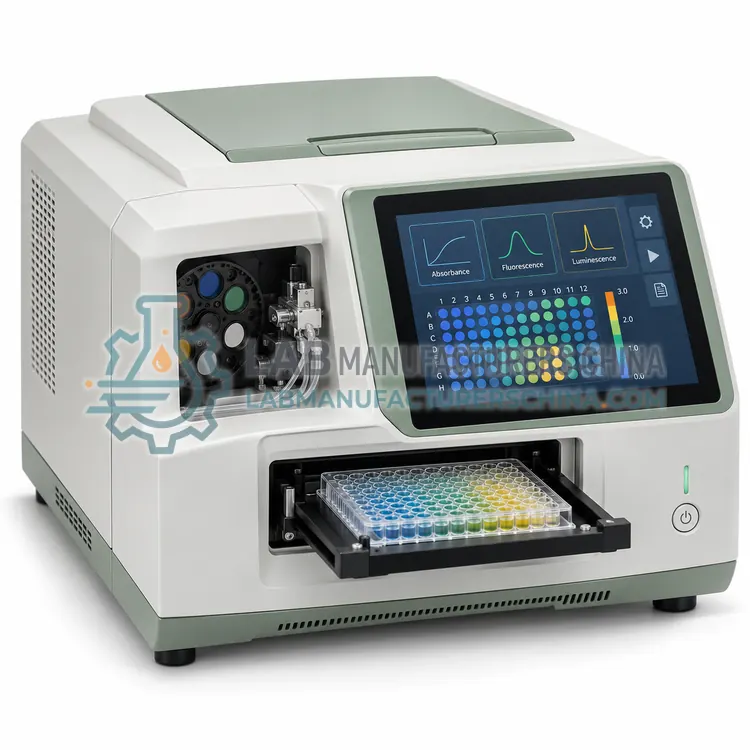
Multimode Microplate Reader (Absorbance, Fluorescence, Luminescence)
多功能酶标仪(吸光度、荧光、发光)
- CE (to be confirmed)
- +2