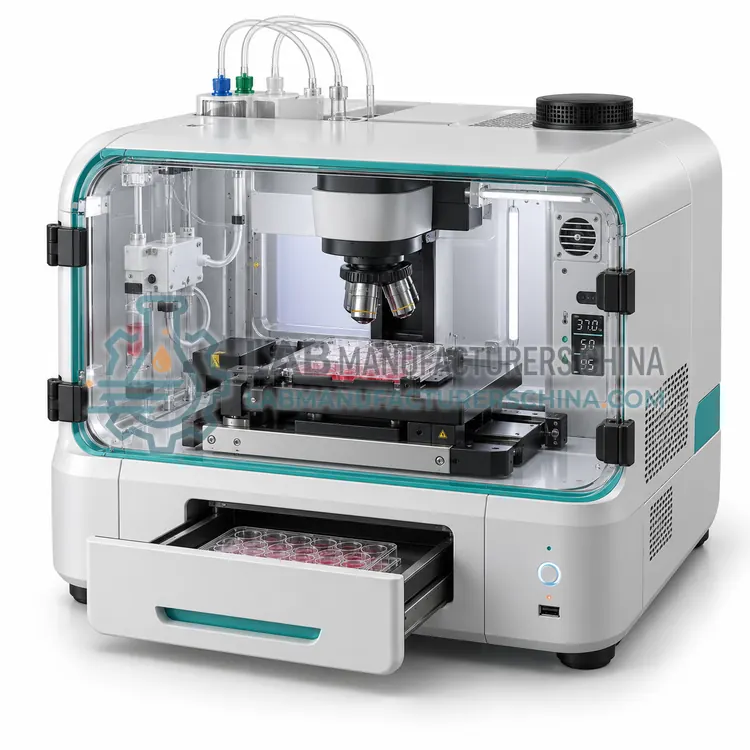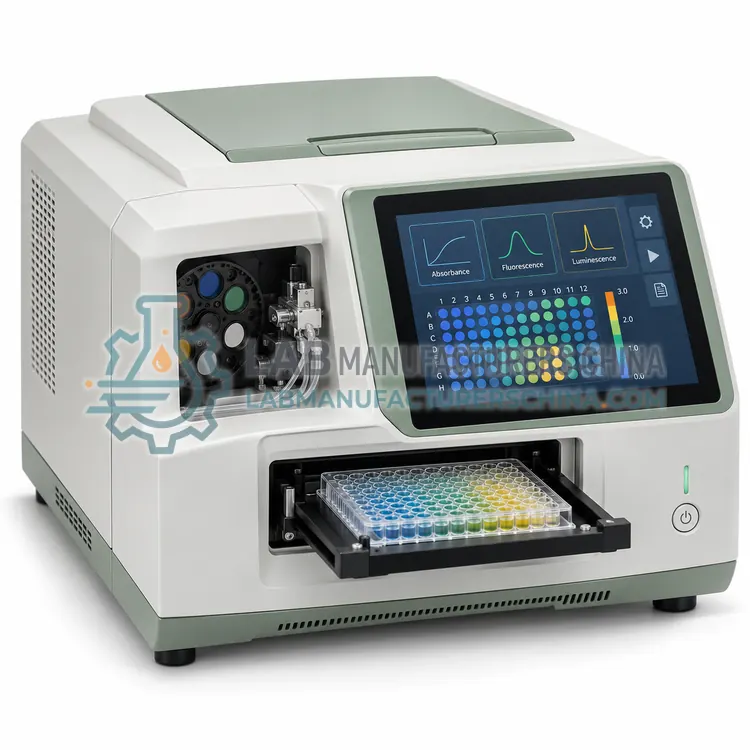
Multimode Microplate Reader (Absorbance, Fluorescence, Luminescence)
多功能酶标仪(吸光度、荧光、发光)
- CE (to be confirmed)
- +2
Welcome to Lab Manufacturers China — laboratory instruments direct from a Chinese manufacturer
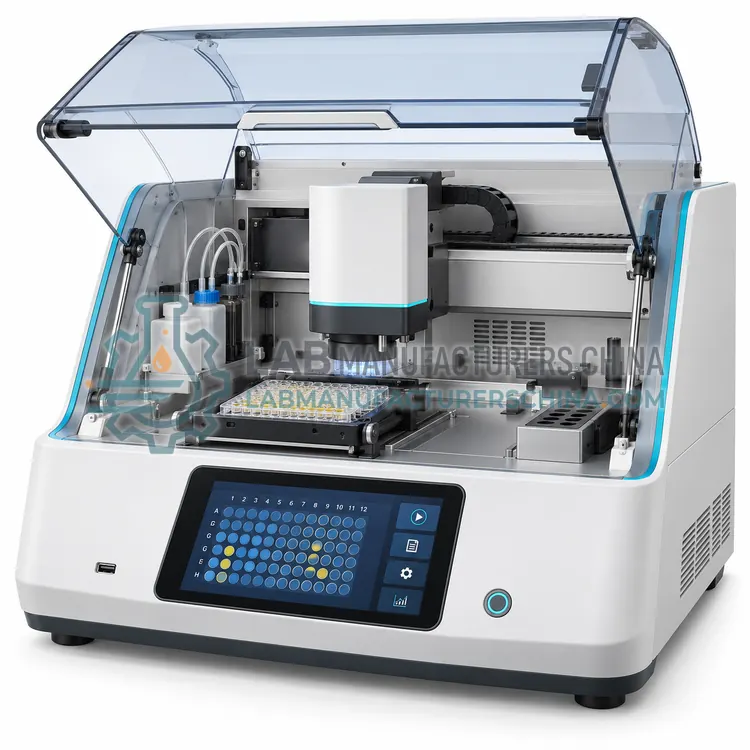
ELISA 吸光度酶标仪
Price on request — FOB / CIF quoted per order
Prices depend on configuration, quantity and destination port.
| Plate formats | 6- to 384-well |
|---|---|
| Wavelength selection | Filters: 405, 450, 492, 562, 620 nm (user-changeable) |
| Wavelength range (monochromator option) | 230–1000 nm |
| Absorbance range | 0–4.0 OD |
| Linear range | 0–3.0 OD |
| Accuracy | ±1 % at 2.0 OD |
By Lab Manufacturers China Technical TeamLast reviewed Standards: IEC 61010-1, IEC 61010-2-101, IEC 61326-2-6
An absorbance microplate reader measures optical density in 96- or 384-well plates at selected wavelengths, most commonly 450 nm for ELISA and 562 nm for BCA assays. It is the right choice for laboratories running colorimetric immunoassays and protein quantification without fluorescence or luminescence needs.
An absorbance microplate reader measures optical density in 96- or 384-well plates at selected wavelengths, most commonly 450 nm for ELISA and 562 nm for BCA assays. It is the right choice for laboratories running colorimetric immunoassays and protein quantification without fluorescence or luminescence needs.
An absorbance reader passes light from a tungsten-halogen or xenon flash lamp through a filter wheel or monochromator and then through each well, where a photodiode records transmitted intensity. Optical density is calculated against blank wells using the Beer–Lambert relationship. Filter-based models cover typical assay wavelengths such as 405, 450, 492, 562, 595 and 620 nm, while monochromator versions scan 230 to 1000 nm. Linear range typically extends to 3.0 OD with accuracy of ±1 percent. Reading a 96-well plate takes roughly 5 to 15 seconds, and kinetic reads and shaking options support enzyme activity assays. Path-length correction normalizes volume differences. Plate handling supports flat-bottom, round-bottom and, on some models, cuvette or microvolume accessories. Software includes standard curve fitting with four-parameter logistic models.
Protein analysis relies on several complementary physical principles. Microplate readers measure absorbance, fluorescence or luminescence from wells to quantify protein by colorimetric assays such as BCA and Bradford or to read ELISA signals, using monochromators or filters and photomultiplier tubes or photodiodes. Electrophoretic systems separate proteins by size, charge or isoelectric point; in capillary systems, SDS-coated proteins migrate through a sieving polymer under high voltage and are detected by UV absorbance or laser-induced fluorescence. Western blot imagers capture chemiluminescent or fluorescent signals from membranes using cooled CCD cameras with long exposure. Chromatography systems such as FPLC pump buffers through columns to bind and elute proteins by affinity, ion exchange or size exclusion, with UV, conductivity and pH monitors guiding fraction collection.
A typical absorbance microplate reader for elisa configuration offers plate formats of 6- to 384-well, wavelength selection of Filters: 405, 450, 492, 562, 620 nm (user-changeable), wavelength range (monochromator option) of 230–1000 nm, absorbance range of 0–4.0 OD, linear range of 0–3.0 OD and accuracy of ±1 % at 2.0 OD. Values are indicative of the product class; the exact figures for each configuration are confirmed on the quotation and the calibration documents supplied with the instrument.
The Absorbance Microplate Reader for ELISA is used in ELISA for cytokines and antibodies, BCA and Bradford protein quantification, enzyme kinetics and microbial growth and cell viability assays (MTT). Across the wider Protein Analysis class, laboratories also deploy it for ELISA and immunoassay readout, protein concentration determination and antibody purity and size variant analysis.
Relevant standards and methods include IEC 61010-1, IEC 61010-2-101, IEC 61326-2-6, USP <1053>, USP <1055>, Ph. Eur. 2.2.31 and ICH Q6B. Certification candidates for this model are CE, ISO 9001 manufacturing and IEC 61010-2-101 test report; each is to be confirmed for the specific configuration before shipment, and certificates are supplied only where they have been issued.
Protein instruments depend on good sample handling: keep samples cold, use protease inhibitors and avoid repeated freeze-thaw cycles. Microplate readers need periodic verification of wavelength accuracy and absorbance linearity with reference filters or dye solutions. Capillary systems require clean buffers, filtered samples and replacement of cartridges on schedule. Imaging systems should be kept in a dust-free, temperature-stable location, and cameras need flat-field correction. FPLC columns must be stored in recommended solutions, and pump seals replaced regularly. Regulated laboratories should perform installation and operational qualification, and consider 21 CFR Part 11 compliant software.
Choose an absorbance reader when assays are colorimetric and budget is limited. Specify wavelengths required, plate formats, incubation, shaking and software features. If you need fluorescence or luminescence such as luciferase or fluorescent immunoassays, choose a multimode reader instead.
Define the analytical goal first: quantification and ELISA point to microplate readers, purity and size variants to capillary electrophoresis, expression and semi-quantitative detection to Western blot imaging, and isolation of milligram quantities to chromatography systems. Check sensitivity and dynamic range against your lowest expected signal, for example pg/mL for ELISA or ng per band for blotting. Consider throughput and automation, such as 96-sample capillary runs or plate stackers. For purification, specify column pressure limits, flow rate range and detector options. Confirm compatibility with your assay formats and reagents, and evaluate software for data integrity, regulatory audit trail and export. Factor in consumable costs, such as capillary cartridges or detection reagents, and available training.
| Plate formats | 6- to 384-well |
|---|---|
| Wavelength selection | Filters: 405, 450, 492, 562, 620 nm (user-changeable) |
| Wavelength range (monochromator option) | 230–1000 nm |
| Absorbance range | 0–4.0 OD |
| Linear range | 0–3.0 OD |
| Accuracy | ±1 % at 2.0 OD |
| Read time (96-well) | approx. 5–15 s |
| Incubation | ambient to 45 °C |
| Shaking | Linear, adjustable speed |
| Power supply | 100–240 V, 50/60 Hz |
Indicative values for this product class. Final specifications are confirmed on the quotation and in the calibration documents supplied with the instrument.
Most HRP-TMB ELISAs are read at 450 nm after adding stop solution, with 570 or 620 nm as a reference to correct for plate imperfections. Alkaline phosphatase substrates are read at 405 nm. Always follow the kit insert.
A four-parameter logistic (4PL) fit is generally preferred because ELISA responses are sigmoidal. Five-parameter fits can handle asymmetry. Linear regression is only appropriate within a narrow range, and results outside the standard range should not be reported.
Use certified absorbance test plates or solutions to check wavelength accuracy, linearity and repeatability, and run precision checks with replicate wells. Verify at installation and at regular intervals per your quality system, typically annually.
Common instruments include microplate readers for protein quantification and ELISA, capillary electrophoresis systems for purity and size variants, Western blot imagers for expression detection and FPLC systems for purification. Choice depends on the information needed, sensitivity and sample number.
BCA relies on copper reduction by protein and is compatible with most detergents but sensitive to reducing agents. Bradford uses Coomassie dye binding, is faster and tolerates reducing agents, but is incompatible with many detergents and varies more between proteins.
CE-SDS is capillary electrophoresis of SDS-denatured proteins in a sieving matrix, separating them by molecular weight. It replaces slab SDS-PAGE in biopharma for quantitative purity and fragment analysis of antibodies, giving reproducible, automated and validated results.
多功能酶标仪(吸光度、荧光、发光)