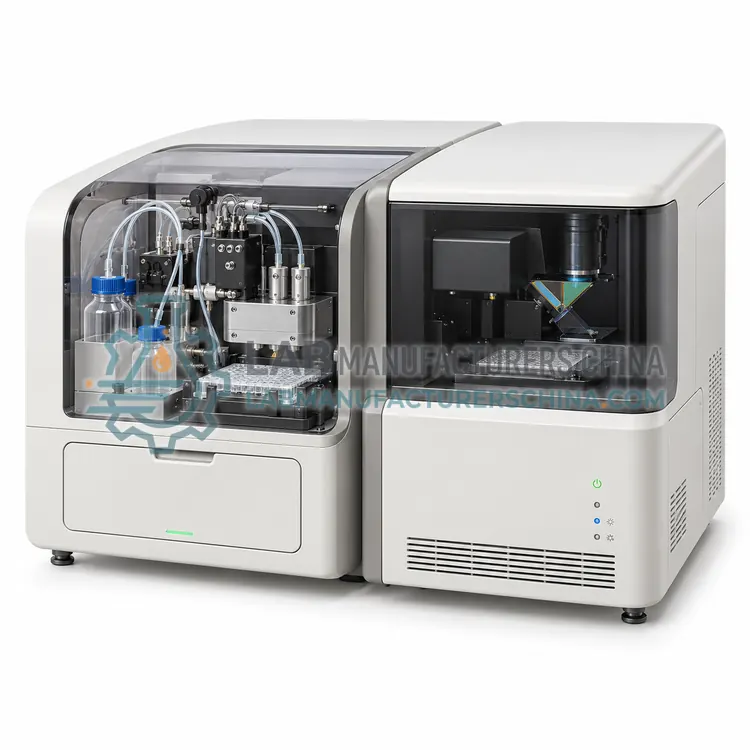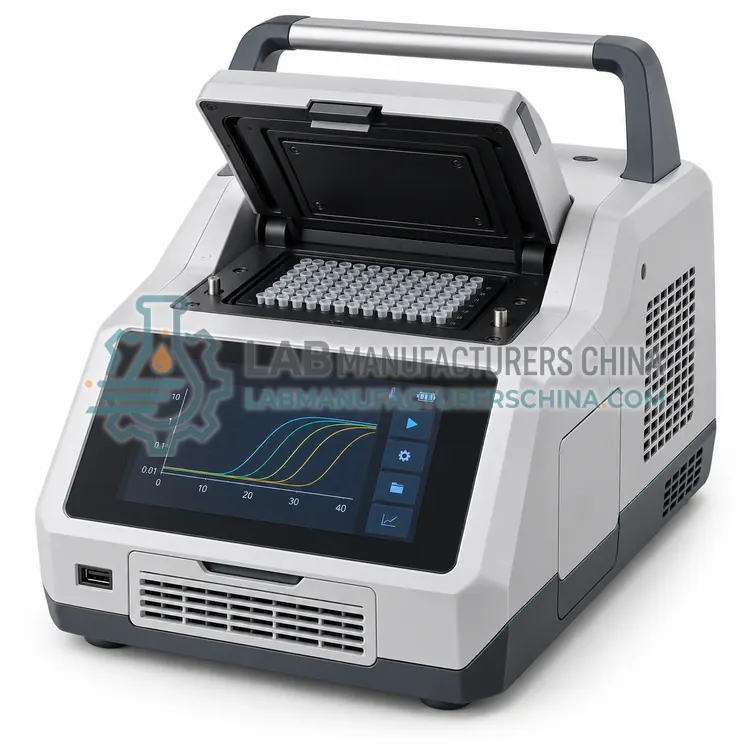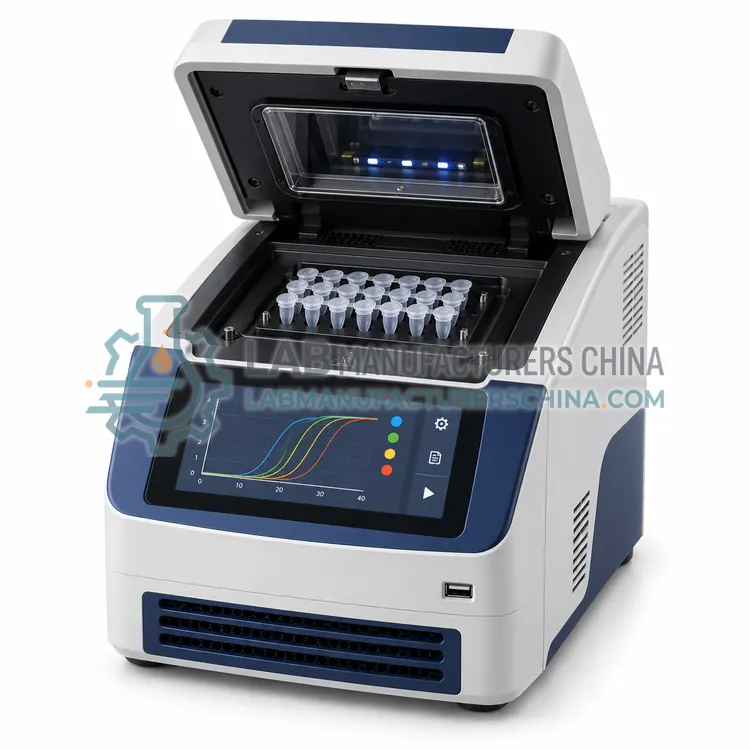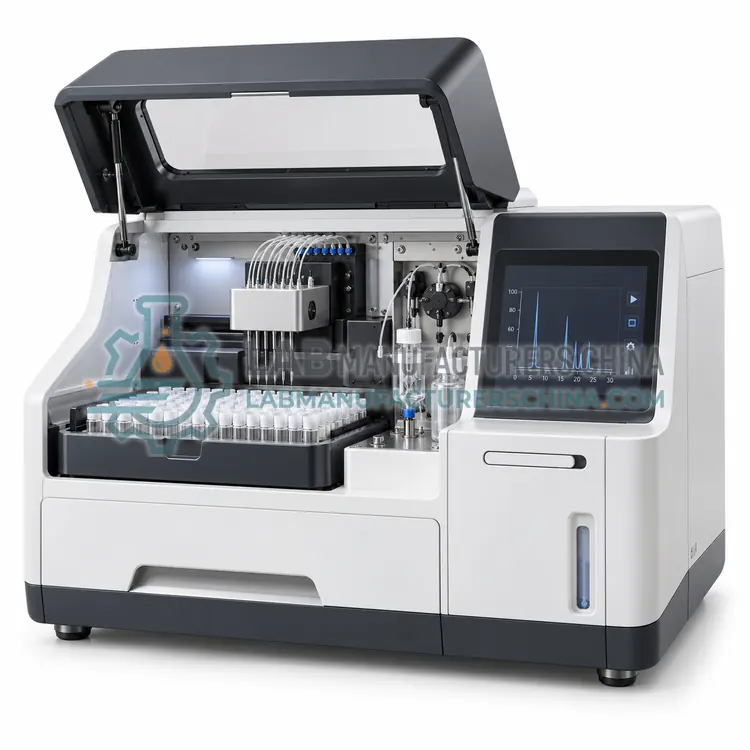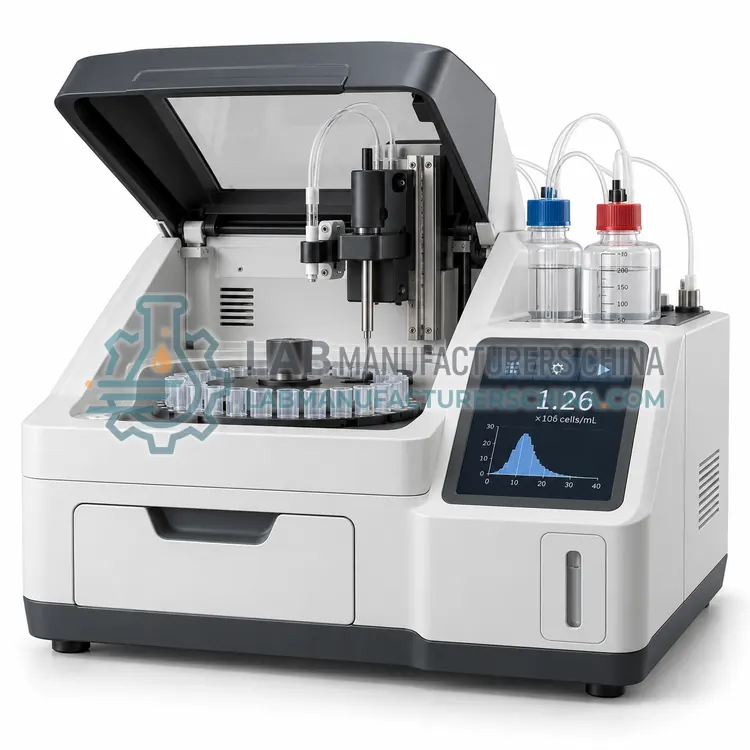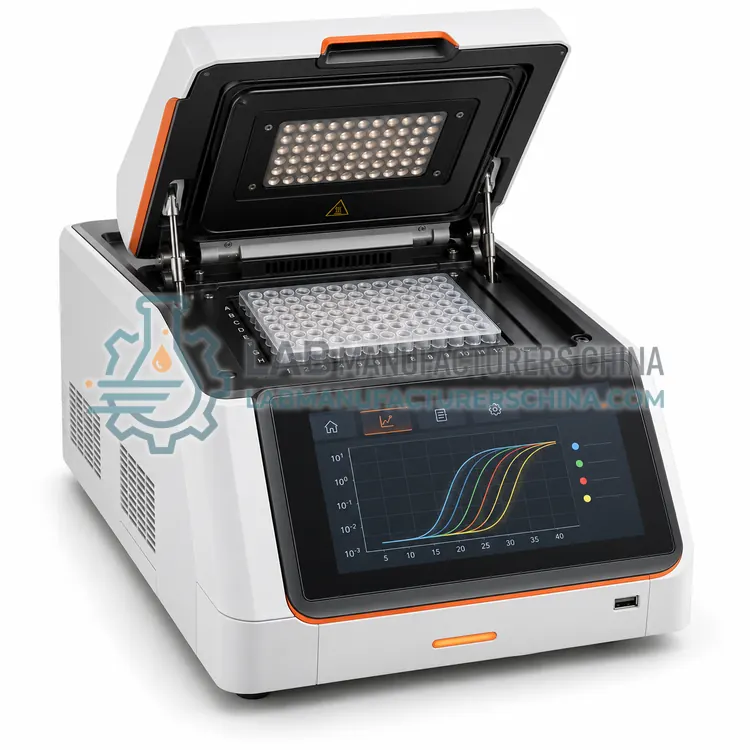
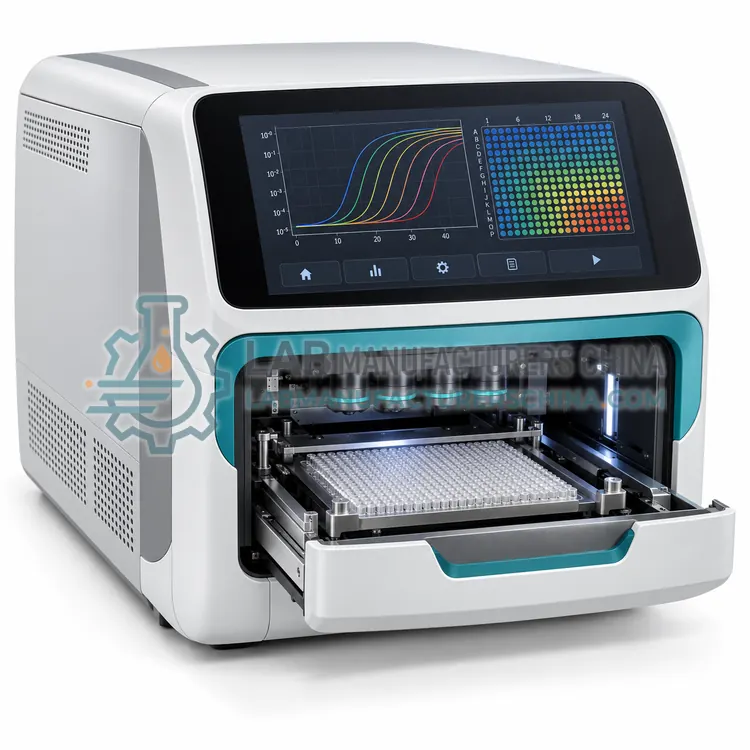
High-Throughput Real-Time PCR System (384-Well)
高通量实时荧光定量 PCR 系统(384 孔)
- SKU MOA-0002
- Molecular Analysis
- CE (to be confirmed)
- ISO 9001 manufacturing (to be confirmed)
- IEC 61010-2-010 test report (to be confirmed)
Price on request — FOB / CIF quoted per order
Prices depend on configuration, quantity and destination port.
Key specifications
| Sample capacity | 384 wells (also 96-well with adapter) |
|---|---|
| Reaction volume | 5–20 μL |
| Temperature range | 4–100 °C |
| Maximum ramp rate | 5–6 °C/s |
| Temperature uniformity | ±0.3 °C |
| Fluorescence channels | 4–6 |
Request a quote Download brochure · to be provided
By Lab Manufacturers China Technical TeamLast reviewed Standards: IEC 61010-1, IEC 61010-2-010, IEC 61010-2-101
What is the High-Throughput Real-Time PCR System (384-Well)?
A 384-well real-time PCR system runs up to 384 reactions of 5 to 20 μL per plate, with fast ramp rates and robotic loading options. It fits screening, biobank and core-facility laboratories that process hundreds of samples per day and want lower reagent use per reaction.
What is the High-Throughput Real-Time PCR System (384-Well)?
A 384-well real-time PCR system runs up to 384 reactions of 5 to 20 μL per plate, with fast ramp rates and robotic loading options. It fits screening, biobank and core-facility laboratories that process hundreds of samples per day and want lower reagent use per reaction.
Overview
A 384-well system uses a thermal block with smaller wells, typically 5 to 20 μL, and an optical system with sufficient sensitivity and uniform illumination across the plate. Fast Peltier blocks reach 5 to 6 °C per second, so a 40-cycle run finishes in roughly 35 to 60 minutes. Read uniformity across all wells is a critical specification, as edge wells are prone to variation. Automation options include plate stackers and integration with liquid handlers, allowing unattended runs of multiple plates. Four to six optical channels are common. Reaction volumes of 5 to 10 μL reduce reagent cost, but evaporation and pipetting precision become more critical, requiring good seals and calibrated liquid handling. Software supports plate layout templates, batch analysis, automated threshold setting and LIMS export.
How does it work?
Molecular analysis instruments amplify a nucleic acid target and monitor the reaction through fluorescence. In real-time PCR, a thermal block cycles between denaturation, annealing and extension, and optics read intercalating dyes such as SYBR Green or hydrolysis probes such as TaqMan at each cycle. The cycle at which fluorescence crosses a threshold, the quantification cycle (Cq), is inversely related to starting copy number, and a standard curve or comparative method gives relative or absolute quantity. Digital PCR partitions the reaction into thousands of nanoliter droplets or wells, amplifies each independently, and counts positive partitions; Poisson statistics then yield absolute copy number without calibration curves. Isothermal methods such as LAMP amplify at a constant temperature and detect fluorescence or turbidity. Melt-curve analysis verifies product specificity.
What are the key features?
- 384 wells per plate in 5 to 20 μL reaction volumes lower reagent cost.
- Fast block with ramp rate of 5 to 6 °C/s.
- Uniform optical reading across all wells including edges.
- Plate stacker and liquid handler integration for unattended runs.
- Four to six fluorescence channels for multiplex assays.
- Batch analysis with plate templates and LIMS-ready export.
What are the technical specifications?
A typical high-throughput real-time pcr system (384-well) configuration offers sample capacity of 384 wells (also 96-well with adapter), reaction volume of 5–20 μL, temperature range of 4–100 °C, maximum ramp rate of 5–6 °C/s, temperature uniformity of ±0.3 °C and fluorescence channels of 4–6. Values are indicative of the product class; the exact figures for each configuration are confirmed on the quotation and the calibration documents supplied with the instrument.
Which applications is it used for?
The High-Throughput Real-Time PCR System (384-Well) is used in high-throughput gene expression screening, biobank sample genotyping, clinical research assay development and environmental and food pathogen screening. Across the wider Molecular Analysis class, laboratories also deploy it for gene expression analysis, pathogen detection assay development and viral vector and residual DNA quantification.
Which standards and certifications apply?
Relevant standards and methods include IEC 61010-1, IEC 61010-2-010, IEC 61010-2-101, IEC 61326-2-6, ISO 20395, ISO 22174 and MIQE guidelines. Certification candidates for this model are CE, ISO 9001 manufacturing and IEC 61010-2-010 test report; each is to be confirmed for the specific configuration before shipment, and certificates are supplied only where they have been issued.
Molecular instruments require careful contamination control: separate pre- and post-amplification areas, use filter tips and include no-template controls. Thermal block temperature accuracy and uniformity should be verified periodically with a calibrated temperature probe, and optical calibration with dye plates should be performed after installation and at intervals recommended by the manufacturer. Keep the instrument on a stable bench with adequate ventilation, and protect lamps or LEDs from unnecessary exposure. Follow MIQE guidance when reporting qPCR data, and keep raw fluorescence data archived. Regulated laboratories should confirm software access control and audit trail.
How do I select the right High-Throughput Real-Time PCR System (384-Well)?
Choose a 384-well system when daily plate counts justify lower reagent volume and automation. Specify optical uniformity, ramp rate, plate handling interface, compatible seals and software export. A 96-well system is simpler for low volumes, while digital PCR is better for absolute quantification. Request demonstration data on your own samples before purchase.
How does it compare with other Molecular Analysis variants?
Decide first between relative quantification, for which real-time PCR is usually sufficient, and absolute quantification of rare targets or small fold changes, for which digital PCR offers better precision. Match well format to throughput: 96-well suits routine work, and 384-well suits screening. Count optical channels against multiplex needs, since four to six channels are common for multiplex panels. Consider ramp rate and run time, block uniformity and lid heating for reproducibility. For field or point-of-need testing, portable analyzers with battery operation and lyophilized reagents are appropriate. Check reagent openness, software features for analysis and export, and whether the instrument can support the validation documents that regulated workflows require.
Full specifications
| Sample capacity | 384 wells (also 96-well with adapter) |
|---|---|
| Reaction volume | 5–20 μL |
| Temperature range | 4–100 °C |
| Maximum ramp rate | 5–6 °C/s |
| Temperature uniformity | ±0.3 °C |
| Fluorescence channels | 4–6 |
| Run time (40 cycles) | approx. 35–60 min |
| Well-to-well CV (Cq) | below 0.3 cycles (typical) |
| Automation | Plate stacker/robot interface |
| Power supply | 100–240 V, 50/60 Hz, approx. 1,000 W |
Indicative values for this product class. Final specifications are confirmed on the quotation and in the calibration documents supplied with the instrument.
Applications
- High-throughput gene expression screening
- Biobank sample genotyping
- Clinical research assay development
- Environmental and food pathogen screening
Key features
- 384 wells per plate in 5 to 20 μL reaction volumes lower reagent cost.
- Fast block with ramp rate of 5 to 6 °C/s.
- Uniform optical reading across all wells including edges.
- Plate stacker and liquid handler integration for unattended runs.
- Four to six fluorescence channels for multiplex assays.
- Batch analysis with plate templates and LIMS-ready export.
Frequently asked questions about High-Throughput Real-Time PCR System (384-Well)
Edge wells can experience faster evaporation and small thermal or optical differences. Good heated lids, compression pads, optical seals and uniformity verification limit these effects, and assay layouts often place controls and replicates across the plate to detect edge bias.
Volumes of 5 to 10 μL are typical, balancing reagent savings with pipetting accuracy. Lower volumes need precise liquid handling, such as positive-displacement or acoustic dispensing, and validated assay performance because small errors become relatively larger.
Many models accept 96-well plates through adapters or interchangeable blocks, but the optical configuration and reaction volume range are optimized for 384-well. Confirm compatibility and validation of 96-well runs with the supplier before relying on mixed-format use.
It measures the amount of a specific DNA or RNA sequence in a sample by amplifying it and monitoring fluorescence. Results are reported as Cq values, relative expression, absolute copy number or presence/absence of a pathogen or genetic variant.
Use digital PCR when you need absolute copy number without standards, detection of rare variants below about 0.1 percent allele fraction, or small fold-change differences such as copy number variation. qPCR remains faster and cheaper for routine relative quantification and high-throughput screening.
The quantification cycle (Cq), also called Ct, is the PCR cycle at which fluorescence first rises above a set threshold. Lower Cq means more starting template, and each cycle difference corresponds to about a twofold change when amplification efficiency is near 100 percent.
Related models