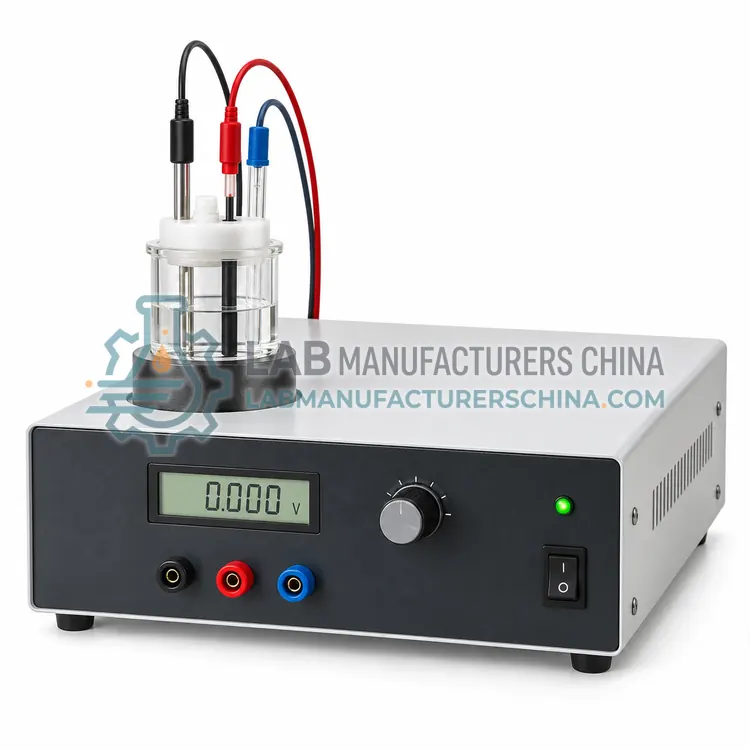
Electrochemical Workstation (Potentiostat/Galvanostat)
电化学工作站(恒电位仪/恒电流仪)
- SKU ELC-0004
- Electrochemical Analyzers
- CE (to be confirmed)
- ISO 9001 manufacturing (to be confirmed)
- RoHS (to be confirmed)
Price on request — FOB / CIF quoted per order
Prices depend on configuration, quantity and destination port.
Key specifications
| Potential range | ±10 V (control), ±5 V measure |
|---|---|
| Compliance voltage | ±12 V or more |
| Current range | ±1 nA to ±1 A (up to 10 A with booster) |
| Potential resolution | ≤ 10 µV |
| Current resolution | 0.0004% of range (minimum 10 fA) |
| Maximum scan rate | 1000 V/s (CV) |
Request a quote Download brochure · to be provided
By Lab Manufacturers China Technical TeamLast reviewed Standards: ASTM D1293, ASTM D1125, ASTM D888
What is the Electrochemical Workstation (Potentiostat/Galvanostat)?
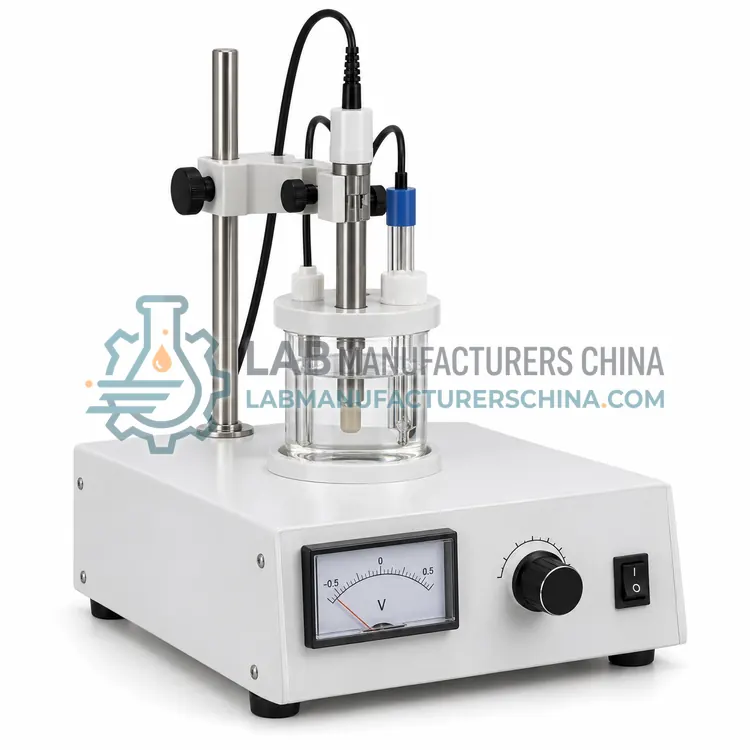
An electrochemical workstation combines a potentiostat, galvanostat and often an impedance analyzer to control potential or current and measure the electrochemical response. It is used for cyclic voltammetry, corrosion testing, battery and supercapacitor research, sensor development and electroplating studies.
What is the Electrochemical Workstation (Potentiostat/Galvanostat)?
An electrochemical workstation combines a potentiostat, galvanostat and often an impedance analyzer to control potential or current and measure the electrochemical response. It is used for cyclic voltammetry, corrosion testing, battery and supercapacitor research, sensor development and electroplating studies.
Overview
A control amplifier maintains the working-electrode potential against a reference electrode by driving current through a counter electrode, and a current-to-voltage converter measures the response. Typical compliance is ±10 V with current ranges from 1 nA to ±1 A, and high-current boosters extend to 10 A or more. Techniques include cyclic and linear sweep voltammetry, differential pulse and square wave voltammetry, chronoamperometry, chronopotentiometry and open circuit potential monitoring. With a frequency response analyzer covering 10 µHz to 1 MHz, electrochemical impedance spectroscopy characterizes coatings, corrosion rates and battery interfaces. Software supports Tafel analysis, equivalent circuit fitting and battery cycling. Low-current work needs shielding and a Faraday cage, and multichannel versions run parallel cells.
How does it work?
Electrochemical analysis links an electrical signal to analyte activity or concentration. Potentiometry measures the potential between an indicator electrode, such as a pH glass membrane or ion-selective membrane, and a reference electrode, related to ion activity by the Nernst equation, about 59.16 mV per decade at 25 °C for monovalent ions. Conductometry measures the ability of ions in solution to carry current between electrodes at alternating voltage, with temperature compensation. Amperometric sensors such as Clark cells measure the current from reduction of dissolved oxygen, whereas optical sensors measure luminescence quenching. Voltammetry sweeps potential across a working electrode and records current, with peak position identifying the species and peak height its concentration. Potentiostats control the potential of the working electrode against a reference while measuring current through a counter electrode.
What are the key features?
- Potentiostat and galvanostat modes with compliance voltage of ±10 V or greater
- Current ranges from 1 nA to 1 A with optional booster to 10 A
- Frequency response analyzer for impedance from 10 µHz to 1 MHz
- Cyclic, pulse, stripping and step techniques in one platform
- Software for Tafel, circuit fitting, corrosion rate and battery cycling analysis
- Single-channel or multichannel configuration for parallel testing
What are the technical specifications?
A typical electrochemical workstation (potentiostat/galvanostat) configuration offers potential range of ±10 V (control), ±5 V measure, compliance voltage of ±12 V or more, current range of ±1 nA to ±1 A (up to 10 A with booster), potential resolution of ≤ 10 µV, current resolution of 0.0004% of range (minimum 10 fA) and maximum scan rate of 1000 V/s (CV). Values are indicative of the product class; the exact figures for each configuration are confirmed on the quotation and the calibration documents supplied with the instrument.
Which applications is it used for?
The Electrochemical Workstation (Potentiostat/Galvanostat) is used in corrosion rate and coating evaluation, battery and supercapacitor characterization, electrocatalyst and fuel cell research, sensor and biosensor development and electroplating and electrodeposition studies. Across the wider Electrochemical Analyzers class, laboratories also deploy it for pH and ion control in water and process chemistry, conductivity of ultrapure and boiler water and dissolved oxygen in wastewater and fermentation.
Which standards and certifications apply?
Relevant standards and methods include ASTM D1293, ASTM D1125, ASTM D888, ISO 10523, ISO 7888, USP <645>, ASTM G5 and IEC 61010-1. Certification candidates for this model are CE, ISO 9001 manufacturing and RoHS; each is to be confirmed for the specific configuration before shipment, and certificates are supplied only where they have been issued.
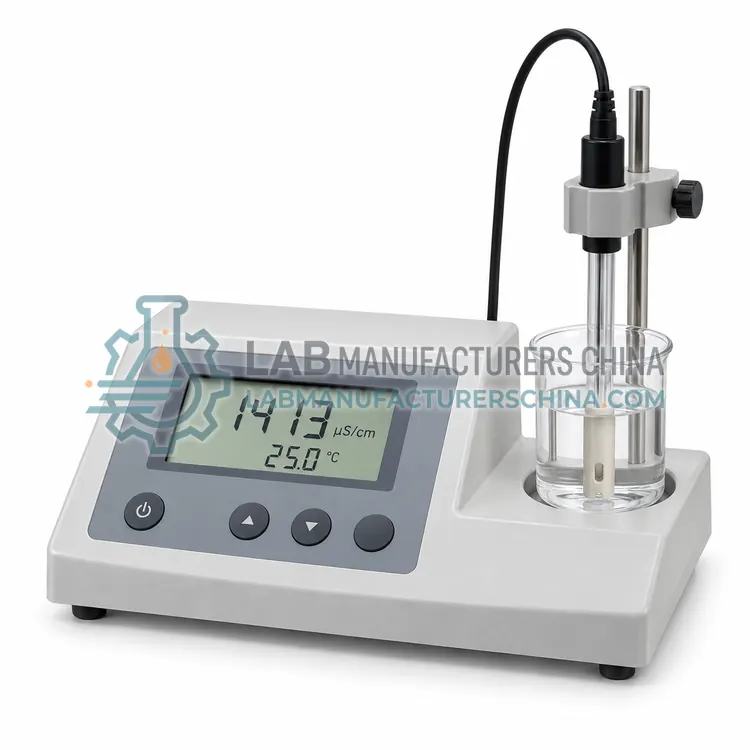
Electrode condition dominates accuracy. Calibrate pH meters with two or three fresh NIST-traceable buffers bracketing the sample, record slope, which should be 95–105% of theoretical, and replace electrodes with slow response. Store glass electrodes in proper storage solution, never distilled water. Calibrate conductivity cells with certified standards such as 1413 µS/cm at 25 °C and verify temperature compensation. Keep optical dissolved oxygen caps within their service life. Reference electrode fill solutions need topping up and periodic replacement. For potentiostats, use shielded cables, a Faraday cage for nA-level work and correct connection to the working, reference and counter electrodes. Maintain calibration records suited to ISO/IEC 17025.
How do I select the right Electrochemical Workstation (Potentiostat/Galvanostat)?
Select this variant for research and testing needing controlled-potential or controlled-current experiments and impedance spectroscopy. For simple ion determination use a pH or ion meter. In an RFQ, specify current range and compliance voltage, EIS frequency limits, channel count, booster need, techniques and software, and applicable standards such as ASTM G5 or ASTM G59.
How does it compare with other Electrochemical Analyzers variants?
Choose by the measured parameter and accuracy demanded. Routine pH, mV and ion concentration call for a benchtop pH or ion meter with suitable electrodes, and resolution of 0.001 pH is worthwhile only when electrodes and buffers support it. Ultrapure water, boiler water and process streams need a conductivity meter with the right cell constant, with 0.01 for ultrapure water and 1.0 for general use. Dissolved oxygen in water and fermentation suit optical sensors, which avoid electrolyte maintenance. Trace heavy metals at ppb level suit stripping voltammetry. Corrosion, battery and materials research require a potentiostat with adequate current range and impedance capability. Also consider data integrity features, electrode availability and calibration automation.
Full specifications
| Potential range | ±10 V (control), ±5 V measure |
|---|---|
| Compliance voltage | ±12 V or more |
| Current range | ±1 nA to ±1 A (up to 10 A with booster) |
| Potential resolution | ≤ 10 µV |
| Current resolution | 0.0004% of range (minimum 10 fA) |
| Maximum scan rate | 1000 V/s (CV) |
| Frequency range (EIS) | 10 µHz to 1 MHz |
| Input impedance | > 10^12 ohm |
| Cell connections | 2-, 3- and 4-electrode |
| Interface | USB 2.0 / Ethernet |
Indicative values for this product class. Final specifications are confirmed on the quotation and in the calibration documents supplied with the instrument.
Applications
- Corrosion rate and coating evaluation
- Battery and supercapacitor characterization
- Electrocatalyst and fuel cell research
- Sensor and biosensor development
- Electroplating and electrodeposition studies
Key features
- Potentiostat and galvanostat modes with compliance voltage of ±10 V or greater
- Current ranges from 1 nA to 1 A with optional booster to 10 A
- Frequency response analyzer for impedance from 10 µHz to 1 MHz
- Cyclic, pulse, stripping and step techniques in one platform
- Software for Tafel, circuit fitting, corrosion rate and battery cycling analysis
- Single-channel or multichannel configuration for parallel testing
Frequently asked questions about Electrochemical Workstation (Potentiostat/Galvanostat)
A potentiostat fixes the working electrode potential and measures current, while a galvanostat fixes current and measures potential. Most workstations provide both modes through the same control amplifier and switch between them by software.
The reference electrode carries negligible current and gives a stable potential reference, while the counter electrode carries the current. This separation lets the working-electrode potential be controlled accurately even when solution resistance causes large ohmic drops.
Coin cells and small laboratory cells work in the µA to mA range, while pouch and cylindrical cells may need 1–10 A. Specify the highest current and voltage of cells tested, and consider a dedicated battery cycler for long cycling.
A pH meter reads hydrogen ion activity from a glass electrode. An ion meter also reads other ions, such as fluoride, nitrate or sodium, with ion-selective electrodes and reports concentration using calibration standards and ionic strength adjusters. Most benchtop units combine both functions.
Ion mobility rises with temperature, increasing conductivity by roughly 2% per °C for most aqueous solutions. Meters use automatic temperature compensation to report conductivity at a reference of 25 °C, using a linear coefficient or nonlinear function for natural and ultrapure water.
With good care, pH glass electrodes last 6–24 months. Replace when calibration slope falls below about 92–95%, response is slow, or readings drift. Extreme pH, high temperature, fluoride and protein-rich samples shorten lifetime.