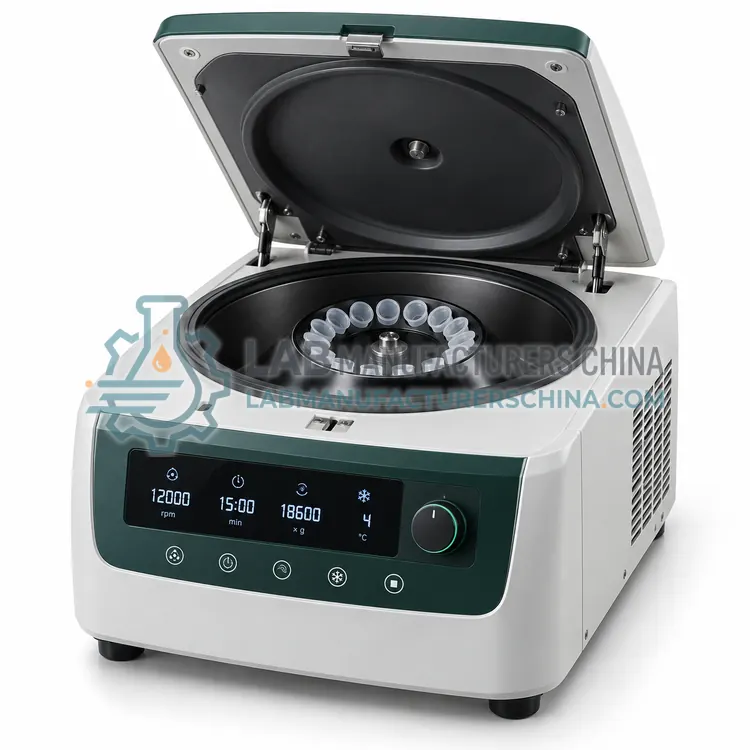
How do Benchtop Centrifuges work?
A benchtop centrifuge accelerates a rotor with a brushless DC or induction motor inside a guarded steel or composite chamber. The centrifugal force on each particle equals mass times angular velocity squared times radius, so particles denser than the medium move outward and form a pellet while lighter components remain in the supernatant. Swing-bucket rotors place tubes horizontal during the spin, which produces a flat pellet interface and suits blood tubes and gradients. Fixed-angle rotors hold tubes at 25 to 45 degrees, shortening the sedimentation path and giving faster pelleting. A microprocessor regulates speed, time and acceleration or braking curves, with a lid lock, imbalance sensor and rotor recognition providing safety.
Which Benchtop Centrifuges variants are available?
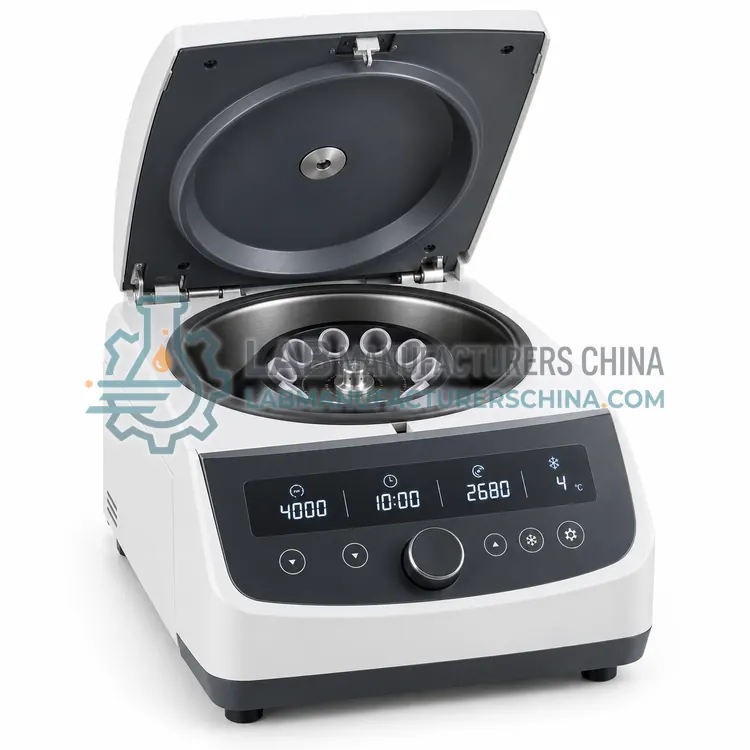
- Low-Speed Benchtop Centrifuge — A low-speed benchtop centrifuge is a compact unit running to about 4,000 to 5,000 rpm with a swing-bucket rotor for routine work.
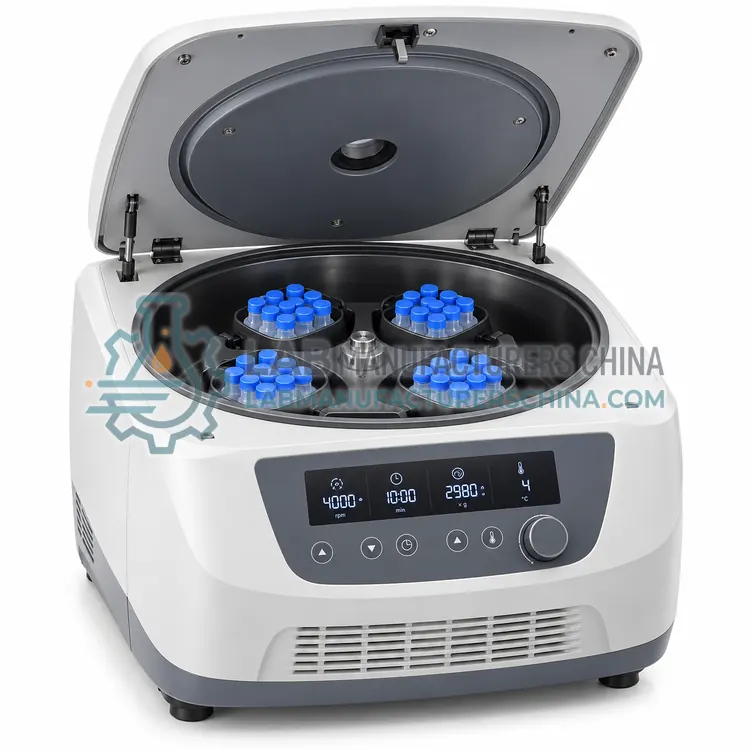
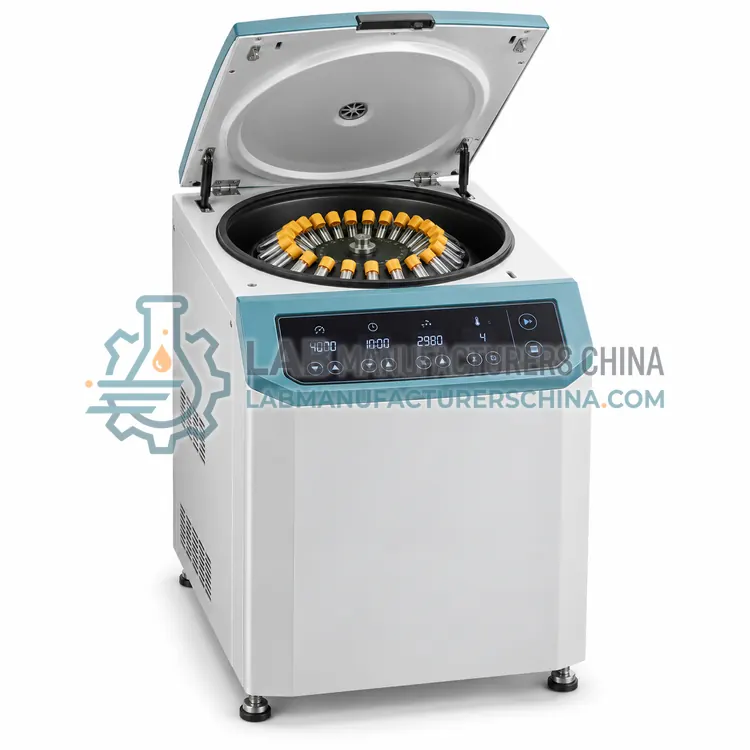
- Large-Capacity Benchtop Centrifuge — A large-capacity benchtop centrifuge holds 4 x 750 mL bottles or up to 96 blood tubes per run at 4,000 to 6,000 rpm.
- Multi-Purpose Programmable Benchtop Centrifuge — A multi-purpose programmable benchtop centrifuge accepts interchangeable swing-bucket, fixed-angle and plate rotors with stored methods and selectable ramps.
- Clinical Serum Separation Centrifuge — A clinical serum separation centrifuge is a benchtop unit optimized for vacuum blood collection tubes, with fixed programs around 3,000 to 4,000 rpm and aerosol-tight buckets.
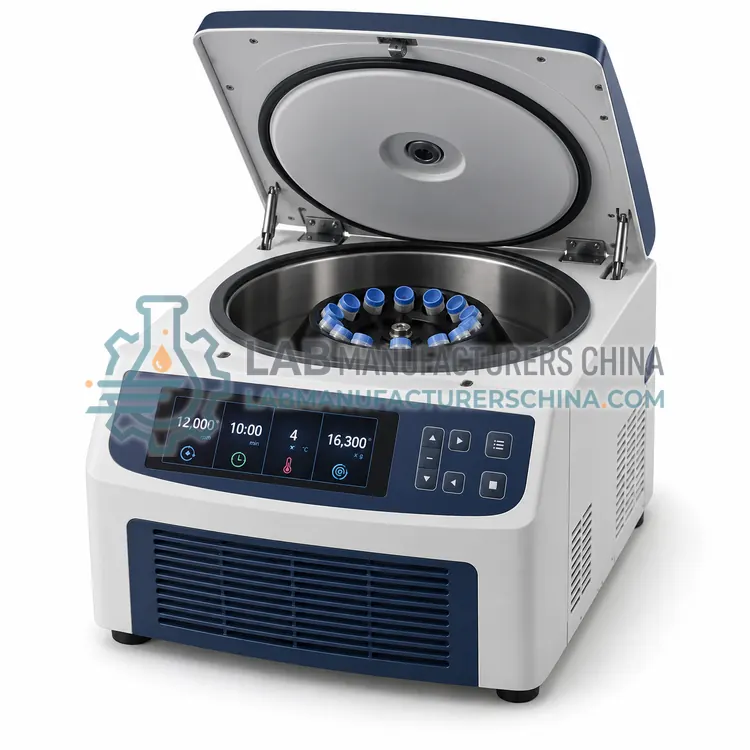
- Refrigerated Benchtop Centrifuge — A refrigerated benchtop centrifuge combines a compressor-cooled chamber with a compact footprint, holding samples between -10 and 40 C at speeds up to 15,000 rpm.
How do I choose the right variant?
Define the tube types first, since blood collection tubes, 15 mL and 50 mL conical tubes, and 96-well plates each require specific buckets or adapters. Next set the required RCF: serum separation typically needs 1,000 to 3,000 x g, while cell washing needs far less. Choose a swing-bucket rotor for clean pellets and plates, and a fixed-angle rotor when speed matters most. Consider capacity, such as 4 x 100 mL or 6 x 50 mL, programmable ramp profiles that protect fragile cells, and noise below about 60 dB for shared spaces. Add aerosol-tight lids if infectious material is handled. If samples are temperature sensitive, consider a refrigerated model instead.
Where are Benchtop Centrifuges used?
Benchtop Centrifuges are specified in blood serum and plasma separation, urine sediment concentration, cell washing and harvesting, teaching laboratory demonstrations and precipitate separation in chemical analysis.
Which standards and certifications apply?
Work with Benchtop Centrifuges is commonly governed by IEC 61010-1, IEC 61010-2-020, IEC 61326-1, CLSI GP44, ISO 15189 and GB 4793.1. Instrument certifications such as CE marking are confirmed per configuration and never assumed.
What are the key considerations before purchase?
Place the unit on a rigid, level bench with at least 30 cm of clearance around it, and balance tubes within the maker's tolerance, commonly 0.5 to 1 g. Verify rotor speed with a tachometer and timer accuracy during annual calibration. Clean buckets and chamber with neutral detergent, avoiding chlorides that corrode aluminum, and inspect rotors for pitting or cracks. Record rotor cycles and respect rated lifetime. Clinical users should follow CLSI guidance on specimen processing and IEC 61010-2-020 safety requirements. Keep the lid open after use to prevent condensation and odor.