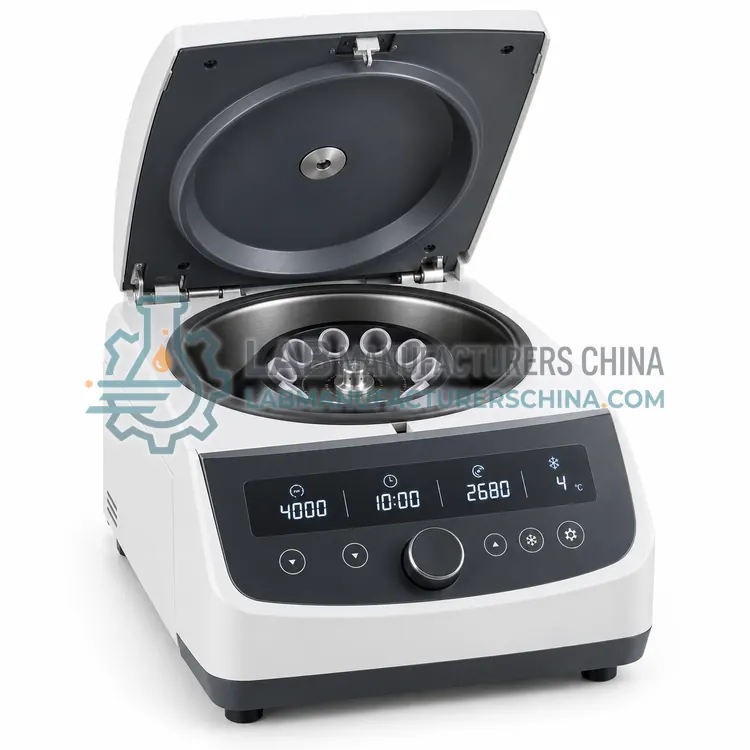
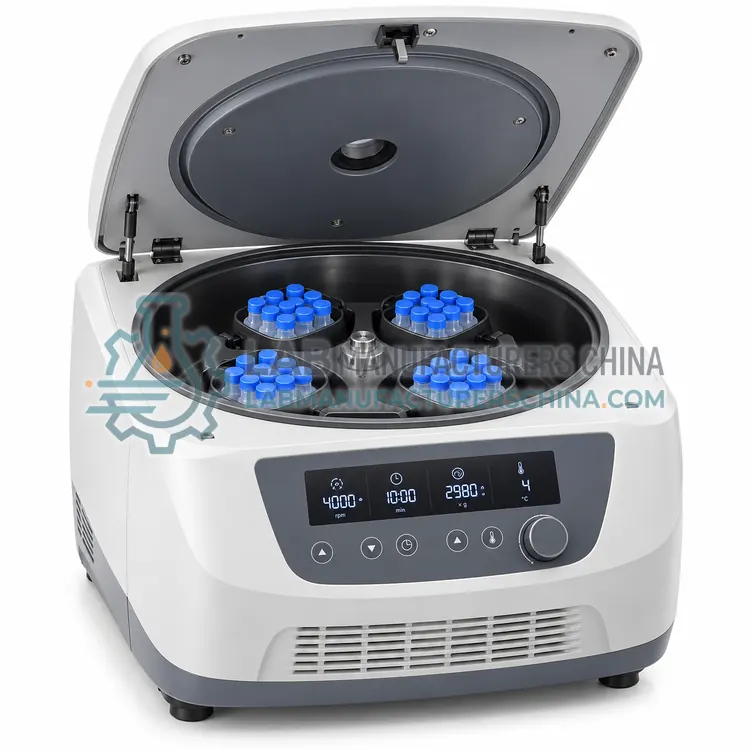
Large-Capacity Benchtop Centrifuge
大容量台式离心机
- SKU BEC-0002
- Benchtop Centrifuges
- CE (to be confirmed)
- ISO 9001 manufacturing (to be confirmed)
- ISO 13485 manufacturing (to be confirmed)
Price on request — FOB / CIF quoted per order
Prices depend on configuration, quantity and destination port.
Key specifications
| Maximum speed | 4,000–6,000 rpm |
|---|---|
| Maximum RCF | up to approx. 6,000 x g |
| Maximum capacity | 4 x 750 mL or 96 x 10 mL tubes |
| Speed accuracy | ±10 rpm |
| Program memory | 10–99 methods |
| Acceleration/braking curves | 9–10 selectable |
Request a quote Download brochure · to be provided
By Lab Manufacturers China Technical TeamLast reviewed Standards: IEC 61010-1, IEC 61010-2-020, IEC 61326-1
What is the Large-Capacity Benchtop Centrifuge?
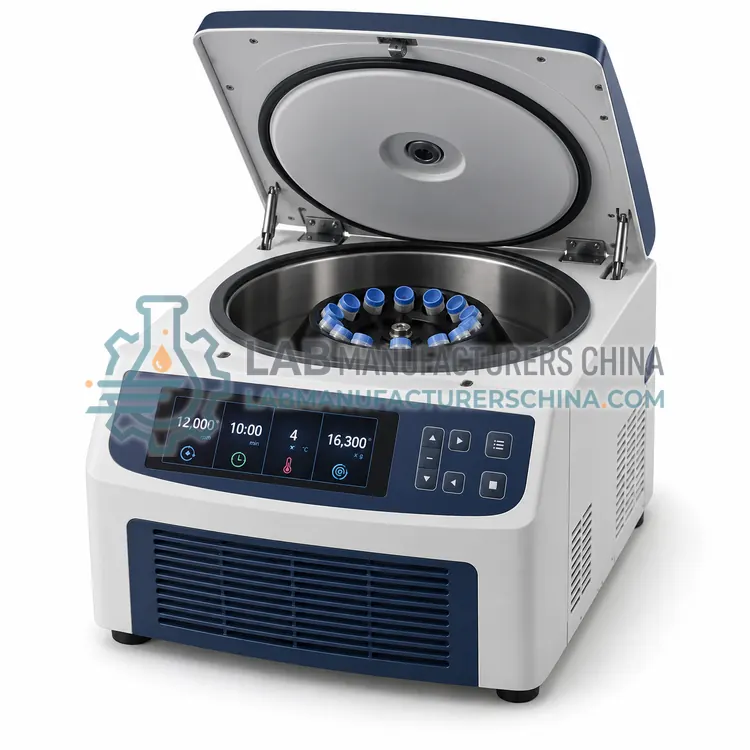
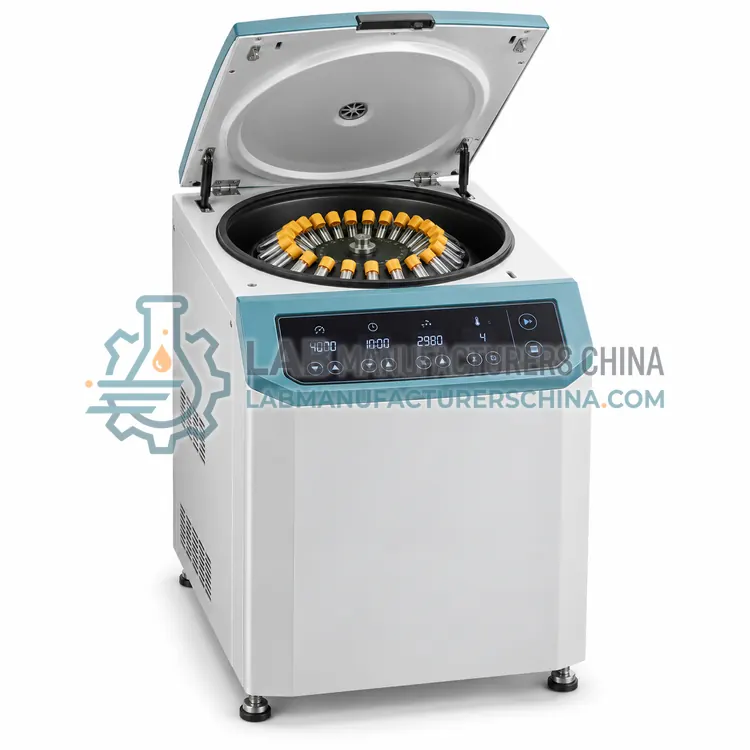
A large-capacity benchtop centrifuge holds 4 x 750 mL bottles or up to 96 blood tubes per run at 4,000 to 6,000 rpm. It suits blood banks, plasma fractionation support and high-throughput clinical laboratories that process large batches of samples in a single cycle.
What is the Large-Capacity Benchtop Centrifuge?
A large-capacity benchtop centrifuge holds 4 x 750 mL bottles or up to 96 blood tubes per run at 4,000 to 6,000 rpm. It suits blood banks, plasma fractionation support and high-throughput clinical laboratories that process large batches of samples in a single cycle.
Overview
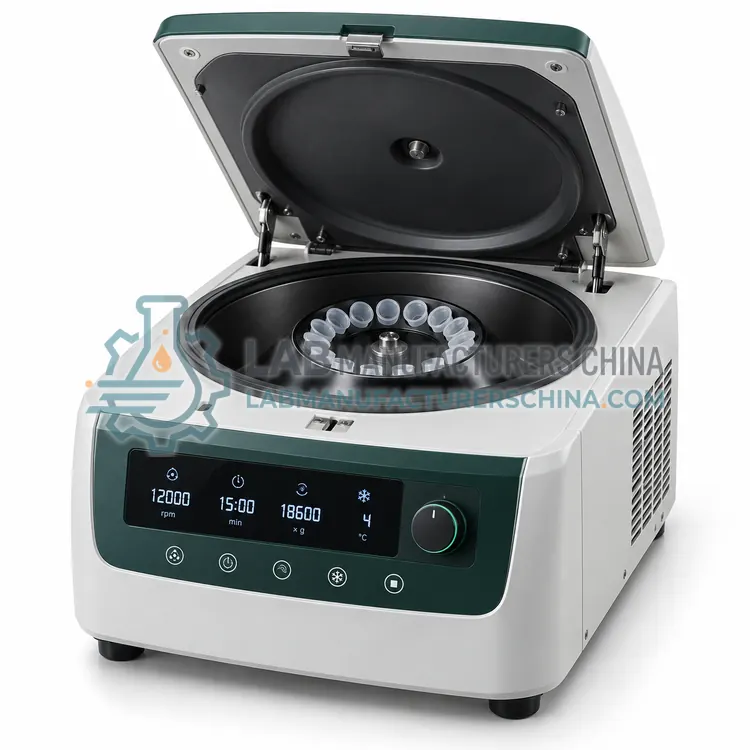
Large-capacity benchtop centrifuges extend the benchtop format to volumes normally handled by floor-standing units. They use a heavy steel chamber and a high-torque induction or brushless motor to spin rotors carrying 4 x 500 mL, 4 x 750 mL or 6 x 250 mL bottles, or multi-tube carriers holding 48 to 96 blood tubes. Top speeds are typically 4,000 to 6,000 rpm with RCF up to about 6,000 x g. Programmable memories hold 10 to 99 methods with 9 to 10 acceleration and deceleration curves, allowing gentle braking to keep a pellet intact. Many models accept plate rotors and offer an optional refrigeration package. The unit remains under 1 m wide but weighs 80 to 150 kg, so a reinforced bench or cart is advisable.
How does it work?
A benchtop centrifuge accelerates a rotor with a brushless DC or induction motor inside a guarded steel or composite chamber. The centrifugal force on each particle equals mass times angular velocity squared times radius, so particles denser than the medium move outward and form a pellet while lighter components remain in the supernatant. Swing-bucket rotors place tubes horizontal during the spin, which produces a flat pellet interface and suits blood tubes and gradients. Fixed-angle rotors hold tubes at 25 to 45 degrees, shortening the sedimentation path and giving faster pelleting. A microprocessor regulates speed, time and acceleration or braking curves, with a lid lock, imbalance sensor and rotor recognition providing safety.
What are the key features?
- Rotor options include 4 x 750 mL bottles and multi-tube blood carriers
- Stores 10 to 99 programs with selectable acceleration and braking curves
- Heavy steel chamber and lid provide containment in case of rotor failure
- Automatic rotor recognition prevents operating above the rated speed
- Optional refrigeration package extends use to temperature-sensitive products
What are the technical specifications?
A typical large-capacity benchtop centrifuge configuration offers maximum speed of 4,000–6,000 rpm, maximum RCF of up to approx. 6,000 x g, maximum capacity of 4 x 750 mL or 96 x 10 mL tubes, speed accuracy of ±10 rpm, program memory of 10–99 methods and acceleration/braking curves of 9–10 selectable. Values are indicative of the product class; the exact figures for each configuration are confirmed on the quotation and the calibration documents supplied with the instrument.
Which applications is it used for?
The Large-Capacity Benchtop Centrifuge is used in blood bank component separation, high-throughput clinical serum processing, large-volume cell harvesting and pharmaceutical pilot batches. Across the wider Benchtop Centrifuges class, laboratories also deploy it for blood serum and plasma separation, urine sediment concentration and cell washing and harvesting.
Which standards and certifications apply?
Relevant standards and methods include IEC 61010-1, IEC 61010-2-020, IEC 61326-1, CLSI GP44, ISO 15189 and GB 4793.1. Certification candidates for this model are CE, ISO 9001 manufacturing and ISO 13485 manufacturing; each is to be confirmed for the specific configuration before shipment, and certificates are supplied only where they have been issued.
Place the unit on a rigid, level bench with at least 30 cm of clearance around it, and balance tubes within the maker's tolerance, commonly 0.5 to 1 g. Verify rotor speed with a tachometer and timer accuracy during annual calibration. Clean buckets and chamber with neutral detergent, avoiding chlorides that corrode aluminum, and inspect rotors for pitting or cracks. Record rotor cycles and respect rated lifetime. Clinical users should follow CLSI guidance on specimen processing and IEC 61010-2-020 safety requirements. Keep the lid open after use to prevent condensation and odor.
How do I select the right Large-Capacity Benchtop Centrifuge?
Choose this variant when a single run must process 500 mL or more, or 48 or more tubes, such as in a blood bank or central lab. It outperforms standard benchtop units on throughput but requires more bench strength and floor space. Specify bottle sizes, carrier types, RCF, refrigeration need, program count and electrical supply in the RFQ.
How does it compare with other Benchtop Centrifuges variants?
Define the tube types first, since blood collection tubes, 15 mL and 50 mL conical tubes, and 96-well plates each require specific buckets or adapters. Next set the required RCF: serum separation typically needs 1,000 to 3,000 x g, while cell washing needs far less. Choose a swing-bucket rotor for clean pellets and plates, and a fixed-angle rotor when speed matters most. Consider capacity, such as 4 x 100 mL or 6 x 50 mL, programmable ramp profiles that protect fragile cells, and noise below about 60 dB for shared spaces. Add aerosol-tight lids if infectious material is handled. If samples are temperature sensitive, consider a refrigerated model instead.
Full specifications
| Maximum speed | 4,000–6,000 rpm |
|---|---|
| Maximum RCF | up to approx. 6,000 x g |
| Maximum capacity | 4 x 750 mL or 96 x 10 mL tubes |
| Speed accuracy | ±10 rpm |
| Program memory | 10–99 methods |
| Acceleration/braking curves | 9–10 selectable |
| Temperature range (refrigerated option) | -10 to 40 °C |
| Noise level | ≤ 62 dB(A) |
| Power supply | 220 V, 50/60 Hz, 1.0–2.0 kW |
| Weight | approx. 80–150 kg |
Indicative values for this product class. Final specifications are confirmed on the quotation and in the calibration documents supplied with the instrument.
Applications
- Blood bank component separation
- High-throughput clinical serum processing
- Large-volume cell harvesting
- Pharmaceutical pilot batches
Key features
- Rotor options include 4 x 750 mL bottles and multi-tube blood carriers
- Stores 10 to 99 programs with selectable acceleration and braking curves
- Heavy steel chamber and lid provide containment in case of rotor failure
- Automatic rotor recognition prevents operating above the rated speed
- Optional refrigeration package extends use to temperature-sensitive products
Frequently asked questions about Large-Capacity Benchtop Centrifuge
Most units weigh between 80 and 150 kg depending on motor size and chamber construction. The bench or stand must be rated for the weight plus dynamic loads during operation, so a dedicated reinforced table or floor cart is recommended.
Many models offer refrigerated versions with compressors maintaining the chamber between -10 and 40 C. Refrigeration adds size and weight and requires ventilation clearance for the condenser, so confirm it at the quotation stage rather than as a later upgrade.
A 4 x 750 mL swing-bucket rotor accepts 750 mL flat- or round-bottom bottles and, with inserts, smaller sizes such as 500 mL, 250 mL and 50 mL conical tubes. Always confirm the bottle's maximum rated RCF, since plastic bottles often have lower limits than the rotor.
General benchtop centrifuges typically reach 4,000 to 6,000 rpm, equal to about 2,000 to 5,000 x g depending on rotor radius. High-capacity models used for blood tubes run near 4,000 rpm, while smaller multi-purpose units may reach 6,000 rpm or higher.
A swing-bucket rotor lets tubes swing to horizontal during the spin, producing a flat pellet and suiting gradients, plates and blood tubes. A fixed-angle rotor holds tubes at a constant angle, giving shorter sedimentation distance, faster pelleting and higher attainable speeds, but the pellet forms against the tube wall.
Yes, provided it has buckets or adapters for the tube diameter and length, such as 13 x 75 mm to 16 x 100 mm. Serum separator tubes typically need 1,000 to 1,300 x g for 10 minutes, but always follow the tube manufacturer's instructions and the laboratory's validated protocol.
Related models