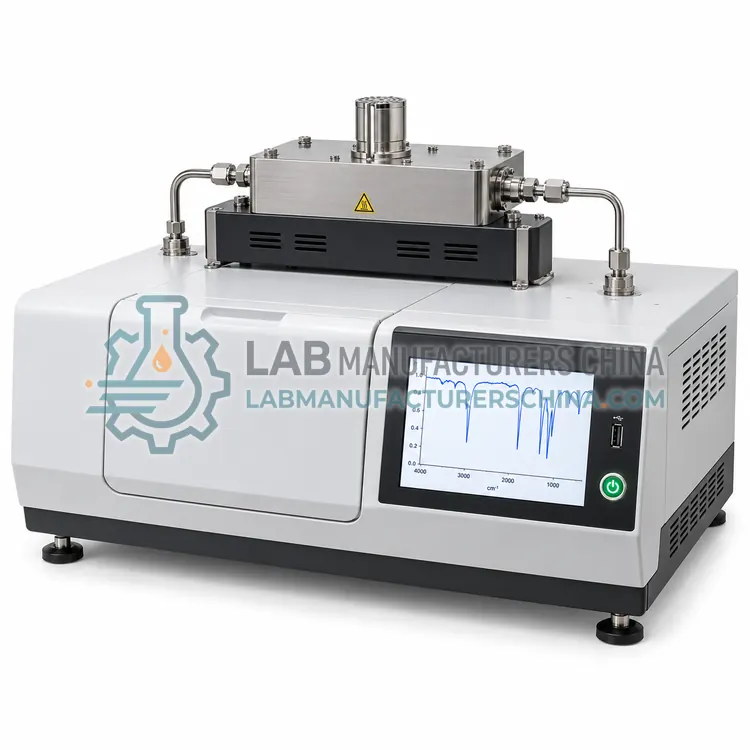
How do FTIR work?
An FTIR spectrometer directs broadband infrared radiation from a globar or ceramic source into a Michelson interferometer, where a beam splitter divides it between a fixed mirror and a moving mirror. The recombined beam produces an interferogram that varies with mirror displacement. The interferogram passes through or reflects from the sample, is recorded by a DTGS or cooled MCT detector, and is converted to a spectrum by a Fourier transform. Multiplexing allows all frequencies to be measured simultaneously, giving the Fellgett advantage, and the circular aperture gives the Jacquinot advantage in throughput. A helium-neon laser tracks mirror position to give wavenumber accuracy of 0.01 cm-1. Sampling accessories include attenuated total reflection crystals, transmission holders, diffuse reflectance cells and gas cells, allowing solids, liquids, films and gases to be analyzed with minimal preparation.
Which FTIR variants are available?
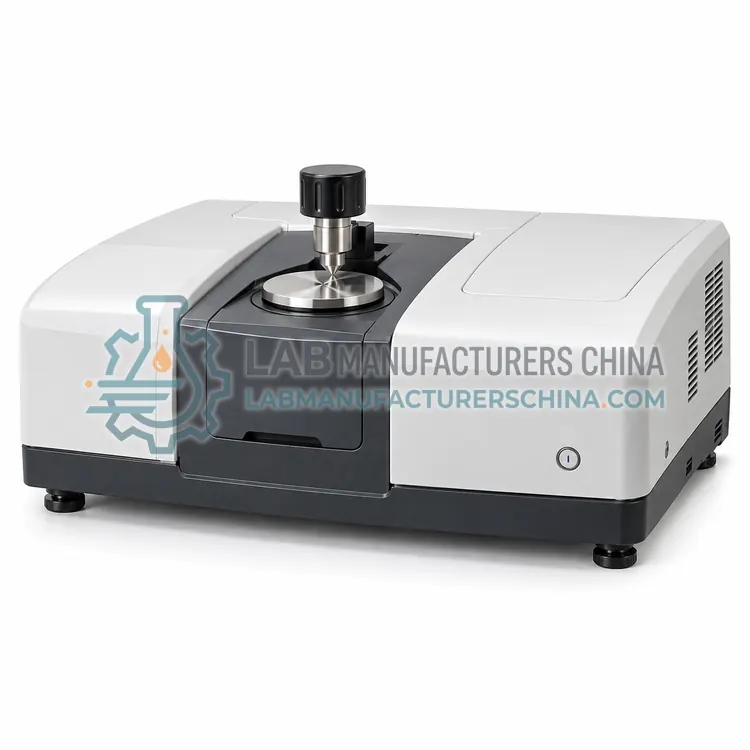
- Benchtop FTIR Spectrometer with Diamond ATR — A benchtop FTIR spectrometer with diamond ATR is the general-purpose instrument for identifying solids, liquids and pastes in seconds with no sample preparation.
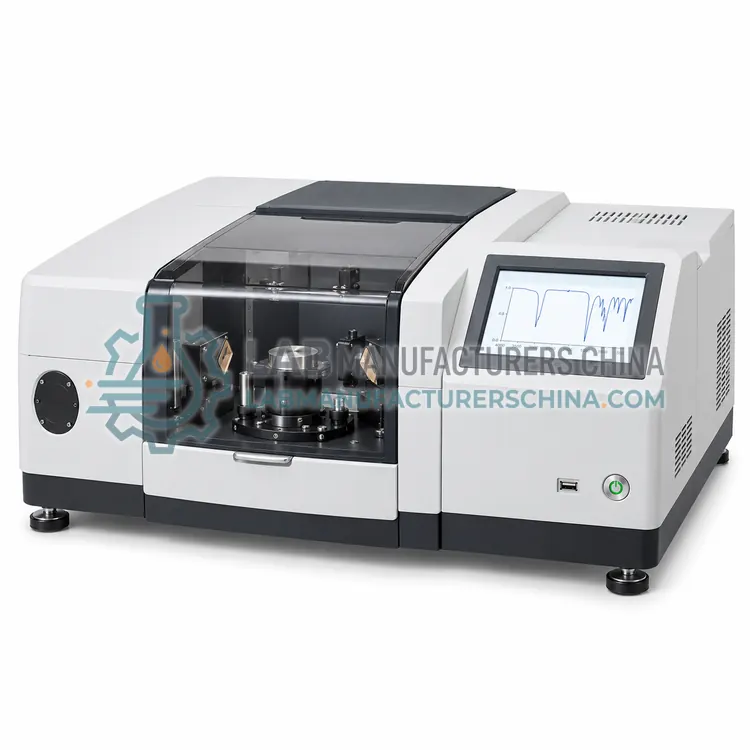
- Research-Grade FTIR Spectrometer with Step-Scan Capability — A research-grade FTIR spectrometer offers 0.1 cm-1 or better resolution, multiple detector and beam splitter options from far-IR to near-IR, and step-scan operation for time-resolved studies.
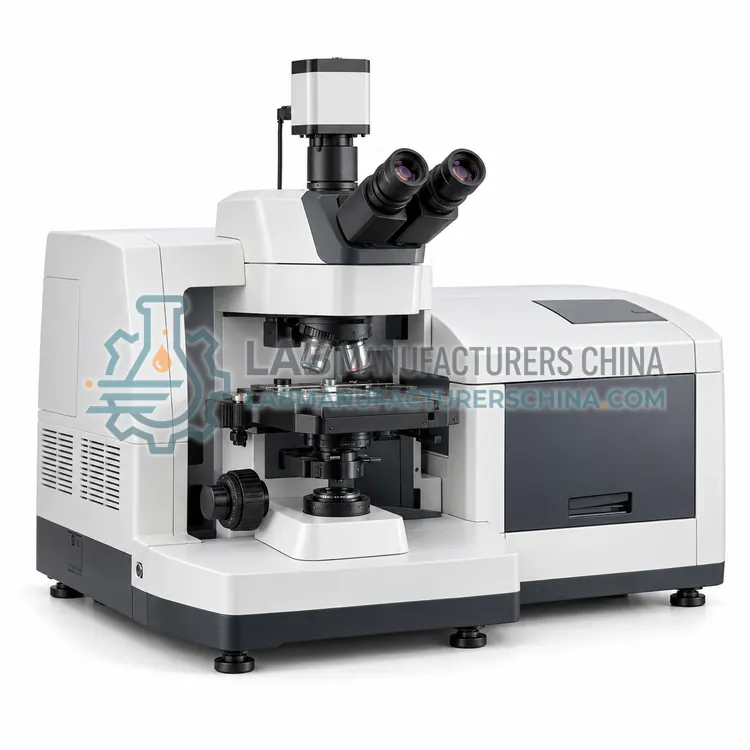
- FTIR Microscope for Microanalysis and Chemical Imaging — An FTIR microscope couples an infrared spectrometer to a visible and infrared microscope to analyze samples down to about 10 µm.
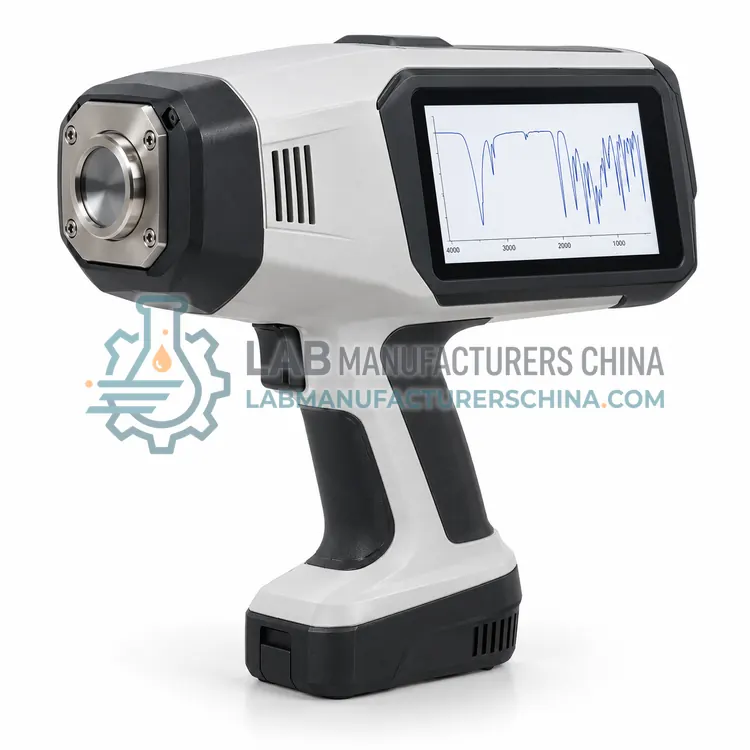
- Portable Handheld FTIR Spectrometer — A portable handheld FTIR spectrometer is a battery-powered, ruggedized instrument with a diamond ATR for on-site identification of unknown solids and liquids.
- FTIR Gas Analyzer with Heated Multipass Cell — An FTIR gas analyzer draws sample gas through a heated multipass cell with path lengths of 2–10 m and identifies and quantifies many species at once.
How do I choose the right variant?
Choose an FTIR instrument by spectral resolution, sensitivity, sampling method and intended environment. Routine identification of polymers and organics is well served by a benchtop unit with 4 cm-1 resolution, a DTGS detector and a diamond ATR accessory. Research requiring 0.1 cm-1 resolution, step-scan time resolution or far-IR coverage needs a research-grade interferometer with optional MCT detectors. Microscopic contaminants below 50 µm require an FTIR microscope with mapping. Field identification of unknown chemicals favors a ruggedized handheld unit, and emissions or atmospheric work needs a gas analyzer with a heated multipass cell. Evaluate signal-to-noise ratio, library availability, purge requirements, accessory flexibility and software features for regulated laboratories.
Where are FTIR used?
FTIR are specified in polymer and plastics identification, forensic trace evidence analysis, contaminant and failure analysis, coatings, adhesives and film characterization, gas emission monitoring and art conservation and pigment analysis.
Which standards and certifications apply?
Work with FTIR is commonly governed by ASTM E1421, ASTM E168, ASTM E1252, ISO 10640, USP <854>, Ph. Eur. 2.2.24 and GB/T 6040. Instrument certifications such as CE marking are confirmed per configuration and never assumed.
What are the key considerations before purchase?
Place the spectrometer on a stable, vibration-free bench with controlled humidity, since KBr optics are hygroscopic and water vapor interferes with spectra. Keep desiccant in the interferometer compartment or use a dry air or nitrogen purge. Collect a fresh background before each sample and clean the ATR crystal with isopropanol or a suitable solvent between measurements. Verify wavenumber accuracy with a polystyrene film and photometric performance with standard checks such as signal-to-noise and energy throughput. Replace the IR source and desiccant cartridges as recommended. Laser and MCT detector cooling with liquid nitrogen require trained handling. For regulated use, implement IQ/OQ/PQ and software with audit trails.