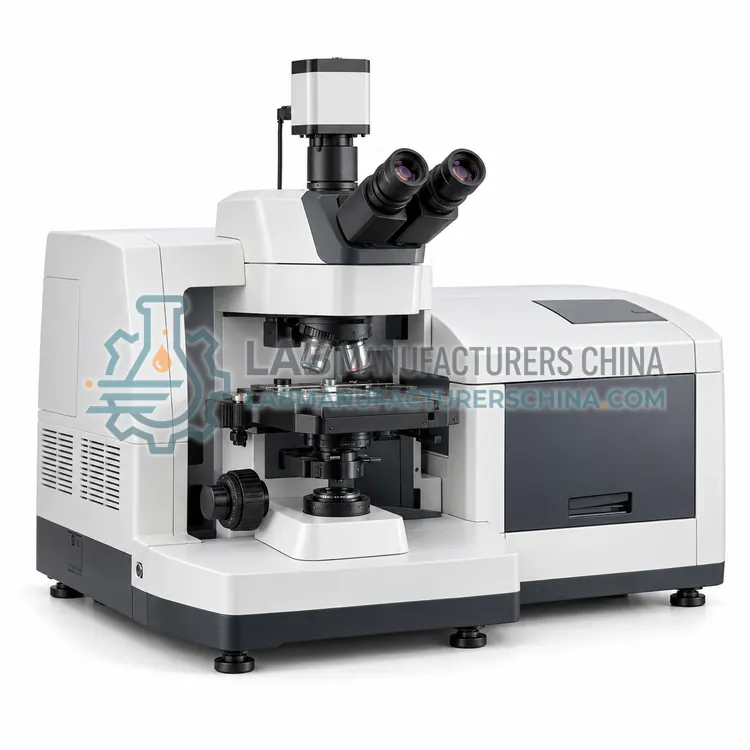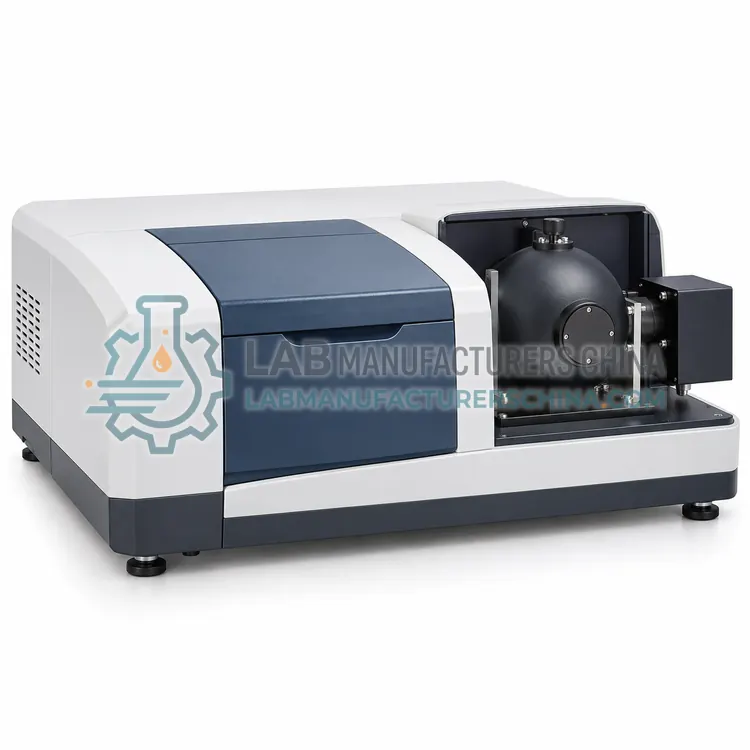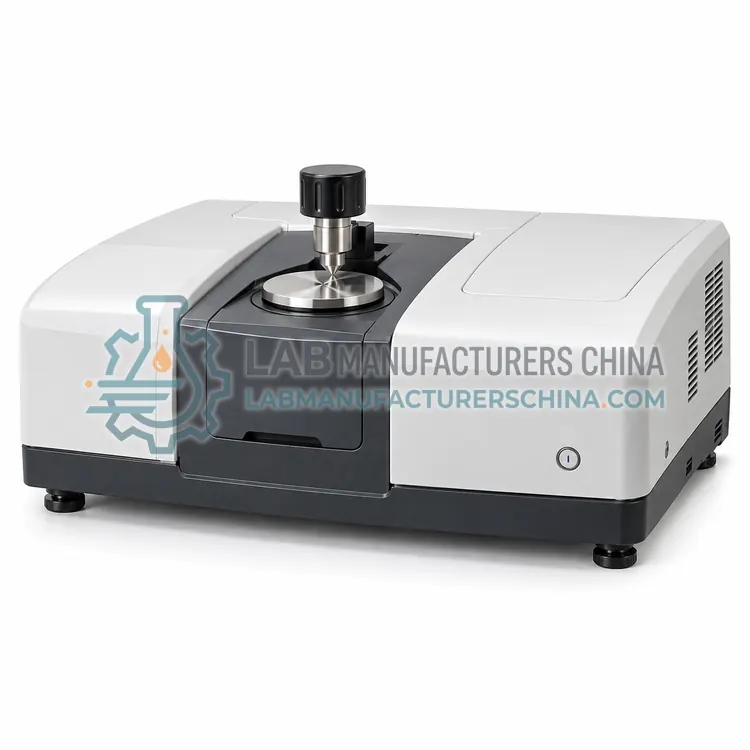
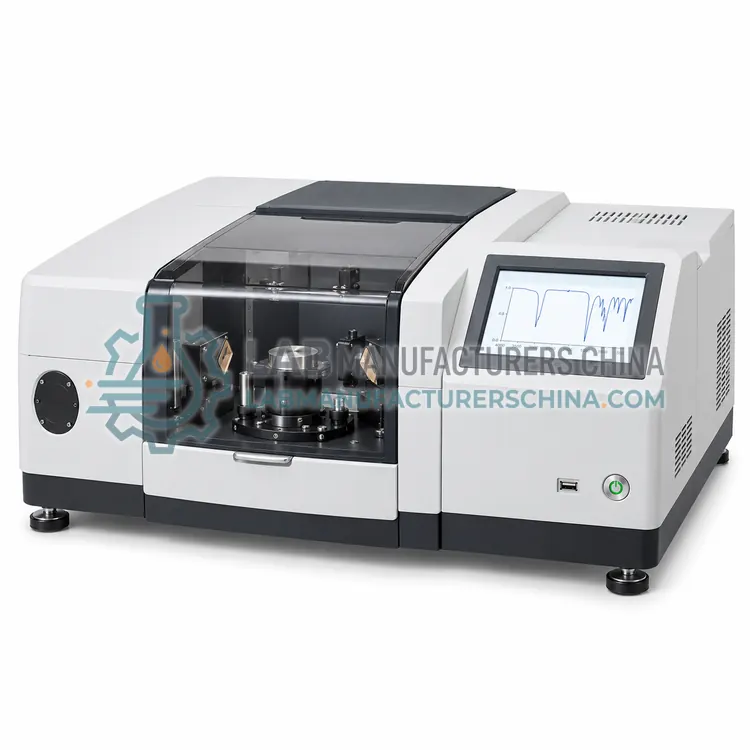
Research-Grade FTIR Spectrometer with Step-Scan Capability
具步进扫描功能的研究级傅里叶红外光谱仪
- SKU FTI-0002
- FTIR
- CE (to be confirmed)
- ISO 9001 manufacturing (to be confirmed)
- IEC 61010-1 safety (to be confirmed)
Price on request — FOB / CIF quoted per order
Prices depend on configuration, quantity and destination port.
Key specifications
| Spectral range | 15–25000 cm-1 (by configuration) |
|---|---|
| Maximum resolution | 0.1 cm-1 (optional 0.06 cm-1) |
| Signal-to-noise ratio | ≥55000:1 (peak to peak, 1 min, 4 cm-1) |
| Wavenumber accuracy | ≤0.005 cm-1 |
| Rapid scan rate | Up to 60 spectra/s at 16 cm-1 |
| Step-scan time resolution | ≤10 ns with external digitizer |
Request a quote Download brochure · to be provided
By Lab Manufacturers China Technical TeamLast reviewed Standards: ASTM E1421, ASTM E168, ASTM E1252
What is the Research-Grade FTIR Spectrometer with Step-Scan Capability?
A research-grade FTIR spectrometer offers 0.1 cm-1 or better resolution, multiple detector and beam splitter options from far-IR to near-IR, and step-scan operation for time-resolved studies. It is selected for advanced spectroscopy, gas-phase analysis and demanding material characterization.
What is the Research-Grade FTIR Spectrometer with Step-Scan Capability?
A research-grade FTIR spectrometer offers 0.1 cm-1 or better resolution, multiple detector and beam splitter options from far-IR to near-IR, and step-scan operation for time-resolved studies. It is selected for advanced spectroscopy, gas-phase analysis and demanding material characterization.
Overview
The research spectrometer uses a high-precision interferometer with air-bearing or flexure mirror drive, offering optical path differences up to 10 cm for 0.1 cm-1 resolution or better. Interchangeable beam splitters such as KBr, CaF2 and Mylar cover 15–25000 cm-1, while DTGS, liquid-nitrogen-cooled MCT and InSb detectors extend sensitivity. Rapid-scan operation reaches 60 spectra per second at 16 cm-1, and step-scan mode enables microsecond time-resolved and photoacoustic experiments. Vacuum versions eliminate water vapor absorption, a critical advantage for far-IR and high-resolution gas work. Multiple external ports allow coupling to microscopes, photoacoustic cells, TGA and emission sources. Signal-to-noise ratios exceed 55000:1. Operators should plan on skilled staff, vacuum or purge infrastructure and higher maintenance budgets.
How does it work?
An FTIR spectrometer directs broadband infrared radiation from a globar or ceramic source into a Michelson interferometer, where a beam splitter divides it between a fixed mirror and a moving mirror. The recombined beam produces an interferogram that varies with mirror displacement. The interferogram passes through or reflects from the sample, is recorded by a DTGS or cooled MCT detector, and is converted to a spectrum by a Fourier transform. Multiplexing allows all frequencies to be measured simultaneously, giving the Fellgett advantage, and the circular aperture gives the Jacquinot advantage in throughput. A helium-neon laser tracks mirror position to give wavenumber accuracy of 0.01 cm-1. Sampling accessories include attenuated total reflection crystals, transmission holders, diffuse reflectance cells and gas cells, allowing solids, liquids, films and gases to be analyzed with minimal preparation.
What are the key features?
- Air-bearing or flexure drive delivers 0.1 cm-1 or better resolution.
- Interchangeable beam splitters cover far-IR to near-IR from 15 to 25000 cm-1.
- Step-scan mode supports microsecond time-resolved spectroscopy.
- Optional vacuum bench eliminates water vapor and CO2 absorption.
- Multiple external ports couple microscopes, photoacoustic cells and TGA.
- MCT and InSb detector options give high sensitivity for weak signals.
What are the technical specifications?
A typical research-grade ftir spectrometer with step-scan capability configuration offers spectral range of 15–25000 cm-1 (by configuration), maximum resolution of 0.1 cm-1 (optional 0.06 cm-1), signal-to-noise ratio of ≥55000:1 (peak to peak, 1 min, 4 cm-1), wavenumber accuracy of ≤0.005 cm-1, rapid scan rate of Up to 60 spectra/s at 16 cm-1 and step-scan time resolution of ≤10 ns with external digitizer. Values are indicative of the product class; the exact figures for each configuration are confirmed on the quotation and the calibration documents supplied with the instrument.
Which applications is it used for?
The Research-Grade FTIR Spectrometer with Step-Scan Capability is used in high-resolution gas-phase spectroscopy, far-IR and terahertz studies, time-resolved photochemistry, semiconductor and thin-film research and photoacoustic depth profiling. Across the wider FTIR class, laboratories also deploy it for polymer and plastics identification, forensic trace evidence analysis and contaminant and failure analysis.
Which standards and certifications apply?
Relevant standards and methods include ASTM E1421, ASTM E168, ASTM E1252, ISO 10640, USP <854>, Ph. Eur. 2.2.24 and GB/T 6040. Certification candidates for this model are CE, ISO 9001 manufacturing and IEC 61010-1 safety; each is to be confirmed for the specific configuration before shipment, and certificates are supplied only where they have been issued.
Place the spectrometer on a stable, vibration-free bench with controlled humidity, since KBr optics are hygroscopic and water vapor interferes with spectra. Keep desiccant in the interferometer compartment or use a dry air or nitrogen purge. Collect a fresh background before each sample and clean the ATR crystal with isopropanol or a suitable solvent between measurements. Verify wavenumber accuracy with a polystyrene film and photometric performance with standard checks such as signal-to-noise and energy throughput. Replace the IR source and desiccant cartridges as recommended. Laser and MCT detector cooling with liquid nitrogen require trained handling. For regulated use, implement IQ/OQ/PQ and software with audit trails.
How do I select the right Research-Grade FTIR Spectrometer with Step-Scan Capability?
Select the research-grade spectrometer when resolution below 0.5 cm-1, time resolution, far-IR coverage or extensive coupling ports are required. For routine identification it is excessive in cost and complexity. In an RFQ, specify spectral range, resolution, detectors, step-scan need, vacuum option and external accessories.
How does it compare with other FTIR variants?
Choose an FTIR instrument by spectral resolution, sensitivity, sampling method and intended environment. Routine identification of polymers and organics is well served by a benchtop unit with 4 cm-1 resolution, a DTGS detector and a diamond ATR accessory. Research requiring 0.1 cm-1 resolution, step-scan time resolution or far-IR coverage needs a research-grade interferometer with optional MCT detectors. Microscopic contaminants below 50 µm require an FTIR microscope with mapping. Field identification of unknown chemicals favors a ruggedized handheld unit, and emissions or atmospheric work needs a gas analyzer with a heated multipass cell. Evaluate signal-to-noise ratio, library availability, purge requirements, accessory flexibility and software features for regulated laboratories.
Full specifications
| Spectral range | 15–25000 cm-1 (by configuration) |
|---|---|
| Maximum resolution | 0.1 cm-1 (optional 0.06 cm-1) |
| Signal-to-noise ratio | ≥55000:1 (peak to peak, 1 min, 4 cm-1) |
| Wavenumber accuracy | ≤0.005 cm-1 |
| Rapid scan rate | Up to 60 spectra/s at 16 cm-1 |
| Step-scan time resolution | ≤10 ns with external digitizer |
| Beam splitters | KBr, CaF2, Mylar, quartz |
| Detectors | DTGS, MCT (LN2), InSb |
| Vacuum level (vacuum option) | ≤3 mbar |
| External ports | 2–4 input and output ports |
Indicative values for this product class. Final specifications are confirmed on the quotation and in the calibration documents supplied with the instrument.
Applications
- High-resolution gas-phase spectroscopy
- Far-IR and terahertz studies
- Time-resolved photochemistry
- Semiconductor and thin-film research
- Photoacoustic depth profiling
Key features
- Air-bearing or flexure drive delivers 0.1 cm-1 or better resolution.
- Interchangeable beam splitters cover far-IR to near-IR from 15 to 25000 cm-1.
- Step-scan mode supports microsecond time-resolved spectroscopy.
- Optional vacuum bench eliminates water vapor and CO2 absorption.
- Multiple external ports couple microscopes, photoacoustic cells and TGA.
- MCT and InSb detector options give high sensitivity for weak signals.
Frequently asked questions about Research-Grade FTIR Spectrometer with Step-Scan Capability
In step-scan mode the moving mirror stops at each retardation position while the signal is measured, instead of moving continuously. This decouples the modulation from the mirror speed and enables time-resolved measurements down to nanoseconds on repeatable events.
Evacuating the optical bench removes water vapor and CO2, which absorb strongly in the mid- and far-infrared. It improves baseline stability, reveals weak bands and is essential for far-IR work below about 400 cm-1 where purge gas is insufficient.
Standard MCT detectors need liquid nitrogen cooling to about 77 K. Thermoelectrically cooled MCT variants exist with reduced sensitivity and narrower range, which can be acceptable when liquid nitrogen handling is inconvenient.
FTIR spectroscopy identifies materials from their infrared absorption fingerprint. It is used to determine functional groups, identify polymers and contaminants, confirm raw materials, study coatings and films and quantify components in mixtures or gases without lengthy sample preparation.
Attenuated total reflection passes the infrared beam through a high-refractive-index crystal such as diamond. An evanescent wave penetrates a few micrometers into the sample pressed on the crystal, so solids, pastes and liquids can be measured with almost no preparation.
A resolution of 4 cm-1 is sufficient for most condensed-phase identification, with 2 cm-1 used for some library matching. Gas-phase work and rotational fine structure need 0.5 cm-1 or better, which requires a research-grade interferometer.
Related models