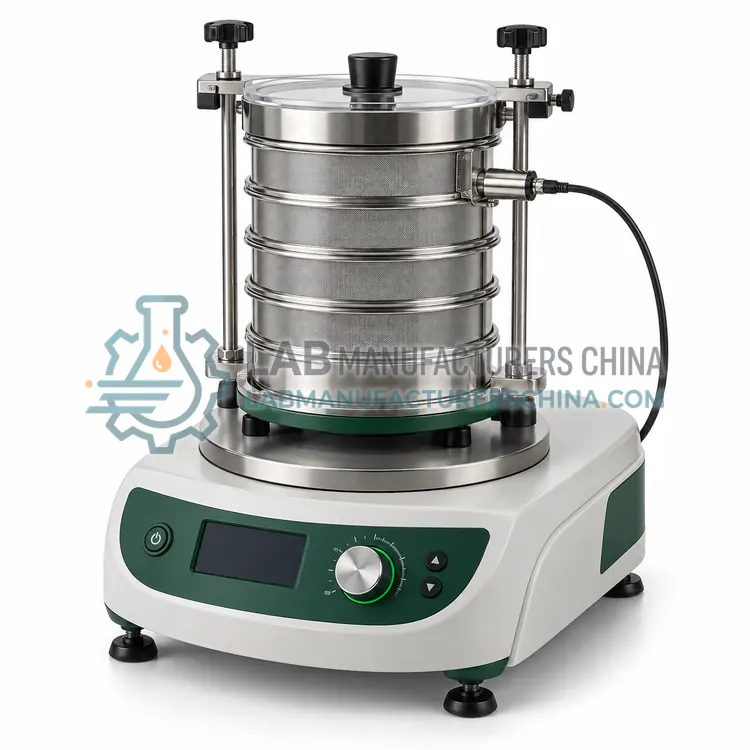
How do Sieve Analyzers work?
A sieve analyzer agitates a stack of test sieves, arranged with the coarsest aperture on top, so that particles either pass through an aperture or are retained on it. The agitation may be vertical throw from an electromagnetic drive, horizontal circular motion combined with tapping, air jets that clear the mesh from below, or ultrasonic vibration for fine sieves. Particles pass when their smallest projected dimension is smaller than the aperture and their orientation allows. After a set time, each sieve and the receiver pan are weighed, and mass percentages are calculated as individual and cumulative retained or passing fractions. Sieve sizes and tolerances are defined in ISO 3310 and ASTM E11, and procedures in ISO 2591-1. Amplitude, time, sample mass and sieve condition govern repeatability and end-point.
Which Sieve Analyzers variants are available?
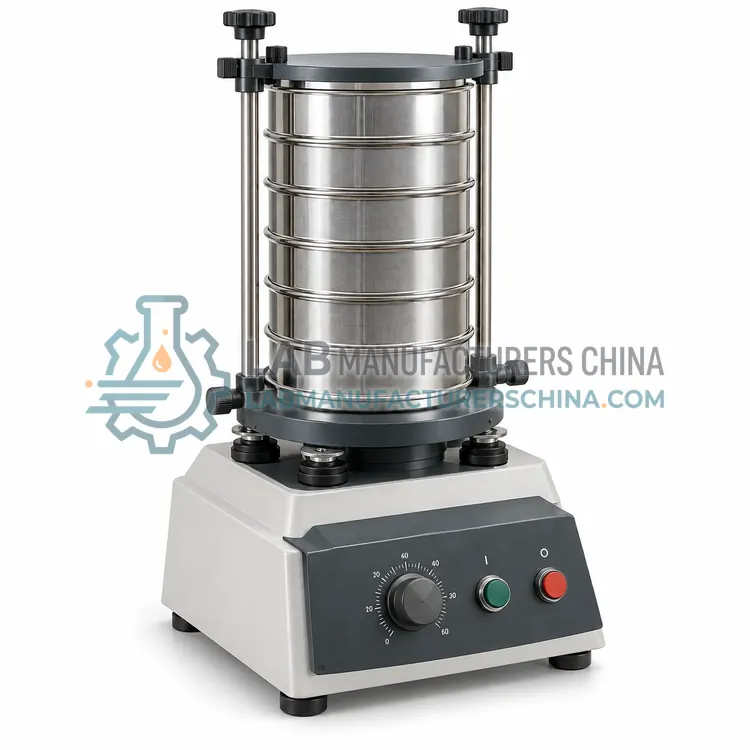
- Electromagnetic Vibratory Sieve Shaker — A sieve shaker that uses an electromagnetic drive to produce three-dimensional throw motion with digitally controlled amplitude and time.
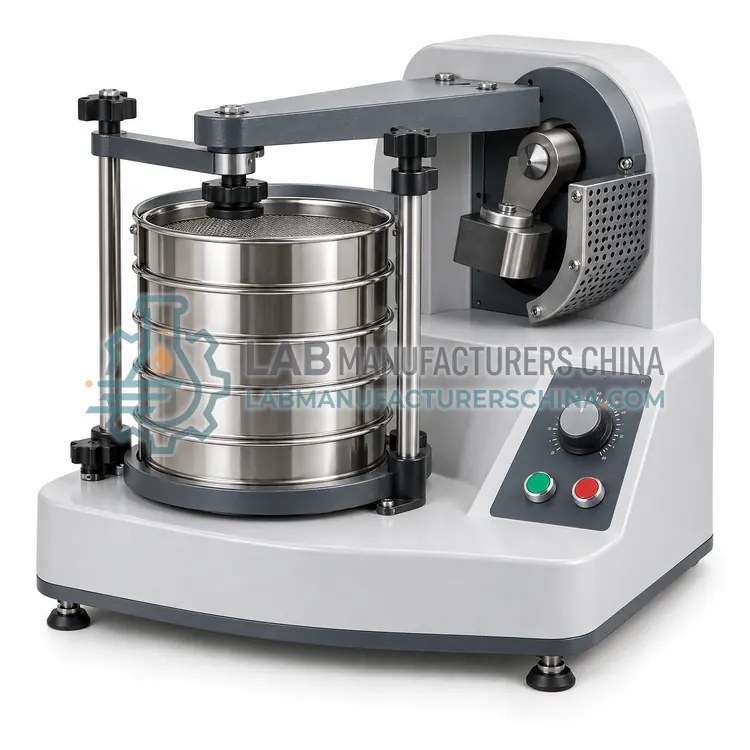
- Horizontal Tapping Sieve Shaker — A mechanical sieve shaker that combines horizontal circular motion with a vertical tapping hammer, traditionally used for aggregates, cement, and coal.
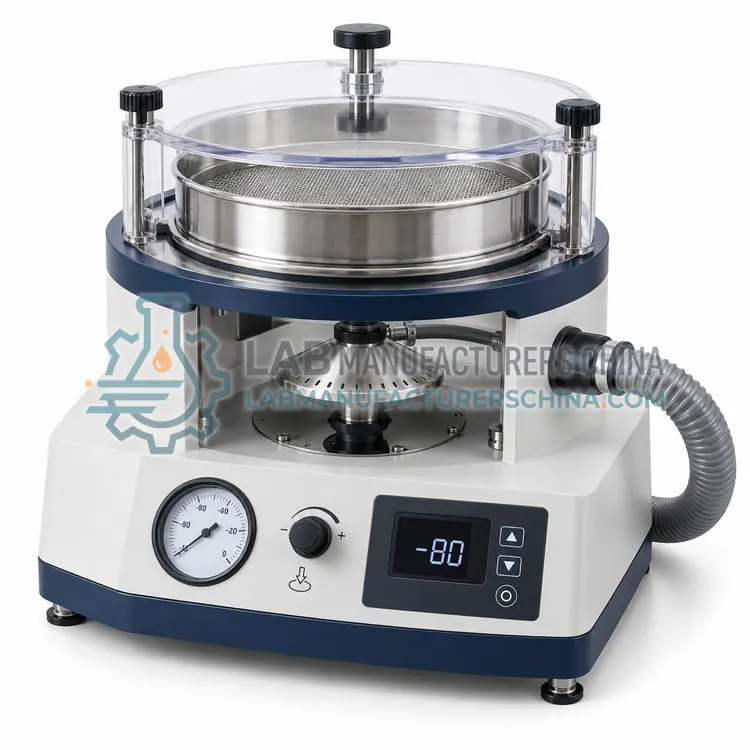
- Air Jet Sieving Machine — A single-sieve analyzer where a rotating slit nozzle beneath the sieve pulls fine powder through the mesh by airflow and a vacuum.
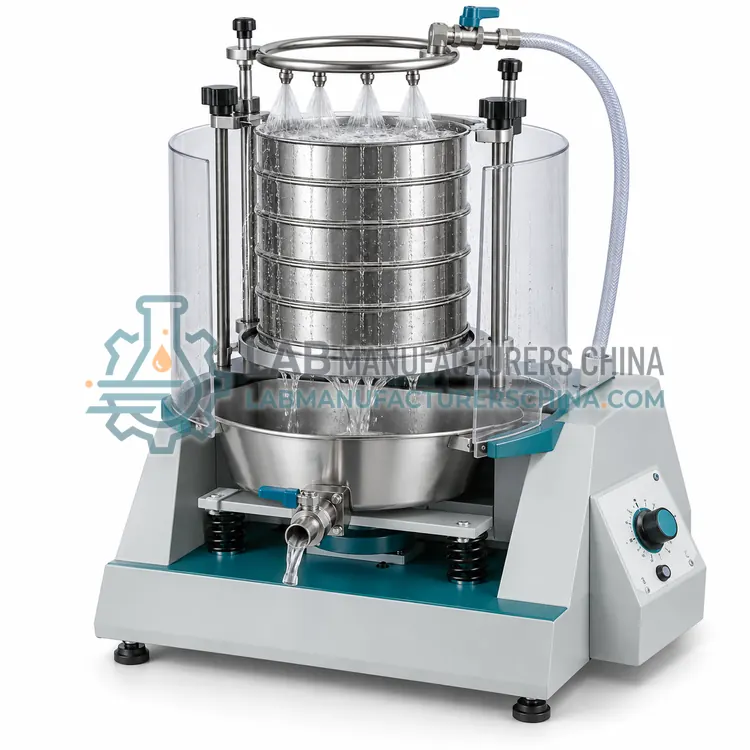
- Wet Sieving Apparatus — A sieving apparatus that uses a controlled water spray or suspension flow to wash fines through stacked sieves.
- Ultrasonic Sieve Analyzer for Fine Powders — A sieving system that adds ultrasonic vibration to the mesh so that fine and cohesive powders pass through micro-aperture sieves without blinding.
How do I choose the right variant?
Select the mechanism from the material. Free-flowing granules and aggregates above about 100 µm suit electromagnetic or tapping shakers. Fine, cohesive powders between roughly 20 and 150 µm need air jet or ultrasonic assistance to prevent blinding. Materials that agglomerate or contain soluble fines need wet sieving. Consider the sieve diameter (200, 300 or 400 mm), maximum stack height, load capacity and programmable amplitude and time. Verify compatibility with the standard you follow, such as ASTM C136 for aggregates, ASTM D422 or ISO 17892-4 for soils, or ISO 2591-1. Noise, dust enclosure, digital amplitude control and whether results are recorded electronically also matter. Compare with laser diffraction or image analysis only after noting that sieve and optical sizes differ.
Where are Sieve Analyzers used?
Sieve Analyzers are specified in aggregate and sand grading in construction, soil and sediment particle size, mining and mineral processing, food, flour and grain classification, fertilizer and chemical granules and metal powder classification.
Which standards and certifications apply?
Work with Sieve Analyzers is commonly governed by ISO 3310-1, ISO 3310-2, ASTM E11, ISO 2591-1, ASTM C136, ASTM D422, ASTM B214 and GB/T 6003.1. Instrument certifications such as CE marking are confirmed per configuration and never assumed.
What are the key considerations before purchase?
Do not overload sieves; typical loads are a single layer of particles or 100 to 200 g on a 200 mm sieve, depending on aperture. Determine the test duration by checking that less than 0.1 percent of the sample mass passes per minute. Inspect sieves for damage, clean them with brushes or ultrasonic baths, and never use sharp tools on fine meshes. Periodically check sieve aperture conformity with certified reference materials or calibration sieves and optical measurement according to ISO 3310. Place the machine on a level, rigid bench, and use dust extraction for fine powders. Record humidity, since moisture causes agglomeration. Keep a maintenance schedule for drives and clamps.