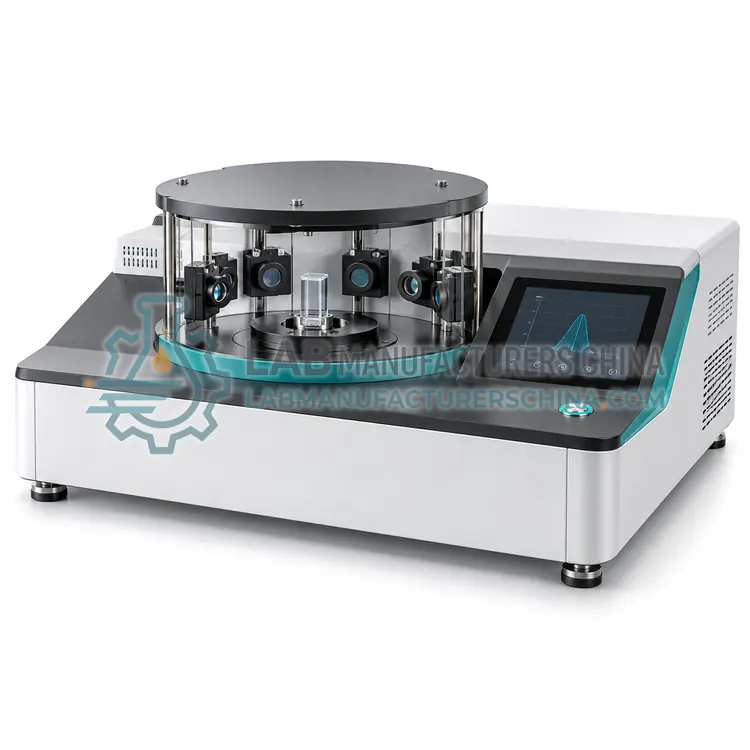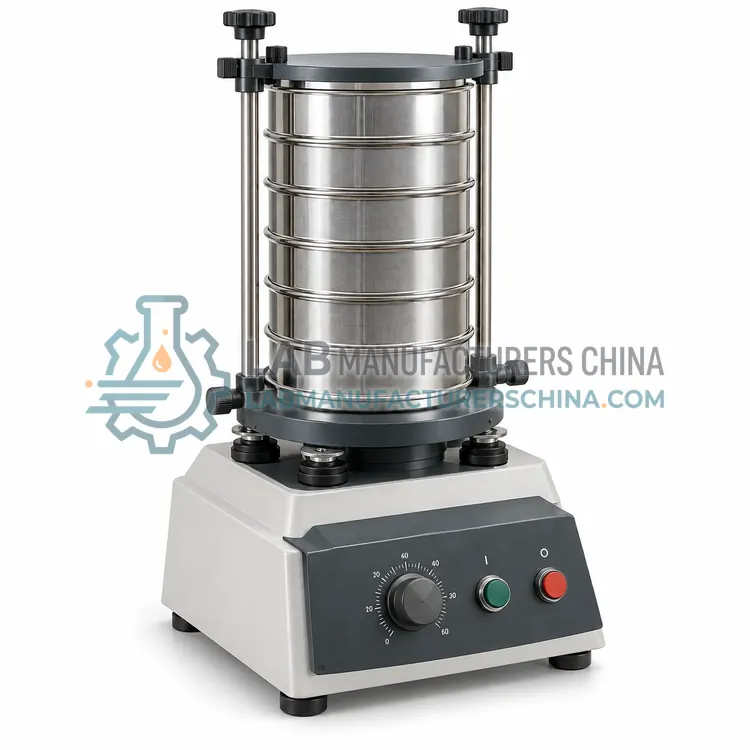
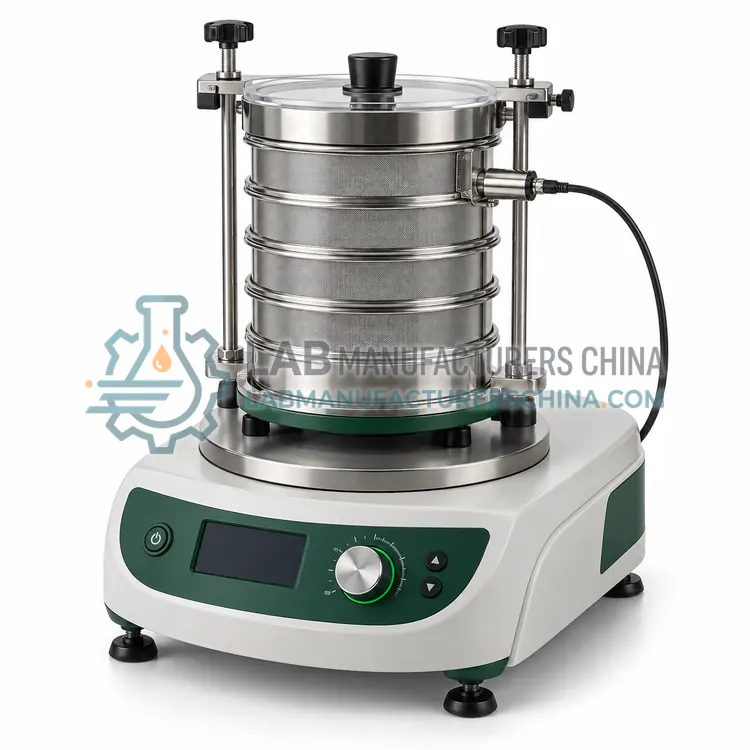
Ultrasonic Sieve Analyzer for Fine Powders
细粉超声筛分仪
- SKU SIA-0005
- Sieve Analyzers
- CE (to be confirmed)
- ISO 9001 manufacturing (to be confirmed)
Price on request — FOB / CIF quoted per order
Prices depend on configuration, quantity and destination port.
Key specifications
| Aperture range | 10–500 µm |
|---|---|
| Ultrasonic frequency | ≈ 35 kHz |
| Generator power | 0–100 W adjustable |
| Sieve diameter | 200 mm |
| Sample mass | 5–50 g |
| Amplitude | 0.2–2 mm |
Request a quote Download brochure · to be provided
By Lab Manufacturers China Technical TeamLast reviewed Standards: ISO 3310-1, ISO 3310-2, ASTM E11
What is the Ultrasonic Sieve Analyzer for Fine Powders?
A sieving system that adds ultrasonic vibration to the mesh so that fine and cohesive powders pass through micro-aperture sieves without blinding. It enables reproducible classification of materials down to about 10 µm, such as metal powders, toners, and pharmaceutical actives.
What is the Ultrasonic Sieve Analyzer for Fine Powders?
A sieving system that adds ultrasonic vibration to the mesh so that fine and cohesive powders pass through micro-aperture sieves without blinding. It enables reproducible classification of materials down to about 10 µm, such as metal powders, toners, and pharmaceutical actives.
Overview
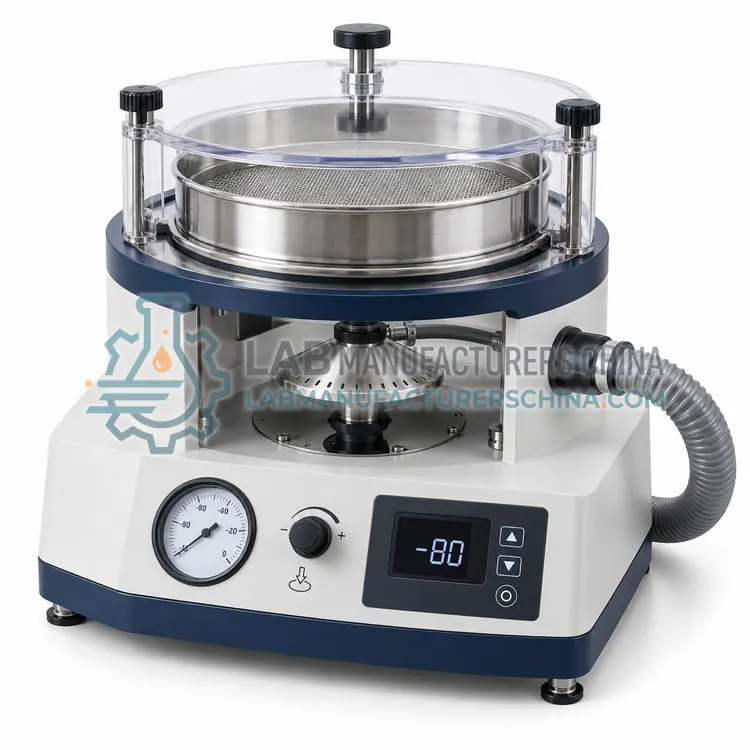
In this variant a piezoelectric transducer and amplifier couple ultrasonic vibration, typically around 35 kHz, into the sieve frame or mesh while a conventional electromagnetic or vibratory drive moves the stack. The ultrasonic energy fluidises particles in contact with the mesh and breaks weak van der Waals or electrostatic bonds, so near-size particles pass through apertures as small as 10 to 20 µm. Electroformed sieves and fine woven mesh are used, and generator power is adjustable. Because fine sieves are fragile, amplitude limits and sample loads are reduced. Typical tests are 5 to 15 minutes with sample masses of 5 to 50 g. The approach gives improved repeatability for additive manufacturing powders, toners and inhalable materials, but sieve costs and handling requirements are greater than for coarse mesh.
How does it work?
A sieve analyzer agitates a stack of test sieves, arranged with the coarsest aperture on top, so that particles either pass through an aperture or are retained on it. The agitation may be vertical throw from an electromagnetic drive, horizontal circular motion combined with tapping, air jets that clear the mesh from below, or ultrasonic vibration for fine sieves. Particles pass when their smallest projected dimension is smaller than the aperture and their orientation allows. After a set time, each sieve and the receiver pan are weighed, and mass percentages are calculated as individual and cumulative retained or passing fractions. Sieve sizes and tolerances are defined in ISO 3310 and ASTM E11, and procedures in ISO 2591-1. Amplitude, time, sample mass and sieve condition govern repeatability and end-point.
What are the key features?
- Piezoelectric ultrasonic transducer with adjustable generator power
- Combined with electromagnetic drive for throw motion
- Compatible with 10 to 20 µm electroformed sieves
- Reduces blinding for cohesive and electrostatic powders
- Digital timer and amplitude control for fine sieves
- Sample masses as small as 5 g
What are the technical specifications?
A typical ultrasonic sieve analyzer for fine powders configuration offers aperture range of 10–500 µm, ultrasonic frequency of ≈ 35 kHz, generator power of 0–100 W adjustable, sieve diameter of 200 mm, sample mass of 5–50 g and amplitude of 0.2–2 mm. Values are indicative of the product class; the exact figures for each configuration are confirmed on the quotation and the calibration documents supplied with the instrument.
Which applications is it used for?
The Ultrasonic Sieve Analyzer for Fine Powders is used in additive manufacturing metal powders, toner and pigment classification, pharmaceutical API fine fractions, battery active materials and ceramic and abrasive micropowders. Across the wider Sieve Analyzers class, laboratories also deploy it for aggregate and sand grading in construction, soil and sediment particle size and mining and mineral processing.
Which standards and certifications apply?
Relevant standards and methods include ISO 3310-1, ISO 3310-2, ASTM E11, ISO 2591-1, ASTM C136, ASTM D422, ASTM B214 and GB/T 6003.1. Certification candidates for this model are CE and ISO 9001 manufacturing; each is to be confirmed for the specific configuration before shipment, and certificates are supplied only where they have been issued.
Do not overload sieves; typical loads are a single layer of particles or 100 to 200 g on a 200 mm sieve, depending on aperture. Determine the test duration by checking that less than 0.1 percent of the sample mass passes per minute. Inspect sieves for damage, clean them with brushes or ultrasonic baths, and never use sharp tools on fine meshes. Periodically check sieve aperture conformity with certified reference materials or calibration sieves and optical measurement according to ISO 3310. Place the machine on a level, rigid bench, and use dust extraction for fine powders. Record humidity, since moisture causes agglomeration. Keep a maintenance schedule for drives and clamps.
How do I select the right Ultrasonic Sieve Analyzer for Fine Powders?
Choose ultrasonic sieving for fine powders from 10 to 100 µm that blind under ordinary dry shaking and where sieve classification is preferred to optical methods. Specify aperture sizes, sieve type, sample mass, generator power and whether powders are hazardous or reactive, requiring enclosure or inert gas.
How does it compare with other Sieve Analyzers variants?
Select the mechanism from the material. Free-flowing granules and aggregates above about 100 µm suit electromagnetic or tapping shakers. Fine, cohesive powders between roughly 20 and 150 µm need air jet or ultrasonic assistance to prevent blinding. Materials that agglomerate or contain soluble fines need wet sieving. Consider the sieve diameter (200, 300 or 400 mm), maximum stack height, load capacity and programmable amplitude and time. Verify compatibility with the standard you follow, such as ASTM C136 for aggregates, ASTM D422 or ISO 17892-4 for soils, or ISO 2591-1. Noise, dust enclosure, digital amplitude control and whether results are recorded electronically also matter. Compare with laser diffraction or image analysis only after noting that sieve and optical sizes differ.
Full specifications
| Aperture range | 10–500 µm |
|---|---|
| Ultrasonic frequency | ≈ 35 kHz |
| Generator power | 0–100 W adjustable |
| Sieve diameter | 200 mm |
| Sample mass | 5–50 g |
| Amplitude | 0.2–2 mm |
| Timer | 1 s–99 min |
| Sieve type | Electroformed or fine woven mesh |
| Stack capacity | ≈ 6 sieves |
| Power supply | AC 220 V, 50/60 Hz |
Indicative values for this product class. Final specifications are confirmed on the quotation and in the calibration documents supplied with the instrument.
Applications
- Additive manufacturing metal powders
- Toner and pigment classification
- Pharmaceutical API fine fractions
- Battery active materials
- Ceramic and abrasive micropowders
Key features
- Piezoelectric ultrasonic transducer with adjustable generator power
- Combined with electromagnetic drive for throw motion
- Compatible with 10 to 20 µm electroformed sieves
- Reduces blinding for cohesive and electrostatic powders
- Digital timer and amplitude control for fine sieves
- Sample masses as small as 5 g
Frequently asked questions about Ultrasonic Sieve Analyzer for Fine Powders
Ultrasound reduces particle-mesh adhesion and breaks weak agglomerates, so particles near the aperture size can pass through rather than wedging in the mesh. This gives more repeatable results for fine powders than mechanical shaking alone.
Excess power or contact can fatigue thin electroformed meshes, so generator power and time are limited per manufacturer guidance, and sieves should be inspected under magnification regularly.
It can be used for metal powders if the sieving is done in an inert atmosphere or sealed chamber and the equipment is grounded, since fine reactive powders present ignition and dust explosion risks.
Standard woven-wire sieves cover about 20 µm to 125 mm; electroformed sieves extend to around 5 µm. The practical lower limit for dry sieving is about 45 µm, below which air jet, wet or ultrasonic methods are better.
Duration is set until the sample mass passing any sieve falls below 0.1 percent per minute, or as prescribed by the applicable standard. Typical times are 5 to 20 minutes for dry sieving; fine or cohesive samples may need longer.
Sieving classifies by the second-smallest particle dimension and reports mass fractions, while laser diffraction reports equivalent spherical volume diameters. Elongated particles in particular show systematic differences, so the methods are correlated rather than interchanged.
Related models
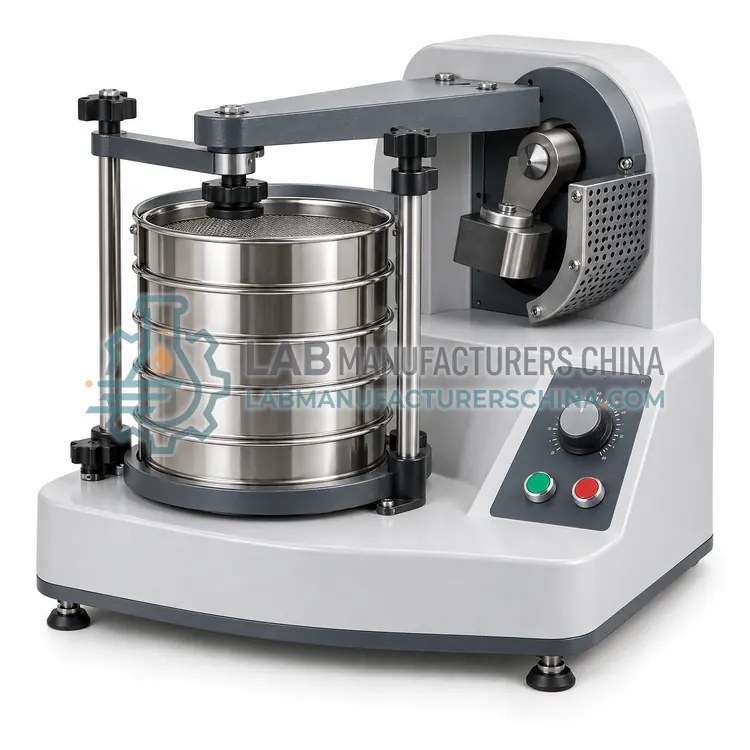
Single-Point Flow BET Surface Area Analyzer for Powder QC
粉体质控单点流动法 BET 比表面积分析仪
- CE (to be confirmed)
- +1