Horizontal Tapping Sieve Shaker
水平拍击式振筛机
- SKU SIA-0002
- Sieve Analyzers
- CE (to be confirmed)
- ISO 9001 manufacturing (to be confirmed)
Price on request — FOB / CIF quoted per order
Prices depend on configuration, quantity and destination port.
Key specifications
| Sieve diameter | 200 mm / 8 in |
|---|---|
| Rotation speed | ≈ 280 rpm |
| Tapping rate | ≈ 150 taps/min |
| Timer | 0–60 min |
| Max stack | ≈ 7 sieves + pan |
| Max load | ≈ 5 kg |
Request a quote Download brochure · to be provided
By Lab Manufacturers China Technical TeamLast reviewed Standards: ISO 3310-1, ISO 3310-2, ASTM E11
What is the Horizontal Tapping Sieve Shaker?
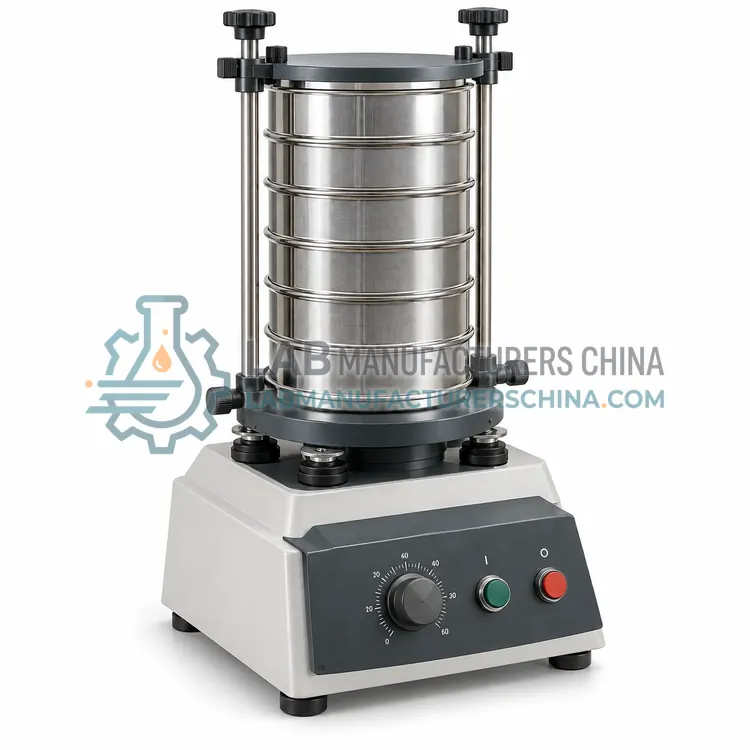
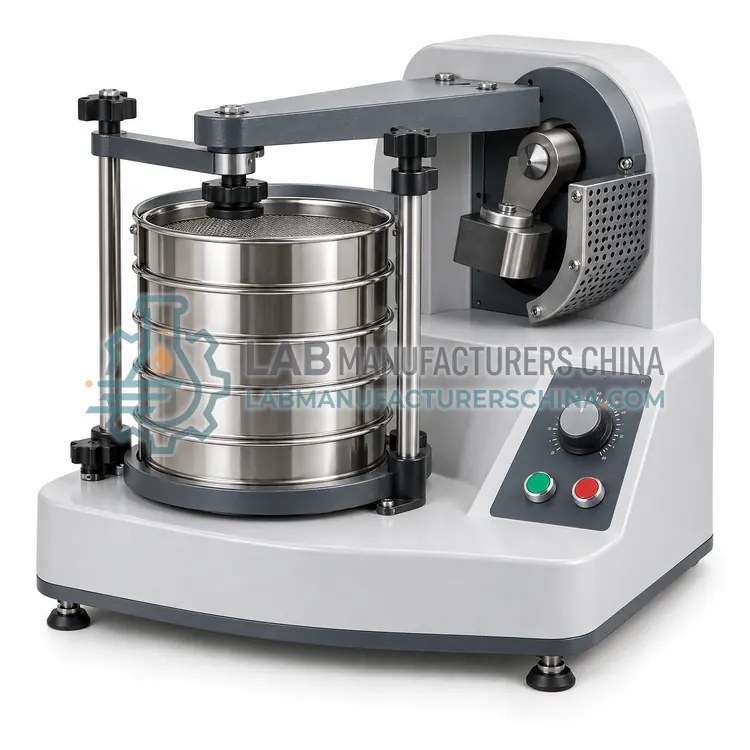
A mechanical sieve shaker that combines horizontal circular motion with a vertical tapping hammer, traditionally used for aggregates, cement, and coal. It applies strong, fixed agitation to loaded 200 mm sieves and suits coarse to medium materials in construction and mining laboratories.
What is the Horizontal Tapping Sieve Shaker?
A mechanical sieve shaker that combines horizontal circular motion with a vertical tapping hammer, traditionally used for aggregates, cement, and coal. It applies strong, fixed agitation to loaded 200 mm sieves and suits coarse to medium materials in construction and mining laboratories.
Overview
In this design an electric motor drives an eccentric that rotates the sieve stack horizontally at around 280 rpm while a spring-loaded tapper strikes the top cap about 150 times per minute. The combined shaking and tapping effectively frees particles lodged in apertures and suits materials such as sand and crushed stone, where standards like ASTM C136 describe this type of action. It holds 200 mm or 8 inch sieves, often up to 7 full-height sieves and a pan, with a timer to 60 minutes. Speed and tap rate are fixed, which simplifies method transfer but prevents fine adjustment for delicate samples. It is robust, low in cost and easy to maintain, although noise is higher than electromagnetic models, and fine powders below about 75 µm may sieve incompletely.
How does it work?
A sieve analyzer agitates a stack of test sieves, arranged with the coarsest aperture on top, so that particles either pass through an aperture or are retained on it. The agitation may be vertical throw from an electromagnetic drive, horizontal circular motion combined with tapping, air jets that clear the mesh from below, or ultrasonic vibration for fine sieves. Particles pass when their smallest projected dimension is smaller than the aperture and their orientation allows. After a set time, each sieve and the receiver pan are weighed, and mass percentages are calculated as individual and cumulative retained or passing fractions. Sieve sizes and tolerances are defined in ISO 3310 and ASTM E11, and procedures in ISO 2591-1. Amplitude, time, sample mass and sieve condition govern repeatability and end-point.
What are the key features?
- Horizontal circular motion with superimposed vertical tapping
- Fixed 280 rpm rotation and about 150 taps per minute
- Accepts 200 mm and 8 inch sieves with pan and cover
- Mechanical timer up to 60 minutes with automatic stop
- Robust steel frame and simple maintenance
- Suitable for aggregate standards calling for tapping action
What are the technical specifications?
A typical horizontal tapping sieve shaker configuration offers sieve diameter of 200 mm / 8 in, rotation speed of ≈ 280 rpm, tapping rate of ≈ 150 taps/min, timer of 0–60 min, max stack of ≈ 7 sieves + pan and max load of ≈ 5 kg. Values are indicative of the product class; the exact figures for each configuration are confirmed on the quotation and the calibration documents supplied with the instrument.
Which applications is it used for?
The Horizontal Tapping Sieve Shaker is used in aggregate and sand grading, cement and fly ash fineness checks, coal and coke sizing, mineral ore fractions and ceramic raw materials. Across the wider Sieve Analyzers class, laboratories also deploy it for aggregate and sand grading in construction, soil and sediment particle size and mining and mineral processing.
Which standards and certifications apply?
Relevant standards and methods include ISO 3310-1, ISO 3310-2, ASTM E11, ISO 2591-1, ASTM C136, ASTM D422, ASTM B214 and GB/T 6003.1. Certification candidates for this model are CE and ISO 9001 manufacturing; each is to be confirmed for the specific configuration before shipment, and certificates are supplied only where they have been issued.
Do not overload sieves; typical loads are a single layer of particles or 100 to 200 g on a 200 mm sieve, depending on aperture. Determine the test duration by checking that less than 0.1 percent of the sample mass passes per minute. Inspect sieves for damage, clean them with brushes or ultrasonic baths, and never use sharp tools on fine meshes. Periodically check sieve aperture conformity with certified reference materials or calibration sieves and optical measurement according to ISO 3310. Place the machine on a level, rigid bench, and use dust extraction for fine powders. Record humidity, since moisture causes agglomeration. Keep a maintenance schedule for drives and clamps.
How do I select the right Horizontal Tapping Sieve Shaker?
Choose a tapping shaker when a standard prescribes horizontal motion with tapping, for example aggregates, and where fixed, robust operation and low cost are valued. Specify sieve size, number of sieves, sample mass and expected noise limits. Delicate, fine or cohesive powders are better served by electromagnetic or air jet machines.
How does it compare with other Sieve Analyzers variants?
Select the mechanism from the material. Free-flowing granules and aggregates above about 100 µm suit electromagnetic or tapping shakers. Fine, cohesive powders between roughly 20 and 150 µm need air jet or ultrasonic assistance to prevent blinding. Materials that agglomerate or contain soluble fines need wet sieving. Consider the sieve diameter (200, 300 or 400 mm), maximum stack height, load capacity and programmable amplitude and time. Verify compatibility with the standard you follow, such as ASTM C136 for aggregates, ASTM D422 or ISO 17892-4 for soils, or ISO 2591-1. Noise, dust enclosure, digital amplitude control and whether results are recorded electronically also matter. Compare with laser diffraction or image analysis only after noting that sieve and optical sizes differ.
Full specifications
| Sieve diameter | 200 mm / 8 in |
|---|---|
| Rotation speed | ≈ 280 rpm |
| Tapping rate | ≈ 150 taps/min |
| Timer | 0–60 min |
| Max stack | ≈ 7 sieves + pan |
| Max load | ≈ 5 kg |
| Motor power | ≈ 370 W |
| Noise level | ≈ 75 dB(A) |
| Dimensions | ≈ 600 × 500 × 900 mm |
| Weight | ≈ 65 kg |
Indicative values for this product class. Final specifications are confirmed on the quotation and in the calibration documents supplied with the instrument.
Applications
- Aggregate and sand grading
- Cement and fly ash fineness checks
- Coal and coke sizing
- Mineral ore fractions
- Ceramic raw materials
Key features
- Horizontal circular motion with superimposed vertical tapping
- Fixed 280 rpm rotation and about 150 taps per minute
- Accepts 200 mm and 8 inch sieves with pan and cover
- Mechanical timer up to 60 minutes with automatic stop
- Robust steel frame and simple maintenance
- Suitable for aggregate standards calling for tapping action
Frequently asked questions about Horizontal Tapping Sieve Shaker
Tapping delivers vertical impulses that dislodge particles wedged in apertures, improving passage for near-size particles. Combined with circular motion it spreads the sample across the mesh.
Usually no, because speed and tap rate are fixed mechanically. This simplifies method consistency, although delicate materials that might break under tapping may need another shaker type.
Standards vary with aperture; for aggregates a few kilograms may be used on 200 mm or larger sieves, while cement or fine materials need about 50 to 200 g to avoid overloading.
Standard woven-wire sieves cover about 20 µm to 125 mm; electroformed sieves extend to around 5 µm. The practical lower limit for dry sieving is about 45 µm, below which air jet, wet or ultrasonic methods are better.
Duration is set until the sample mass passing any sieve falls below 0.1 percent per minute, or as prescribed by the applicable standard. Typical times are 5 to 20 minutes for dry sieving; fine or cohesive samples may need longer.
Sieving classifies by the second-smallest particle dimension and reports mass fractions, while laser diffraction reports equivalent spherical volume diameters. Elongated particles in particular show systematic differences, so the methods are correlated rather than interchanged.
Related models
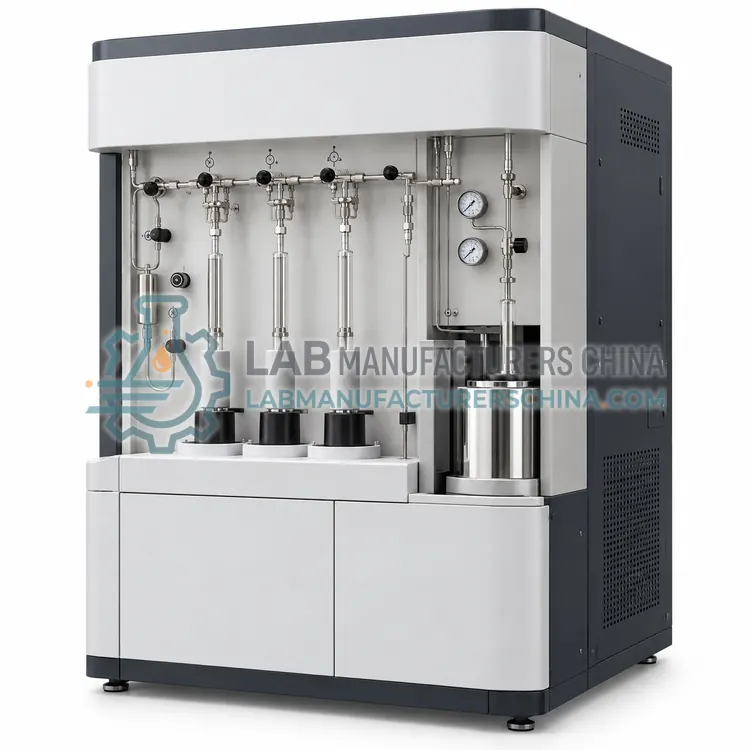
Nanopowder and Fine Particle BET Surface Area Analyzer with Micropore Option
带微孔选项的纳米粉体细颗粒 BET 比表面积分析仪
- CE (to be confirmed)
- +1