Lab Manufacturers China

Nanoparticle Analyzers

纳米颗粒分析仪

NAA · Particle Analysis Instruments · 6 models

By Lab Manufacturers China Technical TeamLast reviewed Standards: ISO 19430, ISO 13322-1, ISO 22412

Standards referenced

  • ISO 19430
  • ISO 13322-1
  • ISO 22412
  • ISO/TS 21362
  • ASTM E2834
  • ISO 21363
  • GB/T 19627

What are Nanoparticle Analyzers?

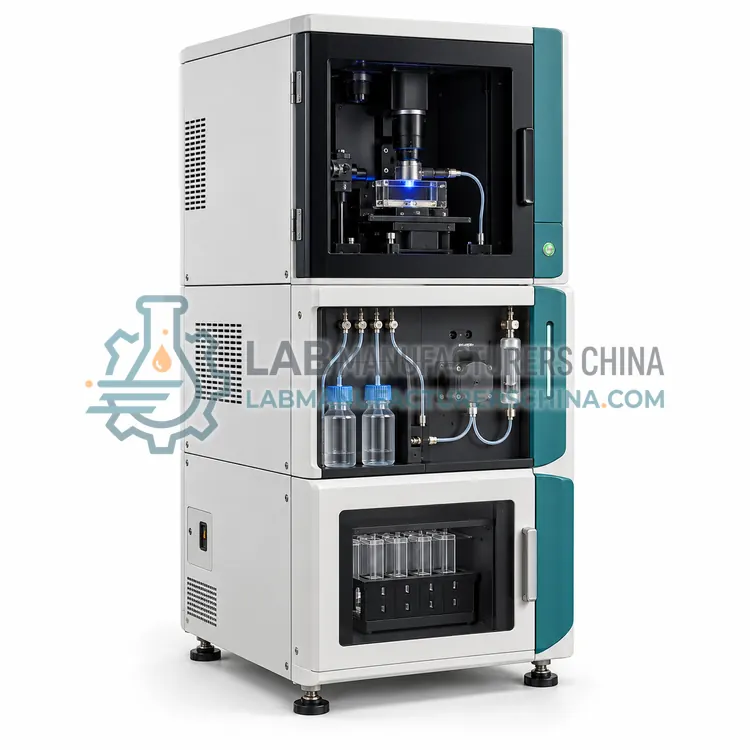
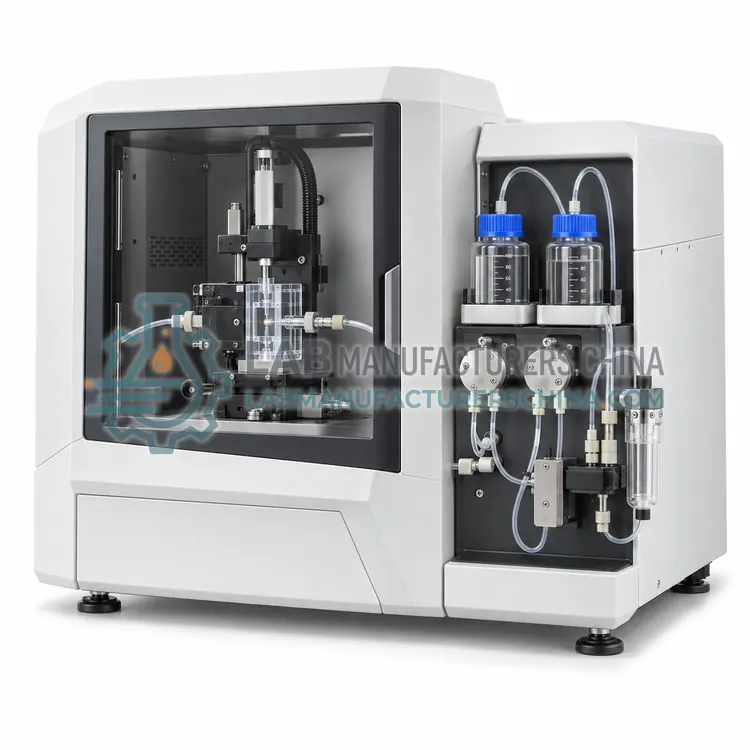
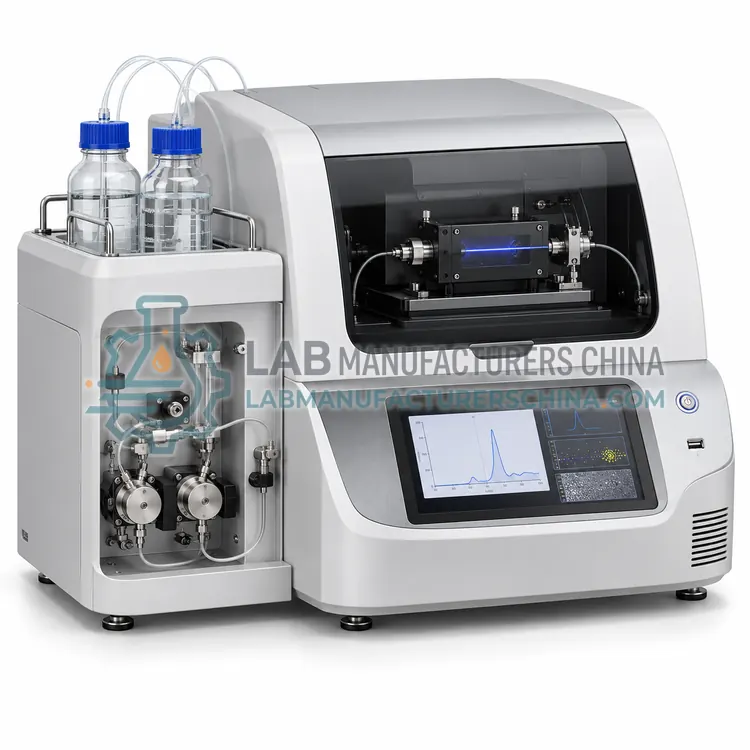
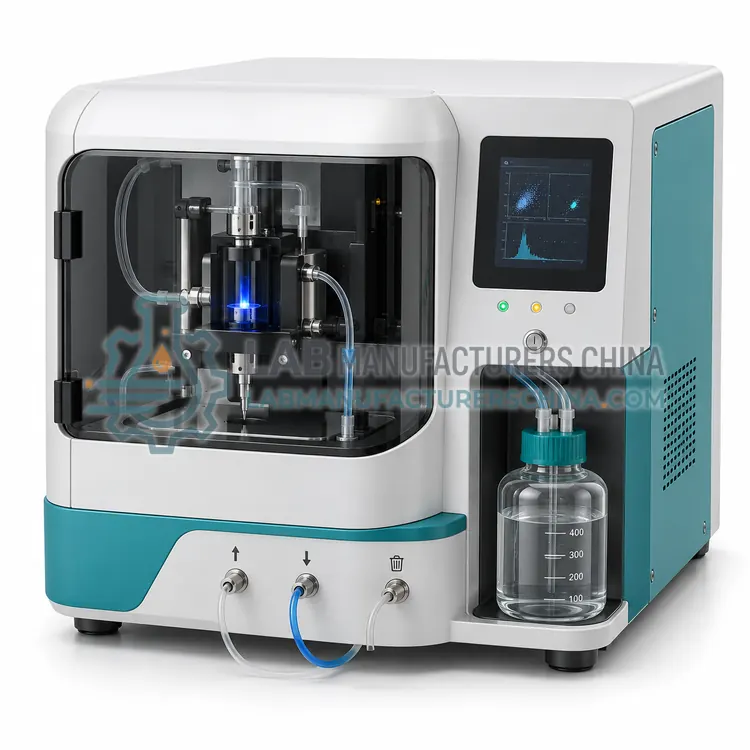
Nanoparticle analyzers determine the size, concentration and sometimes the charge or composition of particles between about 1 and 1000 nm in liquids. Methods include particle tracking, resistive pulse sensing, field-flow fractionation and nano flow cytometry. Drug delivery, vaccine, extracellular vesicle and advanced materials laboratories use them to characterize particle-by-particle populations.

6 models of Nanoparticle Analyzers

The 6 models below are current configurations; specifications are confirmed on quotation.

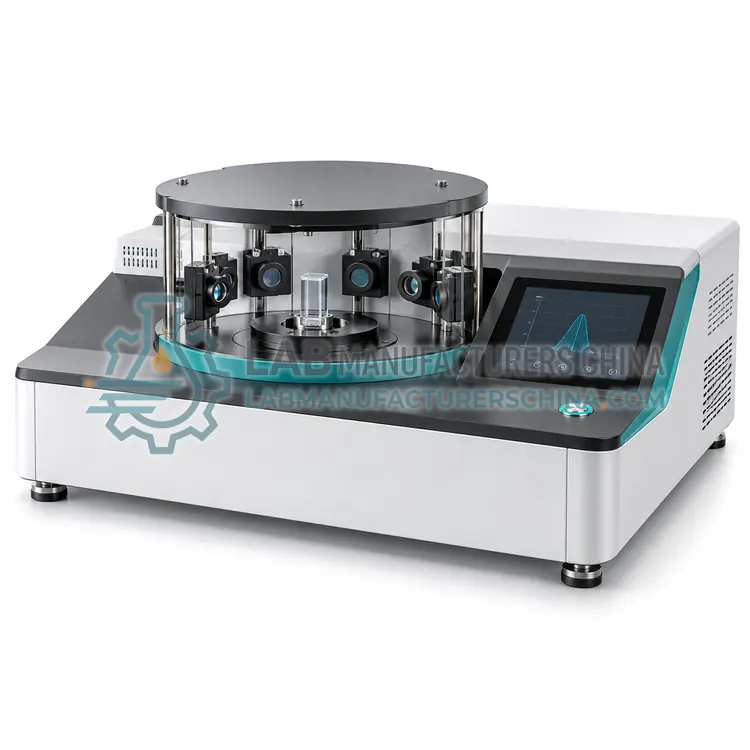
Nanoparticle Tracking Analyzer

纳米颗粒追踪分析仪

  • NAA-0001
  • Nanoparticle Analyzers
  • CE (to be confirmed)
  • ISO 9001 manufacturing (to be confirmed)
Size range:
30–1000 nm (material dependent)
Concentration range:
10⁷–10⁹ particles/mL
Laser:
488 nm or 532 nm, 40–100 mW
Camera:
sCMOS, ≥ 30 fps
Sample volume:
0.3–1 mL
Temperature control:
15–55 °C, ±0.1 °C

A scattering-mode instrument that tracks Brownian motion of individual nanoparticles under a laser sheet to report number-weighted size distribution and particle concentration. It fits 30 to 1000 nm dilute suspensions such as liposomes, vesicles and colloids where concentration data are required.

Request a quote
View details

Fluorescence-Mode Nanoparticle Tracking Analyzer

荧光模式纳米颗粒追踪分析仪

  • NAA-0002
  • Nanoparticle Analyzers
  • CE (to be confirmed)
  • ISO 9001 manufacturing (to be confirmed)
Size range (fluorescence):
≈ 50–1000 nm (fluorophore dependent)
Laser lines:
405, 488, 532, 640 nm (selectable)
Emission filters:
Long-pass, several cut-on wavelengths
Camera:
sCMOS, ≥ 30 fps, high sensitivity
Concentration range:
10⁷–10⁹ particles/mL
Sample volume:
0.3–1 mL

A nanoparticle tracking instrument with laser lines and emission filters that distinguishes fluorescently labelled particles from the unlabelled background. It counts and sizes specific subpopulations, such as antibody-labelled vesicles or dye-loaded liposomes, in complex matrices like plasma or cell culture media.

Request a quote
View details

Tunable Resistive Pulse Sensing Nanoparticle Analyzer

可调电阻脉冲传感纳米颗粒分析仪

  • NAA-0003
  • Nanoparticle Analyzers
  • CE (to be confirmed)
  • ISO 9001 manufacturing (to be confirmed)
Size range:
40 nm–10 µm (pore dependent)
Measurement principle:
Resistive pulse sensing (Coulter principle)
Concentration range:
10⁵–10¹¹ particles/mL
Sample volume:
35–100 µL
Applied voltage:
0.1–1.5 V
Pressure control:
0–2 kPa, programmable

An analyzer that detects particles one by one as they pass through an adjustable elastomeric nanopore, using blockade of ionic current to measure size, concentration and, with voltage scaling, surface charge. It provides refractive-index-independent, high-resolution data in conductive electrolytes.

Request a quote
View details

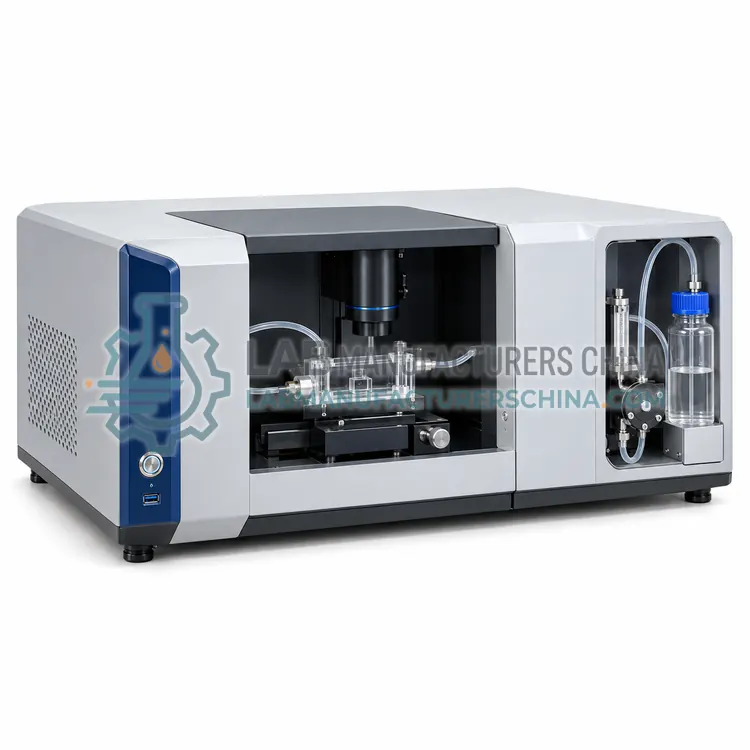
AF4-MALS Nanoparticle Fractionation and Analysis System

AF4-MALS 纳米颗粒分离分析系统

  • NAA-0004
  • Nanoparticle Analyzers
  • CE (to be confirmed)
  • ISO 9001 manufacturing (to be confirmed)
Size range:
1 nm–1 µm
Separation principle:
Asymmetric flow field-flow fractionation
MALS detector:
18 angles, 659 nm laser
Cross-flow range:
0–5 mL/min programmable
Channel flow:
0.1–5 mL/min
Membrane cut-off:
1–30 kDa regenerated cellulose or PES

A system combining asymmetric flow field-flow fractionation with multi-angle light scattering, UV and refractive index detection. It first separates particles or macromolecules by hydrodynamic size, then measures size, molar mass and concentration for each fraction, resolving mixtures, aggregates and polydisperse samples.

Request a quote
View details

Nano Flow Cytometer for Single-Particle Analysis

单颗粒纳米流式细胞仪

  • NAA-0005
  • Nanoparticle Analyzers
  • CE (to be confirmed)
  • ISO 9001 manufacturing (to be confirmed)
Detectable size:
≈ 40–1000 nm (scatter)
Lasers:
488 nm and 561 or 640 nm
Fluorescence channels:
2–4
Sample flow rate:
0.3–5 µL/min
Event rate:
≤ 10,000 events/s
Sheath fluid:
Filtered PBS, 0.1 µm

A flow cytometer built for nanoparticle detection with hydrodynamic focusing, high-sensitivity side-scatter and multi-channel fluorescence. It measures size, concentration and marker expression of individual particles from roughly 40 nm, making it suited to extracellular vesicles, viruses and lipid nanoparticles.

Request a quote
View details

Multi-Angle Dynamic Light Scattering Nanoparticle Analyzer

多角度动态光散射纳米颗粒分析仪

  • NAA-0006
  • Nanoparticle Analyzers
  • CE (to be confirmed)
  • ISO 9001 manufacturing (to be confirmed)
Size range:
0.3 nm–10 µm
Detection angles:
15°, 90°, 173°
Laser:
633 nm, ≥ 10 mW
Detector:
Avalanche photodiode
Correlator:
Digital, ≥ 1000 channels, ≥ 10 ns
Sample volume:
≥ 3 µL (low-volume cell)

A dynamic light scattering system measuring at several scattering angles, typically 15°, 90° and 173°, to resolve polydisperse or multimodal nanoparticle samples more reliably than single-angle DLS. It provides intensity, volume and number distributions and helps detect small fractions of large aggregates.

Request a quote
View details

Compare Nanoparticle Analyzers models

ModelSize rangeConcentration rangeLaserCameraSample volume
Nanoparticle Tracking AnalyzerNAA-000130–1000 nm (material dependent)10⁷–10⁹ particles/mL488 nm or 532 nm, 40–100 mWsCMOS, ≥ 30 fps0.3–1 mL
Fluorescence-Mode Nanoparticle Tracking AnalyzerNAA-0002—10⁷–10⁹ particles/mL—sCMOS, ≥ 30 fps, high sensitivity0.3–1 mL
Tunable Resistive Pulse Sensing Nanoparticle AnalyzerNAA-000340 nm–10 µm (pore dependent)10⁵–10¹¹ particles/mL——35–100 µL
AF4-MALS Nanoparticle Fractionation and Analysis SystemNAA-00041 nm–1 µm————
Nano Flow Cytometer for Single-Particle AnalysisNAA-0005—10⁷–10¹¹ particles/mL——≥ 50 µL
Multi-Angle Dynamic Light Scattering Nanoparticle AnalyzerNAA-00060.3 nm–10 µm0.1 ppm–40% w/v633 nm, ≥ 10 mW—≥ 3 µL (low-volume cell)

Indicative values for this product class. Final specifications are confirmed on the quotation and in the calibration documents supplied with the instrument.

How do Nanoparticle Analyzers work?

Nanoparticle tracking analysis illuminates a dilute suspension with a laser sheet and records the scattered light of individual particles with a camera; software follows each track and derives a diffusion coefficient, converted to hydrodynamic diameter with the Stokes–Einstein equation, and counts particles per millilitre in a known volume. Resistive pulse sensing passes particles through a nanopore in an electrolyte; each particle transiently reduces ionic current in proportion to its volume, giving size and concentration. Field-flow fractionation separates particles in a thin channel by diffusion under a cross-flow before in-line light scattering detectors measure size and molar mass. Nano flow cytometers use hydrodynamic focusing and sensitive side-scatter and fluorescence detection to phenotype single particles. Sample dilution and calibration with reference beads are essential.

Which Nanoparticle Analyzers variants are available?

  • Nanoparticle Tracking Analyzer — A scattering-mode instrument that tracks Brownian motion of individual nanoparticles under a laser sheet to report number-weighted size distribution and particle concentration.
  • Fluorescence-Mode Nanoparticle Tracking Analyzer — A nanoparticle tracking instrument with laser lines and emission filters that distinguishes fluorescently labelled particles from the unlabelled background.
  • Tunable Resistive Pulse Sensing Nanoparticle Analyzer — An analyzer that detects particles one by one as they pass through an adjustable elastomeric nanopore, using blockade of ionic current to measure size, concentration and, with voltage scaling, surface charge.
  • AF4-MALS Nanoparticle Fractionation and Analysis System — A system combining asymmetric flow field-flow fractionation with multi-angle light scattering, UV and refractive index detection.
  • Nano Flow Cytometer for Single-Particle Analysis — A flow cytometer built for nanoparticle detection with hydrodynamic focusing, high-sensitivity side-scatter and multi-channel fluorescence.
  • Multi-Angle Dynamic Light Scattering Nanoparticle Analyzer — A dynamic light scattering system measuring at several scattering angles, typically 15°, 90° and 173°, to resolve polydisperse or multimodal nanoparticle samples more reliably than single-angle DLS.

How do I choose the right variant?

Decide what the measurement must deliver: concentration and size distribution of polydisperse samples, fluorescent subpopulation counts, high-resolution separation of mixtures, or single-particle phenotype. Nanoparticle tracking suits 30 to 1000 nm particles at 10⁷ to 10⁹ particles/mL. Resistive pulse sensing gives high-resolution, refractive-index-independent size for conductive dispersions. Field-flow fractionation coupled to multi-angle light scattering resolves mixtures and aggregates. Nano flow cytometry is preferred when labelling and marker analysis are needed. Check detection limit versus your smallest particle, required dynamic range, sample volume, and optical property dependence. Consider whether applicable guidance such as ISO 19430 and regulatory expectations for liposomes or vaccines apply, and who will operate and maintain the system.

Where are Nanoparticle Analyzers used?

Nanoparticle Analyzers are specified in liposome and lipid nanoparticle characterisation, extracellular vesicle and exosome research, viral vector and vaccine particle counting, nanomaterials R&D and protein aggregate and subvisible particle analysis.

Which standards and certifications apply?

Work with Nanoparticle Analyzers is commonly governed by ISO 19430, ISO 13322-1, ISO 22412, ISO/TS 21362, ASTM E2834, ISO 21363 and GB/T 19627. Instrument certifications such as CE marking are confirmed per configuration and never assumed.

What are the key considerations before purchase?

Nanoparticle measurements are very sensitive to sample preparation. Use particle-free, filtered diluents and clean glassware, and dilute to the instrument's optimum concentration window. Dust and bubbles produce false counts. Verify size and concentration with certified polystyrene or silica nanosphere standards at start-up and after changes of settings, and report camera level, detection threshold, temperature and number of tracks, because these parameters change results. Keep laser optics, flow cells and nanopores clean and stored as advised. Install in a stable, temperature-controlled room. Regulated work needs IQ/OQ/PQ, locked methods and audit trails.

Frequently asked questions about Nanoparticle Analyzers

Most cover about 1 to 1000 nm, but each technique has its own window. Tracking analysis typically detects 30 to 1000 nm, resistive pulse sensing 50 nm to several micrometres depending on pore, and field-flow fractionation 1 nm to 1 µm.

Need help specifying Nanoparticle Analyzers?

Request a quote