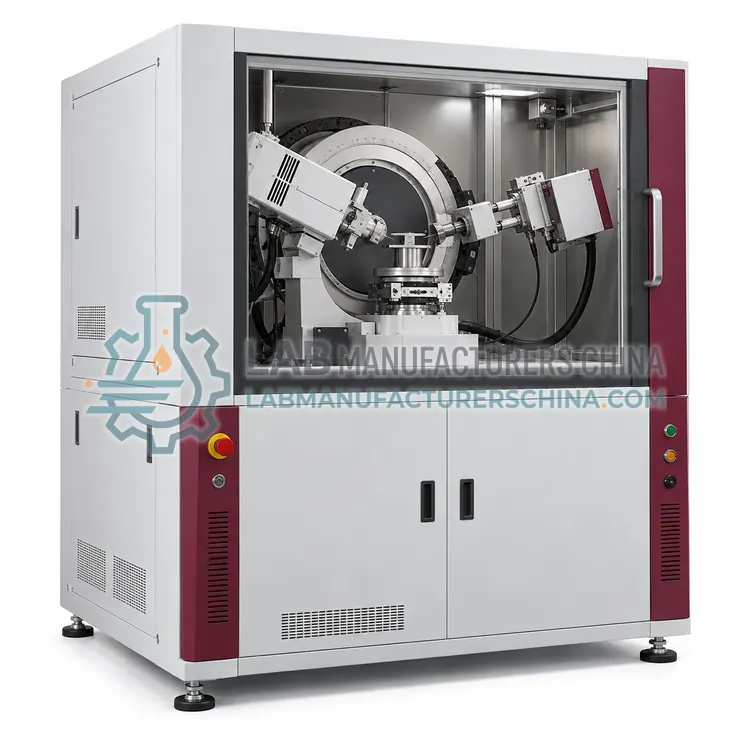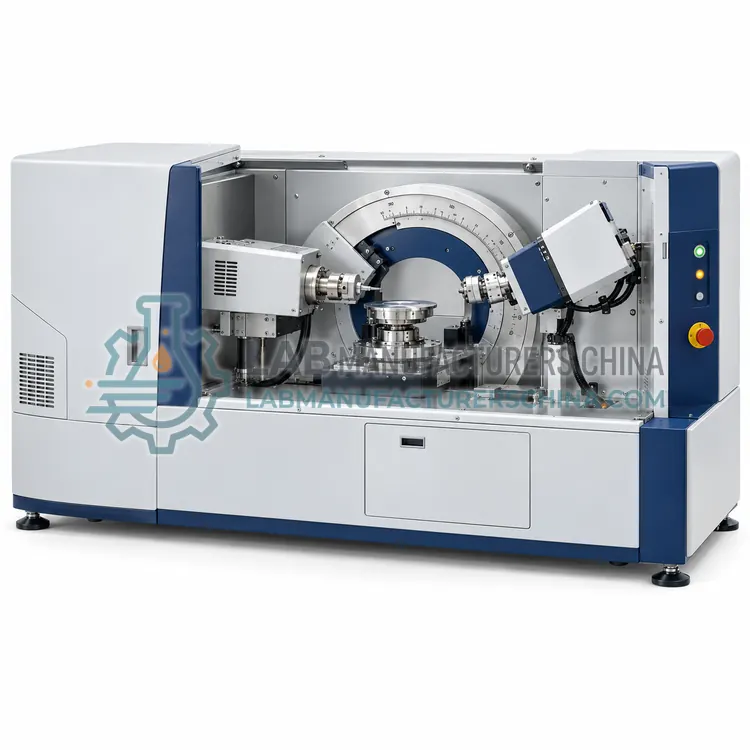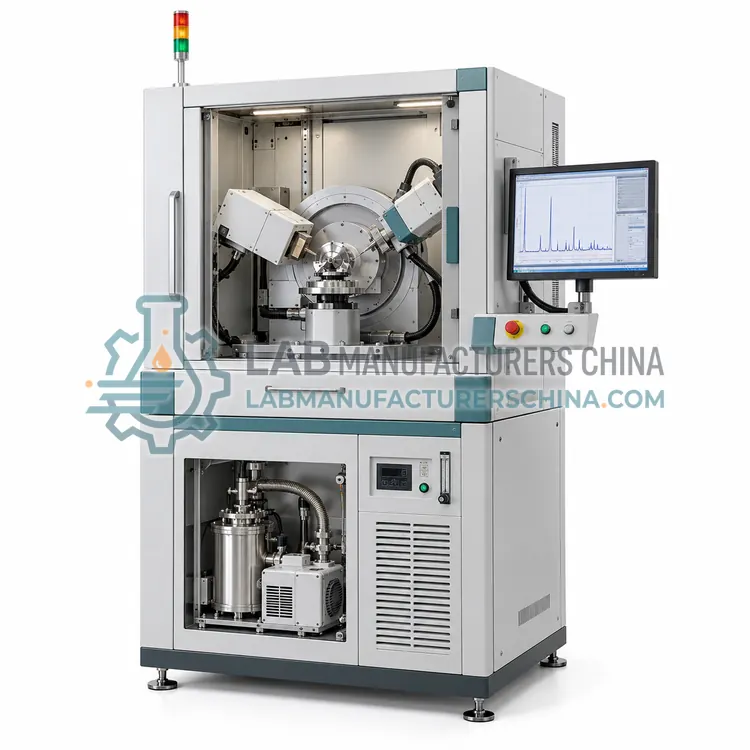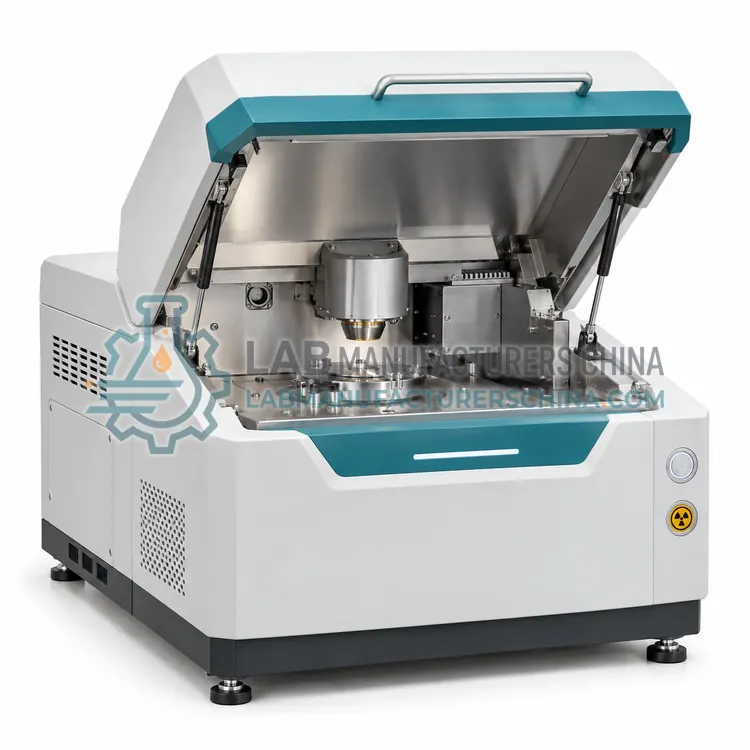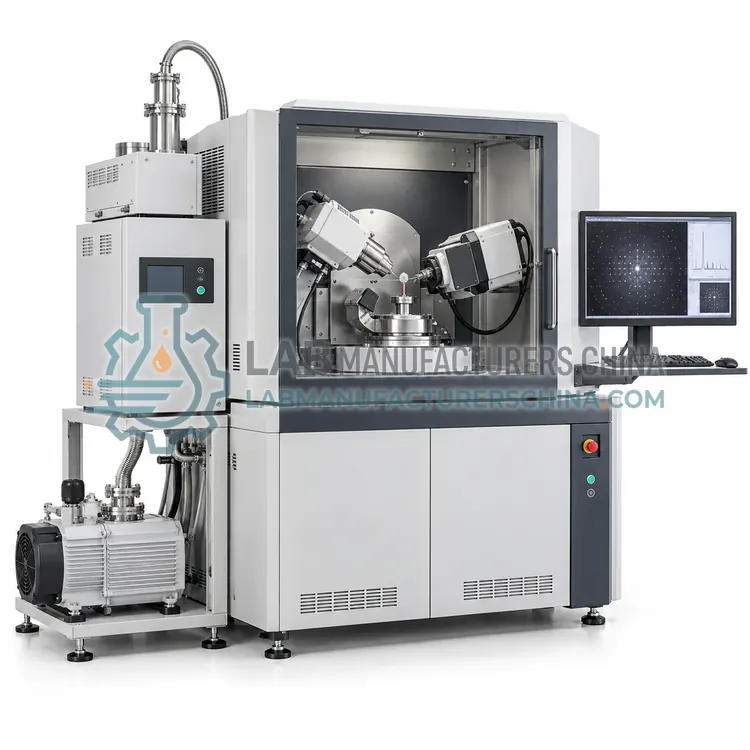
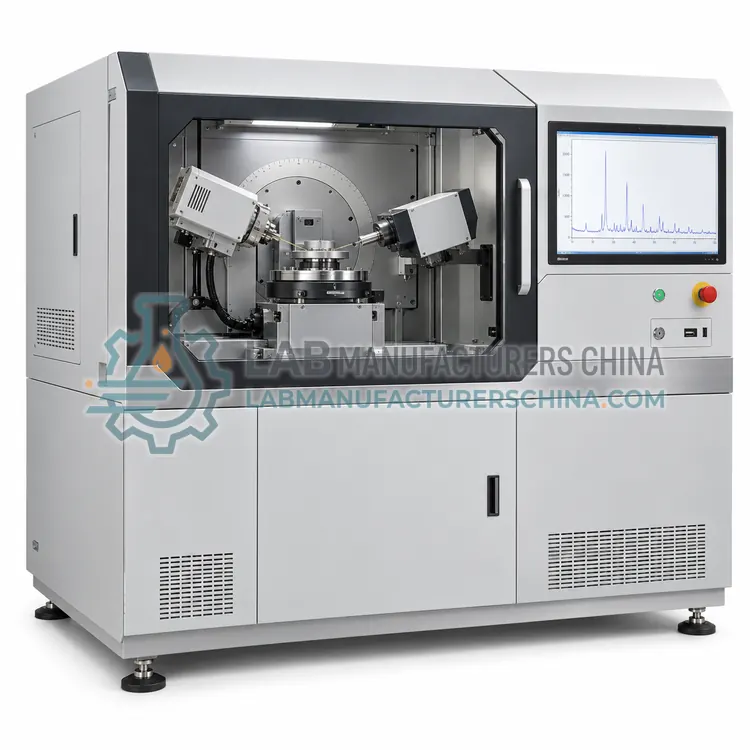
Thin-Film X-Ray Diffractometer with Grazing Incidence
掠入射薄膜 X 射线衍射仪
- SKU XRA-0003
- X-Ray Diffractometers
- CE (to be confirmed)
- Radiation safety enclosure (to be confirmed)
- ISO 9001 manufacturing (to be confirmed)
Price on request — FOB / CIF quoted per order
Prices depend on configuration, quantity and destination port.
Key specifications
| Incidence angle | 0.1–5° |
|---|---|
| 2-theta range | 0–120° |
| Optics | parallel beam with mirror |
| Detector | line or area detector |
| Film thickness | 1 nm to 10 µm |
| X-ray tube power | 1–3 kW |
Request a quote Download brochure · to be provided
By Lab Manufacturers China Technical TeamLast reviewed Standards: ASTM E915 Verifying the alignment of X-ray diffraction instrumentation, ASTM E1426 Determining the effective elastic parameter for X-ray diffraction measurements of residual stress, USP <941> X-Ray Diffraction
What is the Thin-Film X-Ray Diffractometer with Grazing Incidence?
A thin-film X-ray diffractometer with grazing-incidence optics characterizes layers, coatings and epitaxial films. It is chosen for phase, texture and thickness analysis of films that are too thin for conventional reflection geometry.
What is the Thin-Film X-Ray Diffractometer with Grazing Incidence?
A thin-film X-ray diffractometer with grazing-incidence optics characterizes layers, coatings and epitaxial films. It is chosen for phase, texture and thickness analysis of films that are too thin for conventional reflection geometry.
Overview
At incidence angles of a few degrees or less, the X-ray beam penetrates only the near-surface region of a sample, so scattering from the substrate is minimized and thin layers dominate the pattern. Parallel-beam optics with a Goebel mirror or multilayer collimator maintain the beam at low angles, and a line or area detector collects data quickly. Configurations measure phase identification, crystallite orientation, epitaxy, strain and layer thickness, and can combine grazing-incidence diffraction with reflectometry on the same instrument. Sample flatness and alignment to the beam are critical because the illuminated area is large and any tilt shifts the effective angle. Multiple incidence angles provide depth information, and rocking curves or reciprocal-space maps resolve epitaxial relationships. The technique is standard in semiconductor, optical coating and hard-coating development.
How does it work?
X-rays scatter from the electron density of a material. In a crystal, scattering from periodic lattice planes interferes constructively at angles given by Bragg's law, producing diffraction peaks. A diffractometer positions the sample and detector with high angular precision and records intensity versus angle or versus a two-dimensional detector image. Single-crystal instruments determine atomic structure from the full set of reflections, while powder and thin-film instruments analyze phase mixtures, preferred orientation and layer structure. Peak positions give lattice parameters and strain, peak widths relate to crystallite size and microstrain, and low-angle scattering reveals nanoscale features. The choice of optics, monochromator, detector and sample stage determines which measurements are possible, and instrument alignment with certified standards underpins accuracy.
What are the key features?
- Grazing-incidence geometry for near-surface analysis
- Parallel-beam mirror or multilayer optics
- Line or area detector for fast collection
- Phase, texture, strain and thickness measurement
- Multiple incidence angles for depth information
- Combined diffraction and reflectometry options
What are the technical specifications?
A typical thin-film x-ray diffractometer with grazing incidence configuration offers incidence angle of 0.1–5°, 2-theta range of 0–120°, optics of parallel beam with mirror, detector of line or area detector, film thickness of 1 nm to 10 µm and X-ray tube power of 1–3 kW. Values are indicative of the product class; the exact figures for each configuration are confirmed on the quotation and the calibration documents supplied with the instrument.
Which applications is it used for?
The Thin-Film X-Ray Diffractometer with Grazing Incidence is used in semiconductor thin film and barrier layers, optical and hard coatings, epitaxial film and substrate relationships and corrosion and oxide layer analysis. Across the wider X-Ray Diffractometers class, laboratories also deploy it for single-crystal structure determination, thin-film thickness, texture and phase analysis and residual stress in welds, coatings and machined parts.
Which standards and certifications apply?
Relevant standards and methods include ASTM E915 Verifying the alignment of X-ray diffraction instrumentation, ASTM E1426 Determining the effective elastic parameter for X-ray diffraction measurements of residual stress, USP <941> X-Ray Diffraction, ISO 20203 Carbonaceous materials — XRD of calcined coke, ISO/IEC 17025 and IEC 61010-2-091. Certification candidates for this model are CE, Radiation safety enclosure and ISO 9001 manufacturing; each is to be confirmed for the specific configuration before shipment, and certificates are supplied only where they have been issued.
These are regulated radiation devices requiring shielding, interlocks, radiation surveys and trained operators. Single crystals must be mounted and centered precisely, and low-temperature or humidity devices often protect them. Thin films and wafers need flat mounting and careful alignment to the beam, and reflectometry requires very low background and precise angular steps. Residual stress methods need defined measurement directions and elastic constants. Small-angle systems require long evacuated paths and clean beam stops. Alignment, angular calibration and detector linearity are verified with standards, and X-ray tubes, goniometer motors and area detectors are wear items. Sample preparation and measurement conditions should be recorded for traceability.
How do I select the right Thin-Film X-Ray Diffractometer with Grazing Incidence?
Select a thin-film diffractometer with grazing-incidence capability when layers from a few nanometres to a few micrometres must be analyzed for phase, texture or strain while suppressing substrate signal. Specify the film and substrate materials, thickness range and required measurements. Confirm sample flatness requirements and whether reflectometry is also needed.
How does it compare with other X-Ray Diffractometers variants?
Select a diffractometer configuration by the structural question. Single-crystal systems with four-circle or kappa goniometers and area detectors determine atomic structures from small crystals. Thin-film instruments with grazing-incidence optics and parallel beams measure layer thickness, texture and phase in coatings. Reflectometry configurations measure electron density profiles, interface roughness and layer thickness at very low angles. Residual stress instruments use side-inclination or psi geometry with precise sample tilting to measure strain in metals and ceramics. Small-angle scattering systems with long camera lengths resolve nanometre-scale particles, pores and lamellae. Confirm the angular range and resolution, sample environment, detector type and software for your application, and verify that the instrument can follow any required standard method.
Full specifications
| Incidence angle | 0.1–5° |
|---|---|
| 2-theta range | 0–120° |
| Optics | parallel beam with mirror |
| Detector | line or area detector |
| Film thickness | 1 nm to 10 µm |
| X-ray tube power | 1–3 kW |
| Sample size | up to 200 mm wafers |
| Texture measurement | rocking curves and pole figures |
| Atmosphere | air or vacuum |
| Interface | Ethernet |
Indicative values for this product class. Final specifications are confirmed on the quotation and in the calibration documents supplied with the instrument.
Applications
- Semiconductor thin film and barrier layers
- Optical and hard coatings
- Epitaxial film and substrate relationships
- Corrosion and oxide layer analysis
Key features
- Grazing-incidence geometry for near-surface analysis
- Parallel-beam mirror or multilayer optics
- Line or area detector for fast collection
- Phase, texture, strain and thickness measurement
- Multiple incidence angles for depth information
- Combined diffraction and reflectometry options
Frequently asked questions about Thin-Film X-Ray Diffractometer with Grazing Incidence
At a shallow angle the beam path lies close to the surface, so it interacts mainly with the top layer before it penetrates deeper. The illuminated area is large but the penetration depth is small, so diffraction from a thin film dominates even when the substrate is highly crystalline.
Small crystallites give broad peaks and few diffracting grains, so intensities fluctuate and peak widths increase. Larger grains give sharper peaks but spotty, less uniform rings. Spinning the sample, using an area detector and measuring over a larger area improve statistics for thin films.
Yes, rocking curves around a reflection reveal the out-of-plane orientation distribution, and pole figures reveal in-plane orientation. For very thin films the signal is weak, so longer counting, an area detector or a more intense source is used. Texture analysis quantifies epitaxy and preferred growth direction.
Single-crystal diffraction measures individual reflections from one crystal, giving enough data to solve the full atomic structure, including bond lengths and angles. Powder diffraction measures the overlapping reflections from many randomly oriented crystallites, which identifies and quantifies phases but cannot alone determine a complete atomic structure.
The sample is tilted to several angles and the shift of a chosen diffraction peak is measured at each tilt. Lattice strain is calculated from the peak shift, and stress follows from the strain and the material elastic constants. Methods follow standards such as ASTM E1426 and require defined measurement directions.
At very shallow incidence angles the X-ray beam probes only the near-surface region of a thin film or coating, which reduces signal from the substrate. This allows phase identification, texture and depth profiling of layers only nanometres to micrometres thick, as used for semiconductors, optical coatings and corrosion films.
Related models