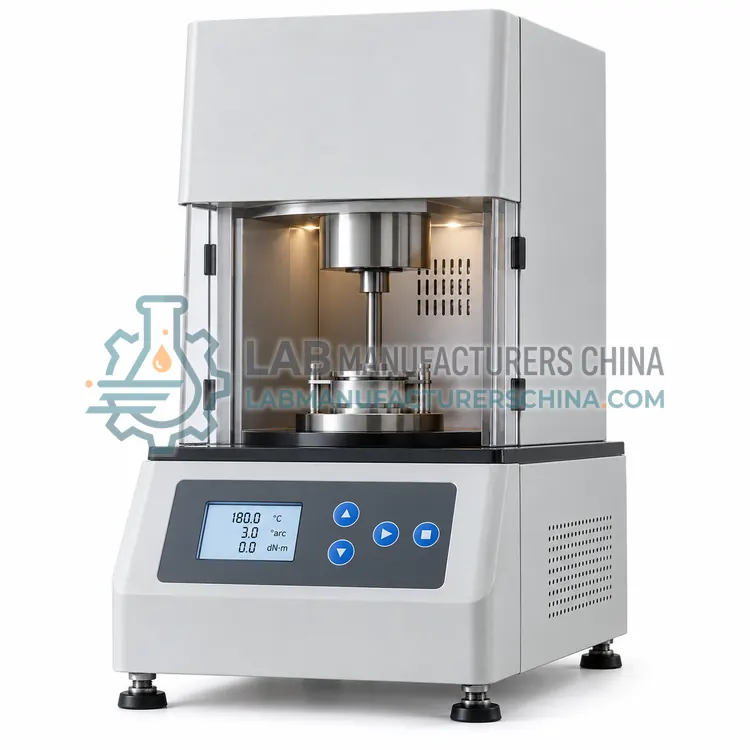
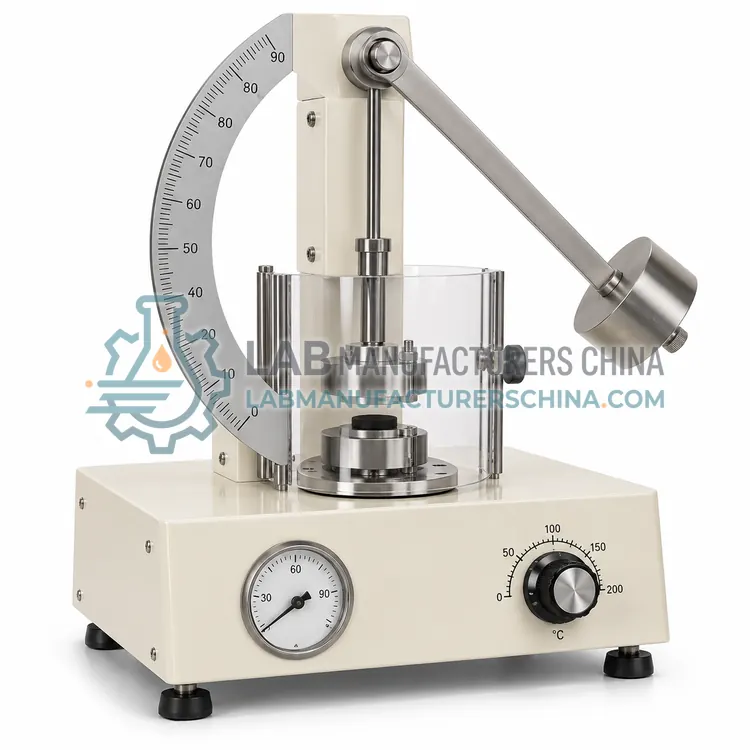
Dynamic Mechanical Analyzer for Rubber
橡胶动态力学分析仪
- SKU RHM-0005
- Rheometers
- CE (to be confirmed)
- ISO 9001 manufacturing (to be confirmed)
Price on request — FOB / CIF quoted per order
Prices depend on configuration, quantity and destination port.
Key specifications
| Temperature range | −100 to 300 °C with cooling accessory |
|---|---|
| Frequency range | 0.1–100 Hz |
| Heating rate | 0.5–10 °C/min |
| Strain amplitude | 0.01–50% depending on mode |
| Force range | 0.001–20 N |
| Deformation modes | Tension, compression, shear, dual cantilever |
Request a quote Download brochure · to be provided
By Lab Manufacturers China Technical TeamLast reviewed Standards: ISO 6502-1, ISO 6502-2, ISO 6502-3
What is the Dynamic Mechanical Analyzer for Rubber?
A dynamic mechanical analyzer applies an oscillating strain to vulcanised rubber and records storage modulus, loss modulus and damping across temperature and frequency. It describes the viscoelastic behaviour that controls heat build-up, rolling resistance and vibration isolation.
What is the Dynamic Mechanical Analyzer for Rubber?
A dynamic mechanical analyzer applies an oscillating strain to vulcanised rubber and records storage modulus, loss modulus and damping across temperature and frequency. It describes the viscoelastic behaviour that controls heat build-up, rolling resistance and vibration isolation.
Overview
Rubber specimens are tested in tension, compression or shear with small oscillatory strains, and the instrument records the in-phase and out-of-phase components of the response, giving storage modulus, loss modulus and loss tangent. A temperature scan shows the glass transition as a damping peak, which is used to judge low-temperature flexibility, while the loss tangent at service temperature correlates with hysteresis and heat build-up in tyres and antivibration mounts. Frequency scans allow time-temperature superposition to build master curves for predicting behaviour at frequencies that cannot be tested directly. Because the properties depend on filler content, crosslink density and cure state, specimens must be prepared and conditioned uniformly and the strain amplitude kept within the linear region.
How does it work?
An unvulcanised rubber compound is viscoelastic and its properties change as crosslinking proceeds, so a rheometer records torque or complex modulus against time at a fixed temperature. Curemeters hold the compound in a sealed cavity at vulcanisation temperature and oscillate a rotor or the cavity itself through a small arc, producing a cure curve from which scorch time, optimum cure time and minimum and maximum torque are read. Oscillating disc instruments turn a biconical rotor inside the sample, while rotorless instruments oscillate the lower die and measure the reaction torque on the upper die, giving faster thermal response and lower inertia. Rotational and dynamic mechanical instruments apply small strains over a frequency range to measure viscoelastic moduli, and capillary instruments push the compound through a die to measure process viscosity at extrusion rates.
What are the key features?
- Tension, compression and shear fixtures
- Frequency range from 0.1 to 100 Hz
- Temperature scan with cooling accessory
- Loss tangent evaluation for hysteresis
- Master curve construction by superposition
- Strain amplitude control within the linear region
What are the technical specifications?
A typical dynamic mechanical analyzer for rubber configuration offers temperature range of −100 to 300 °C with cooling accessory, frequency range of 0.1–100 Hz, heating rate of 0.5–10 °C/min, strain amplitude of 0.01–50% depending on mode, force range of 0.001–20 N and deformation modes of Tension, compression, shear, dual cantilever. Values are indicative of the product class; the exact figures for each configuration are confirmed on the quotation and the calibration documents supplied with the instrument.
Which applications is it used for?
The Dynamic Mechanical Analyzer for Rubber is used in damping and heat build-up assessment of rubber compounds, low-temperature flexibility and glass transition testing, comparison of cure systems and filler loadings and vibration isolation material selection. Across the wider Rheometers class, laboratories also deploy it for scorch and cure time determination for production control, compound development and accelerator selection and batch-to-batch consistency of mixed rubber.
Which standards and certifications apply?
Relevant standards and methods include ISO 6502-1, ISO 6502-2, ISO 6502-3, ASTM D2084, ASTM D5289, ASTM D6204, ASTM D5099, ASTM D5992 and IEC 61010-1. Certification candidates for this model are CE and ISO 9001 manufacturing; each is to be confirmed for the specific configuration before shipment, and certificates are supplied only where they have been issued.
Cavity cleanliness is the main source of error: cured residue from a previous test alters the torque reading, so dies should be cleaned after every specimen and inspected at intervals. Verify cavity temperature with a calibrated probe, because cure rate changes steeply with temperature and a one degree offset changes the optimum cure time measurably. Weigh or volume-dose specimens consistently, close the dies fully and record test temperature, arc amplitude and frequency with every curve. Condition compounds at standard temperature before testing, and store them away from heat. Calibration with reference compounds, such as a certified rubber standard, provides a periodic check on the whole measurement chain.
How do I select the right Dynamic Mechanical Analyzer for Rubber?
Specify dynamic mechanical analysis when the application depends on damping or heat build-up rather than on cure parameters, as with tyres, antivibration mounts or seals. Confirm the deformation modes and low-temperature capability needed, and check the strain amplitude range, because rubber moduli fall quickly once the strain exceeds the linear region.
How does it compare with other Rheometers variants?
Begin with the standard your product or customer specifies. Rotorless curemeters dominate modern production control because they reach thermal equilibrium quickly and give repeatable scorch and cure times, while oscillating disc instruments remain in use where historical data or older specifications require them. Where the interest is the compound's response to varying strain and frequency, for example in filler networking or processability studies, a rotorless instrument with frequency sweep capability or a dedicated rotational rheometer is chosen. Capillary instruments are used when extrusion viscosity, die swell or the behaviour of a stiff or highly filled compound must be quantified. For vulcanised rubber, dynamic mechanical analysis describes the viscoelastic behaviour that governs damping, heat build-up and fatigue.
Full specifications
| Temperature range | −100 to 300 °C with cooling accessory |
|---|---|
| Frequency range | 0.1–100 Hz |
| Heating rate | 0.5–10 °C/min |
| Strain amplitude | 0.01–50% depending on mode |
| Force range | 0.001–20 N |
| Deformation modes | Tension, compression, shear, dual cantilever |
| Specimen dimensions | Strips about 20 × 5 × 2 mm typical |
| Purge gas | Nitrogen, 50–200 mL/min |
| Data output | Storage and loss modulus, tan delta |
| Power supply | 220 V, 50/60 Hz |
Indicative values for this product class. Final specifications are confirmed on the quotation and in the calibration documents supplied with the instrument.
Applications
- Damping and heat build-up assessment of rubber compounds
- Low-temperature flexibility and glass transition testing
- Comparison of cure systems and filler loadings
- Vibration isolation material selection
Key features
- Tension, compression and shear fixtures
- Frequency range from 0.1 to 100 Hz
- Temperature scan with cooling accessory
- Loss tangent evaluation for hysteresis
- Master curve construction by superposition
- Strain amplitude control within the linear region
Frequently asked questions about Dynamic Mechanical Analyzer for Rubber
It quantifies hysteresis: a higher loss tangent means more energy is dissipated as heat per cycle, which raises the temperature of a tyre tread or a mount in service. Compounds for low heat build-up are selected for a low loss tangent in the relevant temperature range without losing stiffness.
Modulus is calculated from specimen geometry, so thickness and width variation translate directly into result variation, and rubber specimens also relax after cutting. Specimens should be cut or moulded to controlled dimensions with parallel faces, measured individually and conditioned before testing, and clamping must avoid pre-strain.
By increasing the strain amplitude stepwise at constant temperature and frequency and plotting the modulus. The modulus stays constant while the response remains linear, then falls as strain rises. Test amplitudes are chosen from the plateau region, which usually lies below about 0.5% for filled rubber compounds.
The curve plots torque against time at constant temperature. Minimum torque indicates the viscosity of the unvulcanised compound, the time to a defined torque rise above minimum gives scorch time, and the time to 90% of the maximum torque rise gives optimum cure time. Maximum torque and the shape after the peak show the degree and stability of crosslinking.
The two designs impose different strain fields and have different thermal masses, so absolute torque values differ and cure times shift slightly even for the same compound. Both are valid within their own standard, but data from one type should not be compared directly with data from the other, and specifications must state the instrument type.
A calibrated thermocouple or a reference compound with a known cure response is used. Thermocouple verification checks the die surface, while a reference compound such as a certified rubber standard checks the whole system, including closing pressure and die condition. Both checks are normally performed at defined intervals and recorded.
Related models