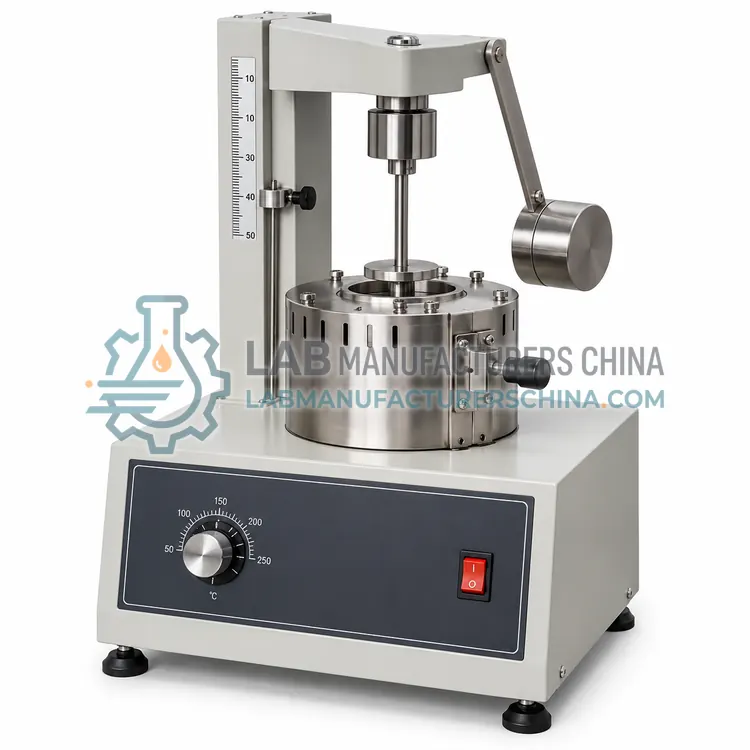
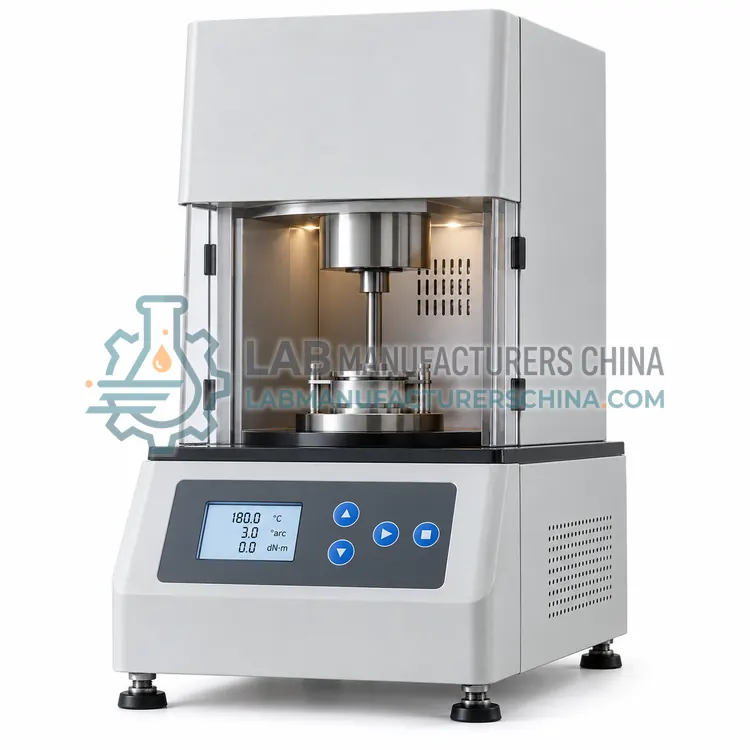
Moving Die Rheometer for Rubber
橡胶无转子硫化仪
- SKU RHM-0001
- Rheometers
- CE (to be confirmed)
- ISO 9001 manufacturing (to be confirmed)
Price on request — FOB / CIF quoted per order
Prices depend on configuration, quantity and destination port.
Key specifications
| Temperature range | Ambient to 200 °C |
|---|---|
| Temperature accuracy | ±0.3 °C |
| Die oscillation amplitude | 0.5° or 1° |
| Oscillation frequency | 1.67 Hz (100 cycles/min) |
| Torque range | 0–200 dN·m |
| Specimen volume | About 4–5 cm³ |
Request a quote Download brochure · to be provided
By Lab Manufacturers China Technical TeamLast reviewed Standards: ISO 6502-1, ISO 6502-2, ISO 6502-3
What is the Moving Die Rheometer for Rubber?
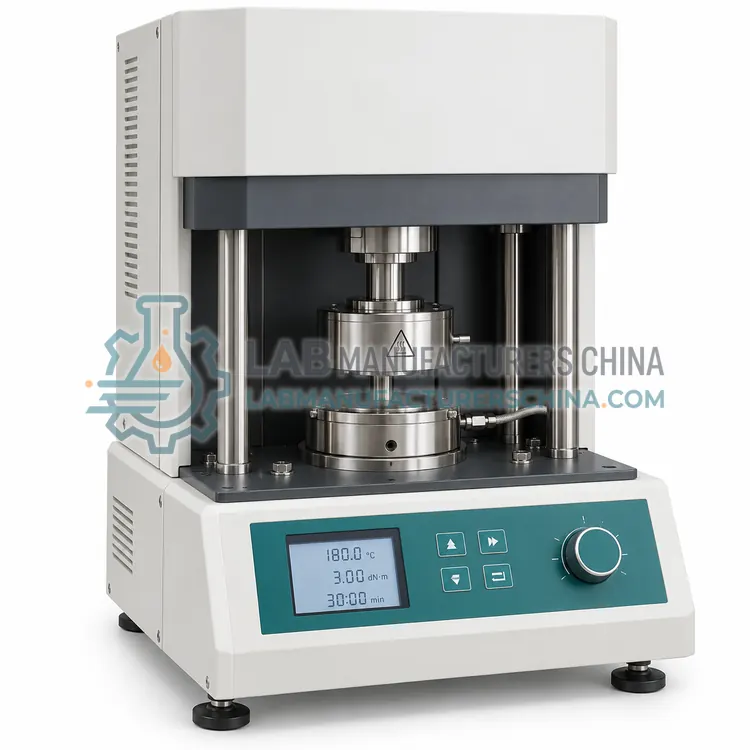
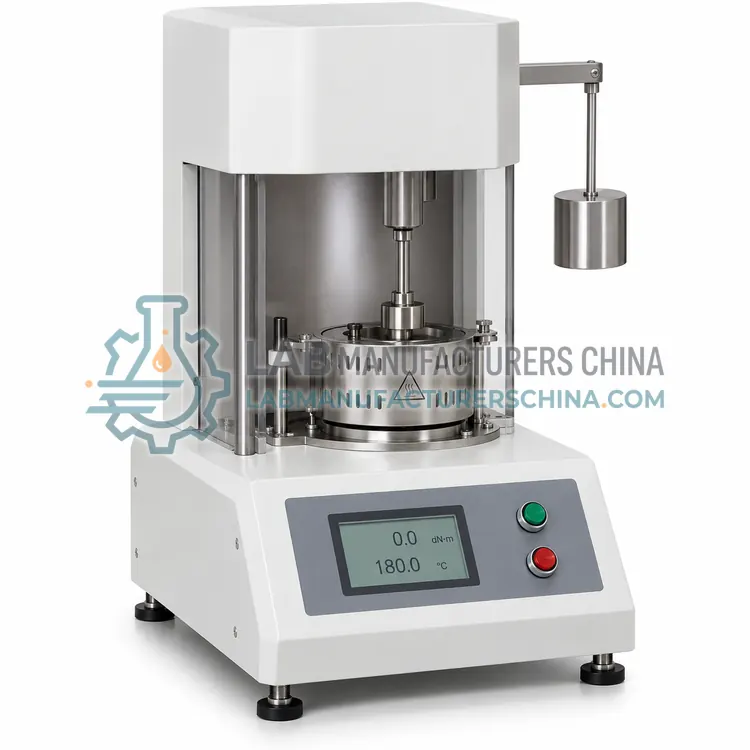
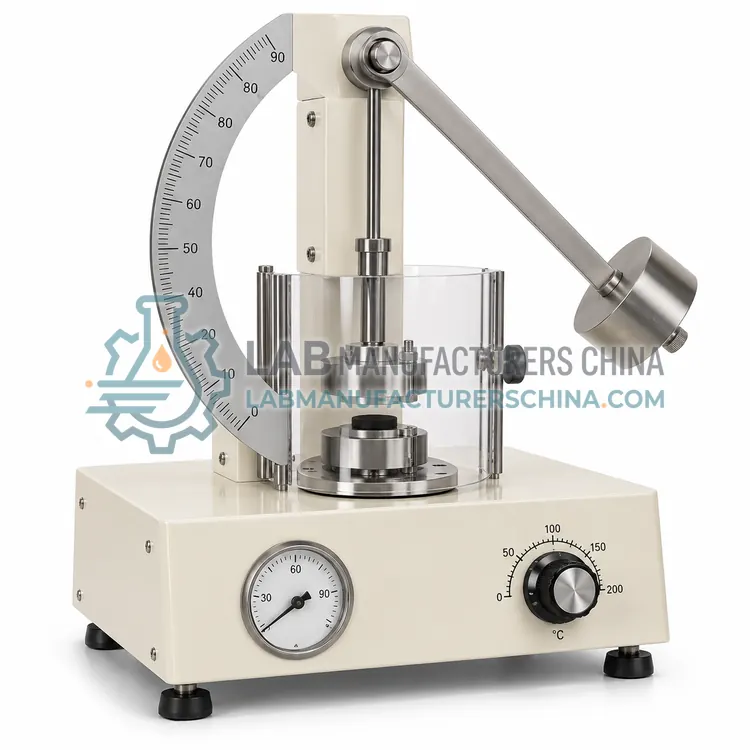
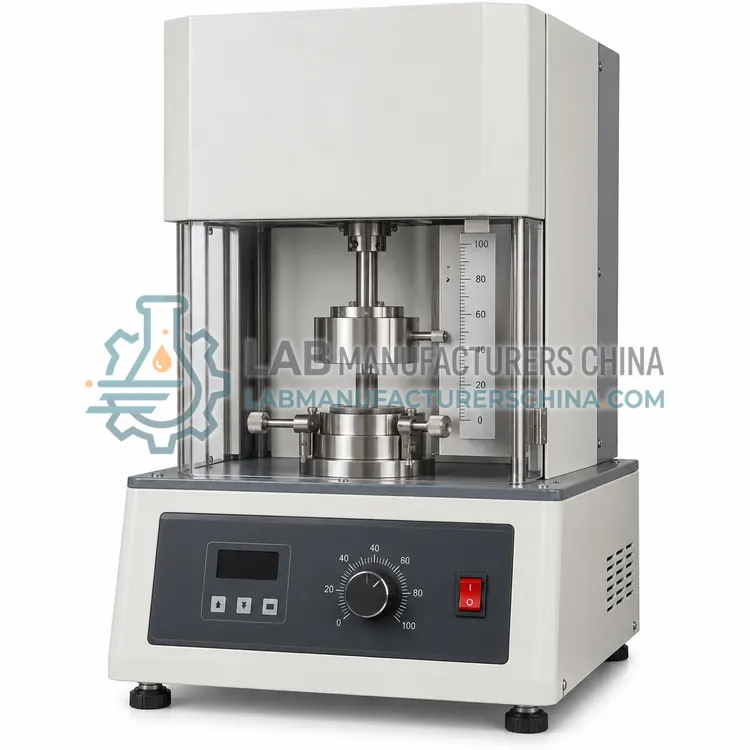
A moving die rheometer seals a rubber compound in a heated cavity and oscillates the lower die, measuring the torque transmitted to the upper die. It gives scorch and cure times with fast thermal response and is the usual production control instrument.
What is the Moving Die Rheometer for Rubber?
A moving die rheometer seals a rubber compound in a heated cavity and oscillates the lower die, measuring the torque transmitted to the upper die. It gives scorch and cure times with fast thermal response and is the usual production control instrument.
Overview
The specimen is placed between two heated dies, one of which oscillates through a small arc at a fixed frequency, typically one degree and 1.67 Hz. Crosslinking raises the elastic response of the compound, so the reaction torque on the fixed die follows the cure curve, and the sealed cavity with applied closing pressure prevents volatile loss and gives uniform temperature. A biconical die profile distributes strain evenly. Modern instruments record cavity pressure, run multiple specimens in one frame and export curves for statistical process control, with test temperatures up to about 200 °C and short dwell times that suit high-throughput release testing of mixed compounds.
How does it work?
An unvulcanised rubber compound is viscoelastic and its properties change as crosslinking proceeds, so a rheometer records torque or complex modulus against time at a fixed temperature. Curemeters hold the compound in a sealed cavity at vulcanisation temperature and oscillate a rotor or the cavity itself through a small arc, producing a cure curve from which scorch time, optimum cure time and minimum and maximum torque are read. Oscillating disc instruments turn a biconical rotor inside the sample, while rotorless instruments oscillate the lower die and measure the reaction torque on the upper die, giving faster thermal response and lower inertia. Rotational and dynamic mechanical instruments apply small strains over a frequency range to measure viscoelastic moduli, and capillary instruments push the compound through a die to measure process viscosity at extrusion rates.
What are the key features?
- Sealed biconical cavity with closing pressure control
- Die oscillation of about 1° at 1.67 Hz
- Cavity pressure measurement during the test
- Temperature up to about 200 °C with fast recovery
- Automatic computation of scorch and cure times
- Multiple cavities in one frame for parallel testing
What are the technical specifications?
A typical moving die rheometer for rubber configuration offers temperature range of Ambient to 200 °C, temperature accuracy of ±0.3 °C, die oscillation amplitude of 0.5° or 1°, oscillation frequency of 1.67 Hz (100 cycles/min), torque range of 0–200 dN·m and specimen volume of About 4–5 cm³. Values are indicative of the product class; the exact figures for each configuration are confirmed on the quotation and the calibration documents supplied with the instrument.
Which applications is it used for?
The Moving Die Rheometer for Rubber is used in production release testing of mixed compounds, scorch safety checks before extrusion, batch consistency monitoring in tyre and hose plants and accelerator and cure system evaluation. Across the wider Rheometers class, laboratories also deploy it for scorch and cure time determination for production control, compound development and accelerator selection and batch-to-batch consistency of mixed rubber.
Which standards and certifications apply?
Relevant standards and methods include ISO 6502-1, ISO 6502-2, ISO 6502-3, ASTM D2084, ASTM D5289, ASTM D6204, ASTM D5099, ASTM D5992 and IEC 61010-1. Certification candidates for this model are CE and ISO 9001 manufacturing; each is to be confirmed for the specific configuration before shipment, and certificates are supplied only where they have been issued.
Cavity cleanliness is the main source of error: cured residue from a previous test alters the torque reading, so dies should be cleaned after every specimen and inspected at intervals. Verify cavity temperature with a calibrated probe, because cure rate changes steeply with temperature and a one degree offset changes the optimum cure time measurably. Weigh or volume-dose specimens consistently, close the dies fully and record test temperature, arc amplitude and frequency with every curve. Condition compounds at standard temperature before testing, and store them away from heat. Calibration with reference compounds, such as a certified rubber standard, provides a periodic check on the whole measurement chain.
How do I select the right Moving Die Rheometer for Rubber?
Select a moving die rheometer for routine cure testing, because it reaches temperature quickly, uses a small specimen volume and gives repeatable scorch and cure times. Specify the number of cavities from your daily sample load, and confirm the final torque range covers your stiffest compound, since highly filled compounds can exceed the range of small instruments.
How does it compare with other Rheometers variants?
Begin with the standard your product or customer specifies. Rotorless curemeters dominate modern production control because they reach thermal equilibrium quickly and give repeatable scorch and cure times, while oscillating disc instruments remain in use where historical data or older specifications require them. Where the interest is the compound's response to varying strain and frequency, for example in filler networking or processability studies, a rotorless instrument with frequency sweep capability or a dedicated rotational rheometer is chosen. Capillary instruments are used when extrusion viscosity, die swell or the behaviour of a stiff or highly filled compound must be quantified. For vulcanised rubber, dynamic mechanical analysis describes the viscoelastic behaviour that governs damping, heat build-up and fatigue.
Full specifications
| Temperature range | Ambient to 200 °C |
|---|---|
| Temperature accuracy | ±0.3 °C |
| Die oscillation amplitude | 0.5° or 1° |
| Oscillation frequency | 1.67 Hz (100 cycles/min) |
| Torque range | 0–200 dN·m |
| Specimen volume | About 4–5 cm³ |
| Closing force | About 8 kN |
| Cavities per frame | 1–4 |
| Data output | Cure curves, parameters, network export |
Indicative values for this product class. Final specifications are confirmed on the quotation and in the calibration documents supplied with the instrument.
Applications
- Production release testing of mixed compounds
- Scorch safety checks before extrusion
- Batch consistency monitoring in tyre and hose plants
- Accelerator and cure system evaluation
Key features
- Sealed biconical cavity with closing pressure control
- Die oscillation of about 1° at 1.67 Hz
- Cavity pressure measurement during the test
- Temperature up to about 200 °C with fast recovery
- Automatic computation of scorch and cure times
- Multiple cavities in one frame for parallel testing
Frequently asked questions about Moving Die Rheometer for Rubber
Volatiles, moisture or blowing agents raise the pressure inside the sealed cavity, and excessive pressure indicates that the compound will blister or that the dosage was wrong. Pressure also shows whether the cavity sealed properly, so abnormal values explain otherwise puzzling curve shapes.
Specimens are normally cut with a defined die or punched to a controlled volume, typically 4 to 5 cm³, so that the cavity fills with a small excess that escapes as flash when the dies close. Both under-filling, which reduces contact, and gross over-filling, which raises pressure, change the curve.
The closing force keeps the cavity sealed under the pressure generated during cure, so volatiles and blowing agents cannot escape and the sample thickness stays constant. It must be set to the value specified in the method, because a change in force changes the effective strain and therefore the measured torque.
The curve plots torque against time at constant temperature. Minimum torque indicates the viscosity of the unvulcanised compound, the time to a defined torque rise above minimum gives scorch time, and the time to 90% of the maximum torque rise gives optimum cure time. Maximum torque and the shape after the peak show the degree and stability of crosslinking.
The two designs impose different strain fields and have different thermal masses, so absolute torque values differ and cure times shift slightly even for the same compound. Both are valid within their own standard, but data from one type should not be compared directly with data from the other, and specifications must state the instrument type.
A calibrated thermocouple or a reference compound with a known cure response is used. Thermocouple verification checks the die surface, while a reference compound such as a certified rubber standard checks the whole system, including closing pressure and die condition. Both checks are normally performed at defined intervals and recorded.