
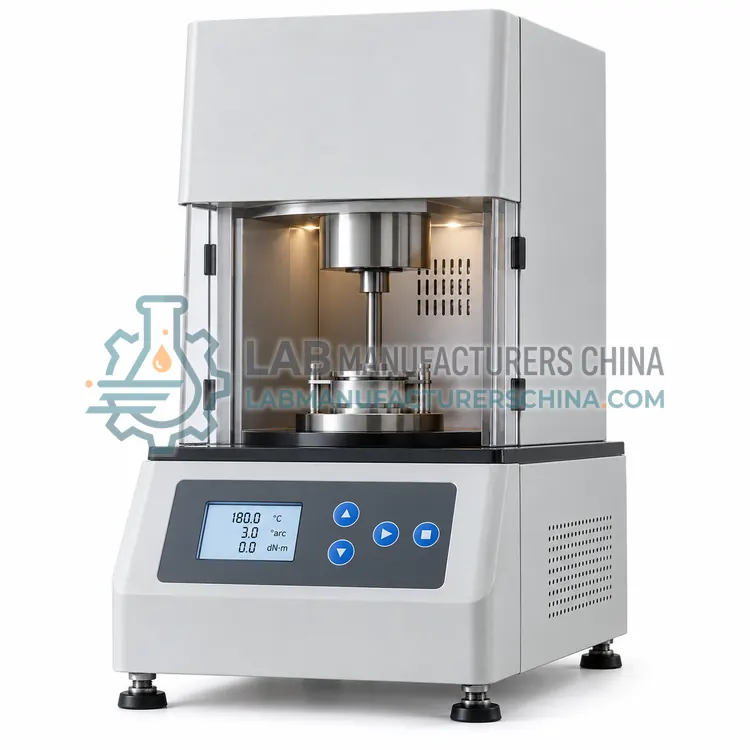
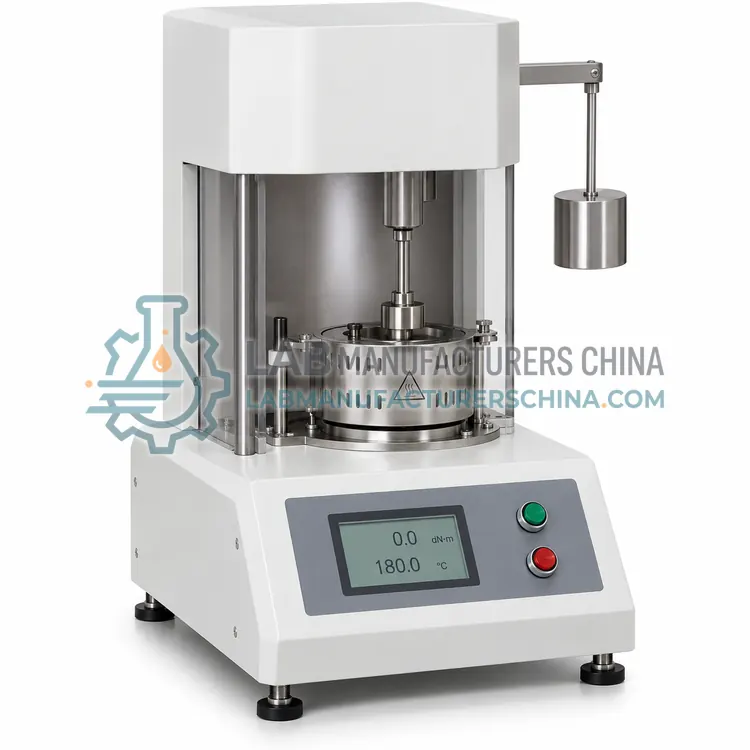
Capillary Rheometer for Rubber Processing
橡胶加工用毛细管流变仪
- SKU RHM-0004
- Rheometers
- CE (to be confirmed)
- ISO 9001 manufacturing (to be confirmed)
Price on request — FOB / CIF quoted per order
Prices depend on configuration, quantity and destination port.
Key specifications
| Maximum pressure | Up to 1000 bar |
|---|---|
| Temperature range | Ambient to 250 °C |
| Temperature accuracy | ±1 °C |
| Die diameters | 1.0–3.0 mm |
| Die L/D ratios | 5, 10, 20 |
| Piston speed | 0.001–20 mm/s |
Request a quote Download brochure · to be provided
By Lab Manufacturers China Technical TeamLast reviewed Standards: ISO 6502-1, ISO 6502-2, ISO 6502-3
What is the Capillary Rheometer for Rubber Processing?
A capillary rheometer forces a rubber compound through a heated die at controlled piston speed and measures the pressure required, giving process viscosity and die swell. It relates compound behaviour directly to extrusion and injection conditions.
What is the Capillary Rheometer for Rubber Processing?
A capillary rheometer forces a rubber compound through a heated die at controlled piston speed and measures the pressure required, giving process viscosity and die swell. It relates compound behaviour directly to extrusion and injection conditions.
Overview
An unvulcanised compound is filled into a heated barrel, compacted and then extruded through a die of defined diameter and length, with the pressure drop measured above the die. Shear stress and apparent shear rate are calculated from pressure and piston speed, and their ratio gives apparent viscosity, which can be corrected with the Bagley and Rabinowitsch treatments for true values. Because rubber compounds are elastic and highly filled, the instrument also records die swell and flow instability, and profiles that fail to extrude smoothly at a given rate are identified. Test temperatures are normally set below scorch temperature to prevent premature cure, so the test runs quickly, and a capillary attachment is often mounted on a torque rheometer so the same mixed sample can be characterised.
How does it work?
An unvulcanised rubber compound is viscoelastic and its properties change as crosslinking proceeds, so a rheometer records torque or complex modulus against time at a fixed temperature. Curemeters hold the compound in a sealed cavity at vulcanisation temperature and oscillate a rotor or the cavity itself through a small arc, producing a cure curve from which scorch time, optimum cure time and minimum and maximum torque are read. Oscillating disc instruments turn a biconical rotor inside the sample, while rotorless instruments oscillate the lower die and measure the reaction torque on the upper die, giving faster thermal response and lower inertia. Rotational and dynamic mechanical instruments apply small strains over a frequency range to measure viscoelastic moduli, and capillary instruments push the compound through a die to measure process viscosity at extrusion rates.
What are the key features?
- Heated barrel with interchangeable dies
- Pressure measurement up to 1000 bar
- Piston speeds spanning extrusion shear rates
- Die swell observation and recording
- Bagley and Rabinowitsch correction utilities
- Mounting option on a torque rheometer frame
What are the technical specifications?
A typical capillary rheometer for rubber processing configuration offers maximum pressure of Up to 1000 bar, temperature range of Ambient to 250 °C, temperature accuracy of ±1 °C, die diameters of 1.0–3.0 mm, die L/D ratios of 5, 10, 20 and piston speed of 0.001–20 mm/s. Values are indicative of the product class; the exact figures for each configuration are confirmed on the quotation and the calibration documents supplied with the instrument.
Which applications is it used for?
The Capillary Rheometer for Rubber Processing is used in extrusion behaviour of profile and hose compounds, injection moulding process window definition, comparison of filler and oil loading effects and prediction of die swell in extrusion dies. Across the wider Rheometers class, laboratories also deploy it for scorch and cure time determination for production control, compound development and accelerator selection and batch-to-batch consistency of mixed rubber.
Which standards and certifications apply?
Relevant standards and methods include ISO 6502-1, ISO 6502-2, ISO 6502-3, ASTM D2084, ASTM D5289, ASTM D6204, ASTM D5099, ASTM D5992 and IEC 61010-1. Certification candidates for this model are CE and ISO 9001 manufacturing; each is to be confirmed for the specific configuration before shipment, and certificates are supplied only where they have been issued.
Cavity cleanliness is the main source of error: cured residue from a previous test alters the torque reading, so dies should be cleaned after every specimen and inspected at intervals. Verify cavity temperature with a calibrated probe, because cure rate changes steeply with temperature and a one degree offset changes the optimum cure time measurably. Weigh or volume-dose specimens consistently, close the dies fully and record test temperature, arc amplitude and frequency with every curve. Condition compounds at standard temperature before testing, and store them away from heat. Calibration with reference compounds, such as a certified rubber standard, provides a periodic check on the whole measurement chain.
How do I select the right Capillary Rheometer for Rubber Processing?
Select a capillary rheometer when you need viscosity at real extrusion shear rates, die swell data for die design, or an assessment of whether a compound will extrude smoothly. Confirm the maximum pressure and temperature, and check that the test temperature is well below the scorch temperature of your compounds to avoid premature cure in the barrel.
How does it compare with other Rheometers variants?
Begin with the standard your product or customer specifies. Rotorless curemeters dominate modern production control because they reach thermal equilibrium quickly and give repeatable scorch and cure times, while oscillating disc instruments remain in use where historical data or older specifications require them. Where the interest is the compound's response to varying strain and frequency, for example in filler networking or processability studies, a rotorless instrument with frequency sweep capability or a dedicated rotational rheometer is chosen. Capillary instruments are used when extrusion viscosity, die swell or the behaviour of a stiff or highly filled compound must be quantified. For vulcanised rubber, dynamic mechanical analysis describes the viscoelastic behaviour that governs damping, heat build-up and fatigue.
Full specifications
| Maximum pressure | Up to 1000 bar |
|---|---|
| Temperature range | Ambient to 250 °C |
| Temperature accuracy | ±1 °C |
| Die diameters | 1.0–3.0 mm |
| Die L/D ratios | 5, 10, 20 |
| Piston speed | 0.001–20 mm/s |
| Shear rate range | 1–10⁴ s⁻¹ |
| Specimen mass | 10–40 g |
| Die material | Hardened steel or tungsten carbide |
| Power supply | 220 V, 50/60 Hz |
Indicative values for this product class. Final specifications are confirmed on the quotation and in the calibration documents supplied with the instrument.
Applications
- Extrusion behaviour of profile and hose compounds
- Injection moulding process window definition
- Comparison of filler and oil loading effects
- Prediction of die swell in extrusion dies
Key features
- Heated barrel with interchangeable dies
- Pressure measurement up to 1000 bar
- Piston speeds spanning extrusion shear rates
- Die swell observation and recording
- Bagley and Rabinowitsch correction utilities
- Mounting option on a torque rheometer frame
Frequently asked questions about Capillary Rheometer for Rubber Processing
At extrusion temperatures an unvulcanised compound can begin to scorch within minutes, which would stiffen it during the measurement and bias the viscosity upwards. Tests are therefore kept short, the barrel is emptied and cleaned between specimens, and any compound with a very short scorch time is tested at a lower temperature.
Die swell is the increase in extrudate diameter compared with the die, caused by elastic recovery of the oriented chains as pressure is released. High swell indicates high elasticity, which correlates with extrudate distortion and with the need for longer die lands or lower throughput in production.
They measure different properties: the curemeter records crosslinking kinetics at vulcanisation temperature, while the capillary rheometer records flow viscosity at processing temperature. Both are needed to describe a compound, and results are compared only within the same test type and conditions.
The curve plots torque against time at constant temperature. Minimum torque indicates the viscosity of the unvulcanised compound, the time to a defined torque rise above minimum gives scorch time, and the time to 90% of the maximum torque rise gives optimum cure time. Maximum torque and the shape after the peak show the degree and stability of crosslinking.
The two designs impose different strain fields and have different thermal masses, so absolute torque values differ and cure times shift slightly even for the same compound. Both are valid within their own standard, but data from one type should not be compared directly with data from the other, and specifications must state the instrument type.
A calibrated thermocouple or a reference compound with a known cure response is used. Thermocouple verification checks the die surface, while a reference compound such as a certified rubber standard checks the whole system, including closing pressure and die condition. Both checks are normally performed at defined intervals and recorded.
Related models
Mooney Viscometer for High-Viscosity and Highly Filled Compounds
高黏度高填充胶料用门尼黏度仪
- CE (to be confirmed)
- +1