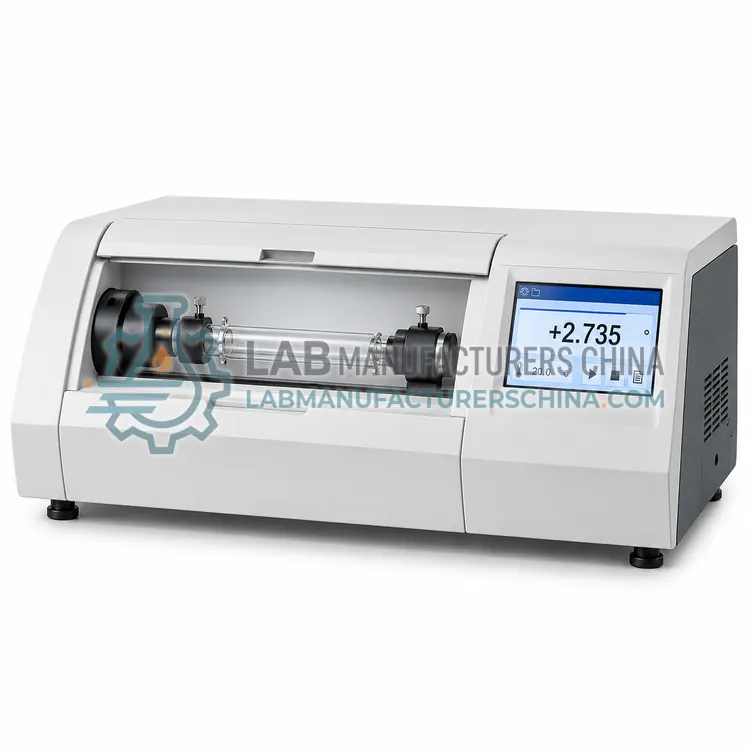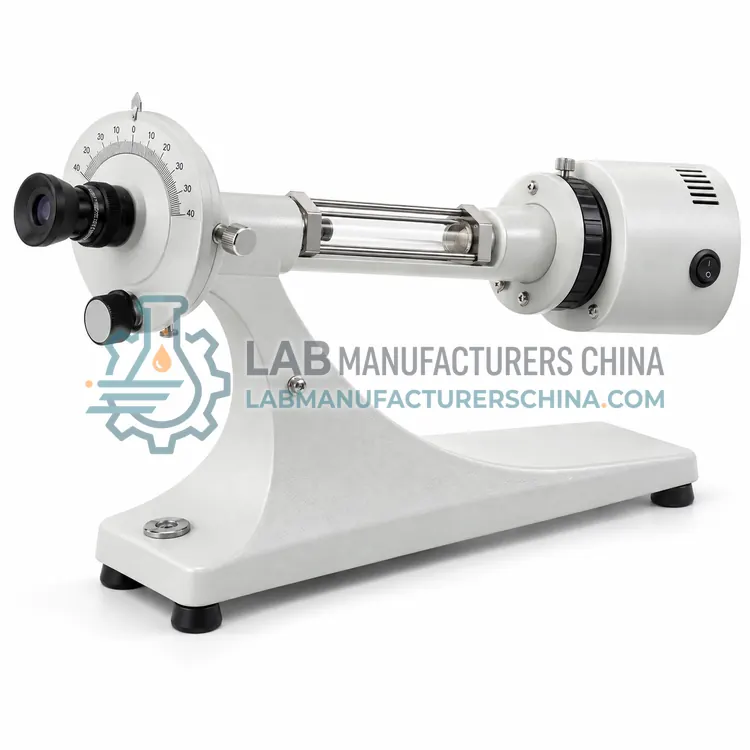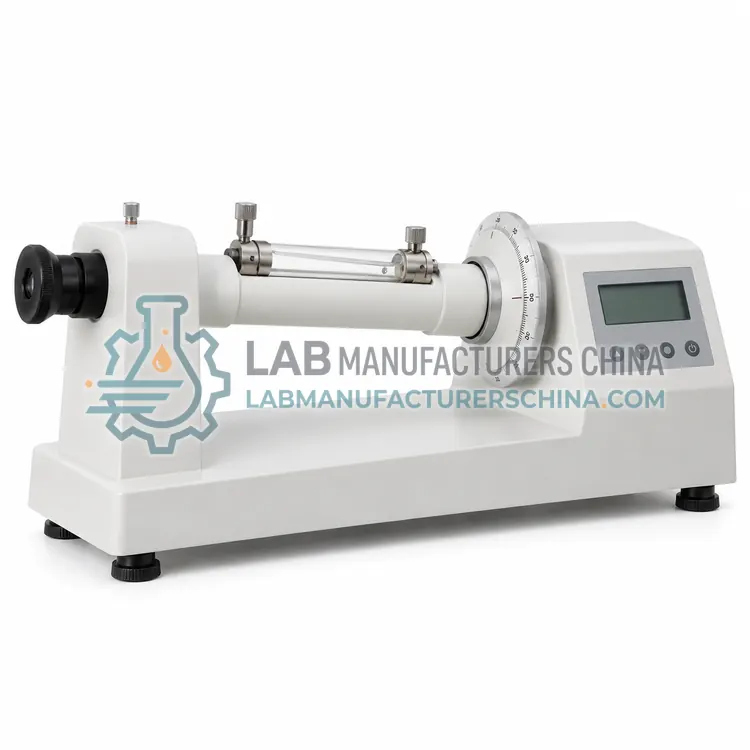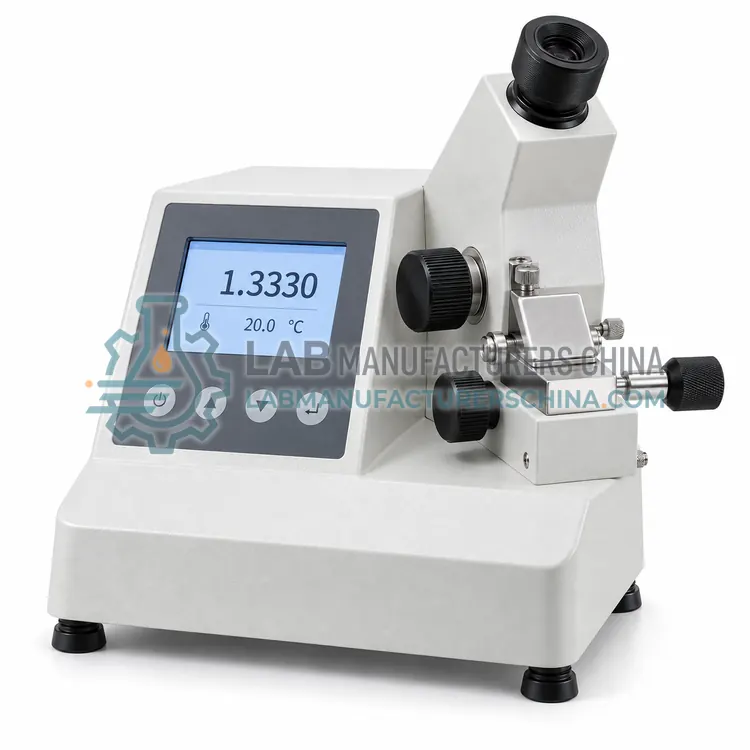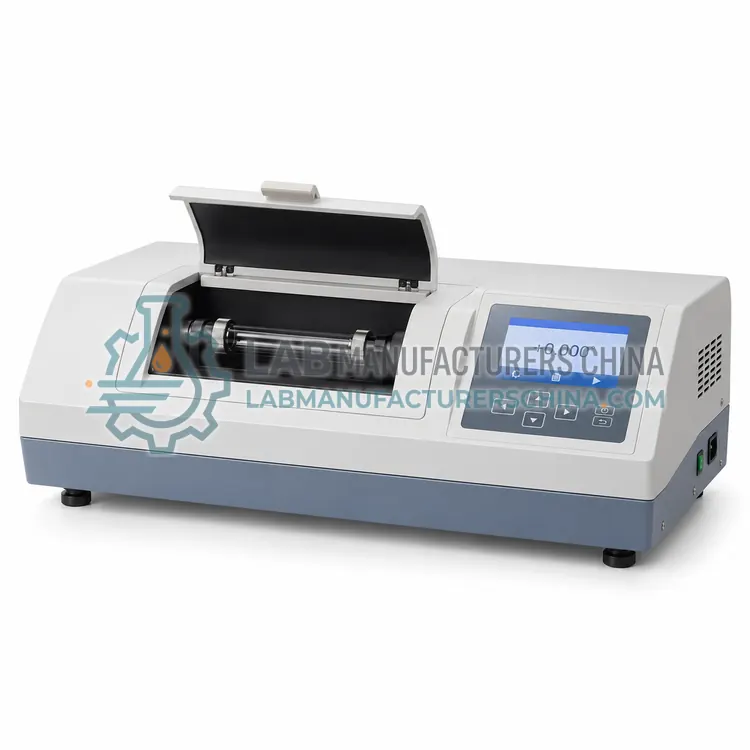
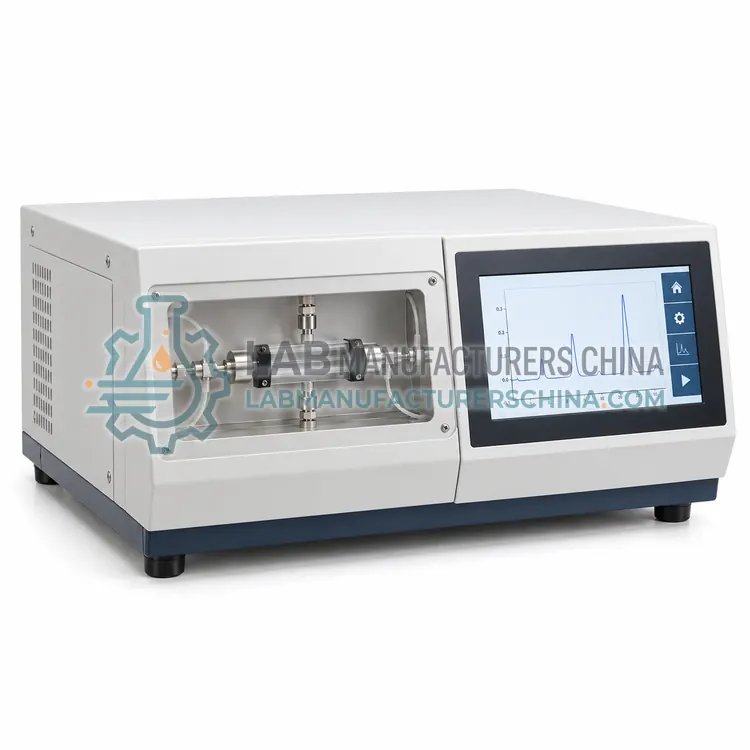
Flow-Through Polarimeter for Online and HPLC Detection
流通式旋光仪(在线及 HPLC 检测用)
- SKU POL-0005
- Polarimeters
- CE (to be confirmed)
- ISO 9001 manufacturing (to be confirmed)
- IEC 61010-1 safety (to be confirmed)
Price on request — FOB / CIF quoted per order
Prices depend on configuration, quantity and destination port.
Key specifications
| Cell volume | 20–80 µL |
|---|---|
| Path length | 10–50 mm |
| Wavelength | 589 nm (optional 546 nm) |
| Noise level | ≤0.0005° (peak to peak, static) |
| Data rate | Up to 10 Hz |
| Flow rate range | 0.1–5 mL/min |
Request a quote Download brochure · to be provided
By Lab Manufacturers China Technical TeamLast reviewed Standards: USP <781>, Ph. Eur. 2.2.7, JP 2.49
What is the Flow-Through Polarimeter for Online and HPLC Detection?
A flow-through polarimeter uses a low-volume cell connected to a process line or HPLC outlet to monitor optical rotation continuously. It suits chiral purity determination in chromatography eluates and real-time monitoring of reactions or fermentation streams.
What is the Flow-Through Polarimeter for Online and HPLC Detection?
A flow-through polarimeter uses a low-volume cell connected to a process line or HPLC outlet to monitor optical rotation continuously. It suits chiral purity determination in chromatography eluates and real-time monitoring of reactions or fermentation streams.
Overview
The flow-through polarimeter places a thermostatted cell of about 20–80 µL and 10–50 mm path in the optical path, and the sample is delivered by a pump or by the outlet of an HPLC column. High-sensitivity Faraday modulation and fast data acquisition at up to 10 Hz allow peak-resolved chiral detection in series with UV detection. The optical rotation signal identifies which eluting enantiomer is dextrorotatory or levorotatory without a chiral reference. For process use, the instrument can be fitted with chemically resistant cell windows and fittings and provides a 4–20 mA or digital output for monitoring crystallization, sugar inversion or enzymatic reactions. Sensitivity is lower than UV detection, so typical on-column amounts are micrograms rather than nanograms, and baseline stability requires careful temperature and flow control.
How does it work?
A polarimeter passes monochromatic light, usually from a sodium D line source at 589.3 nm or an LED with a filter, through a polarizer, a sample tube and an analyzer. An optically active sample rotates the plane of polarization by an angle proportional to path length, concentration and specific rotation, following Biot's law. Manual instruments rely on the operator matching a split field visually, while automatic instruments use a Faraday modulator or a rotating analyzer with a photodetector to find the null position. Temperature strongly affects rotation, so many models include a thermostatted sample chamber, often Peltier controlled to 20.0 °C or 25.0 °C. Results are reported as optical rotation in degrees, specific rotation, concentration, or sugar scale such as °Z or ISS. Some models add multiple wavelengths to allow measurement of optical rotatory dispersion.
What are the key features?
- Low-volume thermostatted flow cell preserves chromatographic peak resolution.
- Fast data acquisition up to 10 Hz tracks narrow eluting peaks.
- Identifies dextrorotatory or levorotatory enantiomers without a chiral reference standard.
- Chemically resistant windows and fittings tolerate common HPLC solvents.
- 4–20 mA and digital outputs integrate with process control systems.
- Software synchronizes optical rotation traces with UV or MS detector data.
What are the technical specifications?
A typical flow-through polarimeter for online and hplc detection configuration offers cell volume of 20–80 µL, path length of 10–50 mm, wavelength of 589 nm (optional 546 nm), noise level of ≤0.0005° (peak to peak, static), data rate of Up to 10 Hz and flow rate range of 0.1–5 mL/min. Values are indicative of the product class; the exact figures for each configuration are confirmed on the quotation and the calibration documents supplied with the instrument.
Which applications is it used for?
The Flow-Through Polarimeter for Online and HPLC Detection is used in chiral HPLC detection, enantiomeric excess determination, reaction and crystallization monitoring, fermentation and enzymatic process control and carbohydrate inversion studies. Across the wider Polarimeters class, laboratories also deploy it for pharmaceutical QC of chiral drug substances, sugar and syrup concentration testing and essential oil and flavor purity checks.
Which standards and certifications apply?
Relevant standards and methods include USP <781>, Ph. Eur. 2.2.7, JP 2.49, ICUMSA GS2/3-1, OIML R 14 and GB/T 613. Certification candidates for this model are CE, ISO 9001 manufacturing and IEC 61010-1 safety; each is to be confirmed for the specific configuration before shipment, and certificates are supplied only where they have been issued.
Place the polarimeter on a vibration-free bench away from direct sunlight and strong electromagnetic fields. Allow the light source to warm up for 15–30 minutes before use. Verify performance with certified quartz control plates or a sucrose solution at defined concentration, and record results in the calibration log. Keep sample tubes clean and free of air bubbles, as bubbles cause unstable readings. Replace tube windows and seals when scratched or leaking. Confirm temperature at the sample, not only at the chamber setpoint. For regulated work, ensure 21 CFR Part 11 compatible software, scheduled calibration against traceable standards and documented installation and operational qualification.
How do I select the right Flow-Through Polarimeter for Online and HPLC Detection?
Select the flow-through polarimeter when optical rotation must be tracked continuously, for example in a chiral HPLC method or a reaction stream. It is not required for discrete sample testing. In an RFQ, specify cell volume, path length, pressure and solvent compatibility, data rate, analog or digital outputs and any hazardous area requirements.
How does it compare with other Polarimeters variants?
Choose a polarimeter by the required accuracy, measurement wavelength, temperature control and regulatory context. Pharmacopoeial testing of drug substances needs an automatic instrument with readability of 0.001° or better, Peltier control within ±0.1 °C and audit-trail software. Sugar and food quality control can use a saccharimeter with an ICUMSA-traceable scale and tolerates ±0.01° accuracy. Manual instruments suit teaching and low-volume checks where budget dominates. Samples that are dark or turbid need a polarimeter with high light throughput and short tubes. Chiral detection in chromatography requires a flow-through cell with a small volume. Also specify tube lengths, including 100 mm and 200 mm, sample volume and whether multiple wavelengths such as 436 nm or 546 nm are required for research work.
Full specifications
| Cell volume | 20–80 µL |
|---|---|
| Path length | 10–50 mm |
| Wavelength | 589 nm (optional 546 nm) |
| Noise level | ≤0.0005° (peak to peak, static) |
| Data rate | Up to 10 Hz |
| Flow rate range | 0.1–5 mL/min |
| Cell temperature | 15–40 °C, ±0.1 °C |
| Maximum pressure | ≤5 bar (cell) |
| Analog output | 4–20 mA or 0–1 V |
| Digital interface | Ethernet, USB, contact closure |
Indicative values for this product class. Final specifications are confirmed on the quotation and in the calibration documents supplied with the instrument.
Applications
- Chiral HPLC detection
- Enantiomeric excess determination
- Reaction and crystallization monitoring
- Fermentation and enzymatic process control
- Carbohydrate inversion studies
Key features
- Low-volume thermostatted flow cell preserves chromatographic peak resolution.
- Fast data acquisition up to 10 Hz tracks narrow eluting peaks.
- Identifies dextrorotatory or levorotatory enantiomers without a chiral reference standard.
- Chemically resistant windows and fittings tolerate common HPLC solvents.
- 4–20 mA and digital outputs integrate with process control systems.
- Software synchronizes optical rotation traces with UV or MS detector data.
Frequently asked questions about Flow-Through Polarimeter for Online and HPLC Detection
Optical rotation detection shows whether an eluting enantiomer is dextrorotatory or levorotatory, which UV detection cannot. When paired with UV detection on a chiral column, it helps assign peak identity and estimate enantiomeric excess without a standard for each enantiomer.
Sensitivity is lower than UV detection because the rotation signal is small. Typical detection needs on-column amounts in the microgram range, depending on specific rotation and cell path length. Low noise, stable temperature and steady flow are essential for reliable baselines.
Yes, with a suitable cell and fittings. Models with chemically resistant windows and 4–20 mA output monitor reactions, crystallization or sugar inversion. Pressure, particulates and bubbles must be controlled, and hazardous area installations need appropriately rated housings.
A polarimeter measures the angle by which an optically active sample rotates plane-polarized light. From the rotation, path length and temperature, the analyst calculates specific rotation, concentration or purity. It is used for sugars, amino acids, essential oils and chiral pharmaceutical ingredients.
Optical rotation changes with temperature, often by several tenths of a percent per degree Celsius for sugars and more for some drugs. Pharmacopoeial methods typically specify 20 °C or 25 °C, so Peltier-controlled sample chambers are used to hold the sample within ±0.1 °C.
Most polarimeters use 589 nm, the sodium D line, because pharmacopoeias and sugar standards refer to it. Modern instruments achieve this with filtered LEDs or sodium lamps. Additional wavelengths such as 365, 436, 546 and 633 nm support research and optical rotatory dispersion studies.
Related models