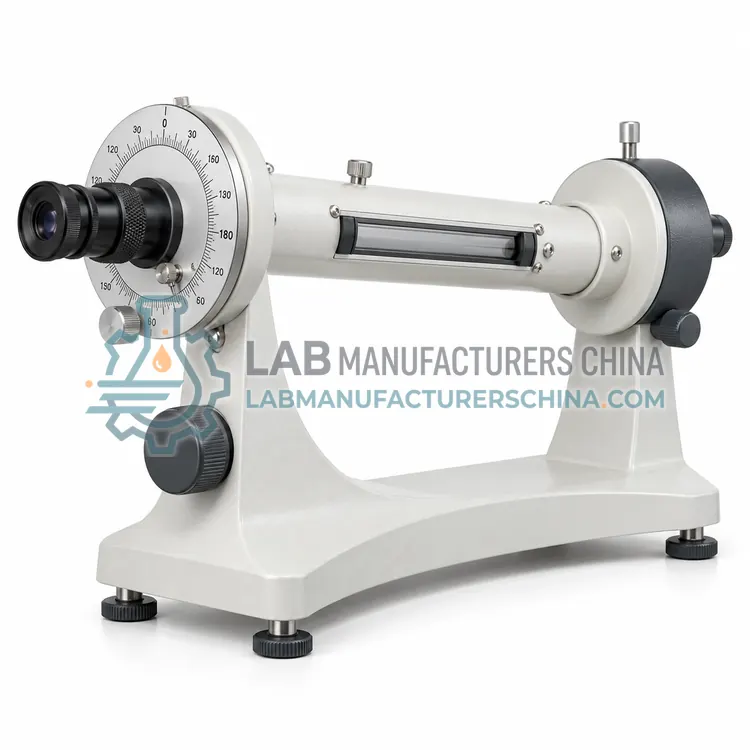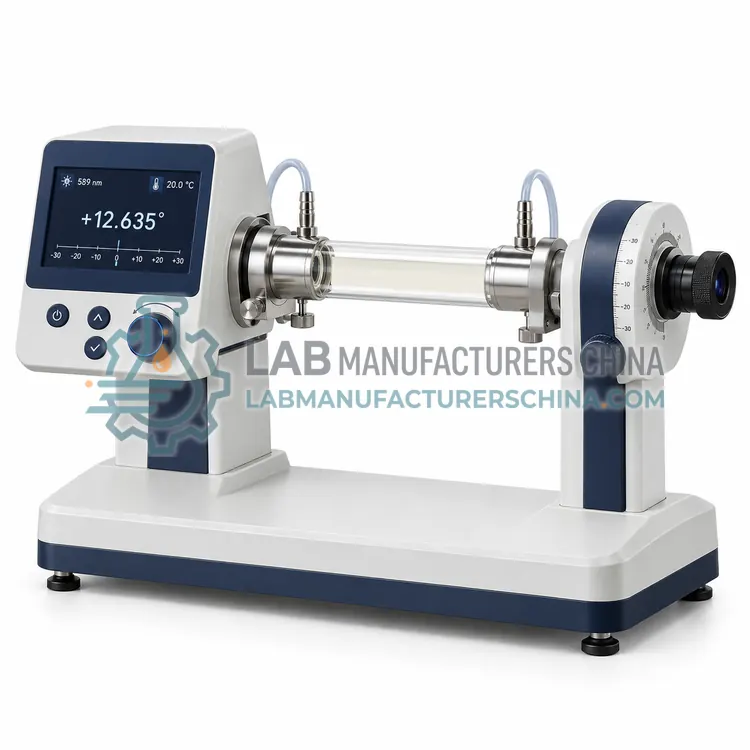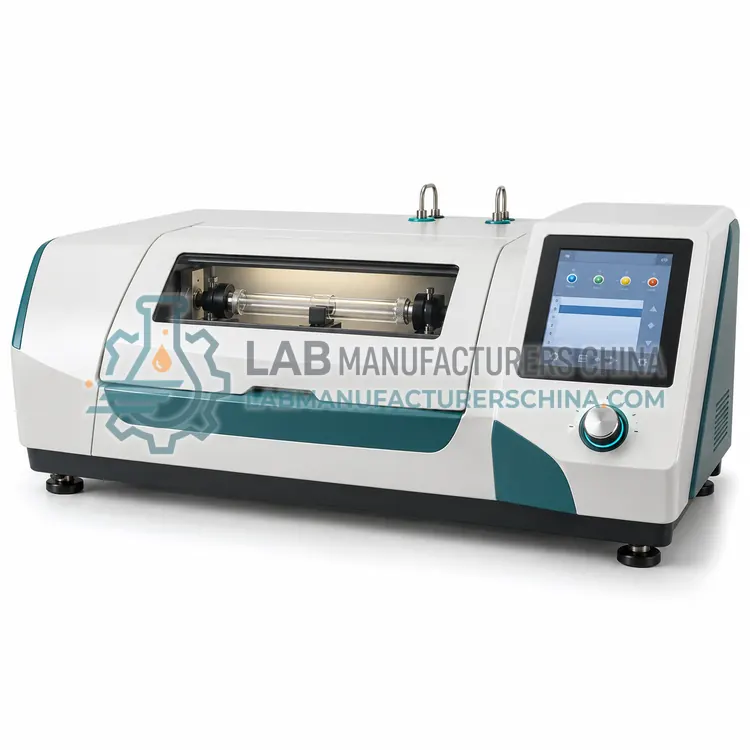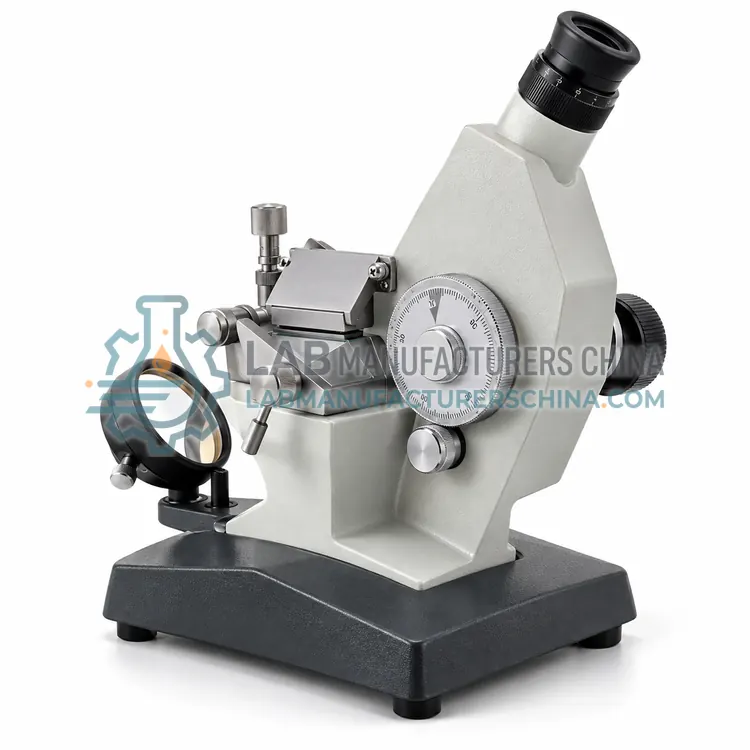
Flow-Through Polarimeter
流通式旋光仪
- SKU PLR-0005
- Polarimeters
- CE (to be confirmed)
- ISO 9001 manufacturing (to be confirmed)
Price on request — FOB / CIF quoted per order
Prices depend on configuration, quantity and destination port.
Key specifications
| Measurement scale | ±90° optical rotation |
|---|---|
| Resolution | 0.001° |
| Accuracy | ±0.01° |
| Measuring wavelength | 589 nm |
| Flow cell path length | 100 mm |
| Flow cell volume | About 80 µL |
Request a quote Download brochure · to be provided
By Lab Manufacturers China Technical TeamLast reviewed Standards: USP <781>, Ph. Eur. 2.2.7, JP 2.49
What is the Flow-Through Polarimeter?
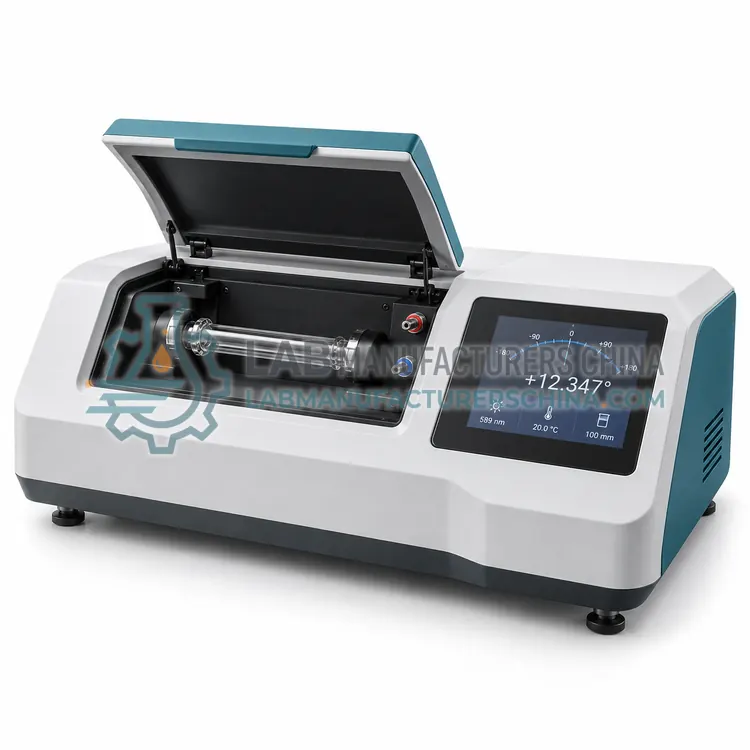
A flow-through polarimeter measures optical rotation of a sample stream passing through a fixed cell. It is used for continuous monitoring and as a detector in chromatographic separation of chiral compounds during research and production.
What is the Flow-Through Polarimeter?
A flow-through polarimeter measures optical rotation of a sample stream passing through a fixed cell. It is used for continuous monitoring and as a detector in chromatographic separation of chiral compounds during research and production.
Overview
A flow-through polarimeter replaces the standard sample tube with a small fixed-volume flow cell connected to tubing or a chromatographic system. Liquid flows continuously through the cell, so rotation is measured in real time without manual filling. This suits online process monitoring, where concentration or purity of an optically active stream is tracked, and chiral high-performance liquid chromatography, where the polarimeter acts as a selective detector for enantiomers. The flow cell has defined path length and volume, and low dead volume is important to preserve chromatographic resolution. Temperature control and baseline stability are critical for reliable continuous measurement.
How does it work?
A polarimeter passes light through a polarizer to produce plane-polarized light, then through a sample cell containing an optically active substance. The sample rotates the plane of polarization by an amount proportional to its concentration, path length and specific rotation. An analyser measures the rotation angle, historically by eye against a vernier scale and now by photoelectric detection with a servomotor or Faraday modulator. Monochromatic light is essential because optical rotation depends strongly on wavelength; the sodium D line at 589 nm is the conventional reference. Temperature control matters because specific rotation changes with temperature. The measured rotation is converted to concentration using the specific rotation and path length.
What are the key features?
- Fixed low-volume flow cell for continuous sampling
- Interface to tubing or chromatographic systems
- Real-time rotation measurement of a flowing stream
- Peltier temperature control for stable baselines
- Analogue output for recording or control
What are the technical specifications?
A typical flow-through polarimeter configuration offers measurement scale of ±90° optical rotation, resolution of 0.001°, accuracy of ±0.01°, measuring wavelength of 589 nm, flow cell path length of 100 mm and flow cell volume of About 80 µL. Values are indicative of the product class; the exact figures for each configuration are confirmed on the quotation and the calibration documents supplied with the instrument.
Which applications is it used for?
The Flow-Through Polarimeter is used in chiral chromatographic detection, continuous process monitoring, online purity tracking of active ingredients and flow chemistry reaction monitoring. Across the wider Polarimeters class, laboratories also deploy it for pharmaceutical chiral purity and assay, sugar and sweetener analysis and essential oil and flavour authentication.
Which standards and certifications apply?
Relevant standards and methods include USP <781>, Ph. Eur. 2.2.7, JP 2.49, ICUMSA Method GS1/2/3 and IEC 61010-1. Certification candidates for this model are CE and ISO 9001 manufacturing; each is to be confirmed for the specific configuration before shipment, and certificates are supplied only where they have been issued.
Fit the polarimeter with the correct tube length and clean, bubble-free sample cells, and allow temperature equilibration before reading. Standardize the instrument with a certified quartz plate or a reference standard at the working wavelength and temperature, and record the result. Keep polarizers and windows clean to avoid stray light and scattering errors. Prepare samples at known concentration and temperature, and note the solvent because specific rotation depends on it. Service and recalibrate periodically, and verify the sodium lamp or light-emitting diode output, since wavelength drift biases results.
How do I select the right Flow-Through Polarimeter?
Choose a flow-through polarimeter for continuous or chromatographic measurement of optically active streams. Confirm the flow cell path length and volume suit the concentration range and required resolution, and that low dead volume is compatible with chromatographic peak widths. Verify temperature control and baseline stability for long runs, and check the output interfaces needed for data acquisition.
How does it compare with other Polarimeters variants?
Choose the polarimeter type according to the application. Sugar analysis uses a saccharimeter reading in sugar degrees, while chiral pharmaceutical testing uses an automatic polarimeter reading in angular degrees and often several wavelengths. Manual instruments suit teaching and occasional measurement where budget is limited. Where temperature-sensitive substances are tested, select a model with Peltier temperature control. Confirm the required resolution, accuracy and tube length, and whether sample tubes or flow cells are needed. For regulatory work, check that the wavelength, temperature and data records match pharmacopoeial requirements, and that the instrument supports audit trails and controlled user access.
Full specifications
| Measurement scale | ±90° optical rotation |
|---|---|
| Resolution | 0.001° |
| Accuracy | ±0.01° |
| Measuring wavelength | 589 nm |
| Flow cell path length | 100 mm |
| Flow cell volume | About 80 µL |
| Temperature control | 20 °C ± 0.2 °C, Peltier |
| Analogue output | 0–1 V |
| Data interface | USB, RS-232 |
| Power supply | 100–240 V AC |
Indicative values for this product class. Final specifications are confirmed on the quotation and in the calibration documents supplied with the instrument.
Applications
- Chiral chromatographic detection
- Continuous process monitoring
- Online purity tracking of active ingredients
- Flow chemistry reaction monitoring
Key features
- Fixed low-volume flow cell for continuous sampling
- Interface to tubing or chromatographic systems
- Real-time rotation measurement of a flowing stream
- Peltier temperature control for stable baselines
- Analogue output for recording or control
Frequently asked questions about Flow-Through Polarimeter
It is connected after the chromatographic column and measures the optical rotation of the eluate as peaks pass through. Because enantiomers rotate light in opposite directions or to different degrees, it acts as a chiral detector, giving selective response that a simple ultraviolet detector may not provide.
A large cell volume broadens and mixes peaks, reducing chromatographic resolution. A small, low-dead-volume cell preserves peak shape, but reduces the optical path and so lowers sensitivity. The choice balances resolution against detection sensitivity for the application.
Baseline drift can come from temperature change, bubbles in the flow cell, source intensity variation or the sample stream itself. Stable temperature control, degassing the stream and allowing lamp warm-up reduce drift, and periodic autozeroing helps for long monitoring runs.
A polarimeter measures the angle by which an optically active sample rotates the plane of polarized light. From the measured rotation, the path length and the specific rotation of the substance, the concentration can be calculated. It also detects the presence of chiral compounds.
Optical rotation depends strongly on wavelength, a phenomenon called optical rotatory dispersion. Broad-band light would give an averaged and unstable reading, so a single wavelength is used, most commonly the sodium D line at 589 nm, as specified in pharmacopoeial methods.
A polarimeter reports optical rotation in angular degrees, while a saccharimeter is calibrated in sugar degrees, denoted °Z, using the international sugar scale. Saccharimeters are used mainly in sugar and food analysis, where results are expressed directly as sucrose content.
Related models