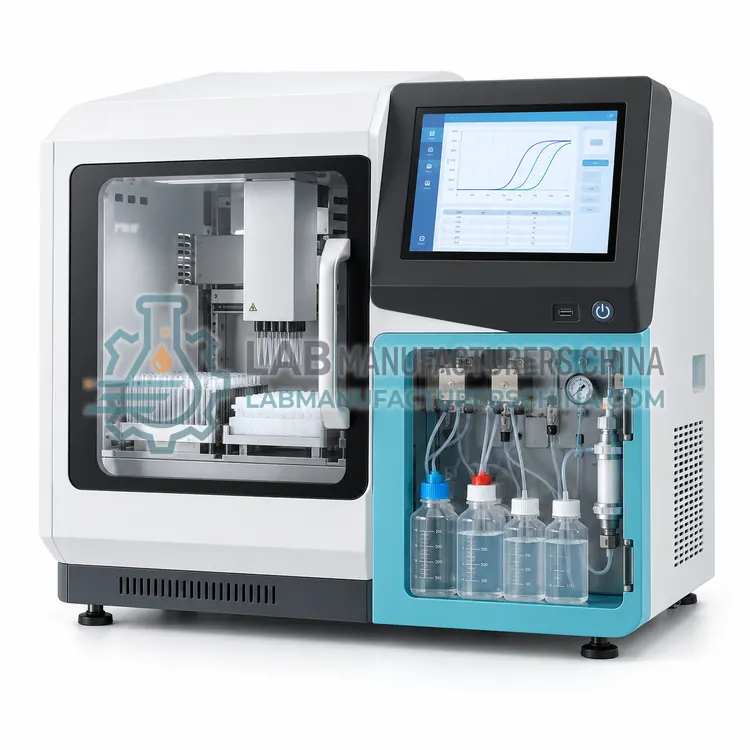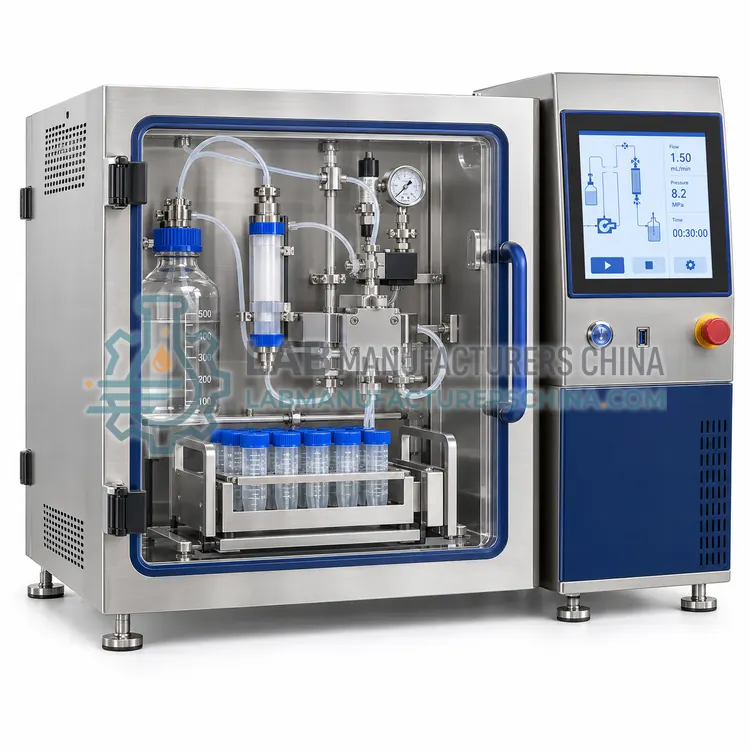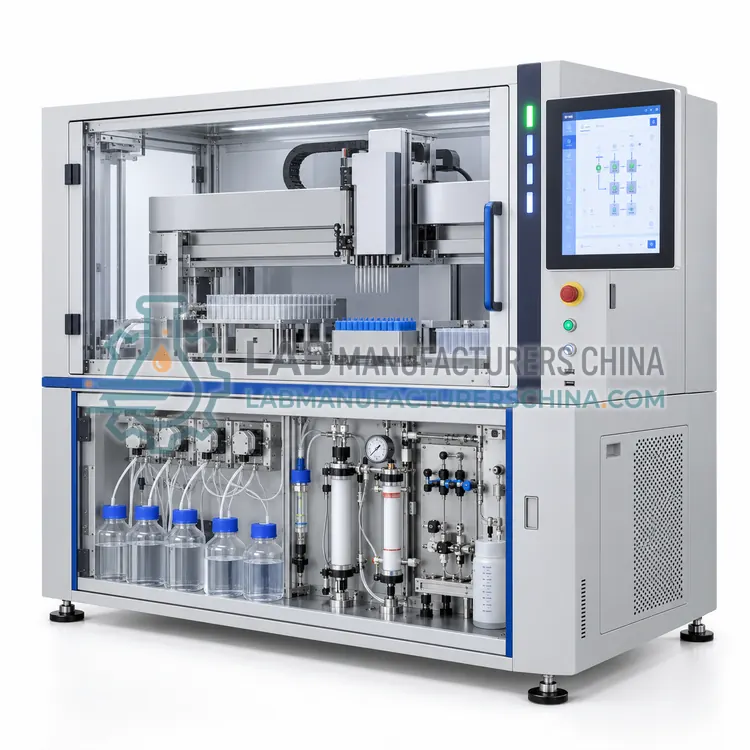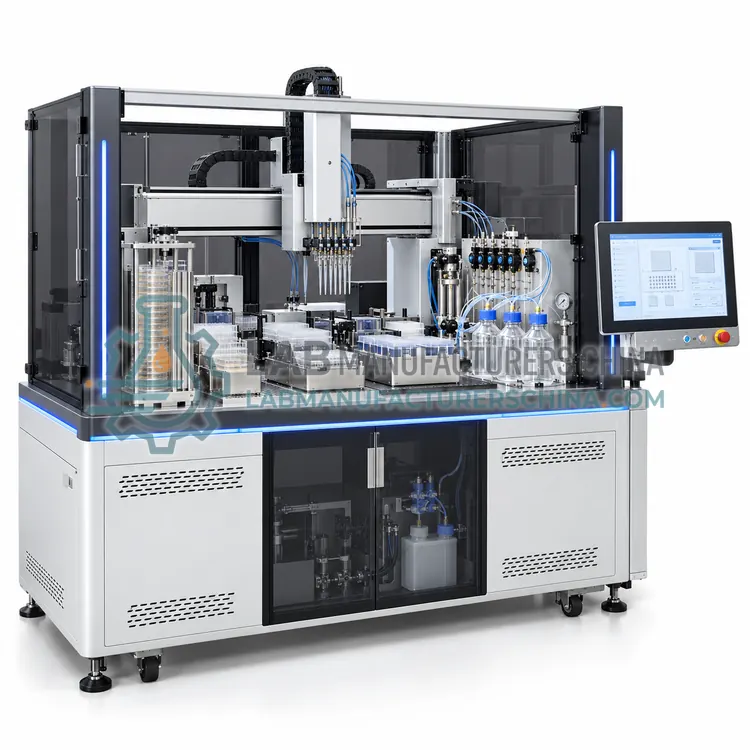
Library Preparation System
文库制备系统
- SKU MOP-0004
- Molecular Processing
- CE (to be confirmed)
- ISO 13485 manufacturing (to be confirmed)
- ISO 9001 manufacturing (to be confirmed)
Price on request — FOB / CIF quoted per order
Prices depend on configuration, quantity and destination port.
Key specifications
| Input DNA | 1 ng–1 µg |
|---|---|
| Library prep time | 1.5–6 h |
| Samples per run | 1–96 (automated) |
| Barcodes | Up to 384 indexes |
| Size selection | Bead-based, 150–800 bp |
| PCR cycles | 5–15, method dependent |
Request a quote Download brochure · to be provided
By Lab Manufacturers China Technical TeamLast reviewed Standards: ISO 13485, ISO 20395, CLSI MM13
What is the Library Preparation System?
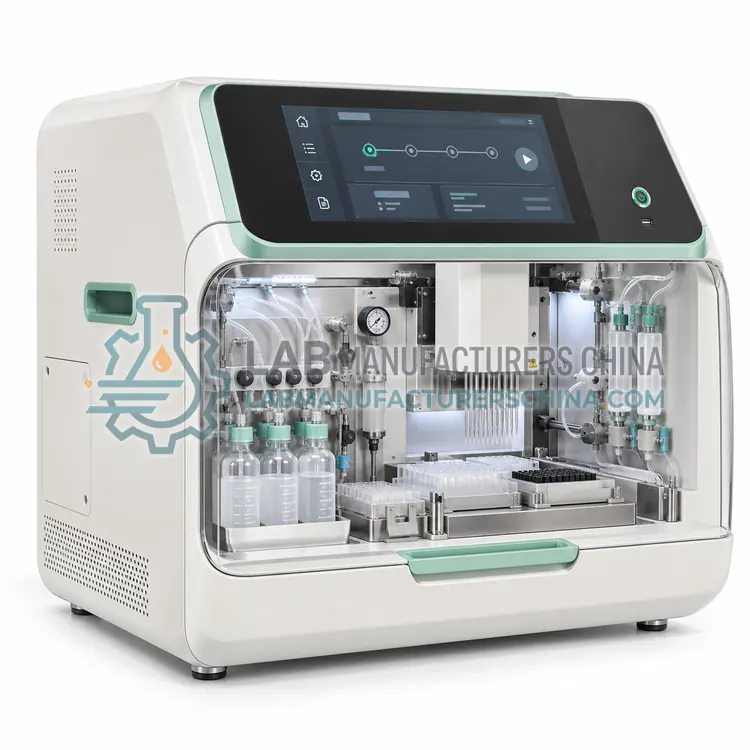
A library preparation system converts fragmented DNA or RNA into sequencing-ready libraries by end repair, adapter ligation, barcoding and amplification. It automates repetitive steps for highly reproducible and scalable next-generation sequencing libraries.
What is the Library Preparation System?
A library preparation system converts fragmented DNA or RNA into sequencing-ready libraries by end repair, adapter ligation, barcoding and amplification. It automates repetitive steps for highly reproducible and scalable next-generation sequencing libraries.
Overview
A library preparation system builds libraries that a sequencing platform can read. It performs end repair and, where needed, adenylation of fragment ends, ligates adapters that carry platform-specific sequences and sample barcodes, size-selects the library, and amplifies it with limited PCR cycles to add index sequences and enough material for clustering. Some methods are tagmentation-based, combining fragmentation and adapter addition in one enzymatic step, and RNA workflows begin with complementary DNA synthesis. Library preparation may be manual with magnetic beads and thermal cyclers, or automated on a liquid handler that controls bead ratios, wash steps and thermal programs. Quality control checks fragment size distribution, concentration and adapter dimers before pooling. Reproducibility depends on precise reagent ratios, bead handling and thermocycler performance.
How does it work?
Molecular processing systems manipulate DNA and RNA through controlled chemistry and liquid handling. Extraction isolates nucleic acid from cells or samples by lysis followed by binding to silica membranes or magnetic beads, with washing to remove proteins and inhibitors and elution into a small volume. Quantification measures concentration and purity by ultraviolet absorbance or fluorescent dye binding, and integrity may be checked by electrophoresis or fragment analysis. Fragmentation breaks long DNA into a controlled size range by enzymatic digestion, sonication or hydrodynamic shearing, which is required before short-read sequencing. Library preparation then ligates adapters and barcodes and amplifies the fragments. Automation platforms coordinate these steps with precise pipetting, heating and magnetic separation, and software tracks samples, reagents and results with the traceability molecular workflows require.
What are the key features?
- End repair, adapter ligation and barcoding
- Automated bead-based size selection
- Limited-cycle PCR with indexed primers
- Checks for adapter dimers before pooling
- Method templates for reproducible libraries
What are the technical specifications?
A typical library preparation system configuration offers input DNA of 1 ng–1 µg, library prep time of 1.5–6 h, samples per run of 1–96 (automated), barcodes of Up to 384 indexes, size selection of Bead-based, 150–800 bp and PCR cycles of 5–15, method dependent. Values are indicative of the product class; the exact figures for each configuration are confirmed on the quotation and the calibration documents supplied with the instrument.
Which applications is it used for?
The Library Preparation System is used in whole-genome and targeted sequencing, RNA sequencing workflows, microbiome and metagenomic studies and clinical and research genomics. Across the wider Molecular Processing class, laboratories also deploy it for genomics and sequencing workflows, molecular diagnostics development and biopharmaceutical cell line characterization.
Which standards and certifications apply?
Relevant standards and methods include ISO 13485, ISO 20395, CLSI MM13, CLSI MM03, 21 CFR Part 11, ISO 15189 and IEC 61010-1. Certification candidates for this model are CE, ISO 13485 manufacturing and ISO 9001 manufacturing; each is to be confirmed for the specific configuration before shipment, and certificates are supplied only where they have been issued.
Work in a unidirectional flow from extraction to amplification to prevent amplicon contamination, and use separate areas and pipettes for each stage. Clean benches and equipment with the recommended agents and include no-template controls to detect contamination. Store reagents within their specified temperature range and check lot-to-lot performance when methods are validated. Monitor nucleic acid purity ratios and integrity, because inhibitors carried into amplification cause false negatives. Keep extraction and library preparation methods version controlled, and record reagent lot numbers with each batch. For clinical or regulated use, validate against reference methods and confirm that software provides the required audit trails and data security.
How do I select the right Library Preparation System?
Choose a library preparation system by workflow, sample number and automation level. In an RFQ specify input amount and type, sequencing platform and read length, barcode needs, throughput, automation, size-selection range and the QC and data-tracking features provided.
How does it compare with other Molecular Processing variants?
Match the system to the sample type, throughput and downstream application. For extraction, confirm the sample matrices supported, the input range, elution volume and the yield and purity achievable for your targets, and whether magnetic bead or membrane chemistry fits your workflow. For quantification, choose ultraviolet absorbance for broad concentration ranges or fluorescence for higher sensitivity with small amounts of DNA or RNA. For fragmentation, define the target insert size and the acceptable size distribution. For library preparation, check compatibility with your sequencing platform and read length, the number of samples per run and the barcode options. Across the category, verify automation level, cross-contamination controls, reagent formats, software traceability and the validation documentation required.
Full specifications
| Input DNA | 1 ng–1 µg |
|---|---|
| Library prep time | 1.5–6 h |
| Samples per run | 1–96 (automated) |
| Barcodes | Up to 384 indexes |
| Size selection | Bead-based, 150–800 bp |
| PCR cycles | 5–15, method dependent |
| Platform compatibility | Multiple short-read platforms |
| QC step | Fragment size and concentration check |
Indicative values for this product class. Final specifications are confirmed on the quotation and in the calibration documents supplied with the instrument.
Applications
- Whole-genome and targeted sequencing
- RNA sequencing workflows
- Microbiome and metagenomic studies
- Clinical and research genomics
Key features
- End repair, adapter ligation and barcoding
- Automated bead-based size selection
- Limited-cycle PCR with indexed primers
- Checks for adapter dimers before pooling
- Method templates for reproducible libraries
Frequently asked questions about Library Preparation System
Standard protocols typically use 100 nanograms to one microgram, while low-input and single-cell methods work with as little as a few nanograms or picograms at the cost of more amplification cycles and reduced complexity. Input must be intact and quantified accurately.
Tagmentation uses a transposase to fragment DNA and add adapters in a single reaction, shortening the workflow and reducing reagent use. Libraries made this way have a characteristic size distribution and may need different size selection than ligation-based methods.
Adapter dimers are short fragments without an insert that consume sequencing capacity and can dominate low-input libraries. Their presence, seen as a peak at the low end of the size distribution, indicates that adapters outnumbered inserts or cleanup was incomplete.
It prepares nucleic acids for downstream analysis by extracting, quantifying, fragmenting and building libraries from samples. Laboratories use it for sequencing, molecular diagnostics, microbial detection and biopharmaceutical characterization where results depend on clean, well-quantified DNA or RNA.
Magnetic bead methods scale easily to plates and automation and handle many sample types, while silica membranes in spin columns often give higher concentration from small volumes. The choice depends on sample matrix, throughput, elution volume and the yield your assay requires.
For DNA, a ratio of absorbance at 260 to 280 nm near 1.8 is common, and near 2.0 for RNA, with 260 to 230 nm ratios above about 1.8 to 2.0 indicating low carry-over of salts and inhibitors. Purity requirements depend on the downstream method.
Related models