
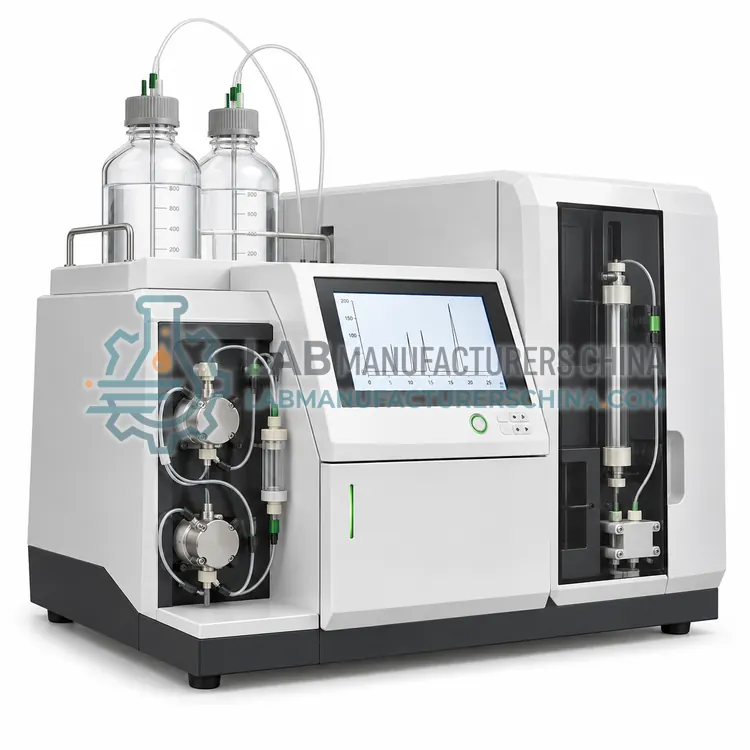
Suppressed-Conductivity Ion Chromatograph for Anion Analysis in Water
水中阴离子分析用抑制电导离子色谱仪
- SKU IOA-0002
- Ion Analyzers
- CE (to be confirmed)
- ISO 9001 manufacturing (to be confirmed)
Price on request — FOB / CIF quoted per order
Prices depend on configuration, quantity and destination port.
Key specifications
| Pump pressure limit | 35 MPa (5000 psi) |
|---|---|
| Flow rate range | 0.2–2.0 mL/min |
| Eluent | Carbonate/bicarbonate or KOH (electrolytic) |
| Injection volume | 10–100 µL |
| Detector | Suppressed conductivity, 0–15,000 µS/cm |
| Column oven temperature | Ambient +5 to 60 °C |
Request a quote Download brochure · to be provided
By Lab Manufacturers China Technical TeamLast reviewed Standards: ISO 10304-1, ISO 10304-2, EPA Method 300.1
What is the Suppressed-Conductivity Ion Chromatograph for Anion Analysis in Water?
An ion chromatograph configured with an anion-exchange column, carbonate or hydroxide eluent, chemical or electrolytic suppression and a conductivity detector. It determines fluoride, chloride, nitrite, bromide, nitrate, phosphate and sulfate in one 15 to 25 minute run at µg/L to mg/L levels.
What is the Suppressed-Conductivity Ion Chromatograph for Anion Analysis in Water?
An ion chromatograph configured with an anion-exchange column, carbonate or hydroxide eluent, chemical or electrolytic suppression and a conductivity detector. It determines fluoride, chloride, nitrite, bromide, nitrate, phosphate and sulfate in one 15 to 25 minute run at µg/L to mg/L levels.
Overview
This variant is the standard configuration for drinking water and environmental anion testing under ISO 10304-1 and EPA 300.1. The system comprises an isocratic or gradient pump delivering 0.2–2.0 mL/min at up to 35 MPa, an injection valve with a 10–100 µL loop, a guard and analytical column, a suppressor and a thermostatted conductivity cell. Electrolytic eluent generation with a hydroxide cartridge removes manual eluent preparation and improves baseline stability. Detection limits are typically 1–20 µg/L per anion with RSD below 2% for retention time and below 3% for peak area. An autosampler with 50–100 positions and 0.45 µm inline filtration supports overnight runs. Software handles integration, calibration, reporting and audit trails. Bromate or perchlorate at sub-µg/L need large loop injection or a dedicated column, and chromatograms can be affected by very high chloride in brackish samples.
How does it work?
Two technologies dominate. Ion-selective electrode (ISE) analyzers use a membrane that responds selectively to one ion, such as a LaF3 crystal for fluoride. The potential against a reference electrode follows the Nernst equation, changing about 59 mV per decade for monovalent ions at 25 °C, and concentration is found from calibration with standards and an ionic strength adjuster. Ion chromatography (IC) separates ions by injecting the sample onto an ion-exchange column, where an eluent such as carbonate-bicarbonate or hydroxide moves them at different rates. A suppressor reduces eluent background conductivity, and a conductivity detector records each ion as a peak whose retention time identifies it and whose area gives concentration. Autosamplers, eluent generators and chromatography software automate multi-ion runs.
What are the key features?
- Electrolytic hydroxide eluent generation removes manual eluent preparation
- Suppressed conductivity detection gives low background and µg/L sensitivity
- Thermostatted column compartment stabilizes retention times
- Autosampler with 50 to 100 positions and inline 0.45 µm filtration
- Gradient capability for resolving fluoride from early-eluting organic acids
- Chromatography software with audit trail and method templates for ISO and EPA methods
What are the technical specifications?
A typical suppressed-conductivity ion chromatograph for anion analysis in water configuration offers pump pressure limit of 35 MPa (5000 psi), flow rate range of 0.2–2.0 mL/min, eluent of Carbonate/bicarbonate or KOH (electrolytic), injection volume of 10–100 µL, detector of Suppressed conductivity, 0–15,000 µS/cm and column oven temperature of Ambient +5 to 60 °C. Values are indicative of the product class; the exact figures for each configuration are confirmed on the quotation and the calibration documents supplied with the instrument.
Which applications is it used for?
The Suppressed-Conductivity Ion Chromatograph for Anion Analysis in Water is used in drinking water anion compliance under GB 5749, groundwater and surface water surveys, wastewater chloride, sulfate and nutrient profiling and condensate and boiler water analysis. Across the wider Ion Analyzers class, laboratories also deploy it for drinking water anion compliance testing, fluoride and nitrate monitoring and boiler and cooling water chemistry.
Which standards and certifications apply?
Relevant standards and methods include ISO 10304-1, ISO 10304-2, EPA Method 300.1, ASTM D4327, ASTM D1179, HJ 84, GB/T 5750.5 and IEC 61010-1. Certification candidates for this model are CE and ISO 9001 manufacturing; each is to be confirmed for the specific configuration before shipment, and certificates are supplied only where they have been issued.
ISE systems need stable temperature, fresh standards and proper electrode conditioning, with slope checks in the 54–60 mV/decade range and membrane replacement when response slows. Ion chromatographs require deionized water of 18.2 MΩ·cm, filtered eluents degassed to avoid baseline noise, and sample filtration through 0.45 µm filters to protect the column. Keep guard columns in place and flush the system when storing. Calibrate with at least five standards and verify with a mid-range check standard each batch. Suppressors and columns have finite life, so track system pressure and retention times. Laboratories working to ISO/IEC 17025 should keep calibration records and control charts.
How do I select the right Suppressed-Conductivity Ion Chromatograph for Anion Analysis in Water?
Select the anion ion chromatograph when a full anion panel is reported, detection limits are in µg/L or interferences rule out ISE. If only cations are needed, choose the cation configuration. In an RFQ, specify target anions and ranges, eluent generation preference, autosampler size, column guard requirements, reference method and regulatory audit-trail needs.
How does it compare with other Ion Analyzers variants?
The choice starts with how many ions you need and at what limit. For one or two ions such as fluoride or ammonium in routine samples, an ISE analyzer is fast and inexpensive. For simultaneous determination of chloride, nitrate, sulfate, phosphate and other anions, or cations like sodium, potassium and calcium, ion chromatography is required because it resolves interferences and gives full profiles at µg/L levels. Consider sample throughput and whether an autosampler is needed, as well as matrix complexity, since high-salt samples may require dilution or matrix elimination. Field work favors portable ISE meters, and continuous process control favors online analyzers with automated calibration. Confirm the reference method, such as ISO 10304-1 or HJ 84, and compare running costs for eluents, suppressors, columns and electrodes.
Full specifications
| Pump pressure limit | 35 MPa (5000 psi) |
|---|---|
| Flow rate range | 0.2–2.0 mL/min |
| Eluent | Carbonate/bicarbonate or KOH (electrolytic) |
| Injection volume | 10–100 µL |
| Detector | Suppressed conductivity, 0–15,000 µS/cm |
| Column oven temperature | Ambient +5 to 60 °C |
| Detection limit (Cl−, NO3−, SO42−) | 1–20 µg/L |
| Retention time RSD | ≤ 1% |
| Typical run time | 15–25 min |
| Autosampler capacity | 50–100 vials |
Indicative values for this product class. Final specifications are confirmed on the quotation and in the calibration documents supplied with the instrument.
Applications
- Drinking water anion compliance under GB 5749
- Groundwater and surface water surveys
- Wastewater chloride, sulfate and nutrient profiling
- Condensate and boiler water analysis
Key features
- Electrolytic hydroxide eluent generation removes manual eluent preparation
- Suppressed conductivity detection gives low background and µg/L sensitivity
- Thermostatted column compartment stabilizes retention times
- Autosampler with 50 to 100 positions and inline 0.45 µm filtration
- Gradient capability for resolving fluoride from early-eluting organic acids
- Chromatography software with audit trail and method templates for ISO and EPA methods
Frequently asked questions about Suppressed-Conductivity Ion Chromatograph for Anion Analysis in Water
The suppressor exchanges eluent cations for hydronium ions, converting carbonate eluent to weakly conducting carbonic acid or hydroxide to water. This lowers background conductivity dramatically while analyte ions remain conductive as acids, giving high signal-to-noise and µg/L detection limits.
With filtered samples and a guard column, analytical anion columns commonly last one to three years. Symptoms of decline are rising backpressure, peak broadening and reduced resolution between fluoride and early peaks. Protect columns by avoiding organic contaminants and particulates.
Seawater chloride at about 19,000 mg/L overwhelms the column unless diluted 100 to 1000 times, which raises limits for minor anions. Matrix elimination or high-capacity columns help, and the method should be validated for saline samples.
An ion-selective electrode responds to one ion and is fast and economical for single-ion routine tests. Ion chromatography separates many ions in one run, gives full anion or cation profiles at lower limits, and resists many matrix interferences, but costs more and needs eluents and skilled operation.
Common anions are fluoride, chloride, nitrite, bromide, nitrate, phosphate and sulfate, run under ISO 10304-1 or EPA 300.1. With a cation column it also measures lithium, sodium, ammonium, potassium, magnesium and calcium. Bromate and other disinfection by-products need a dedicated method.
An electrode responds to ion activity, not concentration. Adding an ionic strength adjuster, such as TISAB for fluoride, fixes the total ionic strength of samples and standards so activity coefficients are constant, letting the measured potential correlate directly with concentration. It also controls pH and masks complexing interferents.
Related models
Online TOC Analyzer for Surface Water and Effluent Monitoring
地表水与排放水在线 TOC 分析仪
- CE (to be confirmed)
- +2