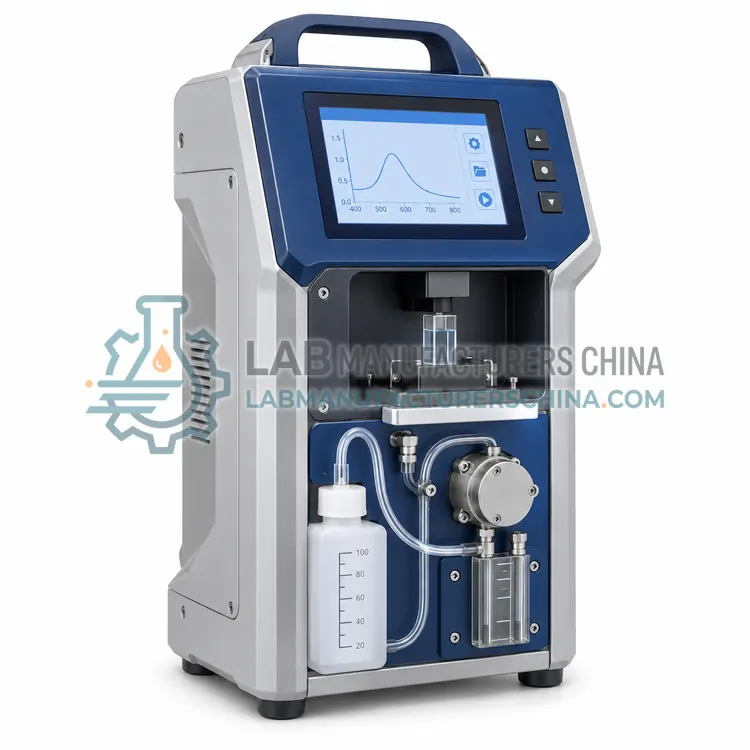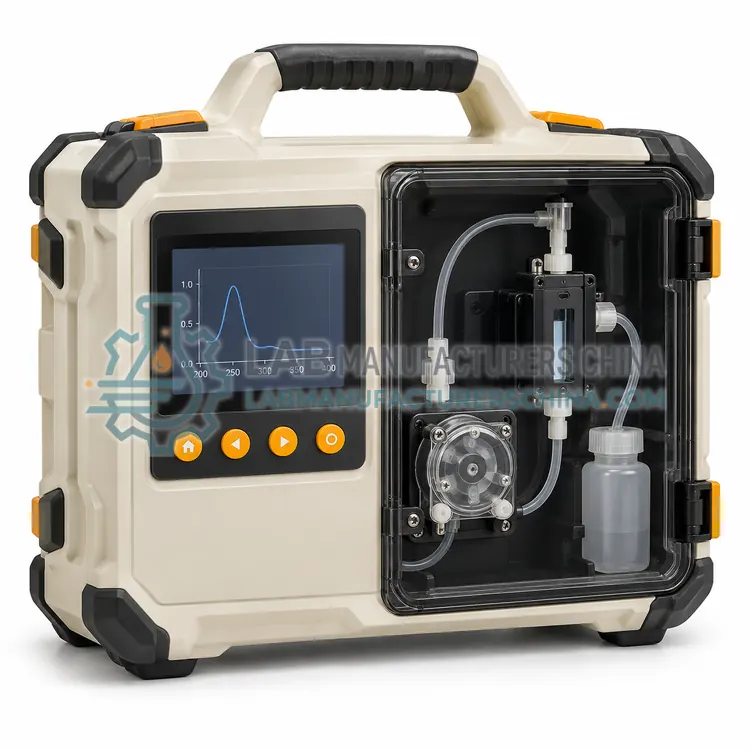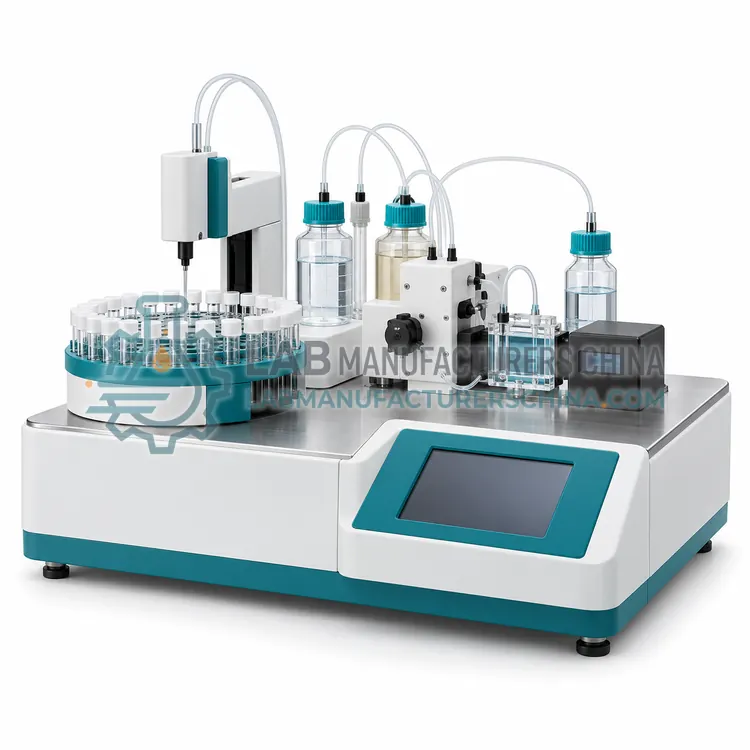
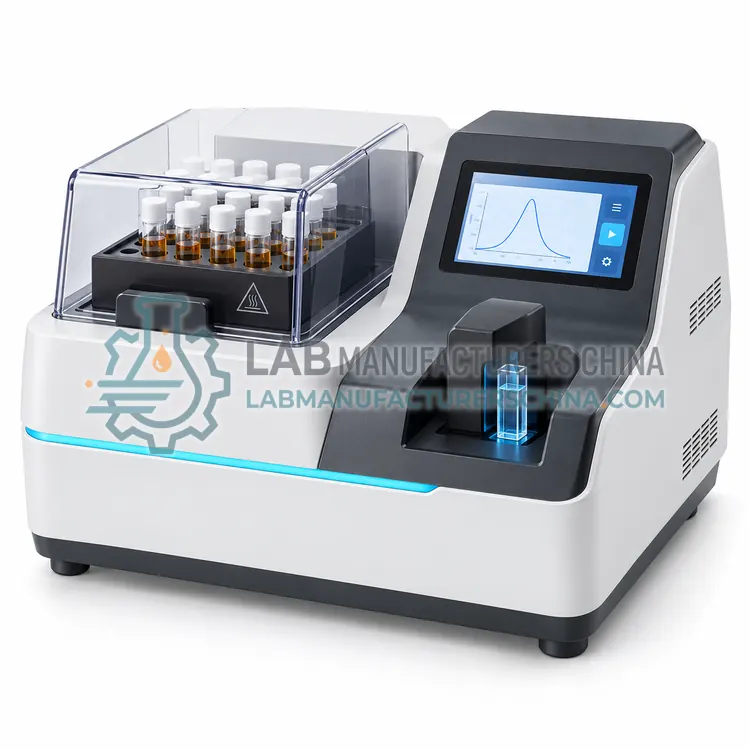
COD Rapid Analyzer with Digestion Reactor and Photometer
带消解反应器和光度计的 COD 快速测定仪
- SKU SPT-0003
- Spectrophotometers
- CE (to be confirmed)
- ISO 9001 manufacturing (to be confirmed)
Price on request — FOB / CIF quoted per order
Prices depend on configuration, quantity and destination port.
Key specifications
| Digestion temperature | 150 °C ± 2 °C |
|---|---|
| Digestion wells | 16 or 25 |
| Digestion time | 120 min (programmable 10–180 min) |
| Measuring wavelengths | 420 nm and 600 nm |
| COD ranges | 0–150, 0–1500, 0–15,000 mg/L |
| Accuracy | ± 5% of reading or ± 3 mg/L |
Request a quote Download brochure · to be provided
By Lab Manufacturers China Technical TeamLast reviewed Standards: ISO 7150-1, ISO 6878, ISO 7393-2
What is the COD Rapid Analyzer with Digestion Reactor and Photometer?
An integrated system combining a thermostatted digestion block and a dedicated photometer for chemical oxygen demand. It reads sealed reagent tubes after 2 hours of digestion at 150 °C, giving COD results in mg/L for wastewater laboratories without titration.
What is the COD Rapid Analyzer with Digestion Reactor and Photometer?
An integrated system combining a thermostatted digestion block and a dedicated photometer for chemical oxygen demand. It reads sealed reagent tubes after 2 hours of digestion at 150 °C, giving COD results in mg/L for wastewater laboratories without titration.
Overview
This variant combines a digestion reactor with 16 or 25 wells at 150 °C ± 2 °C, a timer and a photometer that reads the digestion tubes directly at 420 nm or 600 nm. Sealed tubes containing potassium dichromate, sulfuric acid and silver sulfate catalyst are available in ranges of 0–150 mg/L, 0–1500 mg/L and 0–15,000 mg/L, and the photometer switches method by range. The approach follows the closed reflux colorimetric method in ISO 15705 and HJ 828, reducing acid handling compared with open-flask reflux. Results come in about two and a half hours and need a chloride check, since chloride above 1000 mg/L interferes unless mercuric sulfate masking is used, which adds hazardous waste. Bar-coded tubes and pre-programmed curves minimize operator error, and a built-in printer or USB export records results. The reactor requires a fume-safe lid and thermal cooling before tubes are handled.
How does it work?
These instruments apply the Beer–Lambert law: absorbance at a chosen wavelength is proportional to the concentration of the absorbing species and the optical path length. For most water tests, a reagent converts the analyte into a colored complex, for example indophenol blue for ammonia, molybdenum blue for orthophosphate, DPD for free chlorine and dichromate reduction for COD. A tungsten-halogen or LED source passes light through a monochromator or interference filter, then through a cuvette or vial to a silicon photodiode or array detector. Readings are compared with a blank and a calibration curve to report mg/L. Water-specific models add pre-programmed methods, barcode-recognized reagent vials, digestion blocks and flow cells to reduce manual steps. UV absorbance at 254 nm is also used directly as a surrogate for dissolved organic matter.
What are the key features?
- Digestion block with 16 or 25 wells held at 150 °C ± 2 °C with timer
- Direct reading of sealed reagent tubes at 420 nm or 600 nm
- Reagent ranges 0–150, 0–1500 and 0–15,000 mg/L with automatic method switching
- Bar-coded tubes and preloaded calibration curves reduce operator error
- Closed reflux colorimetric method per ISO 15705 and HJ 828
- Built-in printer or USB export for result records
What are the technical specifications?
A typical cod rapid analyzer with digestion reactor and photometer configuration offers digestion temperature of 150 °C ± 2 °C, digestion wells of 16 or 25, digestion time of 120 min (programmable 10–180 min), measuring wavelengths of 420 nm and 600 nm, COD ranges of 0–150, 0–1500, 0–15,000 mg/L and accuracy of ± 5% of reading or ± 3 mg/L. Values are indicative of the product class; the exact figures for each configuration are confirmed on the quotation and the calibration documents supplied with the instrument.
Which applications is it used for?
The COD Rapid Analyzer with Digestion Reactor and Photometer is used in industrial wastewater discharge COD reporting, municipal wastewater treatment process control, surface water COD surveys and food and beverage plant effluent monitoring. Across the wider Spectrophotometers class, laboratories also deploy it for ammonia nitrogen and phosphorus determination, COD testing for wastewater discharge and residual chlorine monitoring in disinfection.
Which standards and certifications apply?
Relevant standards and methods include ISO 7150-1, ISO 6878, ISO 7393-2, HJ 535, HJ 828, HJ 636, USP <857>, JJG 178 and IEC 61010-1. Certification candidates for this model are CE and ISO 9001 manufacturing; each is to be confirmed for the specific configuration before shipment, and certificates are supplied only where they have been issued.
Warm the lamp as specified and zero with reagent blanks prepared from the same water. Use matched, scratch-free cuvettes or vials, clean the optical windows and keep reagents within expiry and storage temperature. Verify wavelength accuracy and photometric linearity with holmium oxide and neutral-density or potassium dichromate standards at least annually, and run a mid-range check standard with each batch. Dispose of mercury-, chromium- and sulfuric acid-containing reagent waste, particularly from COD digestion, in accordance with local rules. Place the instrument away from direct sunlight, vibration and drafts. Laboratories operating under ISO/IEC 17025 should record lamp hours, calibration dates and control charts.
How do I select the right COD Rapid Analyzer with Digestion Reactor and Photometer?
Choose the integrated COD analyzer when COD is a primary routine parameter and titration labor or acid handling should be reduced. Use a TOC analyzer if faster, reagent-free organic load results are acceptable. In an RFQ, specify COD range, chloride content, samples per batch, tube format, waste handling for mercury or chromium, and the method HJ 828 or ISO 15705.
How does it compare with other Spectrophotometers variants?
Start from the test list and methods you must run. If you report a handful of colorimetric parameters, a visible-range instrument with pre-programmed methods is sufficient. If you need nitrate, UV254 or other UV-absorbing parameters, choose a UV-Vis model. Match throughput to the format: cuvette-based instruments suit flexible method development, while vial-based systems with barcodes cut errors in high-volume testing. For COD, an integrated digestion reactor and photometer reduces handling. Field teams need battery operation and IP-rated housings. Check wavelength accuracy and photometric stability, because trace-level tests near detection limits demand low noise. Also confirm that reagent chemistries follow recognized methods such as ISO, EPA or HJ and that the supplier can provide traceable calibration standards and validation data.
Full specifications
| Digestion temperature | 150 °C ± 2 °C |
|---|---|
| Digestion wells | 16 or 25 |
| Digestion time | 120 min (programmable 10–180 min) |
| Measuring wavelengths | 420 nm and 600 nm |
| COD ranges | 0–150, 0–1500, 0–15,000 mg/L |
| Accuracy | ± 5% of reading or ± 3 mg/L |
| Repeatability | CV ≤ 2% |
| Tube size | 16 mm diameter sealed vials |
| Data output | Thermal printer, USB |
| Power supply | AC 220 V, 50 Hz, 500 W |
Indicative values for this product class. Final specifications are confirmed on the quotation and in the calibration documents supplied with the instrument.
Applications
- Industrial wastewater discharge COD reporting
- Municipal wastewater treatment process control
- Surface water COD surveys
- Food and beverage plant effluent monitoring
Key features
- Digestion block with 16 or 25 wells held at 150 °C ± 2 °C with timer
- Direct reading of sealed reagent tubes at 420 nm or 600 nm
- Reagent ranges 0–150, 0–1500 and 0–15,000 mg/L with automatic method switching
- Bar-coded tubes and preloaded calibration curves reduce operator error
- Closed reflux colorimetric method per ISO 15705 and HJ 828
- Built-in printer or USB export for result records
Frequently asked questions about COD Rapid Analyzer with Digestion Reactor and Photometer
Chloride is oxidized by dichromate and produces a falsely high COD. Methods allow up to about 1000 mg/L chloride with mercuric sulfate masking, which creates mercury waste. For high-chloride samples, use special low-mercury or chloride-corrected methods, or dilute.
These conditions are prescribed in closed reflux methods, such as ISO 15705 and HJ 828, to fully oxidize most organic compounds with dichromate and silver catalyst. Deviating from temperature or time reduces oxidation and biases the result.
Spent tubes contain hexavalent or trivalent chromium, silver, sulfuric acid and sometimes mercury. Collect them as hazardous laboratory waste and use licensed disposal, and consider low-mercury or mercury-free reagent options where your method allows.
It measures any analyte that forms a colored complex or absorbs light directly. Typical parameters are ammonia nitrogen, nitrite, nitrate, total phosphorus, COD, residual chlorine, iron, manganese, copper, phenol, sulfate, silica, color and UV254 absorbance.
A water sample is heated with potassium dichromate and sulfuric acid, usually at 150 °C for two hours, oxidizing organics. The photometer then measures the change in chromium color at 600 nm (Cr3+) or 420 nm (Cr6+) and converts it to COD in mg/L by calibration.
A spectrophotometer selects wavelengths continuously, so it can run many methods and verify peaks. A colorimeter uses fixed filters, is simpler and cheaper and works well for a limited set of tests. For multi-method laboratories, a spectrophotometer is the more flexible option.
Related models
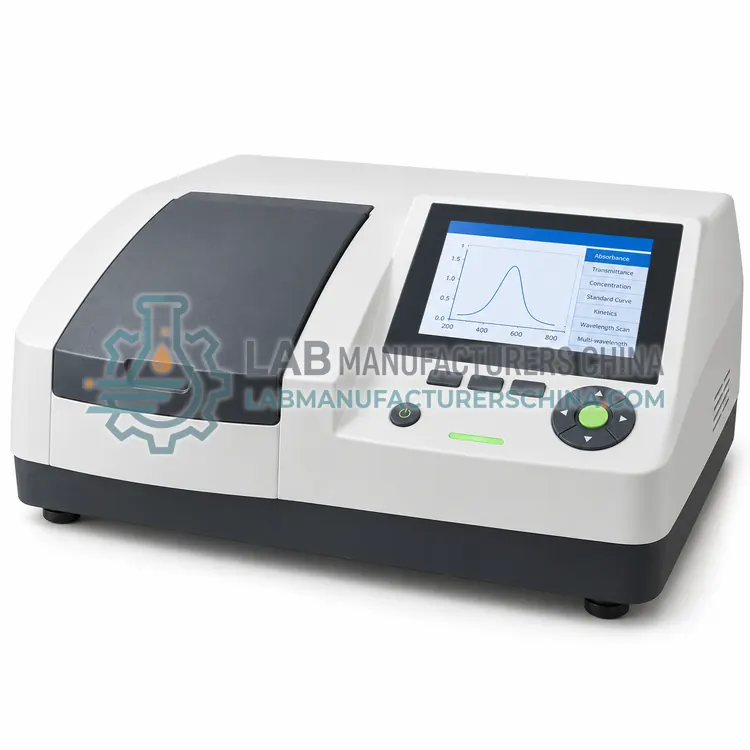
UV-Vis Spectrophotometer for Water Analysis with Preset Methods
带预设方法的水质分析 UV-Vis 分光光度计
- CE (to be confirmed)
- +1