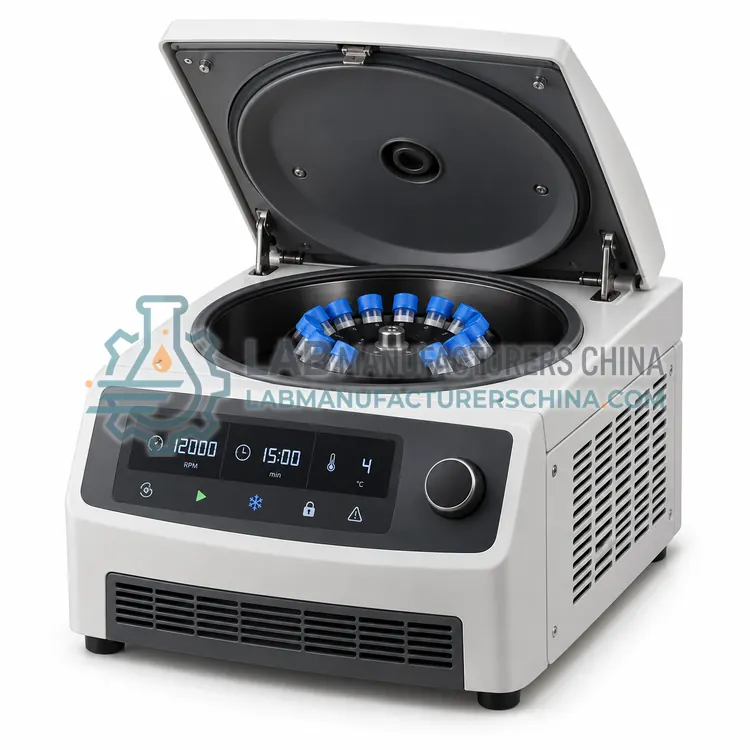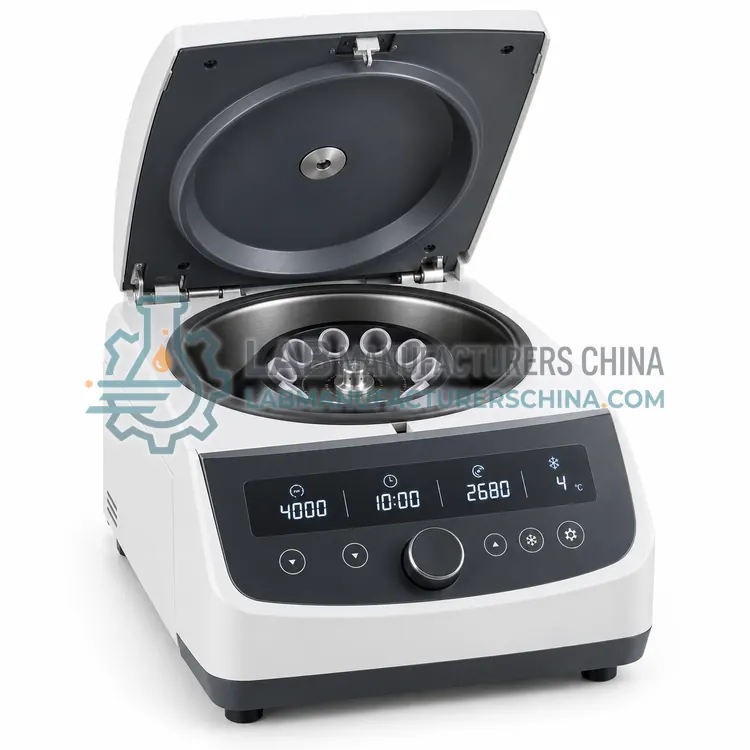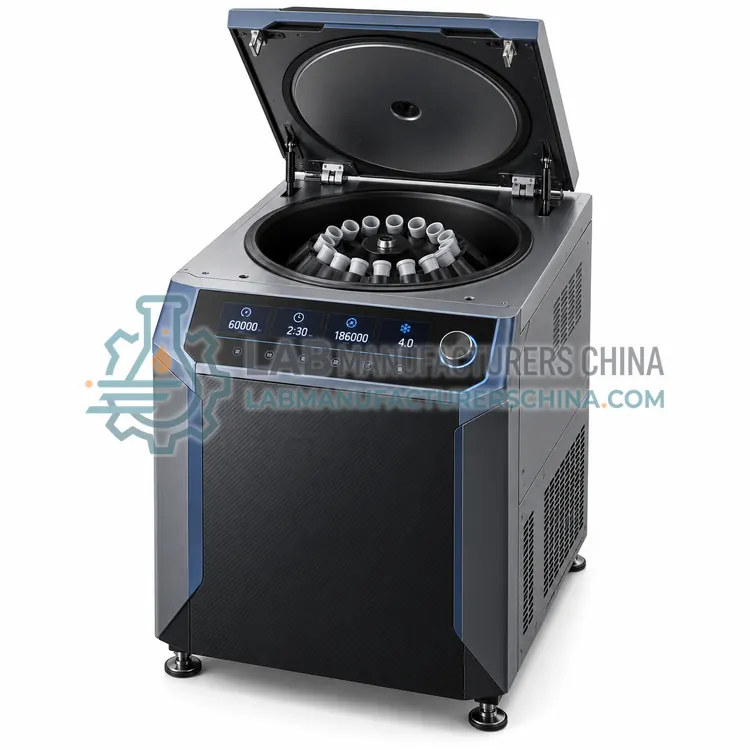
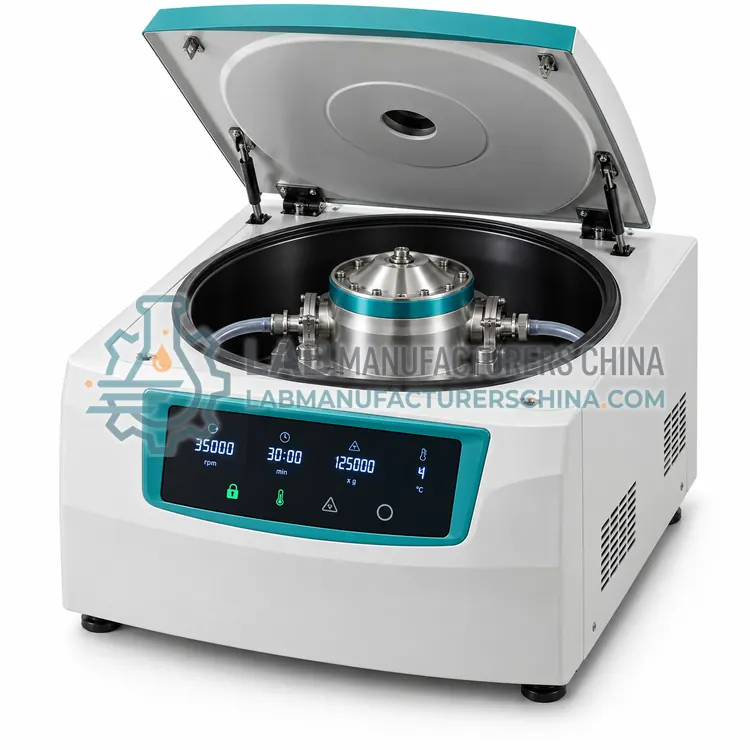
Continuous-Flow High-Speed Centrifuge
连续流高速离心机
- SKU HSC-0005
- High-Speed Centrifuges
- CE (to be confirmed)
- ISO 9001 manufacturing (to be confirmed)
- cGMP-oriented documentation (to be confirmed)
Price on request — FOB / CIF quoted per order
Prices depend on configuration, quantity and destination port.
Key specifications
| Maximum speed | 15,000–35,000 rpm |
|---|---|
| Maximum RCF | up to approx. 60,000 x g |
| Flow rate range | 0.1–2 L/min |
| Bowl solids capacity | 0.2–1 L |
| Throughput | 10–100 L/h |
| Temperature range | -5 to 30 °C |
Request a quote Download brochure · to be provided
By Lab Manufacturers China Technical TeamLast reviewed Standards: IEC 61010-1, IEC 61010-2-020, IEC 61326-1
What is the Continuous-Flow High-Speed Centrifuge?
A continuous-flow high-speed centrifuge feeds liquid through a tubular or zonal rotor while spinning at 15,000 to 35,000 rpm, collecting solids inside. It suits processing tens of liters of cell culture or lysate that would be impractical to handle in bottles.
What is the Continuous-Flow High-Speed Centrifuge?
A continuous-flow high-speed centrifuge feeds liquid through a tubular or zonal rotor while spinning at 15,000 to 35,000 rpm, collecting solids inside. It suits processing tens of liters of cell culture or lysate that would be impractical to handle in bottles.
Overview
Continuous-flow centrifugation pumps feed liquid through a rotating tubular bowl or zonal rotor so particles sediment on the wall while clarified supernatant exits continuously. Tubular bowl units run at 15,000 to 35,000 rpm and process 10 to 100 L per hour at flow rates of 0.1 to 2 L per minute, depending on particle size. Bowl capacity is 0.2 to 1 L of solids. A peristaltic pump, pressure sensor and flow controller govern feed, and sanitary fittings allow clean-in-place in pharmaceutical settings. Refrigeration keeps the product cold, and the bowl is removed after the run to recover pellet. This variant reduces handling steps and time compared with repeated batch runs, although residence time limits capture of very fine particles. It is used for pilot-scale and development work.
How does it work?
High-speed centrifuges use a high-torque induction or brushless drive, typically with a flexible shaft or direct coupling, to spin rotors made of aluminum alloy, titanium or carbon fiber. Centrifugal force scales with the square of angular velocity, so a 20,000 rpm rotor of 10 cm radius produces about 44,800 x g. Fixed-angle rotors shorten the sedimentation path and give fast pellets. Swing-bucket rotors allow gentle separation and gradients at lower speeds. Because friction with air heats the rotor significantly at these speeds, most units are refrigerated, with compressors holding 4 C and sensors monitoring rotor temperature. Armored chambers, rotor recognition, overspeed and imbalance protection, and lid interlocks contain energy in the event of a rotor failure.
What are the key features?
- Tubular bowl processes 10 to 100 L per hour depending on particle size
- Peristaltic feed pump and pressure sensor control flow precisely
- Sanitary fittings support clean-in-place and steam-in-place protocols
- Refrigerated bowl chamber keeps product at 4 C during processing
- Removable bowl allows easy recovery of the solid pellet
What are the technical specifications?
A typical continuous-flow high-speed centrifuge configuration offers maximum speed of 15,000–35,000 rpm, maximum RCF of up to approx. 60,000 x g, flow rate range of 0.1–2 L/min, bowl solids capacity of 0.2–1 L, throughput of 10–100 L/h and temperature range of -5 to 30 °C. Values are indicative of the product class; the exact figures for each configuration are confirmed on the quotation and the calibration documents supplied with the instrument.
Which applications is it used for?
The Continuous-Flow High-Speed Centrifuge is used in pilot-scale cell culture harvest, vaccine and virus clarification, yeast and bacterial biomass recovery and process development clarification. Across the wider High-Speed Centrifuges class, laboratories also deploy it for bacterial and yeast cell harvest, protein precipitate recovery and organelle and membrane fractionation.
Which standards and certifications apply?
Relevant standards and methods include IEC 61010-1, IEC 61010-2-020, IEC 61326-1, ISO 9001, ISO 3734 and GB 4793.1. Certification candidates for this model are CE, ISO 9001 manufacturing and cGMP-oriented documentation; each is to be confirmed for the specific configuration before shipment, and certificates are supplied only where they have been issued.
Floor-standing units weigh 150 to 400 kg and require a level, reinforced floor and dedicated power, often 220 V single phase at 16 A. Rotor care is critical: log run hours, derate aluminum rotors per the maker's schedule, and never exceed rated speed with lightly filled tubes that are not rated for the RCF. Clean with neutral pH detergents, lubricate threads and O-rings, and inspect for corrosion. Schedule annual preventive maintenance including tachometer and temperature verification. Comply with IEC 61010-2-020 and, for regulated work, document IQ/OQ and calibration records.
How do I select the right Continuous-Flow High-Speed Centrifuge?
Choose continuous flow when batch volumes exceed 10 L or repeated bottle loading is impractical. It is not efficient for small samples. In the RFQ, state feed volume, particle size and concentration, required flow rate, product temperature, cleaning method, materials of construction and available three-phase power.
How does it compare with other High-Speed Centrifuges variants?
Begin with the pelleting requirement: bacteria and yeast typically pellet at 6,000 to 10,000 x g, while organelles, protein precipitates and membranes need 20,000 to 50,000 x g. Match capacity to batch size, from 6 x 50 mL to 6 x 500 mL or 4 x 1 L. Decide whether a floor or large benchtop unit fits the lab. Refrigeration is almost always required. Choose rotor materials by lifetime and corrosion resistance, since aluminum is economical but carbon fiber and titanium offer higher speed and better chemical tolerance. Evaluate programmable ramps, rotor life logging, aerosol-tight lids, and whether a swing-bucket option is needed for gradients or large-volume clarification.
Full specifications
| Maximum speed | 15,000–35,000 rpm |
|---|---|
| Maximum RCF | up to approx. 60,000 x g |
| Flow rate range | 0.1–2 L/min |
| Bowl solids capacity | 0.2–1 L |
| Throughput | 10–100 L/h |
| Temperature range | -5 to 30 °C |
| Wetted materials | 316L stainless steel, PTFE, silicone |
| Feed pump | Peristaltic, 0.1–2 L/min |
| Noise level | ≤ 68 dB(A) |
| Power supply | 380 V three-phase, 50 Hz, 3–5 kW |
Indicative values for this product class. Final specifications are confirmed on the quotation and in the calibration documents supplied with the instrument.
Applications
- Pilot-scale cell culture harvest
- Vaccine and virus clarification
- Yeast and bacterial biomass recovery
- Process development clarification
Key features
- Tubular bowl processes 10 to 100 L per hour depending on particle size
- Peristaltic feed pump and pressure sensor control flow precisely
- Sanitary fittings support clean-in-place and steam-in-place protocols
- Refrigerated bowl chamber keeps product at 4 C during processing
- Removable bowl allows easy recovery of the solid pellet
Frequently asked questions about Continuous-Flow High-Speed Centrifuge
Continuous-flow centrifugation feeds liquid through a spinning rotor while solids accumulate inside and clarified liquid exits, allowing processing of large volumes in one run. Batch centrifugation spins a fixed volume in bottles, requiring repeated loading, unloading and supernatant handling.
Throughput depends on particle size and density, liquid viscosity, bowl speed and residence time. Slower flow improves capture of fine particles, while faster flow risks carryover. Test runs with process material are the best way to set the flow rate.
Models with sanitary wetted parts of 316L stainless steel and PTFE or silicone seals support clean-in-place with alkaline and acid solutions, and some support steam sterilization. Confirm cleaning validation, dead-leg limits and allowable chemical concentrations with the manufacturer.
A high-speed centrifuge typically operates between 15,000 and 30,000 rpm, reaching 20,000 to 60,000 x g. It normally includes refrigeration, a wide range of interchangeable rotors, and safety systems such as armored chambers and overspeed protection. Speeds above this are classified as ultracentrifuges.
No. High-speed centrifuges suit pelleting bacteria, membranes and protein precipitates up to about 60,000 x g. Viruses, ribosomes, exosomes and lipoproteins require 100,000 x g or more under vacuum, which only ultracentrifuges provide.
Service life depends on material, speed and cycles. Aluminum rotors are often derated after a specified number of cycles or years, while carbon fiber rotors have cycle-based limits. Manufacturers typically define lifetimes of 5 to 10 years or a set number of runs, and rotors should be retired on schedule.
Related models
Microprocessor-Controlled High-Speed Centrifuge with Swing-Bucket Rotor
配水平转子的微机控制高速离心机
- CE (to be confirmed)
- +2